January 8 – Seventeen new Roman Catholic Cardinals are added to the College of Cardinals afer having been appointed by Pope Eugene IV on December 18.[2]
February 22 – Four months after the death of King Albert of Hungary, his son, Ladislaus the Posthumous, is born at Komárom (modern-day Komárno in Slovakia) to Albert’s widow, Elisabeth, regent for the vacant throne. Elizabeth argues to the Hungarian nobles that Ladislaus should be elected as the rightful successor to King Albert, and that she should serve as the boy’s regent.[4]
February 26 – Ibrahim II becomes the Bey of Candar, a monarchy on the Black Sea that encompasses 10 modern-day Turkish provinces, upon the death of his father, Mubariz al-Din Isfendiyar, in the capital, Sinop.[5]
March 8 – Despite the birth of a posthumous son of the late King Albert V, the Hungarian nobles vote to elect King Vladislaus III of Poland as the new King of Hungary.[6]
April – Ottoman Sultan Murad II begins the siege of Belgrade, at this time part of the Kingdom of Hungary following the conquest of Serbia. The fortress is heavily damaged, but the defenders’ use of artillery prevents the Turks from capturing the city, and the siege ends after six months.
The Diet of Hungary approves a resolution declaring the coronation of Ladislaus as King of Hungary to be invalid, declaring that “the crowning of kings is always dependent on the will of the kingdom’s inhabitants, in whose consent both the effectiveness and the force of the crown reside”.[10]
July–September
July 11 – John V, Duke of Brittany, signs a neutrality agreement with the Kingdom of England, promising not to give shelter to England’s enemies in the ongoing English occupation of western France.[11]
July 24 – At Basel in Switzerland, Amadeus VIII, Duke of Savoy is crowned as “Pope Felix V” by Roman Catholic cardinals of the Council of Basel who had voted to depose Pope Eugene IV as leader of the Roman Catholic Church.[13] As Felix V, he is designated in Vatican history as the last “antipope”. He remains in Basel and never travels to Rome to assume the papacy; in 1449, after the death of Eugene IV, Amadeus assumes an oath of loyalty to Eugene’s successor, Pope Nicholas V.
August 31 – In France, the Siege of Tartas is commenced in Gascony by troops of the Kingdom of England and the English-controlled Duchy of Gascony in an attempt to oust a French supporter of King Charles VII, Charles II d’Albret, who has taken control of Tartas. The siege lasts for almost two years before being abandoned by the English.[14][15]
September 12 – Eton College, one of the most famous boarding schools for boys in England, is founded by King Henry VI as “Kynge’s College of Our Ladye of Eton besyde Windesore”.
October 22 – Gilles de Rais confesses and is sentenced to death on a conviction of murdering at least 140 children. He is hanged on October 26 and his corpse is then burned at the stake.[18]
November 3 – Charles, Duke of Orléans, is released from incarceration in England, 25 years after he had been taken as a prisoner of war at the Battle of Agincourt in 1415. His freedom is gained after negotiations made by two of his former enemies, the Duke of Burgundy and the Queen of Portugal, and payment of a ransom of 80,000 gold coins. The Duke of Orleans, now aged 46, returns to French soil after more than a quarter of a century in England.[19]
The Ming dynasty government of China begins a decade-long series of issuing harsh edicts towards those who illegally mine silver, the latter known as ‘miner bandits’ (kuangzei), a trend begun in 1438. The government wants to cap the amount of silver circulating into the market, as more grain taxes are converted into silver taxes. The government establishes community night watches known as ‘watches and tithings’ (baojia), who ensure that illegal mining activities are brought to a halt. However, these are desperate measures, as illegal silver mining continues to thrive as a dangerous but lucrative venture.
Uwaifiokun, Oba of Benin, is killed by his brother, the Prince Ogun, who succeeds him as Ewuare I.
^Górski, Karol (1949). Związek Pruski i poddanie się Prus Polsce: zbiór tekstów źródłowych (in Polish). Poznań: Instytut Zachodni. p. xxxi.
^Pálosfalvi, Tamás (2002). “V. László”. In Kristó, Gyula (ed.). Magyarország vegyes házi királyai [The Kings of Various Dynasties of Hungary] (in Hungarian). Szukits Könyvkiadó. pp. 139–140. ISBN 963-9441-58-9.
^Solymosi, László; Körmendi, Adrienne (1981). “A középkori magyar állam virágzása és bukása, 1301–1526 [The Heyday and Fall of the Medieval Hungarian State, 1301–1526]”. In Solymosi, László (ed.). Magyarország történeti kronológiája, I: a kezdetektől 1526-ig [Historical Chronology of Hungary, Volume I: From the Beginning to 1526] (in Hungarian). Akadémiai Kiadó. p. 257. ISBN 963-05-2661-1.
^Dundulis, Bronius (2004). “Žygimantas I Kęstutaitis”. In Spečiūnas, Vytautas (ed.). Lietuvos valdovai (XIII–XVIII a.): enciklopedinis žinynas (in Lithuanian). Vilnius: Mokslo ir enciklopedijų leidybos institutas. pp. 94–96. ISBN 5-420-01535-8.
^J. Kiaupienė, Valdžios krizės pabaiga ir Kazimieras Jogailaitis (The End of the Government Crisis and Kazimieras Jogailaitis), (Vilnius: Electronic Publishing House, 2003)
^Engel, Pál (2001). The Realm of St Stephen: A History of Medieval Hungary, 895–1526. I.B. Tauris Publishers. ISBN 1-86064-061-3.
^Bataille, Georges (1959), Procès de Gilles de Rais. Documents précédés d’une introduction de Georges Bataille (in French), Paris: Club français du livre, p. 158
^Benedetti, Jean (1971). Gilles de Rais. New York: Stein and Day. pp. 182–190. ISBN 978-0-8128-1450-7.
^Goldstone, Nancy (2013). The Maid and the Queen: The Secret History of Joan of Arc. Phoenix Paperbacks, London. pp. 225–226.

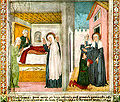 Saint Frances of Rome