In four-dimensional geometry, the 24-cell is a convex regular 4-polytope,[1] a four-dimensional analogue of a Platonic solid. It is named for the 24 octahedra that form its boundary.
It is also called C24, or the icositetrachoron,[2] octaplex (short for “octahedral complex”), icosatetrahedroid,[3] octacube, hyper-diamond or polyoctahedron, being constructed of octahedral cells.
Geometric description
The 24-cell is a convex four-dimensional polytope boundary, an analogy of nearly the cuboctahedron and its dual the rhombic dodecahedron in four dimensions.[4] It is composed of 24 octahedral cells with six meeting at each vertex, and three at each edge.[5] Together, it has 96 triangular faces, 96 edges, and 24 vertices. Like other four-dimensional regular polytope, 5-cell, the 24-cell is self-dual. The 24-cell and the tesseract are the only convex regular 4-polytopes in which the edge length equals the radius. Its geometry is summarized by its Schläfli symbol, , which indicates that its faces are regular 3-gons (triangles), its cells are octahedra (polyhedra with 3-sided faces, 4 of which meet at each vertex), and the vertex figure is a cube (a polyhedron with 4-sided faces, 3 of which meet at each vertex).


The 24-cell incorporates the geometries of every convex regular polytope in the first four dimensions, except the 5-cell, those with a 5 in their Schlӓfli symbol, and the regular polygons with 7 or more sides. In other words, the 24-cell contains all of the regular polytopes made of triangles and squares that exist in four dimensions except the regular 5-cell, but none of the pentagonal polytopes. The geometric relationships among all of these regular polytopes can be observed in a single 24-cell or the 24-cell honeycomb.
The 24-cell is the fourth in the sequence of six convex regular 4-polytopes (in order of size and complexity). The convex regular 4-polytopes can be ordered by size as a measure of 4-dimensional content (hypervolume) for the same radius. This is their proper order of enumeration, the order in which they nest inside each other as compounds.[6] Each greater polytope in the sequence is rounder than its predecessor, enclosing more content within the same radius. The 4-simplex (5-cell) is the limit smallest case, and the 120-cell is the largest. Complexity (as measured by comparing configuration matrices or simply the number of vertices) follows the same ordering. This provides an alternative numerical naming scheme for regular polytopes in which the 24-cell is the 24-point 4-polytope: fourth in the ascending sequence that runs from 5-point 4-polytope to 600-point 4-polytope. It can be deconstructed into 3 overlapping instances of its predecessor the tesseract (8-cell), as the 8-cell can be deconstructed into 2 instances of its predecessor the 16-cell.[7] The reverse procedure to construct each of these from an instance of its predecessor preserves the radius of the predecessor, but generally produces a successor with a smaller edge length.
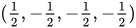
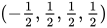
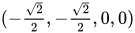
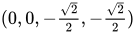
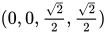
The 24-cell is the convex hull of its vertices which can be described as the 24 coordinate permutations of:[8]Those coordinates can be constructed as the 24-cell 


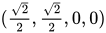
 , rectifying the 16-cell with the 8 vertices that are permutations of .[8] The vertex figure of a 16-cell is the octahedron; thus, cutting the vertices of the 16-cell at the midpoint of its incident edges produces 8 octahedral cells. This process also rectifies the tetrahedral cells of the 16-cell which become 16 octahedra, giving the 24-cell 24 octahedral cells.[9]


The 12 axes and 16 hexagons of the 24-cell constitute a Reye configuration, which in the language of configurations is written as 124163 to indicate that each axis belongs to 4 hexagons, and each hexagon contains 3 axes.[10]
This configuration matrix represents the 24-cell. The rows and columns correspond to vertices, edges, faces, and cells. The diagonal numbers say how many of each element occur in the whole 24-cell. The non-diagonal numbers say how many of the column’s element occur in or at the row’s element.[11]

Root systems

The 24 root vectors of the D4 root system of the simple Lie group SO(8) form the vertices of a 24-cell. The vertices can be seen in 3 hyperplanes, with the 6 vertices of an octahedron cell on each of the outer hyperplanes and 12 vertices of a cuboctahedron on a central hyperplane. These vertices, combined with the 8 vertices of the 16-cell, represent the 32 root vectors of the B4 and C4 simple Lie groups.
The 48 vertices (or strictly speaking their radius vectors) of the union of the 24-cell and its dual form the root system of type F4.[12] The 24 vertices of the original 24-cell form a root system of type D4; its size has the ratio √2:1. This is likewise true for the 24 vertices of its dual. The full symmetry group of the 24-cell is the Weyl group of F4, which is generated by reflections through the hyperplanes orthogonal to the F4 roots. This is a solvable group of order 1152. The rotational symmetry group of the 24-cell is of order 576.
Quaternionic interpretation

When interpreted as the quaternions, the F4 root lattice (which is the integral span of the vertices of the 24-cell) is closed under multiplication and is therefore a ring. This is the ring of Hurwitz integral quaternions. The vertices of the 24-cell form the group of units (i.e. the group of invertible elements) in the Hurwitz quaternion ring (this group is also known as the binary tetrahedral group). The vertices of the 24-cell are precisely the 24 Hurwitz quaternions with norm squared 1, and the vertices of the dual 24-cell are those with norm squared 2. The D4 root lattice is the dual of the F4 and is given by the subring of Hurwitz quaternions with even norm squared.[13]
Viewed as the 24 unit Hurwitz quaternions, the unit radius coordinates of the 24-cell represent (in antipodal pairs) the 12 rotations of a regular tetrahedron.[5]
Vertices of other convex regular 4-polytopes also form multiplicative groups of quaternions, but few of them generate a root lattice.[14]
Voronoi cells and tessellation

The Voronoi cells of the D4 root lattice are regular 24-cells. The corresponding Voronoi tessellation gives the tessellation of four-dimensional Euclidean space by regular 24-cells, the 24-cell honeycomb. As a polytope that can tile by translation, the 24-cell is an example of a parallelotope, the simplest one that is not also a zonotope.[15] The Schläfli symbol for this tessellation is . It is one of only three regular tessellations of . The 24-cells are centered at the D4 lattice points (Hurwitz quaternions with even norm squared) while the vertices are at the F4 lattice points with odd norm squared. Each 24-cell of this tessellation has 24 neighbors. With each of these it shares an octahedron. It also has 24 other neighbors with which it shares only a single vertex. Eight 24-cells meet at any given vertex in this tessellation.


The dual tessellation of the 24-cell honeycomb {3,4,3,3} is the 16-cell honeycomb {3,3,4,3}. The third regular tessellation of four dimensional space is the tesseractic honeycomb {4,3,3,4}, whose vertices can be described by 4-integer Cartesian coordinates. The congruent relationships among these three tessellations can be helpful in visualizing the 24-cell, in particular the radial equilateral symmetry which it shares with the tesseract.
Rotations
The regular convex 4-polytopes are an expression of their underlying symmetry which is known as SO(4), the group of rotations about a fixed point in 4-dimensional Euclidean space.[16]


Rotations in 4-dimensional Euclidean space can be seen as the composition of two 2-dimensional rotations in completely orthogonal planes.[17] Thus the general rotation in 4-space is a double rotation.[18] There are two important special cases: a simple rotation (in which one rotational angle is 0) and an isoclinic rotation (similar but not identical to two simple rotations through the same angle).
- In the 24-cell, there is a simple rotation which will take any vertex directly to any other vertex, also moving most of the other vertices but leaving at least 2 and at most 6 other vertices fixed (the vertices that the fixed central plane intersects). The vertex moves along a great circle in the invariant plane of rotation between adjacent vertices of a great hexagon, a great square or a great digon, and the completely orthogonal fixed plane is a digon, a square or a hexagon, respectively.
- Double rotations come in two chiral forms: left and right rotations. In a double rotation each vertex moves in a spiral along two orthogonal great circles at once. Either the path is right-hand threaded (like most screws and bolts), moving along the circles in the “same” directions, or it is left-hand threaded (like a reverse-threaded bolt), moving along the circles in what we conventionally say are “opposite” directions (according to the right hand rule by which we conventionally say which way is “up” on each of the 4 coordinate axes).[19] In double rotations of the 24-cell that take vertices to vertices, one invariant plane of rotation contains either a great hexagon, a great square, or only an axis (two vertices, a great digon). The completely orthogonal invariant plane of rotation will necessarily contain a great digon, a great square, or a great hexagon, respectively. The selection of an invariant plane of rotation, a rotational direction and angle through which to rotate it, and a rotational direction and angle through which to rotate its completely orthogonal plane, completely determines the nature of the rotational displacement. In the 24-cell, there are several noteworthy kinds of double rotation permitted by these parameters.[20]
- When the angles of rotation in the two completely orthogonal invariant planes are exactly the same, a remarkably symmetric transformation occurs:[21] all the great circle planes Clifford parallel to the pair of invariant planes become pairs of invariant planes of rotation themselves, through that same angle, and the 4-polytope rotates isoclinically in many directions at once.[22] Each vertex moves an equal distance in four orthogonal directions at the same time. In the 24-cell any isoclinic rotation through 60 degrees in a hexagonal plane takes each vertex to a vertex two edge lengths away, rotates all 16 hexagons by 60 degrees, and takes every great circle polygon (square, hexagon or triangle) to a Clifford parallel great circle polygon of the same kind 120 degrees away. An isoclinic rotation is also called a Clifford displacement, after its discoverer.
The 24-cell in the double rotation animation appears to turn itself inside out. It appears to, because it actually does, reversing the chirality of the whole 4-polytope just the way your bathroom mirror reverses the chirality of your image by a 180 degree reflection. Each 360 degree isoclinic rotation is as if the 24-cell surface had been stripped off like a glove and turned inside out, making a right-hand glove into a left-hand glove (or vice versa).[23]
Characteristic orthoscheme
| Characteristics of the 24-cell[24] | |||||
|---|---|---|---|---|---|
| edge[25] | arc | dihedral[26] | |||
| 𝒍 | 60° | 120° | |||
| 𝟀 | 45° | 45° | |||
| 𝝉 | 30° | 60° | |||
| 𝟁 | 30° | 60° | |||
| 45° | 90° | ||||
| 30° | 90° | ||||
| 30° | 90° | ||||




Every regular 4-polytope has its characteristic 4-orthoscheme, an irregular 5-cell. The characteristic 5-cell of the regular 24-cell is represented by the Coxeter-Dynkin diagram , which can be read as a list of the dihedral angles between its mirror facets. It is an irregular tetrahedral pyramid based on the characteristic tetrahedron of the regular octahedron. The regular 24-cell is subdivided by its symmetry hyperplanes into 1152 instances of its characteristic 5-cell that all meet at its center.[27]
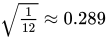
The characteristic 5-cell (4-orthoscheme) has four more edges than its base characteristic tetrahedron (3-orthoscheme), joining the four vertices of the base to its apex (the fifth vertex of the 4-orthoscheme, at the center of the regular 24-cell). If the regular 24-cell has radius and edge length 𝒍 = 1, its characteristic 5-cell’s ten edges have lengths , , around its exterior right-triangle face (the edges opposite the characteristic angles 𝟀, 𝝉, 𝟁), plus , , (the other three edges of the exterior 3-orthoscheme facet the characteristic tetrahedron, which are the characteristic radii of the octahedron), plus , , , (edges which are the characteristic radii of the 24-cell). The 4-edge path along orthogonal edges of the orthoscheme is , , , , first from a 24-cell vertex to a 24-cell edge center, then turning 90° to a 24-cell face center, then turning 90° to a 24-cell octahedral cell center, then turning 90° to the 24-cell center.


Reflections
The 24-cell can be constructed by the reflections of its characteristic 5-cell in its own facets (its tetrahedral mirror walls). Reflections and rotations are related: a reflection in an even number of intersecting mirrors is a rotation.[28] Consequently, regular polytopes can be generated by reflections or by rotations. For example, any 720° isoclinic rotation of the 24-cell in a hexagonal invariant plane takes each of the 24 vertices to and through 5 other vertices and back to itself, on a skew hexagram2 geodesic isocline that winds twice around the 3-sphere on every second vertex of the hexagram. Any set of four orthogonal pairs of antipodal vertices (the 8 vertices of one of the three inscribed 16-cells) performing half such an orbit visits 3 * 8 = 24 distinct vertices and generates the 24-cell sequentially in 3 steps of a single 360° isoclinic rotation, just as any single characteristic 5-cell reflecting itself in its own mirror walls generates the 24 vertices simultaneously by reflection.
Tracing the orbit of one such 16-cell vertex during the 360° isoclinic rotation reveals more about the relationship between reflections and rotations as generative operations. The vertex follows an isocline (a doubly curved geodesic circle) rather than an ordinary great circle. The isocline connects vertices two edge lengths apart, but curves away from the great circle path over the two edges connecting those vertices, missing the vertex in between. Although the isocline does not follow any one great circle, it is contained within a ring of another kind: in the 24-cell it stays within a 6-cell ring of spherical[29] octahedral cells, intersecting one vertex in each cell, and passing through the volume of two adjacent cells near the missed vertex.
Chiral symmetry operations
A symmetry operation is a rotation or reflection which leaves the object indistinguishable from itself before the transformation. The 24-cell has 1152 distinct symmetry operations (576 rotations and 576 reflections). Each rotation is equivalent to two reflections, in a distinct pair of non-parallel mirror planes.
Pictured are sets of disjoint great circle polygons, each in a distinct central plane of the 24-cell. For example, {24/4}=4{6} is an orthogonal projection of the 24-cell picturing 4 of its [16] great hexagon planes. The 4 planes lie Clifford parallel to the projection plane and to each other, and their great polygons collectively constitute a discrete Hopf fibration of 4 non-intersecting great circles which visit all 24 vertices just once.
Each row of the table describes a class of distinct rotations. Each rotation class takes the left planes pictured to the corresponding right planes pictured. The vertices of the moving planes move in parallel along the polygonal isocline paths pictured. For example, the rotation class consists of [32] distinct rotational displacements by an arc-distance of 2𝝅/3 = 120° between 16 great hexagon planes represented by quaternion group and a corresponding set of 16 great hexagon planes represented by quaternion group . One of the [32] distinct rotations of this class moves the representative vertex coordinate to the vertex coordinate .
![{\displaystyle [32]R_{q7,q8}}](https://wikimedia.org/api/rest_v1/media/math/render/svg/489741954b4269c41ef0d491551ee3eb322f003d)


| Proper rotations of the 24-cell symmetry group F4[30] | ||||||||||||||
|---|---|---|---|---|---|---|---|---|---|---|---|---|---|---|
| Isocline | Rotation class | Left planes | Right planes | |||||||||||
{24/8}=4{6/2} [16] 4𝝅 {6/2} |
{24/4}=4{6} [16] 2𝝅 {6} |
{24/8}=4{6/2} [16] 2𝝅 {6} |
||||||||||||
| 2𝝅/3 | 120° | √3 | 1.732~ | 𝝅/3 | 60° | √1 | 1 | 2𝝅/3 | 120° | √3 | 1.732~ | |||
{24/2}=2{12} [16] 4𝝅 {12} |
{24/4}=4{6} [16] 2𝝅 {6} |
{24/4}=4{6} [16] 2𝝅 {6} |
||||||||||||
| 𝝅/3 | 60° | √1 | 1 | 𝝅/3 | 60° | √1 | 1 | 𝝅/3 | 60° | √1 | 1 | |||
{24/1}={24} [16] 4𝝅 {1} |
{24/4}=4{6} [16] 2𝝅 {6} |
{24/4}=4{6} [16] 2𝝅 {6} |
||||||||||||
| 2𝝅 | 360° | √0 | 0 | 𝝅/3 | 60° | √1 | 1 | 𝝅/3 | 60° | √1 | 1 | |||
{24/12}=12{2} [16] 4𝝅 {2} |
{24/4}=4{6} [16] 2𝝅 {6} |
{24/8}=4{6/2} [16] 2𝝅 {6} |
||||||||||||
| 𝝅 | 180° | √4 | 2 | 𝝅/3 | 60° | √1 | 1 | 2𝝅/3 | 120° | √3 | 1.732~ | |||
| {24/2}=2{12} [8] 4𝝅 {12} |
{24/4}=4{6} [8] 2𝝅 {6} |
{24/6}=6{4} [8] 2𝝅 {4} |
||||||||||||
| 𝝅/3 | 60° | √1 | 1 | 𝝅/3 | 60° | √1 | 1 | 𝝅/2 | 90° | √2 | 1.414~ | |||
| {24/8}=4{6/2} [8] 4𝝅 {6/2} |
{24/4}=4{6} [8] 2𝝅 {6} |
{24/6}=6{4} [8] 2𝝅 {4} |
||||||||||||
| 2𝝅/3 | 120° | √3 | 1.732~ | 𝝅/3 | 60° | √1 | 1 | 𝝅/2 | 90° | √2 | 1.414~ | |||
| {24/1}={24} [18] 4𝝅 {1} |
{24/6}=6{4} [18] 2𝝅 {4} |
{24/6}=6{4} [18] 2𝝅 {4} |
||||||||||||
| 2𝝅 | 360° | √0 | 0 | 𝝅/2 | 90° | √2 | 1.414~ | 𝝅/2 | 90° | √2 | 1.414~ | |||
| {24/12}=12{2} [18] 4𝝅 {2} |
{24/6}=6{4} [18] 2𝝅 {4} |
{24/6}=6{4} [18] 2𝝅 {4} |
||||||||||||
| 𝝅 | 180° | √4 | 2 | 𝝅/2 | 90° | √2 | 1.414~ | 𝝅/2 | 90° | √2 | 1.414~ | |||
{24/9}=3{8/3} [72] 4𝝅 {8/3} |
{24/6}=6{4} [72] 2𝝅 {4} |
{24/6}=6{4} [72] 2𝝅 {4} |
||||||||||||
| 𝝅/2 | 90° | √2 | 1.414~ | 𝝅/2 | 90° | √2 | 1.414~ | 𝝅 | 180° | √4 | 2 | |||
| {24/1}={24} [36] 4𝝅 {1} |
{24/6}=6{4} [36] 2𝝅 {4} |
{24/6}=6{4} [36] 2𝝅 {4} |
||||||||||||
| 2𝝅 | 360° | √0 | 0 | 𝝅/2 | 90° | √2 | 1.414~ | 𝝅/2 | 90° | √2 | 1.414~ | |||
| {24/2}=2{12} [48] 4𝝅 {12} |
{24/6}=6{4} [48] 2𝝅 {4} |
{24/4}=4{6} [48] 2𝝅 {6} |
||||||||||||
| 𝝅/3 | 60° | √1 | 1 | 𝝅/2 | 90° | √2 | 1.414~ | 𝝅/3 | 60° | √1 | 1 | |||
| {24/12}=12{2} [9] 4𝝅 {2} |
{24/6}=6{4} [9] 2𝝅 {4} |
{24/6}=6{4} [9] 2𝝅 {4} |
||||||||||||
| 𝝅 | 180° | √4 | 2 | 𝝅/2 | 90° | √2 | 1.414~ | 𝝅/2 | 90° | √2 | 1.414~ | |||
| {24/12}=12{2} [12] 4𝝅 {2} |
{24/12}=12{2} [12] 2𝝅 {2} |
{24/12}=12{2} [12] 2𝝅 {2} |
||||||||||||
| 𝝅/2 | 90° | √2 | 1.414~ | 𝝅/2 | 90° | √2 | 1.414~ | 𝝅/2 | 90° | √2 | 1.414~ | |||
| {24/1}={24} [0] 0𝝅 {1} |
{24/12}=12{2} [0] 2𝝅 {2} |
{24/12}=12{2} [0] 2𝝅 {2} |
||||||||||||
| 0 | 0° | √0 | 0 | 𝝅/2 | 90° | √2 | 1.414~ | 𝝅/2 | 90° | √2 | 1.414~ | |||
| {24/12}=12{2} [12] 2𝝅 {2} |
{24/12}=12{2} [12] 2𝝅 {2} |
{24/12}=12{2} [12] 2𝝅 {2} |
||||||||||||
| 𝝅 | 180° | √4 | 2 | 𝝅/2 | 90° | √2 | 1.414~ | 𝝅/2 | 90° | √2 | 1.414~ | |||


![{\displaystyle [32]R_{q7,-q8}}](https://wikimedia.org/api/rest_v1/media/math/render/svg/75389b1a12b5ecc21fcf5aa341e21ea1a735185e)


![{\displaystyle [32]R_{q7,q7}}](https://wikimedia.org/api/rest_v1/media/math/render/svg/0ac021392aa0cc4678c9af39214f175504d374ab)

![{\displaystyle [32]R_{q7,-q7}}](https://wikimedia.org/api/rest_v1/media/math/render/svg/90455b7de215a272c1f8b03f89d553a617c778c2)



![{\displaystyle [16]R_{q7,q1}}](https://wikimedia.org/api/rest_v1/media/math/render/svg/1d24c32c1cbc71058e7641ea96c69e98007561df)


![{\displaystyle [16]R_{q7,-q1}}](https://wikimedia.org/api/rest_v1/media/math/render/svg/13f88d38fb45fb9aef8062cde605b83186924cd8)


![{\displaystyle [36]R_{q6,q6}}](https://wikimedia.org/api/rest_v1/media/math/render/svg/a314e52d3680d2dc1dc28729f1ff0dbbf052b885)


![{\displaystyle [36]R_{q6,-q6}}](https://wikimedia.org/api/rest_v1/media/math/render/svg/d9ebb3a857917b540fe0c670009be886efe59caa)


![{\displaystyle [144]R_{q6,-q4}}](https://wikimedia.org/api/rest_v1/media/math/render/svg/2c5b13de83f9b8da9b3751c83873524f5eb6d267)


![{\displaystyle [72]R_{q4,q4}}](https://wikimedia.org/api/rest_v1/media/math/render/svg/306d2b2366566140b924e18d4538c03a27a3db95)


![{\displaystyle [96]R_{q2,q7}}](https://wikimedia.org/api/rest_v1/media/math/render/svg/1a9526fab41f1ec7f186656fc326a4437467f564)


![{\displaystyle [18]R_{q2,-q2}}](https://wikimedia.org/api/rest_v1/media/math/render/svg/e0ba6f25fdb101b789fc5799477ca895d33cfe98)


![{\displaystyle [12]R_{q2,q1}}](https://wikimedia.org/api/rest_v1/media/math/render/svg/a697458f87b1290700d8ce01919f215dc0b038ea)

![{\displaystyle [1]R_{q1,q1}}](https://wikimedia.org/api/rest_v1/media/math/render/svg/6b5c23335f59d47afb2203de0dd0057e5195b2b0)

![{\displaystyle [1]R_{q1,-q1}}](https://wikimedia.org/api/rest_v1/media/math/render/svg/7b4bd1b012a0bed1d34937533f1cc8a6bf4afb73)
In a rotation class each quaternion group may be representative not only of its own fibration of Clifford parallel planes but also of the other congruent fibrations. For example, rotation class takes the 4 hexagon planes of to the 4 hexagon planes of which are 120° away, in an isoclinic rotation. But in a rigid rotation of this kind, all [16] hexagon planes move in congruent rotational displacements, so this rotation class also includes , and . The name is the conventional representation for all [16] congruent plane displacements.
![{\displaystyle [d]{R_{ql,qr}}}](https://wikimedia.org/api/rest_v1/media/math/render/svg/5bbb52ecdb49bbf48eca911c51159a7cde6297b5)

![{\displaystyle [4]R_{q7,q8}}](https://wikimedia.org/api/rest_v1/media/math/render/svg/142972752f455c2ebf6dfa810fad486e42a64adc)
![{\displaystyle [4]R_{-q7,-q8}}](https://wikimedia.org/api/rest_v1/media/math/render/svg/979305387cd62fe7cd50162981451034c04d0a46)
![{\displaystyle [4]R_{q8,q7}}](https://wikimedia.org/api/rest_v1/media/math/render/svg/ce6367e92819738a98ca78a723632627cbac1d46)
![{\displaystyle [4]R_{-q8,-q7}}](https://wikimedia.org/api/rest_v1/media/math/render/svg/55ec9c74197b1c39b504adea0b886925dd1c3c53)
![{\displaystyle [16]R_{q7,q8}}](https://wikimedia.org/api/rest_v1/media/math/render/svg/b226f3971360ad4951192127156d716546993525)
These rotation classes are all subclasses of which has [32] distinct rotational displacements rather than [16] because there are two chiral ways to perform any class of rotations, designated its left rotations and its right rotations. The [16] left displacements of this class are not congruent with the [16] right displacements, but enantiomorphous like a pair of shoes. Each left (or right) isoclinic rotation takes [16] left planes to [16] right planes, but the left and right planes correspond differently in the left and right rotations. The left and right rotational displacements of the same left plane take it to different right planes.
Each rotation class (table row) describes a distinct left (and right) isoclinic rotation. The left (or right) rotations carry the left planes to the right planes simultaneously, through a characteristic rotation angle. For example, the rotation moves all [16] hexagonal planes at once by 2𝝅/3 = 120° each. Repeated 6 times, this left (or right) isoclinic rotation moves each plane 720° and back to itself in the same orientation, passing through all 4 planes of the left set and all 4 planes of the right set once each. The picture in the isocline column represents this union of the left and right plane sets. In the example it can be seen as a set of 4 Clifford parallel skew hexagrams, each having one edge in each great hexagon plane, and skewing to the left (or right) at each vertex throughout the left (or right) isoclinic rotation.
Visualization

Cell rings
The 24-cell is bounded by 24 octahedral cells. For visualization purposes, it is convenient that the octahedron has opposing parallel faces (a trait it shares with the cells of the tesseract and the 120-cell). One can stack octahedrons face to face in a straight line bent in the 4th direction into a great circle with a circumference of 6 cells.[31][32] The cell locations lend themselves to a hyperspherical description. Pick an arbitrary cell and label it the “North Pole“. Eight great circle meridians (two cells long) radiate out in 3 dimensions, converging at the 3rd “South Pole” cell. This skeleton accounts for 18 of the 24 cells (2 + 8×2). See the table below.
| Layer # | Number of Cells | Description | Colatitude | Region |
|---|---|---|---|---|
| 1 | 1 cell | North Pole | 0° | Northern Hemisphere |
| 2 | 8 cells | First layer of meridian cells | 60° | |
| 3 | 6 cells | Non-meridian / interstitial | 90° | Equator |
| 4 | 8 cells | Second layer of meridian cells | 120° | Southern Hemisphere |
| 5 | 1 cell | South Pole | 180° | |
| Total | 24 cells | |||

The 24-cell can be partitioned into cell-disjoint sets of four of these 6-cell great circle rings, forming a discrete Hopf fibration of four non-intersecting linked rings. One ring is “vertical”, encompassing the pole cells and four meridian cells. The other three rings each encompass two equatorial cells and four meridian cells, two from the northern hemisphere and two from the southern.[33]
Related polytopes
The regular complex polygon 4{3}4, 
 or
or 
 contains the 24 vertices of the 24-cell, and 24 4-edges that correspond to central squares of 24 of 48 octahedral cells. Its symmetry is 4[3]4, order 96.[34]
The following are some polytopes constructed from the 24-cell.
| 24-cell family polytopes | |||||||||||
|---|---|---|---|---|---|---|---|---|---|---|---|
| Name | 24-cell | truncated 24-cell | snub 24-cell | rectified 24-cell | cantellated 24-cell | bitruncated 24-cell | cantitruncated 24-cell | runcinated 24-cell | runcitruncated 24-cell | omnitruncated 24-cell | |
| Schläfli symbol |
{3,4,3} | t0,1{3,4,3} t{3,4,3} |
s{3,4,3} | t1{3,4,3} r{3,4,3} |
t0,2{3,4,3} rr{3,4,3} |
t1,2{3,4,3} 2t{3,4,3} |
t0,1,2{3,4,3} tr{3,4,3} |
t0,3{3,4,3} | t0,1,3{3,4,3} | t0,1,2,3{3,4,3} | |
| Coxeter diagram |
|
|
|
|
|
|
|
|
|
| |
| Schlegel diagram |

|

|

|

|

|

|

|

|

|

| |
| F4 | 
|

|

|

|

|

|

|

|

|

| |
| B4 | 
|

|

|

|

|

|

|

|

|

| |
| B3(a) | 
|

|

|

|

|

|

|

|

|

| |
| B3(b) | 
|

|

|

|

|

| |||||
| B2 | 
|

|

|

|

|

|

|

|

|

| |
The 24-cell can also be derived as a rectified 16-cell:
| B4 symmetry polytopes | |||||||||||
|---|---|---|---|---|---|---|---|---|---|---|---|
| Name | tesseract | rectified tesseract |
truncated tesseract |
cantellated tesseract |
runcinated tesseract |
bitruncated tesseract |
cantitruncated tesseract |
runcitruncated tesseract |
omnitruncated tesseract | ||
| Coxeter diagram |
|
=  
|
|
|
|
=
|
|
|
| ||
| Schläfli symbol |
{4,3,3} | t1{4,3,3} r{4,3,3} |
t0,1{4,3,3} t{4,3,3} |
t0,2{4,3,3} rr{4,3,3} |
t0,3{4,3,3} | t1,2{4,3,3} 2t{4,3,3} |
t0,1,2{4,3,3} tr{4,3,3} |
t0,1,3{4,3,3} | t0,1,2,3{4,3,3} | ||
| Schlegel diagram |

|

|

|

|

|

|

|

|

| ||
| B4 | 
|

|

|

|

|

|

|

|

| ||
| Name | 16-cell | rectified 16-cell |
truncated 16-cell |
cantellated 16-cell |
runcinated 16-cell |
bitruncated 16-cell |
cantitruncated 16-cell |
runcitruncated 16-cell |
omnitruncated 16-cell | ||
| Coxeter diagram |
= 
|
=
|
=
|
=
|
|
=
|
=
|
|
| ||
| Schläfli symbol |
{3,3,4} | t1{3,3,4} r{3,3,4} |
t0,1{3,3,4} t{3,3,4} |
t0,2{3,3,4} rr{3,3,4} |
t0,3{3,3,4} | t1,2{3,3,4} 2t{3,3,4} |
t0,1,2{3,3,4} tr{3,3,4} |
t0,1,3{3,3,4} | t0,1,2,3{3,3,4} | ||
| Schlegel diagram |

|

|

|
|

|

|

|

|

| ||
| B4 | 
|
|

|
|
|
|
|

|
| ||
See also
Citations
- ^ Coxeter 1973, p. 118, Chapter VII: Ordinary Polytopes in Higher Space.
- ^ Johnson 2018, p. 249, 11.5.
- ^ Ghyka 1977, p. 68.
- ^ Coxeter 1995, p. 25, (Paper 3) Two aspects of the regular 24-cell in four dimensions.
- ^ a b Stillwell 2001, p. 22.
- ^ Coxeter 1973, p. 136, §7.8 The enumeration of possible regular figures.
- ^ Coxeter 1973, p. 302, Table VI (ii): 𝐈𝐈 = {3,4,3}: see Result column
- ^ a b Coxeter 1973, p. 156, §8.7. Cartesian Coordinates.
- ^ Coxeter 1973, pp. 145–146, §8.1 The simple truncations of the general regular polytope.
- ^ Waegell & Aravind 2009, pp. 4–5, §3.4 The 24-cell: points, lines and Reye’s configuration; In the 24-cell Reye’s “points” and “lines” are axes and hexagons, respectively.
- ^ Coxeter 1973, p. 12, §1.8. Configurations.
- ^ van Ittersum 2020, p. 78, §4.2.5.
- ^ Egan 2021; quaternions, the binary tetrahedral group and the binary octahedral group, with rotating illustrations.
- ^ Koca, Al-Ajmi & Koc 2007.
- ^ Coxeter 1968, p. 70, §4.12 The Classification of Zonohedra.
- ^ Mamone, Pileio & Levitt 2010, pp. 1438–1439, §4.5 Regular Convex 4-Polytopes; the 24-cell has 1152 symmetry operations (rotations and reflections) as enumerated in Table 2, symmetry group 𝐹4.
- ^ Kim & Rote 2016, p. 6, §5. Four-Dimensional Rotations.
- ^ Perez-Gracia & Thomas 2017, §7. Conclusions; “Rotations in three dimensions are determined by a rotation axis and the rotation angle about it, where the rotation axis is perpendicular to the plane in which points are being rotated. The situation in four dimensions is more complicated. In this case, rotations are determined by two orthogonal planes and two angles, one for each plane. Cayley proved that a general 4D rotation can always be decomposed into two 4D rotations, each of them being determined by two equal rotation angles up to a sign change.”
- ^ Perez-Gracia & Thomas 2017, pp. 12−13, §5. A useful mapping.
- ^ Coxeter 1995, pp. 30–32, (Paper 3) Two aspects of the regular 24-cell in four dimensions; §3. The Dodecagonal Aspect; Coxeter considers the 150°/30° double rotation of period 12 which locates 12 of the 225 distinct 24-cells inscribed in the 120-cell, a regular 4-polytope with 120 dodecahedral cells that is the convex hull of the compound of 25 disjoint 24-cells.
- ^ Perez-Gracia & Thomas 2017, pp. 2−3, §2. Isoclinic rotations.
- ^ Kim & Rote 2016, pp. 7–10, §6. Angles between two Planes in 4-Space.
- ^ Coxeter 1973, p. 141, §7.x. Historical remarks; “Möbius realized, as early as 1827, that a four-dimensional rotation would be required to bring two enantiomorphous solids into coincidence. This idea was neatly deployed by H. G. Wells in The Plattner Story.”
- ^ Coxeter 1973, pp. 292–293, Table I(ii); “24-cell”.
- ^ Coxeter 1973, p. 139, §7.9 The characteristic simplex.
- ^ Coxeter 1973, p. 290, Table I(ii); “dihedral angles”.
- ^ Kim & Rote 2016, pp. 17–20, §10 The Coxeter Classification of Four-Dimensional Point Groups.
- ^ Coxeter 1973, pp. 33–38, §3.1 Congruent transformations.
- ^ Coxeter 1973, p. 138; “We allow the Schläfli symbol {p,…, v} to have three different meanings: a Euclidean polytope, a spherical polytope, and a spherical honeycomb. This need not cause any confusion, so long as the situation is frankly recognized. The differences are clearly seen in the concept of dihedral angle.”
- ^ Mamone, Pileio & Levitt 2010, pp. 1438–1439, §4.5 Regular Convex 4-Polytopes, Table 2, Symmetry operations.
- ^ Coxeter 1970, p. 18, §8. The simplex, cube, cross-polytope and 24-cell; Coxeter studied cell rings in the general case of their geometry and group theory, identifying each cell ring as a polytope in its own right which fills a three-dimensional manifold (such as the 3-sphere) with its corresponding honeycomb. He found that cell rings follow Petrie polygons and some (but not all) cell rings and their honeycombs are twisted, occurring in left- and right-handed chiral forms. Specifically, he found that since the 24-cell’s octahedral cells have opposing faces, the cell rings in the 24-cell are of the non-chiral (directly congruent) kind. Each of the 24-cell’s cell rings has its corresponding honeycomb in Euclidean (rather than hyperbolic) space, so the 24-cell tiles 4-dimensional Euclidean space by translation to form the 24-cell honeycomb.
- ^ Banchoff 2013, studied the decomposition of regular 4-polytopes into honeycombs of tori tiling the Clifford torus, showed how the honeycombs correspond to Hopf fibrations, and made a particular study of the 24-cell’s 4 rings of 6 octahedral cells with illustrations.
- ^ Banchoff 2013, pp. 265–266.
- ^ Coxeter 1991.
References
- Kepler, Johannes (1619). Harmonices Mundi (The Harmony of the World). Johann Planck.
- Coxeter, H.S.M. (1973) [1948]. Regular Polytopes (3rd ed.). New York: Dover.
- Coxeter, H.S.M. (1991), Regular Complex Polytopes (2nd ed.), Cambridge: Cambridge University Press
- Coxeter, H.S.M. (1995), Sherk, F. Arthur; McMullen, Peter; Thompson, Anthony C.; Weiss, Asia Ivic (eds.), Kaleidoscopes: Selected Writings of H.S.M. Coxeter (2nd ed.), Wiley-Interscience Publication, ISBN 978-0-471-01003-6
- (Paper 3) H.S.M. Coxeter, Two aspects of the regular 24-cell in four dimensions
- (Paper 22) H.S.M. Coxeter, Regular and Semi Regular Polytopes I, [Math. Zeit. 46 (1940) 380–407, MR 2,10]
- (Paper 23) H.S.M. Coxeter, Regular and Semi-Regular Polytopes II, [Math. Zeit. 188 (1985) 559-591]
- (Paper 24) H.S.M. Coxeter, Regular and Semi-Regular Polytopes III, [Math. Zeit. 200 (1988) 3-45]
- Coxeter, H.S.M. (1968). The Beauty of Geometry: Twelve Essays (2nd ed.). New York: Dover.
- Coxeter, H.S.M. (1989). “Trisecting an Orthoscheme”. Computers Math. Applic. 17 (1–3): 59–71. doi:10.1016/0898-1221(89)90148-X.
- Coxeter, H.S.M. (1970), “Twisted Honeycombs”, Conference Board of the Mathematical Sciences Regional Conference Series in Mathematics, 4, Providence, Rhode Island: American Mathematical Society
- Stillwell, John (January 2001). “The Story of the 120-Cell” (PDF). Notices of the AMS. 48 (1): 17–25.
- Johnson, Norman (2018), Geometries and Transformations, Cambridge: Cambridge University Press, ISBN 978-1-107-10340-5
- Johnson, Norman (1991), Uniform Polytopes (Manuscript ed.)
- Johnson, Norman (1966), The Theory of Uniform Polytopes and Honeycombs (Ph.D. ed.)
- Weisstein, Eric W. “24-Cell”. MathWorld. (also under Icositetrachoron)
- Klitzing, Richard. “4D uniform polytopes (polychora) x3o4o3o – ico”.
- Ghyka, Matila (1977). The Geometry of Art and Life. New York: Dover Publications. ISBN 978-0-486-23542-4.
- Banchoff, Thomas F. (2013). “Torus Decompostions of Regular Polytopes in 4-space”. In Senechal, Marjorie (ed.). Shaping Space. Springer New York. pp. 257–266. doi:10.1007/978-0-387-92714-5_20. ISBN 978-0-387-92713-8.
- Copher, Jessica (2019). “Sums and Products of Regular Polytopes’ Squared Chord Lengths”. arXiv:1903.06971 [math.MG].
- van Ittersum, Clara (2020). Symmetry groups of regular polytopes in three and four dimensions (Thesis). Delft University of Technology.
- Kim, Heuna; Rote, G. (2016). “Congruence Testing of Point Sets in 4 Dimensions”. arXiv:1603.07269 [cs.CG].
- Perez-Gracia, Alba; Thomas, Federico (2017). “On Cayley’s Factorization of 4D Rotations and Applications” (PDF). Adv. Appl. Clifford Algebras. 27: 523–538. doi:10.1007/s00006-016-0683-9. hdl:2117/113067. S2CID 12350382.
- Waegell, Mordecai; Aravind, P. K. (2009-11-12). “Critical noncolorings of the 600-cell proving the Bell-Kochen-Specker theorem”. Journal of Physics A: Mathematical and Theoretical. 43 (10) 105304. arXiv:0911.2289. doi:10.1088/1751-8113/43/10/105304. S2CID 118501180.
- Tyrrell, J. A.; Semple, J.G. (1971). Generalized Clifford parallelism. Cambridge University Press. ISBN 0-521-08042-8.
- Egan, Greg (23 December 2021). “Symmetries and the 24-cell”. gregegan.net. Retrieved 10 October 2022.
- Mamone, Salvatore; Pileio, Giuseppe; Levitt, Malcolm H. (2010). “Orientational Sampling Schemes Based on Four Dimensional Polytopes”. Symmetry. 2 (3): 1423–1449. Bibcode:2010Symm….2.1423M. doi:10.3390/sym2031423.
- Mebius, Johan (July 2015) [11 Jan 1994]. Applications of Quaternions to Dynamical Simulation, Computer Graphics and Biomechanics (Thesis). Delft University of Technology. doi:10.13140/RG.2.1.3310.3205.
- Feynman, Richard; Weinberg, Steven (1987). Elementary particles and the laws of physics. Cambridge University Press.
- Dorst, Leo (2019). “Conformal Villarceau Rotors”. Advances in Applied Clifford Algebras. 29 (44) 44. doi:10.1007/s00006-019-0960-5. S2CID 253592159.
- Koca, Mehmet; Al-Ajmi, Mudhahir; Koc, Ramazan (November 2007). “Polyhedra obtained from Coxeter groups and quaternions”. Journal of Mathematical Physics. 48 (11): 113514. Bibcode:2007JMP….48k3514K. doi:10.1063/1.2809467.
External links
- 24-cell animations
- 24-cell in stereographic projections
- Subsumptions of regular polytopes
- 24-cell description and diagrams Archived 2007-07-15 at the Wayback Machine
- Petrie dodecagons in the 24-cell: mathematics and animation software