59P/Kearns–Kwee is a periodic comet in the Solar System with a current orbital period of 9.49 years.[3][6]
Observational history
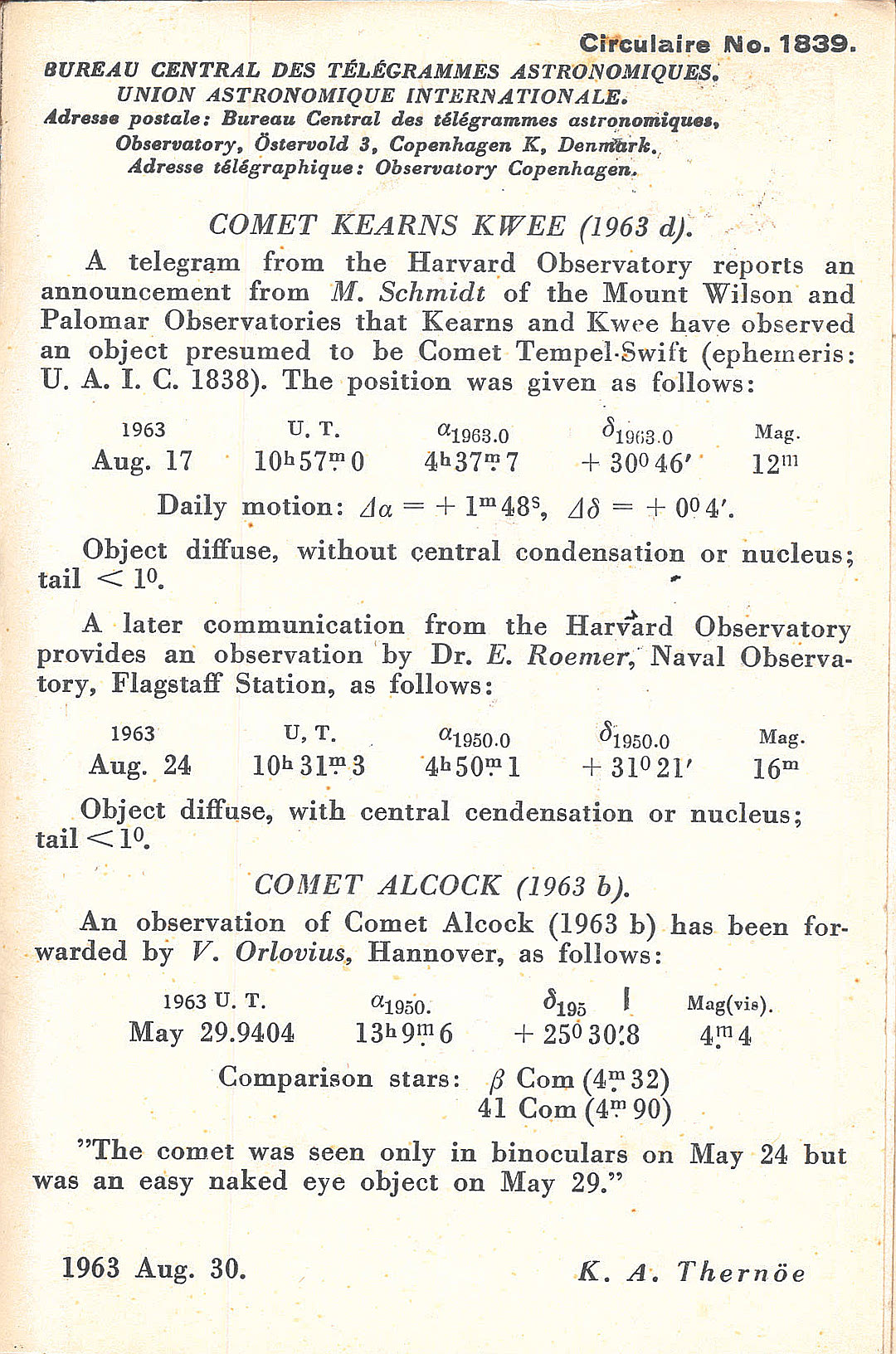
It was discovered by Charles E. Kearns and Kiem King Kwee on a photographic plate taken on 17 August 1963 during a search for the then-lost comet 55P/Tempel–Tuttle, and was later confirmed by Elizabeth Roemer at the US Naval Observatory Flagstaff Station in Arizona. She estimated its brightness at a faint magnitude of 16. The perihelion was initially calculated as 28 October 1963 and the periodicity as 8.48 years, but calculations based on further observations revised the data to 7 December and 8.95 years.
The 1972 apparition was observed by Elizabeth Roemer and L. M. Vaughn of the University of Arizona, using the 229-cm reflector at Kitt Peak as early as 26 July 1971. It was relocated in 1981 by Tsutomu Seki of Japan and again on 10 September 1989 by J. Gibson at Palomar Observatory. It was also successfully re-observed in 1999 and 2009.
Physical characteristics
The nucleus of the comet has an effective radius of 0.79±0.03 km, assuming a geometric albedo of 0.04.[5]
See also
References
- ^ C. E. Kearns; K. K. Kwee; M. Schmidt; E. Roemer (30 August 1963). K. A. Thernöe (ed.). “Comet Kearns–Kwee (1963d)”. IAU Circular. 1839 (1).
- ^ “Horizons Batch for 59P/Kearns-Kwee (90000649) on 2028-Mar-15” (Perihelion occurs when rdot flips from negative to positive). JPL Horizons. Archived from the original on 29 September 2025. Retrieved 29 September 2025. (JPL#K182/6 Soln.date: 2023-Jan-17)
- ^ a b “59P/Kearns–Kwee Orbit”. Minor Planet Center. Retrieved 24 February 2019.
- ^ “59P/Kearns–Kwee – JPL Small-Body Database Lookup”. ssd.jpl.nasa.gov. Jet Propulsion Laboratory. Retrieved 10 June 2025.
- ^ a b P. L. Lamy; I. Toth; H. A. Weaver; M. F. A’Hearn; L. Jorda (2009). “Properties of the nuclei and comae of 13 ecliptic comets from Hubble Space Telescope snapshot observations” (PDF). Astronomy & Astrophysics. 508 (2): 1045–1056. Bibcode:2009A&A…508.1045L. doi:10.1051/0004-6361/200811462. S2CID 125249770.
- ^ G. W. Kronk. “59P/Kearns-Kwee”. Cometography.com. Retrieved 21 February 2015.
External links