In mathematics, the adele ring is a construction in number theory that combines all local versions of a global field into one object. For the rational numbers, these local versions include the real numbers and the fields of -adic numbers for all prime numbers . More generally, if is a global field, its adele ring, often denoted , is a topological ring built from the completions of at all its places . Formally, it is a restricted product of the local fields , with respect to the valuation rings at the non-archimedean places. Its elements are called adeles.


The restricted product topology makes a locally compact topological ring. The field embeds diagonally in as a discrete subring, and the quotient is compact. As an additive locally compact abelian group, the adele ring is self-dual, making it a natural setting for Fourier analysis on global fields.

The group of units of the adele ring, with its natural topology, is the idele group . The quotient , called the idele class group, is a central object in class field theory. Adeles and ideles are also used in Tate’s thesis, the theory of automorphic forms, local-global principles, and adelic descriptions of divisors, line bundles, and principal bundles on algebraic curves.


Definition
Let be a global field, meaning either a number field or a global function field. Let run over the places of . For each place , let be the completion of at . If is non-archimedean, let be the corresponding valuation ring.[1][2]

The set of finite adeles of , denoted , is the restricted product of the non-archimedean completions with respect to the subrings :


It is equipped with the restricted product topology. A basis of open sets is given by products

where is a finite set of non-archimedean places and each is open in . With componentwise addition and multiplication, is a topological ring.[1][3]


The adele ring of , denoted , is obtained by adjoining the completions at the archimedean places:

The number of archimedean places is finite, and each archimedean completion is isomorphic to or . The elements of are called adeles of . Addition and multiplication are defined componentwise. For brevity, one often writes


with the understanding that the restricted product condition applies only at the non-archimedean places.[2][1]
If is a global function field, then there are no archimedean places, so .

There is a natural diagonal embedding

This map is well-defined because an element lies in for all but finitely many non-archimedean places . After this embedding, is regarded as a subring of , and its elements are sometimes called the principal adeles of .[3][1]

More generally, if is a set of places of , one may define the ring of -adeles by


again using the valuation rings at the non-archimedean places in . If

then there is a natural product decomposition

Motivation
The purpose of the adele ring is to look at all completions of a global field at once. For the rational numbers, the usual absolute value gives the completion , but Ostrowski’s theorem shows that there are also the -adic absolute values, one for each prime number . More generally, a global field has a family of completions , one for each place . The adele ring packages these completions into a single object, so that analytic methods can be applied while still retaining arithmetic information from all finite primes.[1][2]
A precursor to this point of view is Minkowski’s geometry of numbers. If is a number field with ring of integers , the classical Minkowski embedding places as a lattice in the finite-dimensional real vector space


This makes it possible to study arithmetic questions using volume and compactness arguments. The adele ring may be viewed as a local-global enlargement of this construction: instead of using only the archimedean completions, it includes all completions of . In the adelic setting, the global field itself embeds diagonally as a discrete subgroup of , and the quotient is compact.[3][1]
The adele ring is defined as a restricted product rather than as the full Cartesian product of all completions. The restricted product condition says that an adele is integral at almost all non-archimedean places. This condition is natural from the point of view of the global field itself: if , then belongs to for all but finitely many finite places . Thus the diagonal embedding


lands in the restricted product.
The restricted product is also the topological condition that makes the adele ring useful for analysis. With its restricted product topology, is a locally compact topological ring. Local compactness gives the additive group of a Haar measure, making it possible to do harmonic analysis on the adele ring. This is one of the main reasons adeles are useful in modern number theory.[1][4]
Tate’s thesis, for example, constructs Fourier analysis on the adele ring and integration over the idele group to give a uniform treatment of Hecke -functions. In this approach, global zeta integrals factor into local integrals over the completions , and the local-global structure of the adele ring explains the Euler product, analytic continuation, and functional equation of these -functions.[5][6]

Examples
Rational adeles
For , Ostrowski’s theorem says that the places of are given by the usual absolute value and the -adic absolute values, one for each prime number . The completion at the infinite place is


and the completion at the place corresponding to is the field of -adic numbers , with valuation ring . Thus the adele ring of is


where the restricted product is taken with respect to the subrings . Equivalently,

Thus an adele of is a real number together with a -adic rational number for each prime , such that all but finitely many of the -adic components are -adic integers.[1][2]
The finite adeles of are

The integral finite adeles are

the ring of profinite integers. With this notation,

The diagonal embedding of sends a rational number to the adele

This is well-defined because a rational number has only finitely many prime factors in its denominator, so for all but finitely many primes .

Number fields
Let be a number field with ring of integers . At each finite place , the completion is a finite extension of some , and its valuation ring is denoted . At each infinite place, the completion is isomorphic to either or . The adele ring is

where the restricted product over finite places is taken with respect to the rings . Thus an adele of is a family with for every place , such that for all but finitely many finite places.


For example, if is a quadratic number field, then its archimedean factor is either , when has two real embeddings, or , when has one pair of complex embeddings. The finite part is a restricted product over the nonzero prime ideals of .[2][1]

If is a finite extension of number fields, then the adelic construction is compatible with extension of scalars. In particular, one has a natural isomorphism


and, in the special case ,

This gives another way to view the adele ring of a number field as the adelic extension of the rational adele ring.[3][1]
Function fields and curves
Now take the function field

of the projective line over a finite field. Its places correspond to the closed points of . Such points may be described as maps


over . For instance, there are points of the form


For a point , the local ring used in the restricted product is the completed local ring

and the corresponding local field is its fraction field, often denoted . Thus the adele ring of may be written


where the restricted product is taken with respect to the completed local rings . Equivalently, its elements are families , with , such that for all but finitely many points .[1]


The same description holds for any smooth proper curve over a finite field. If is its function field, then


where runs over the closed points of . Unlike number fields, global function fields have no archimedean places, so the finite adele ring and the full adele ring are the same.

Topology and main properties
The topology on the adele ring is the restricted product topology. For a finite set of places containing the archimedean places, define

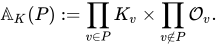
Equipped with the product topology and componentwise addition and multiplication, is a locally compact topological ring. If is another finite set of places of containing , then is an open subring of . The adele ring is the union of all these open subrings:


Equivalently, is the set of all such that for almost all non-archimedean places . The topology of is induced by the requirement that all be open subrings. Thus is a locally compact topological ring.[1][3]


The same construction applies to sets of places. For every set of places , the ring of -adeles

is a locally compact topological ring, with the restricted product topology. If

then there is a natural product decomposition
The diagonal embedding

identifies with a subring of . With this embedding, the elements of are called principal adeles. The image of is discrete in , and the quotient
is compact. In particular, is closed in . This compactness property is one of the main reasons the adele ring is useful in harmonic analysis and in arithmetic applications.[3][1]
The adele ring also separates naturally into any chosen local factor and the remaining factors. Fix a place of . Let be a finite set of places containing and , and define


Then

Furthermore, define
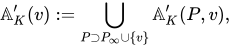
where runs through all finite sets containing . Then


via the map

Thus there is a natural embedding and a natural projection . The same construction works with any finite set of places in place of the single place .


Since is locally compact as an additive group, it has an additive Haar measure. This measure is used in harmonic analysis on global fields and is usually normalized as a product of local Haar measures. With the standard normalization at the non-archimedean places, the valuation ring has measure for almost all finite places.[5][4]

Haar measure and Fourier analysis
Since is locally compact as an additive group, it has an additive Haar measure, usually denoted . This measure may be normalized as a product of local Haar measures on the completions . At a non-archimedean place , the local measure is commonly normalized so that the valuation ring has measure ; at the archimedean places one uses the usual Lebesgue measure on or .[1][4]


A function is called simple if


where each is measurable and for almost all non-archimedean places . With the standard normalization, every integrable simple function satisfies


The product is finite in the sense that almost all factors are equal to .[7][1]
Fourier analysis on the adele ring is based on the characters of its additive group. If is a locally compact abelian group, its character group is the group of all continuous homomorphisms from to



with the topology of uniform convergence on compact subsets. The adele ring is self-dual as a locally compact abelian group:

This is proved by reducing to the corresponding local statement for each completion . For example, the usual character

gives an isomorphism

Analogous local characters are used at the non-archimedean places, and their restricted product gives the global self-duality of .[1][4]
After choosing a nontrivial additive character , the Fourier transform of a suitable function on is defined by


With a compatible choice of Haar measure, this Fourier transform satisfies the usual inversion and Plancherel formulas. One of the important features of the adelic setting is that global Fourier analysis factors into local Fourier analysis over the completions .
With the help of the characters of , Fourier analysis can be done on the adele ring. In Tate’s thesis, John Tate used Fourier analysis on the adele ring and integration over the idele group to study the Riemann zeta function, Dirichlet -functions, and more general Hecke -functions. Adelic forms of these functions can be represented as integrals over the adele ring or the idele group, with respect to corresponding Haar measures. Their functional equations and meromorphic continuations can then be proved by applying Fourier analysis and Poisson summation in the adelic setting.[5][6][8]
For example, for ,


where is the multiplicative Haar measure on the finite idele group , normalized so that has volume , and extended by zero to the finite adele ring. Thus the Riemann zeta function can be written as an integral over a subset of the adele ring.[9]


Applications
Class field theory
The adele ring enters class field theory through its group of units, the idele group . The quotient

is the idele class group of . Global class field theory describes the abelian extensions of in terms of topological quotients of . In one formulation, the global Artin reciprocity law gives a reciprocity homomorphism from the idele class group to the Galois group of the maximal abelian extension of . At finite level, for a finite abelian extension , the corresponding quotient of is described using the norm subgroup from .[10][11]


This adelic formulation packages the local reciprocity maps of local class field theory into a global statement. It replaces the older ideal-theoretic formulation, involving ideal class groups and ray class groups, by a statement about the topology and quotients of the idele class group.
Ideal classes and units
The idele group gives a topological refinement of the group of fractional ideals of a number field. For a number field , the finite part of the idele group maps onto the group of fractional ideals by

The kernel is the product of the local unit groups. Consequently, the ordinary ideal class group can be recovered as a quotient of the idele class group. This viewpoint gives an adelic interpretation of the finiteness of the class number: the compactness of the norm-one idele classes implies that the ideal class group is compact, and since it is discrete, it is finite.[3][1]
The same circle of ideas also gives an adelic formulation of the unit theorem. If is a finite set of places containing the archimedean places, the group of -units appears as an intersection of with a natural open subgroup of the idele group. In particular, for a number field , Dirichlet’s unit theorem states that


where is the finite cyclic group of roots of unity in , is the number of real embeddings, and is the number of conjugate pairs of complex embeddings.[1][3]


Tate’s thesis and L-functions
The topology on makes the quotient compact, allowing one to do harmonic analysis on the adele ring. With the help of the characters of , Fourier analysis can be done on the adele ring; integration over the idele group then gives zeta integrals.[5][4]
In Tate’s thesis, John Tate used Fourier analysis on the adele ring and the idele group to study the Riemann zeta function, Dirichlet -functions, and more general Hecke -functions. Adelic forms of these functions can be represented as integrals over the adele ring or the idele group, with respect to corresponding Haar measures. Their functional equations and meromorphic continuations can then be proved using Fourier analysis and Poisson summation in the adelic setting.[5][12][6]
For example, for , one has an adelic integral representation of the Riemann zeta function,
where is the multiplicative Haar measure on the finite idele group , normalized so that has volume , and extended by zero to the finite adele ring. Thus the Riemann zeta function can be written as an integral over a subset of the adele ring.
Automorphic forms
Adeles also provide the natural language for automorphic forms. Instead of studying functions separately over the real, complex, and -adic points of an algebraic group, one studies functions on adelic groups such as . For example, automorphic forms for over may be viewed as functions on


satisfying suitable algebraic, analytic, and growth conditions. In this setting, automorphic -functions can often be described by integrals over adelic groups.[13][14]
More generally, the use of adelic points for reductive algebraic groups is central in the modern theory of automorphic representations. This viewpoint is also one of the starting points of the Langlands program, which relates automorphic representations of adelic groups to Galois representations.[13]
Approximation and local-global principles
The adele ring provides a unified interpretation of approximation theorems and local-global questions. The weak approximation theorem says that, for finitely many inequivalent valuations of , the diagonal image of is dense in the product of the corresponding completions. The strong approximation theorem says that, after omitting one place , the field is dense in the restricted product over all other places. Thus the global field is discrete in its full adele ring, but becomes dense when one place is omitted.[3]

Adelic language is also used to formulate local-global principles, such as the Hasse principle. In such problems one compares solutions over the global field with compatible families of solutions over all completions . The adele ring provides a single space in which these local conditions can be collected and studied together.
Curves, divisors, and bundles
For a smooth proper curve with function field , the adele ring of can be described using the completions at the closed points of . In this setting, ideles recover the divisor and Picard groups of the curve. One has

and

Thus the divisor-class description of line bundles on a curve can be expressed adelically.
More generally, for an algebraic group , adelic double quotients describe moduli of bundles on curves. In Weil uniformization, for suitable groups such as semisimple groups, and also for , one has an adelic description of the form


For , this recovers the adelic description of the Picard group.

Serre duality on curves
Adeles also occur in the cohomology of algebraic curves. If is a smooth proper curve over the complex numbers, one can define the adeles of its function field in a way analogous to the function-field case over finite fields. Tate proved that Serre duality on ,


can be deduced by working with this adele ring , where is a line bundle on .[15]


Idele group
The idele group of a global field is the group of invertible elements of the adele ring . It is usually denoted
or . Equivalently, it is the restricted direct product


of the multiplicative groups of the completions , taken with respect to the unit groups at the non-archimedean places. Thus an idele is a family , with for every place , such that for all but finitely many non-archimedean .


Although is the group of units of the adele ring, it is not given the subspace topology inherited from . Instead it is given the restricted product topology, equivalently the topology induced by the embedding

With this topology, is an abelian locally compact topological group.
The diagonal embedding of into gives the subgroup of principal ideles. The quotient
is the idele class group. This group is a central object in class field theory, where abelian extensions of are described in terms of topological quotients of .
The idele group also carries a natural absolute value, or module,

where the local absolute values are normalized in the standard way. The product is finite for ideles, since almost all finite components are units. The subgroup

is the group of norm-one ideles. By the product formula, lies in , and the quotient is compact.


For number fields, the finite part of the idele group maps naturally onto the group of fractional ideals by
The kernel is , so the ordinary ideal class group is recovered as a quotient of the idele class group. In this way, the idele class group refines the ideal class group by retaining local unit data and archimedean information.

Ideles are also used in harmonic analysis on global fields. In Tate’s thesis, integration over the adele ring and the idele group gives a uniform treatment of Hecke -functions, including their Euler products, analytic continuation, and functional equations.
Further properties and proof sketches
The preceding sections give the basic definition and main uses of the adele ring. This section records some standard structural facts and proof sketches.
Restricted product topology
The difference between the restricted and unrestricted product topologies can be illustrated using a sequence in .

- Lemma. Consider the following sequence in :
- In the product topology this converges to , but it does not converge at all in the restricted product topology.
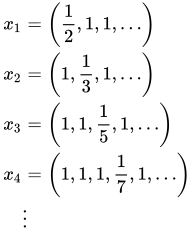

Proof. In product topology convergence corresponds to the convergence in each coordinate, which is trivial because the sequences become stationary. The sequence does not converge in restricted product topology. For each adele and for each restricted open rectangle it has for and therefore for all As a result for almost all In this consideration, and are finite subsets of the set of all places.




Alternative descriptions for number fields
The profinite integers are defined as the profinite completion of the rings with the partial order i.e.,



- Lemma.

Proof. This follows from the Chinese Remainder Theorem.
- Lemma.

Proof. Use the universal property of the tensor product. Define a -bilinear function


This is well-defined because for a given with coprime there are only finitely many primes dividing Let be another -module with a –bilinear map It must be the case that factors through uniquely, i.e., there exists a unique -linear map such that can be defined as follows: for a given there exist and such that for all Define One can show is well-defined, -linear, satisfies and is unique with these properties.







- Corollary. Define This results in an algebraic isomorphism
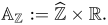

Proof.

- Lemma. For a number field ,

Remark. Using where there are summands, the right side receives the product topology and this topology is transported via the isomorphism onto

![{\displaystyle [K:\mathbb {Q} ]}](https://wikimedia.org/api/rest_v1/media/math/render/svg/73f278623b66f0d6bdde5d01dbc8391b4d82e4de)

Finite extensions
If is a finite extension, then is a global field. Thus is defined, and The ring can be identified with a subring of Map to , where for Then is in the subring if for and for all lying above the same place of









- Lemma. If is a finite extension, then both algebraically and topologically.

With the help of this isomorphism, the inclusion is given by


Furthermore, the principal adeles in can be identified with a subgroup of principal adeles in via the natural embedding

Proof.[16] Let be a basis of over Then for almost all



Furthermore, there are the following isomorphisms:

For the second use the map
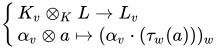
in which is the canonical embedding and The restricted product is taken on both sides with respect to
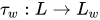


- Corollary. As additive groups where the right side has summands.

![{\displaystyle [L:K]}](https://wikimedia.org/api/rest_v1/media/math/render/svg/aece5b0ecef53af76d4af496d68ed1c41532bb79)
The set of principal adeles in is identified with the set , where the left side has summands and is considered as a subset of


Adeles of vector spaces and algebras
Let be a finite-dimensional vector space over and a basis for over For each place of :
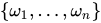

The adele ring of is defined as

This definition is based on the alternative description of the adele ring as a tensor product equipped with the same topology that was defined when giving an alternate definition of the adele ring for number fields. Next, is equipped with the restricted product topology. Then and is embedded in naturally via the map



An alternative definition of the topology on can be provided. Consider all linear maps Using the natural embeddings and extend these linear maps to The topology on is the coarsest topology for which all these extensions are continuous.


The topology can be defined in a different way. Fixing a basis for over results in an isomorphism Therefore fixing a basis induces an isomorphism The left-hand side is supplied with the product topology and this topology is transported with the isomorphism onto the right-hand side. The topology does not depend on the choice of the basis, because another basis defines a second isomorphism. By composing both isomorphisms, a linear homeomorphism which transfers the two topologies into each other is obtained. More formally,

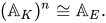

where the sums have summands. In case of the definition above is consistent with the results about the adele ring of a finite extension [17]


Let be a finite-dimensional algebra over In particular, is a finite-dimensional vector space over As a consequence, is defined and Since there is multiplication on and a multiplication on can be defined via





As a consequence, is an algebra with a unit over Let be a finite subset of , containing a basis for over For any finite place , is defined as the -module generated by in For each finite set of places define


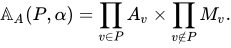
One can show there is a finite set so that is an open subring of , if Furthermore is the union of all these subrings and for , the definition above is consistent with the definition of the adele ring.


Trace and norm
Let be a finite extension. Since and from the lemma above, can be interpreted as a closed subring of For this embedding, write . Explicitly, for all places of above and for any ,




Let be a tower of global fields. Then


Furthermore, restricted to the principal adeles is the natural injection

Let be a basis of the field extension Then each can be written as , where are unique. The map is continuous. Define , depending on , via the equations


Now define the trace and norm of as

These are the trace and the determinant of the linear map

They are continuous maps on the adele ring, and they fulfil the usual equations:

Furthermore, for , and are identical to the trace and norm of the field extension For a tower of fields , the result is


Moreover, it can be proven that:[18]

Discreteness and compactness of the diagonal image
- Theorem.[19] is discrete and cocompact in In particular, is closed in
Proof. Prove the case To show is discrete it is sufficient to show the existence of a neighbourhood of which contains no other rational number. The general case follows via translation. Define


is an open neighbourhood of It is claimed that Let Then and for all , and therefore Additionally, and therefore


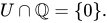


Next, to show compactness, define
![{\displaystyle W:=\left\{(\alpha _{p})_{p}:\forall p<\infty ,\ |\alpha _{p}|_{p}\leq 1\quad {\text{and}}\quad |\alpha _{\infty }|_{\infty }\leq {\frac {1}{2}}\right\}={\widehat {\mathbb {Z} }}\times \left[-{\frac {1}{2}},{\frac {1}{2}}\right].}](https://wikimedia.org/api/rest_v1/media/math/render/svg/cb4327dd2fbbbbd208197960ad411ff222202f64)
Each element in has a representative in , that is, for each , there exists such that Let be arbitrary and be a prime for which Then there exists , with and , such that Replace with and let be another prime. Then





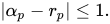


Next, it can be claimed that

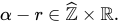
The reverse implication is trivially true. The implication is true because the two terms of the strong triangle inequality are equal if the absolute values of both integers are different. As a consequence, the finite set of primes for which the components of are not in is reduced by one. With iteration, it can be deduced that there exists such that Now select such that Then The continuous projection is surjective, therefore , as the continuous image of a compact set, is compact.


![{\displaystyle \alpha _{\infty }-r-s\in [-{\tfrac {1}{2}},{\tfrac {1}{2}}].}](https://wikimedia.org/api/rest_v1/media/math/render/svg/4e20485c760e6b5995579fa6404207a323b43a74)


- Corollary. Let be a finite-dimensional vector space over Then is discrete and cocompact in

Approximation theorems
- Weak Approximation Theorem.[20] Let be inequivalent valuations of Let be the completion of with respect to Embed diagonally in Then is everywhere dense in In other words, for each and for each , there exists such that






- Strong Approximation Theorem.[21] Let be a place of Define

- Then is dense in

Remark. The global field is discrete in its adele ring. The strong approximation theorem tells us that, if one place or more is omitted, the property of discreteness of is turned into a denseness of
Arithmetic consequences
- Theorem (finiteness of the class number of a number field). Let be a number field. Then

Proof. The map
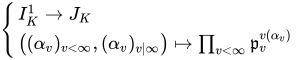
is surjective and therefore is the continuous image of the compact set Thus is compact. In addition, it is discrete and so finite.


Remark. There is a similar result for the case of a global function field. In this case, the so-called divisor group is defined. It can be shown that the quotient of the set of all divisors of degree by the set of the principal divisors is a finite group.[22]
Let be a finite set of places. Define


Then is a subgroup of , containing all elements satisfying for all Since is discrete in , is a discrete subgroup of and, with the same argument, is discrete in



An alternative definition is , where is a subring of defined by


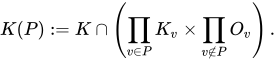
As a consequence, contains all elements which fulfil for all

- Lemma. Let The following set is finite:


Proof. Define

is compact and the set described above is the intersection of with the discrete subgroup in and therefore finite.
- Lemma. Let be set of all such that for all Then , the group of all roots of unity of In particular it is finite and cyclic.


Proof. All roots of unity of have absolute value , so For the converse, note that the preceding lemma with and any implies is finite. Moreover for each finite set of places Finally, suppose there exists which is not a root of unity of Then for all , contradicting the finiteness of


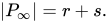
- Unit Theorem. is the direct product of and a group isomorphic to , where if and if [23]


- Dirichlet’s Unit Theorem. Let be a number field. Then

where is the finite cyclic group of all roots of unity of , is the number of real embeddings of , and is the number of conjugate pairs of complex embeddings of It stands that
![{\displaystyle [K:\mathbb {Q} ]=r+2s.}](https://wikimedia.org/api/rest_v1/media/math/render/svg/ab4a6794fb048a2f632ee764850bb88ae743a79e)
Remark. The Unit Theorem generalises Dirichlet’s Unit Theorem. To see this, let be a number field. It is already known that , set and note Then there is


Duality for adelic vector spaces
The self-duality of the adele ring extends to adelic vector spaces.
- Theorem (algebraic and continuous duals of the adele ring).[24] Let be a non-trivial character of , which is trivial on Let be a finite-dimensional vector space over Let and be the algebraic duals of and Denote the topological dual of by and use and to indicate the natural bilinear pairings on and Then the formula


![{\displaystyle [\cdot ,\cdot ]}](https://wikimedia.org/api/rest_v1/media/math/render/svg/28dd4c22d60192519c1c12cf645b040f368db9e9)


![{\displaystyle \langle e,e'\rangle =\chi ([e,e^{\star }])}](https://wikimedia.org/api/rest_v1/media/math/render/svg/1620e9d3a77121cb3bc69d4785927eeeb8f59739)
for all determines an isomorphism of onto , where and Moreover, if fulfils for all , then


![{\displaystyle \chi ([e,e^{\star }])=1}](https://wikimedia.org/api/rest_v1/media/math/render/svg/b2e1af4eb468d2e2427afdf023b1b0efca03c3cd)


References
- ^ a b c d e f g h i j k l m n o p q r Weil 1995, Ch. IV.
- ^ a b c d e Neukirch 1999, Ch. VI, §1.
- ^ a b c d e f g h i Cassels & Fröhlich 1967, Ch. II.
- ^ a b c d e Ramakrishnan & Valenza 1999, Ch. 5.
- ^ a b c d e Tate 1967.
- ^ a b c Ramakrishnan & Valenza 1999.
- ^ Deitmar 2010, p. 126.
- ^ Deitmar 2010, pp. 128–139.
- ^ Deitmar 2010, p. 128.
- ^ Neukirch 1999, Ch. VI.
- ^ Weil 1995, Ch. VII.
- ^ Cassels & Fröhlich 1967.
- ^ a b Bump 1997.
- ^ Deitmar 2010, Chs. 7–8.
- ^ Tate 1968.
- ^ This proof can be found in Cassels & Fröhlich 1967, p. 64.
- ^ The definitions are based on Weil 1967, p. 60.
- ^ See Weil 1967, p. 64 or Cassels & Fröhlich 1967, p. 74.
- ^ See Cassels & Fröhlich 1967, p. 64, Theorem, or Weil 1967, p. 64, Theorem 2.
- ^ A proof can be found in Cassels & Fröhlich 1967, p. 48.
- ^ A proof can be found in Cassels & Fröhlich 1967, p. 67.
- ^ For more information, see Cassels & Fröhlich 1967, p. 71.
- ^ A proof can be found in Weil 1967, p. 78 or in Cassels & Fröhlich 1967, p. 72.
- ^ A proof can be found in Weil 1967, p. 66.
Sources
- Bump, Daniel (1997), Automorphic Forms and Representations, Cambridge Studies in Advanced Mathematics, vol. 55, Cambridge University Press, ISBN 978-0-521-65818-8
- Cassels, John; Fröhlich, Albrecht (1967). Algebraic number theory: proceedings of an instructional conference, organized by the London Mathematical Society, (a NATO Advanced Study Institute). Vol. XVIII. London: Academic Press. ISBN 978-0-12-163251-9. 366 pages.
- Deitmar, Anton (2010). Automorphe Formen (in German). Vol. VIII. Berlin; Heidelberg (u.a.): Springer. ISBN 978-3-642-12389-4. 250 pages.
- Neukirch, Jürgen (1999), Algebraic Number Theory, Grundlehren der mathematischen Wissenschaften, vol. 322, translated by Schappacher, Norbert, Springer, ISBN 978-3-540-65399-8
- Ramakrishnan, Dinakar; Valenza, Robert J. (1999), Fourier Analysis on Number Fields, Graduate Texts in Mathematics, vol. 186, Springer, ISBN 978-0-387-98436-0
- Tate, John (1967), “Fourier analysis in number fields, and Hecke’s zeta-functions”, in Cassels, J. W. S.; Fröhlich, Albrecht (eds.), Algebraic Number Theory, London: Academic Press, pp. 305–347
- Tate, John (1968), “Residues of differentials on curves”, Annales scientifiques de l’École Normale Supérieure, 4, 1 (1): 149–159, doi:10.24033/asens.1162, Zbl 0159.22702
- Weil, André (1967). Basic number theory. Vol. XVIII. Berlin; Heidelberg; New York: Springer. ISBN 978-3-662-00048-9. 294 pages.
- Weil, André (1995), Basic Number Theory, Classics in Mathematics, Springer, ISBN 978-3-540-58655-5