In mathematics, a derivation is a function on an algebra that generalizes certain features of the derivative operator. Specifically, given an algebra over a ring or a field , a -derivation is a –linear map that satisfies Leibniz’s law:



More generally, if is an –bimodule, a -linear map that satisfies the Leibniz law is also called a derivation. The collection of all -derivations of to itself is denoted by . The collection of -derivations of into an -module is denoted by .


Derivations occur in many different contexts in diverse areas of mathematics. The partial derivative with respect to a variable is an -derivation on the algebra of real-valued differentiable functions on . The Lie derivative with respect to a vector field is an -derivation on the algebra of differentiable functions on a differentiable manifold; more generally it is a derivation on the tensor algebra of a manifold. It follows that the adjoint representation of a Lie algebra is a derivation on that algebra. The Pincherle derivative is an example of a derivation in abstract algebra. If the algebra is noncommutative, then the commutator with respect to an element of the algebra defines a linear endomorphism of to itself, which is a derivation over . That is,


![{\displaystyle [FG,N]=[F,N]G+F[G,N]\,,}](https://wikimedia.org/api/rest_v1/media/math/render/svg/836ced4d428fe3cf3a62a476cc76b476bdeea1cc)
where is the commutator with respect to . An algebra equipped with a distinguished derivation forms a differential algebra, and is itself a significant object of study in areas such as differential Galois theory.
![{\displaystyle [\cdot ,N]}](https://wikimedia.org/api/rest_v1/media/math/render/svg/d61055f1a5b4d930c261dd9b052d756ed1f8ab21)


Properties
If is a -algebra, for a ring, and D: → is a -derivation, then
- If has a unit 1, then , so that . Thus by -linearity, for all .
- If is commutative, then , and , by the Leibniz rule.
- More generally, for any , it follows by induction that



- which is if for all , commutes with .



- For , is not a derivation, instead satisfying a higher-order Leibniz rule:


- Moreover, if is an -bimodule, write
- for the set of -derivations from to .

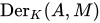
- is a module over .
- is a Lie algebra with Lie bracket defined by the commutator:
- since it is readily verified that the commutator of two derivations is again a derivation.
![{\displaystyle [D_{1},D_{2}]=D_{1}\circ D_{2}-D_{2}\circ D_{1}.}](https://wikimedia.org/api/rest_v1/media/math/render/svg/9196a962e980d7f5237277994ccc82fe82b3c205)
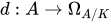
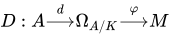
- There is an -module (called the Kähler differentials) with a -derivation through which any derivation factors. That is, for any derivation ‘ there is a -module map with



- The correspondence is an isomorphism of -modules:


- If is a subring, then inherits a -algebra structure, so there is an inclusion


- since any -derivation is a fortiori a -derivation.

Graded derivations
Given a graded algebra and a homogeneous linear map of grade on , is a homogeneous derivation if


for every homogeneous element and every element of for a commutator factor . A graded derivation is sum of homogeneous derivations with the same .


If , this definition reduces to the usual case. If , however, then


for odd , and is called an anti-derivation.
Examples of anti-derivations include the exterior derivative and the interior product acting on differential forms.
Graded derivations of superalgebras (i.e., -graded algebras) are often called superderivations.

Related notions
Hasse–Schmidt derivations are -algebra homomorphisms
![{\displaystyle A\to A[[t]].}](https://wikimedia.org/api/rest_v1/media/math/render/svg/21d5019fc824697626911b9b24eff8d080bc8fe9)
Composing further with the map that sends a formal power series to the coefficient gives a derivation.


See also
- In differential geometry derivations are tangent vectors
- Kähler differential
- Hasse derivative
- p-derivation
- Wirtinger derivatives
- Derivative of the exponential map
References
- Bourbaki, Nicolas (1989), Algebra I, Elements of mathematics, Springer-Verlag, ISBN 3-540-64243-9.
- Eisenbud, David (1999), Commutative algebra with a view toward algebraic geometry (3rd. ed.), Springer-Verlag, ISBN 978-0-387-94269-8.
- Matsumura, Hideyuki (1970), Commutative algebra, Mathematics lecture note series, W. A. Benjamin, ISBN 978-0-8053-7025-6.
- Kolař, Ivan; Slovák, Jan; Michor, Peter W. (1993), Natural operations in differential geometry, Springer-Verlag.