Bonchon International Inc., operating under the name Bonchon Chicken (Korean: 본촌치킨; Hanja: 本村치킨; pronounced [pɔntɕʰɔn], which means “my hometown”), is an international fast food chain that specializes in Korean fried chicken.[1][2][3] The company was founded in 2002 by Jinduk Seo in Busan, South Korea, and currently has its headquarters in Dallas, Texas. Bonchon is considered to be one of the biggest Asian restaurant chains by revenue in the United States.[4][5][6] The chain is credited as the first Korean fried chicken brand to expand internationally, bringing a broader wave of Korean food chains to global markets.
The brand is primarily known for its double-frying process and own-recipe sauces.[6] These sauces are manufactured centrally at the South Korean facilities to maintain consistency across all franchises worldwide.[6] To overcome competition within their home country, Bonchon stopped its South Korean restaurant activities in 2016 and switched to a pure export-oriented franchise.[6] At present, there are around 500 restaurants located in over 10 different countries and regions.[7][8] Among the most significant markets, there are the US, the Philippines, and Thailand.[7][8]
The company has been majority owned by South Korea-based private equity firm VIG Partners since December 2018.[6] Since then, the brand moved its global headquarters from South Korea to the US, launched new fast-casual dining formats, and put the business up for auction in 2026.[3][9] In its journey of expanding globally, the chain has at times come under public criticism on premium pricing and labor issues. [10][11]
History
Origins and Concept
The Bonchon Chicken restaurant began in 2002 in Busan, South Korea.[12] Jinduk Seo is the founder of Bonchon Chicken.[13] The name “Bonchon” translates to “my hometown” in Korean.[6] The brand’s initial development focused on the South Korean chimaek (fried chicken paired with beer) market, utilizing a specific double-frying method designed to reduce fat and produce a thin crust.[6][14] The company also standardized two flagship sauces—soy garlic and spicy—made with regional Korean ingredients.[6]
Market Expansion
Due to domestic market saturation, the company transitioned to an international franchise model. The first location in the U.S. was in Fort Lee, New Jersey.[12][6] It later spread to California, New York, Connecticut, Illinois, Pennsylvania, Maryland, Massachusetts, Minnesota, New Jersey, Virginia, North Carolina, Florida, Texas, Delaware, and Washington state.[15][16][17] The Korean fried chicken franchise currently operates in 21 states in the U.S. and over 10 countries internationally.[7][8] In the Southeast Asian market, the company utilized master franchise partnerships, beginning with the Scotland Food Group to establish fast-casual locations in the Philippines in 2010.[7][8] Similar expansion models were applied in Thailand, Cambodia, and Vietnam.[7][18]
Corporate Restructuring and Ownership
In December 2018, the South Korean private equity fund VIG Partners acquired a majority 55 percent stake in the company for 60 billion won, while the founding family retained the remaining 45 percent.[6][9] In October of 2020, South Korean native Jaehong (Jae) Park joined Bonchon as executive chef. Since then, Park has moved into the International R&D Chef position, responsible for recipe innovation.[19] In 2021, Bonchon moved its global headquarters to Dallas, Texas.[19][3] The company’s operational models eventually diversified to include fast-casual restaurants and ghost kitchens.[3] In March 2026, VIG Partners engaged the investment banking firm William Blair to initiate a formal auction process for the brand’s sale.[9] The auction drew over 100 potential buyers from the United States and Asia, with market analysts valuing the enterprise at 3,000 billion won.[9] Concurrent with the auction process, new retail locations were developed in markets including Puerto Rico and San Antonio.[9]
Operations
Bonchon operates an approximate total of 500 stores in over ten different nations and territories.[7][8] The United States is the company’s primary market, generating more than 60 percent of its worldwide revenue, with more than 150 stores spread out in major cities such as New York, Los Angeles, Chicago, and Dallas.[6][8] In the plan for its future geographical development, Bonchon plans on opening up new stores in Puerto Rico by 2026.[6] To fully concentrate on expanding internationally and avoid oversaturation in its own home market, Bonchon stopped all retailing in South Korea by the end of 2016.[9]
Southeast Asia Master Franchise Locations
Apart from the US, Bonchon has expanded outside its borders mainly due to franchising deals.[6] For instance, in the Philippines, the chain entered the market in 2010 through a master deal with Scotland Food Group, resulting in 180 franchise restaurants based on the localized family-oriented fast-casual concept.[7][8] In Thailand, the operations are run by Minor International and operates over 110 Bonchon locations, relying on digital delivery systems.[20][18]
Bonchon uses a number of architectural and operational formats for its restaurant stores depending on the real estate market conditions.[6][3] While older restaurants used a fine-casual sit-down concept with a bar in their premises, new franchises use a fast-casual concept featuring smaller menu selection, counter service, and a reduced property footprint.[3] As part of efforts to diversify the format, in 2023, Bonchon started to introduce alternative store types such as ghost kitchens and locations at hotels and airports.[18][3]
Locations
As of recent company data, Bonchon operates globally across North America, Asia, the Middle East, Oceania, and Europe. Its densest markets are currently the Philippines, the United States, and Thailand.[7][8]
North America
- United States: 150 stores[21]
Asia
- Philippines: 180 stores[22]
- Thailand: 110+ stores[23]
- Cambodia: 12 stores[24]
- Myanmar: 7 stores[25]
- Vietnam: 24 stores[26]
- Singapore: 6 stores[27]
- Taiwan: 7 stores [28]
- Laos: 2 stores[29]
- South Korea: 1 sauce manufacturing facility[30]
Middle East
Oceania
- Australia: 2 stores[33]
Europe
- France: 2 stores[34]
Corporate Affairs
Leadership
As a subsidiary of VIG Partners, which holds the majority share of the firm, Bonchon has its two main headquarters in Seoul, South Korea, and Dallas, Texas.[6][3] The international business strategy of the company is under the leadership of Bryan Shin, who acts as both the International Chief Executive Officer (CEO) and Group Chief Financial Officer (CFO).[35] Early in 2024, Suzie Tsai took charge as the CEO of the U.S. division of the firm.[35]
Supply Chain
While Bonchon has ceased operating its retail stores in South Korea since 2016, it still sources its supply chains from the nation in order to safeguard its intellectual property and maintain brand consistency globally.[6] All proprietary sauces, such as Soy Garlic, Spicy, and Yangnyeom, are manufactured by the company in South Korea and subsequently distributed to its global franchise partners.[6]
Corporate Social Responsibility
Bonchon participates in several philanthropic activities within the hospitality industry, notably through its support of the National Restaurant Association Educational Foundation (NRAEF).[36] Through this partnership, the firm collaborates with the ProStart initiative that educates high school students in vocational training programs.[36] Bonchon also partners with the Restaurant Ready program, which is meant to provide skill training opportunities for opportunity youth and justice-involved individuals. Bonchon also offers career opportunities in the food service industry to former military veterans.[36]
Products
Cooking Methods and Sauces
The cooking methods used by Bonchon involve its own recipe that requires cooking the chicken in two steps.[6] In the first step, the chicken is cooked until the fat from the skin is cooked off and the moisture is maintained within the meat. It is then allowed to rest before being cooked a second time.[6] Through this dehydration process, a thin and crispy shell forms around the chicken, forming a protective layer to prevent moisture from entering.[6] After frying, the chicken is manually brushed with sauce rather than tossed in containers; this process is intended to distribute the seasoning evenly without compromising the texture.[6] The two original sauces offered at Bonchon include Soy Garlic, which uses Daseo-jong garlic, and Spicy, which involves using dried Gochugaru chili pepper.[6]
Regional Diversity of Menu Offerings
In addition to its core fried chicken, a portion of the usual menu offerings in Bonchon is composed of common Korean comfort food, such as bibimbap, japchae (stir-fried Korean glass noodles), and bulgogi.[6] Other menu items available in Bonchon are Korean fusion foods, which consist of bulgogi fries, Korean tacos, bao buns, and the MoPo Corn Dog (mozzarella sticks encased in a potato batter).[3]
The master franchisee for the international market has been permitted to make alterations to the menu offerings according to regional preferences to cater to customers seeking a full meal.[7] Examples of menu offerings available in the Philippines include the Creamy Rose Tteokbokki, Sizzling Bibimbowl, and Cafe Koreano (coffee and snow ice).[7] Similarly, Thai locations operated by Minor Food Group have adapted their offerings by introducing single-serving meal sizes alongside regional dishes like spicy seafood soup.[18][20]
Menu Highlights
Bonchon serves Korean food favorites, and orders can be placed in restaurant, online at Bonchon.com, through the Bonchon app, or third-party delivery services. Menu highlights include:
- Korean Fried Chicken – Wings, Drumsticks, Strips, and a Chicken Sandwich with signature sauces of Soy Garlic, Spicy, Korean BBQ, and Yangnyeom.
- Korean Dishes – Bibimbap, Japchae, Tteokbokki, Bulgogi, and more.
- Side Dishes – Kimchi, Pickled Radish, Coleslaw, Korean Street Corn, and more.
- Korean Donuts – Traditional soft and fluffy Korean donuts coated with cinnamon and sugar on the outside, served with a sweet cream dipping sauce.
-
 Bonchon Chicken in Thailand
 -
 Kimchi pork rice from Bonchon Chicken
 -
 Deep-fried squid from Bonchon Chicken
 -
 Tteokbokki from Bonchon Chicken
 -
 Assorted fried appetizers from Bonchon Chicken


-
 Bonchon Chicken in New York City
 -
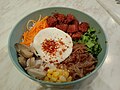 Bibimbap from Bonchon Chicken


Advertising
Bonchon Marketing Campaigns and Brand Ambassadors
Bonchon’s marketing campaigns frequently emphasize the brand’s South Korean origins.[6] The marketing strategy of Bonchon includes multimedia campaigns like “Crunch Out Loud,” which utilizes ASMR-style audio formats to highlight the audible texture of its fried chicken.[3] In Asian markets, Bonchon relies on its own brand ambassadors to target the younger generation of consumers, especially the Generation Z group.[18] For instance, in Thailand, the brand’s master franchisee, Minor Food Group, engaged Thai actor and singer Vachirawit Chivaree as its first-ever brand ambassador to increase youth market penetration.[18]
Brand Perception
An empirical study conducted by sociologists at Chulalongkorn University in 2022 regarding Generation Z consumers in Thailand revealed that although the target audience held positive perceptions about Bonchon as comfort food, they did not relate the brand with broader Korean pop culture (K-pop).[20] According to the research, past advertising efforts had emphasized the product quality more than the lifestyle aspects of the brand.[20]
Digital Platforms
The brand has been incorporating advanced technological tools in its marketing strategy to help in promoting the e-commerce business, which contributes to more than fifty percent of the firm’s income from the leading markets.[3] Bonchon uses mobile apps and social media sites such as Facebook to communicate promotions, menu updates, and facilitate quick ordering.[3][18] The company also runs a membership club named ‘Crunch Club.’[3]
Controversies and Criticism
Disputes Related to Pricing
Bonchon in South Korea, as well as the fried chicken industry in general, has come under public and government criticism for practicing shrinkflation by reducing the size of products while simultaneously increasing their prices.[11] In light of the negative public perception, it was stipulated that all South Korean chicken restaurants must inform customers of the pre-cooking weight of their chicken.[11] Because of high prices, the product has been subjected to claims from consumers about its serving sizes.[11] Moreover, in 2024, the Thai branch of Bonchon removed a 10% mandatory service charge after facing consumer complaints.[37]
Labor Disputes
There have been cases involving the company’s employees. Specifically, employees at the Dinkytown branch of Bonchon, located near the University of Minnesota in Minneapolis, claimed that the employer was stealing their wages by unlawfully re-appropriating their tips to kitchen workers.[10][38] This dispute led the Restaurant Opportunities Center of Minnesota to get involved.[10][38] In October 2019, Bonchon paid more than $10,000 in back wages, tips, and damages to the former workers following a settlement with the Minneapolis Labor Standards Enforcement Division.[10]
See also
References
- ^ Moskin, Julia (February 7, 2007). “Koreans Share Their Secret for Chicken With a Crunch”. The New York Times.
- ^ Gubbins, Teresa (January 23, 2015). “Bonchon Chicken Dallas gives Greenville Avenue the bird”. CultureMap Dallas. Retrieved March 22, 2015.
- ^ a b c d e f g h i j k l m “Bonchon Relocates Global Headquarters to Dallas, Texas and Introduces New Fast-casual Restaurant Model” (Press release).
- ^ “Leading Asian restaurant chains in the United States in 2021, by systemwide sales”. Statista. Hamburg, Germany: Ströer.
- ^ “The largest Asian chains in the U.S.” Restaurant Business. Washington D.C., USA: National Restaurant Association. May 13, 2020.
- ^ a b c d e f g h i j k l m n o p q r s t u v w x Stern, Gary. “Fast-Growing Korean Fried Chicken Chain Bonchon Is Gaining On KFC”. Forbes. Retrieved April 22, 2026.
- ^ a b c d e f g h i j “Korean food chains expand rapidly overseas”. 동아일보. Retrieved April 22, 2026.
- ^ a b c d e f g h Kyung-min, No (February 5, 2026). “US tops overseas markets for Korean food chains: data”. The Korea Herald. Retrieved April 22, 2026.
- ^ a b c d e f Hwang, Hyouyi (March 19, 2026). “VIG Sees Strong Early Interest in Bonchon Chicken Sale”.
- ^ a b c d Gomez, Filiberto Nolasco (October 23, 2019). “Former Bonchon Workers and Allies Say “When we fight, we win!”“. Workday Magazine. Retrieved April 22, 2026.
- ^ a b c d Alphabiz (January 2, 2026). “South Korea Introduces Pre-Cooking Weight Disclosure Rule for Fried Chicken to Curb ‘Shrinkflation’“. alphabiz.co.kr (in Korean). Retrieved April 22, 2026.
- ^ a b “Press Kit 2017” (PDF). BonChon Chicken. p. 2. Archived from the original (PDF) on October 26, 2018. Retrieved October 26, 2018.
- ^ “Bonchon names Bryan Shin its U.S. CEO”. Restaurant Business. Retrieved July 29, 2023.
- ^ Nancheva, Nevena (October 9, 2024). “First-generation Korean food entrepreneurship: strategies of living with (ethnic) difference in the city”. www.tandfonline.com. doi:10.1080/01419870.2024.2405656. Retrieved April 22, 2026.
- ^ “BonChon Chicken to Open at Greenville and Lovers Lane in Dallas”. Retrieved February 19, 2018.
- ^ “Bonchon Korean Fried Chicken restaurant opens in Newark”. Retrieved July 12, 2022.
- ^ “Bonchon Keeps Growing in Virginia”. QSR magazine. November 23, 2022.
- ^ a b c d e f g “Bonchon sharpens 5 strategies to win consumers’ hearts in 2023”. www.minorfood.com. Retrieved April 22, 2026.
- ^ a b “The Bonchon Story and Mission”. Bonchon. Retrieved March 25, 2026.
- ^ a b c d Jirattikorn, Aditep (January 1, 2022). “Thailand generation Z consumers’ brand perception of Bonchon restaurantin Thailand”. Chulalongkorn University Theses and Dissertations (Chula ETD). doi:10.58837/CHULA.IS.2022.47.
- ^ Coley, Ben (March 4, 2025). “Bonchon Opens 150th U.S. Store”. QSR Magazine. Retrieved July 8, 2025.
- ^ “Locations”. BonChon Chicken Philippines. Archived from the original on November 25, 2022. Retrieved November 25, 2022.
- ^ “Bonchon Thailand”. www.bonchonthailand.com. Retrieved July 29, 2023.
- ^ “Bonchon Cambodia :: The Original Korean Fried Chicken Secret”. Bonchon. Retrieved July 29, 2023.
- ^ “Restaurants Directory – MYANMORE YANGON”. MYANMORE. Retrieved July 29, 2023.
- ^ “BONCHON VIỆT NAM Trang chủ”. bonchon.com.vn. Retrieved July 29, 2023.
- ^ “Bonchon”. Bonchon Singapore. Archived from the original on December 1, 2020. Retrieved December 2, 2020.
- ^ “Central – Bonchon Chicken 本村韓食炸雞”. April 26, 2024. Retrieved April 22, 2026.
- ^ “BONCHON CONTINUES MOMENTUM ANNOUNCING STRONG FIRST QUARTER”. Bonchon Chicken. April 17, 2024.
- ^ “BonChon at Promenade Bolingbrook”. Promenade Bolingbrook. Retrieved July 29, 2023.
- ^ “Bonchon delivery service in Kuwait | Talabat”. www.talabat.com. Retrieved April 22, 2026.
- ^ “Bonchon delivery service in Bahrain | Talabat”. www.talabat.com. Retrieved April 22, 2026.
- ^ “Bonchon Australia”. Bonchon Australia. Archived from the original on October 26, 2022. Retrieved October 29, 2022.
- ^ “Welcome to Bonchon”. Bonchon France. Retrieved July 29, 2023.
- ^ a b Ruggless, Ron (January 17, 2024). “Bonchon names Suzie Tsai as U.S. CEO”. NRN.
- ^ a b c Bonchon. “Bonchon Launches ‘Hearts & Soles’ Campaign In Support Of Restaurant Industry Employees Impacted By COVID-19”. www.prnewswire.com. Retrieved April 22, 2026.
- ^ “…” moneyandbanking.co.th. Retrieved April 22, 2026.
- ^ a b snoadmin; Sheehy, Brooke (October 24, 2019). “Ex-Bonchon workers celebrate settlement over alleged wage theft in Dinkytown”. The Minnesota Daily. Retrieved April 22, 2026.