

Brown hair, also referred to as brunette (when female), is the second-most common human hair color, after black hair. It varies from light to dark brown. It is characterized by moderate levels of the dark pigment eumelanin and no levels of the pale pigment pheomelanin.
Brown hair is common among populations in the Western world, especially among those from Northwestern Europe and the United States, as well as populations in Central Europe, Southeastern Europe, Eastern Europe, Southern Europe, Southern Cone, Brazil, Colombia, Costa Rica, Puerto Rico, and also some populations in the Middle East, Central Asia, Afghanistan and South Asia where it transitions smoothly into black hair.[1][2] Additionally, brown hair is common among Australian Aboriginals, East Asians and Melanesians.[3]
Etymology and grammar
The term brunette is the feminine form of the French word brunet, which is a diminutive form of brun meaning “brown/brown-haired”, the feminine of which is brune. All of these terms ultimately derive from the Proto-Indo-European root *bhrūn- “brown, grey”. The form “brun” (pronounced /bruːn/) is still commonly used in Scotland, particularly in rural areas, and is also the word for “brown” in the Scandinavian languages. In modern English usage, however, it has lost the diminutive meaning and usually refers to any brown-haired girl or woman, or the associated hair color. Merriam-Webster defines “brunet” as “a person having brown hair”—with which they may have “a relatively dark complexion—spelled brunet when used of a boy or man and usually brunette when used of a girl or woman”.[4] Although brunet is the masculine version of the popular diminutive form used to describe a little boy or young man with brown hair, the use of “brunet” is uncommon in English. One is more likely to say about a man or boy, “He has brown hair” or “He is brown-haired” than to say, “He is a brunette” (or brunet).
Lighter or darker shades of brown hair may be referred to as “light brunette” or “dark brunette”, though in such cases one is generally referring only to the hair color, not using the term as a descriptor for the person; one would be unlikely to say, “She is a light brunette.” Rather, one would say, “She has light-brown hair.”
Geographical distribution and ethnic groups
Europe
Brown-haired individuals predominate in most parts of Europe. In northern and central Europe medium to light brown shades are the most common, while darker shades prevail in the rest of the continent. Brown hair, mostly medium to light brown shades, are also dominant in Australia, Canada, South Africa among White South Africans and the United States among European Americans (from Northern, Central and Eastern Europe), British, Irish, Baltic, Dutch/Flemish, German (including Swiss-German and Austrian), Slovenian, Polish, Ukrainian and Russian people, as well as Southern (Italian, Spanish, Greek, Portuguese) and Southeastern Europe (Bulgarian, Croatian, Serbian).[1]
In Spain, 57% are brown (7% of Spaniards are naturally blonde, 26% brunette, 3% redhead and the remaining 10% dark and light brown).[5]
Dark brown hair is common throughout Europe.[6]
North Africa
Brown hair is common in North Africa (such as Morocco, Algeria, Tunisia), ranging from light to dark brown, with dark brown being the most prevalent.
Oceania
Similarly to blond hair, brown hair occurs commonly among Australian Aboriginal and Melanesian populations.[3]
America
Brown hair is also found among people in the Americas, including in the Southern Cone of South America (Chile, Argentina, Uruguay, Paraguay, central-southern Brazil), Colombia, the Andean Region of Venezuela, the Costa Rican Central Valley, and the Puerto Rico.[2][7][8]
A study of 1,023 students in Chile found that the most common eye color was brown-black: 71 to 89.4% and the most common hair color was brown from 65.8% to 66.8%.[9]
Dark brown hair also be found among Indigenous Americans
Asia
Middle East

Brown hair in the Middle East is typically medium to dark brown, though light brown can also be seen.
-
 Brown-haired Israeli childrens
 -
 Brown-haired Israelis
 -
 Dima Ghawi‘s dark brown hair
 -
 Brown-haired Middle Eastern boy


Central Asia

Brown hair is also found in Central Asia, typically medium to dark brown.
-
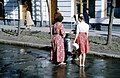 Brown-haired Central Asian womens
 -
 Central Asian people
 -
 Brown-haired Central Asian toddler being held
 -
 Brown-haired Central Asian women
 -
 Brown-haired Central Asian boy


East Asia


The natural hair color of East Asians is mostly brown to black.[10] Regarding natural brown hair, dark brown is the most common, sometimes mistaken for black. Medium brown hair is also quite frequent, and while light brown hair is less common than medium and dark brown, it’s still present to some extent, not rare. Even hair that appears visually black can reveal its color when exposed to light if it contains natural reddish-brown pigment (pheomelanin).[11] Like Europeans, East Asians’ hair color gradually darkens with age, which is why there are more young people with brown hair.[12]
-
 Brown-haired Korean girl and boy
 -
 Brown-haired Chinese girl
 -
 Brown-haired girl from China
 -
 Baby with light brown hair from China
 -
 Two brown-haired Chinese high school students
 -
 A brown-haired Chinese woman
 -
 A brown-haired woman from China
 -
 Four brown-haired Chinese students
 -
 Brown-haired Chinese primary school student
 -
 Brown-haired Chinese women


Southeast Asia
Brown hair is more common in most parts of Southeast Asia (such as the Philippines, Malaysia, and Vietnam) due to pigmentation changes, especially among young people and other groups.
South Asia
Brown hair in South Asia is typically dark brown, and some may be mistaken for black hair.
Biochemistry
The pigment eumelanin gives brown hair its distinctive color. Brown hair has more eumelanin than blond hair but also has far less than black. There are two different types of eumelanin, which are distinguished from each other by their pattern of polymer bonds. The two types are black eumelanin and brown eumelanin. Black eumelanin is the darkest; brown eumelanin is much lighter than black. A small amount of black eumelanin in the absence of other pigments causes grey hair. A small amount of brown eumelanin without any other pigments causes yellow (blond) color hair. Often, natural blond or red hair will darken to a brown color over time. Brown-haired people have medium-thick strands of hair.
Brown-haired people are thought to produce more skin-protecting eumelanin and are associated with having a more even skin tone. The range of skin colors associated with brown hair is vast, ranging from the palest of skin tones to a dark olive complexion.
Varieties of brown hair
Brown hair comes in a wide variety of shades from the very darkest of brown (almost black) to lightest brown (almost blond) showing small signs of blondism.[13] Shades of brown hair include:
- deepest brunette: the darkest brown, which can be a very dark chocolate; sometimes appears to be off-black at a distance, and is often considered to be black.[14] Sometimes the term “dark brown” includes the darkest shade of brown.
- dark brown
- milk chocolate brown
- dark chestnut brown
- light chestnut brown
- medium brown: standard brunette, comparable to Russet brown
- walnut brown: a warmer variant of medium brown, comparable to a light chestnut
- caramel brown: warm brown tone.
- light golden brown : the lightest brown, almost dirty blond
- mousy: a dull light brown color, sometimes seen as a dirty blond
- light ash brown: almost blond hair
- auburn brown: reddish-brown hair
- lightest brown: light brown that goes mid blonde in the sun
- maple brown: a dark golden brown color, like maple syrup
-
 deepest brown
(Eoin Macken) -
 dark brown
(Eddie Van Halen) -
 dark chestnut brown
(Brian May) -
 medium brown
(Antje Kapek) -
 light brown
(Italian girl) -

-
 light ash brown
(Guido Westerwelle)


Culture
Cultural connotations
In Western popular culture, a common stereotype is that brunettes are stable, serious, smart and sophisticated. According to Allure magazine, in 2005, 76 percent of American women believed that the first female president of the United States will have brown hair.[15]
Modern fiction
Anita Loos, the author of the novel and play Gentlemen Prefer Blondes, wrote a sequel entitled But Gentlemen Marry Brunettes. A film of this was made, Gentlemen Marry Brunettes, starring Jane Russell and Jeanne Crain.
Art and fiction
The Lady of Shalott from Alfred, Lord Tennyson‘s poem is depicted as a brunette in most paintings. The woman portrayed in Leonardo da Vinci‘s most well-known painting, Mona Lisa, is brunette. In the French folk song “Au clair de la lune“, the likable Lubin visits his brunette neighbor at Pierrot’s suggestion. In the Irish song “The Star of the County Down” the narrator falls in love with a woman with “nut-brown” hair, called Rose McCann.
Rivalry with blondes
In popular culture, brunettes are sometimes portrayed as being in a rivalry or competition with blonde women.[16]
See also
References
- ^ a b Frost, Peter. “Why Do Europeans Have So Many Hair and Eye Colors?” (summarizing Frost, P. 2006. European hair and eye color – A case of frequency-dependent sexual selection? Evolution and Human Behavior 27:85-103)
- ^ a b Ruiz-Linares, Andrés; Adhikari, Kaustubh; Acuña-Alonzo, Victor; Quinto-Sanchez, Mirsha; Jaramillo, Claudia; Arias, William; Fuentes, Macarena; Pizarro, María; Everardo, Paola; Avila, Francisco de; Gómez-Valdés, Jorge (25 September 2014). “Admixture in Latin America: Geographic Structure, Phenotypic Diversity and Self-Perception of Ancestry Based on 7,342 Individuals”. PLOS Genetics. 10 (9) e1004572. Bibcode:2014PLOSG..10.4572R. doi:10.1371/journal.pgen.1004572. ISSN 1553-7404. PMC 4177621. PMID 25254375.
- ^ a b “Modern Human Variation”. Overview. Archived from the original on 5 November 2012. Retrieved 16 December 2012.
- ^ “Brunet”. Merriam-Webster Dictionary. Merriam-Webster. Retrieved 25 October 2012.
- ^ “ELMUNDO.ES | SUPLEMENTOS | MAGAZINE 183 | Después de 3.000 años la tentación sigue siendo rubia”. www.elmundo.es. Retrieved 28 March 2024.
- ^ Ohnemus, Alexander. (2025). Correcting “unmixed europeans don’t have dark brown eyes and black hair.
- ^ Mooney, Jazlyn A.; Huber, Christian D.; Service, Susan; Sul, Jae Hoon; Marsden, Clare D.; Zhang, Zhongyang; Sabatti, Chiara; Ruiz-Linares, Andrés; Bedoya, Gabriel; Freimer, Nelson; Lohmueller, Kirk E. (1 November 2018). “Understanding the Hidden Complexity of Latin American Population Isolates”. American Journal of Human Genetics. 103 (5): 707–726. doi:10.1016/j.ajhg.2018.09.013. ISSN 0002-9297. PMC 6218714. PMID 30401458.
- ^ Homburger, Julian R.; Moreno-Estrada, Andrés; Gignoux, Christopher R.; Nelson, Dominic; Sanchez, Elena; Ortiz-Tello, Patricia; Pons-Estel, Bernardo A.; Acevedo-Vasquez, Eduardo; Miranda, Pedro; Langefeld, Carl D.; Gravel, Simon (4 December 2015). “Genomic Insights into the Ancestry and Demographic History of South America”. PLOS Genetics. 11 (12) e1005602. doi:10.1371/journal.pgen.1005602. ISSN 1553-7390. PMC 4670080. PMID 26636962.
- ^ Zemelman, Viviana; von Beck, Petra; Alvarado, Orlando; Valenzuela, Carlos Y (August 2002). “Dimorfismo sexual en la pigmentación de la piel, color de ojos y pelo y presencia de pecas en adolescentes chilenos en dos estratos socioeconómicos”. Revista médica de Chile. 130 (8). doi:10.4067/S0034-98872002000800006. ISSN 0034-9887.
- ^ Melvin. “ASIAN HAIR.COLORING FOR A NATURAL LOOK”. MELVIN’S HAIR DO. Retrieved 15 April 2026.
- ^ Leerunyakul K, Suchonwanit P. Asian Hair: A Review of Structures, Properties, and Distinctive Disorders. Clin Cosmet Investig Dermatol. 2020 Apr 24;13:309-318. doi: 10.2147/CCID.S247390. PMID: 32425573; PMCID: PMC7187942.
- ^ Itou T, Ito S, Wakamatsu K. Effects of Aging on Hair Color, Melanosome Morphology, and Melanin Composition in Japanese Females. Int J Mol Sci. 2019 Jul 31;20(15):3739. doi: 10.3390/ijms20153739. PMID: 31370161; PMCID: PMC6696507.
- ^ “The Best Brown Hair Colors Today”. LadyInfo.com. 22 September 2011. Archived from the original on 4 August 2012. Retrieved 25 October 2012.
- ^ McAfee, Clare. “Hair Color Chart”. wiggoddess.com. Archived from the original on 15 August 2012. Retrieved 25 October 2012.
- ^ Milk, Leslie (1 August 2005). “Great Hair: Coloring”. The Washingtonian. Retrieved 25 October 2012.
- ^ Cummings, Tucker (16 November 2011). “Blondes vs. Brunettes: TV Shows with Betty and Veronica-Style Love Triangles”. Yahoo! TV. Retrieved 25 October 2012.
External links
 Media related to Brown hair at Wikimedia Commons
