A button knot is a knot that forms a bulge of thread. Button knots are essentially stopper knots, but may be aesthetically pleasing enough to be used as a button on clothes.
The single-strand button is a third type of knob knot, in which the working end leaves the knot at the neck, parallel with the standing part, so that the two parts, or ends, together form a stem. The lay of the two ends is the same, and the knot is symmetrical throughout. — The Ashley Book of Knots[1]
There are many methods for tying button knots, such as the Chinese button knot, the Celtic button knot and the monkey fist. The Ashley Book of Knots contains over a hundred examples.
-
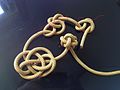 Celtic button knot single, with 4 steps of tying it
 -
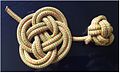 Celtic button knot double, flat and tightened forms
 -
 Celtic button knot formed on the bight, untightened – flat
 -
 Celtic button knot formed on the bight, tightened
 -
 Chinese button knot front side
 -
 Chinese button knot back side
 -
 Rose knot on 2 ropes step1 wall
 -
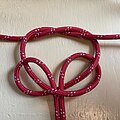 Rose knot on 2 ropes step2 crown
 -
 Rose knot on 2 ropes step3
 -
 Rose knot on 2 ropes step4 second wall
 -
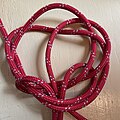 Rose knot on 2 ropes step5
 -
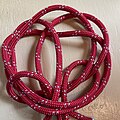 Rose knot on 2 ropes step6 second crown and tucked ends
 -
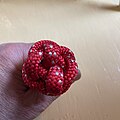 Rose knot on 2 ropes top view
 -
 Rose knot on 2 ropes side view
 -
 Rose knot on 2 ropes back view, animated tying
 -
 Rose knot on 4 ropes
 -
 tying of Rose knot on 4 ropes
 -
 Pairs of monkey’s fists formed as cufflinks in silk
 -
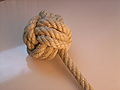 a larger monkey’s fist formed with a thicker rope
 -
 a heavy monkey’s fist for throwing with an eye splice


References
- ^ Ashley, Clifford W. (1993) [1944]. The Ashley Book of Knots. New York: Doubleday. p. 101. ISBN 0-385-04025-3.


