Convolvulus is a genus of about 200[1] to 250[2][3] species of flowering plants in the bindweed family Convolvulaceae,[4] with a cosmopolitan distribution; the Plants of the World Online database currently accepts 227 species and 12 natural hybrids.[5] Common names include bindweed and morning glory; both are names shared with other closely related genera.
Taxonomy
The genus Calystegia, until recently widely accepted, has been shown to be genetically embedded within Convolvulus,[6] and is now treated as a synonym of it by the Plants of the World Online database.[5]
Description
They are annual or perennial herbaceous vines; a few species are woody shrubs. They grow to heights of 0.3–4 m scrambling through ground vegetation, shrubs and trees; the shrubby species (e.g. C. cneorum) growing to 0.5 m tall with a woody base. The leaves are spirally arranged, and the flowers trumpet-shaped, mostly white or pink, but blue, violet, purple, or yellow in some species.[7]
Ecology

Many of the species are invasive weeds; but others are cultivated for their attractive flowers, while some are globally threatened.[citation needed]
Convolvulus species are used as food plants by the larvae of some Lepidoptera species, including the convolvulus hawk moth, the sweet potato leaf miner (Bedellia somnulentella) and the gem; the leaf miner Bucculatrix cantabricella feeds exclusively on C. cantabricus.[citation needed]
Gallery
-

-

-
 Cultivated Convolvulus tricolor
 -

-

-
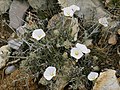 Convolvulus cneorum in Catalonia, Spain
 -
 Convolvulus cephalopodus in Behbahan
 -
 Seed under a microscope


References
- ^ Carine, M. A. and L. Robba. (2010). Taxonomy and evolution of the Convolvulus sabatius complex (Convolvulaceae). Phytotaxa 14 1.
- ^ Convolvulus. Flora of China.
- ^ Convolvulus. The Jepson eFlora. 2013.
- ^ Parnell, J. and Curtis, T. 2012. Webb’s An Irish Flora. Cork University Press. ISBN 978-185918-4783
- ^ a b “Convolvulus L.” Plants of the World Online. Retrieved 2026-05-25.
- ^ Mitchell, Thomas C.; Williams, Bethany R. M.; Wood, John R. I.; Harris, David. J.; Scotland, Robert W.; Carine, Mark A. (2016). “How the temperate world was colonised by bindweeds: biogeography of the Convolvuleae (Convolvulaceae)”. BMC Evolutionary Biology. 16 (1): 1–12. doi:10.1186/s12862-016-0591-6. ISSN 1471-2148. PMC 4719731. PMID 26787507.
- ^ Thorogood, Chris (2016). Field guide to the wild flowers of the western Mediterranean. Richmond (Va.): Kew publishing Royal botanic gardens. pp. 412–414. ISBN 978-1-84246-616-2.
External links
- Beach, Chandler B., ed. (1914). . . Chicago: F. E. Compton and Co.
- Flora Europaea: Convolvulus
| National | |
|---|---|
| Other | |
