Exponential tilting (ET), exponential twisting, or exponential change of measure (ECM) is a distribution-shifting technique used in many parts of mathematics. The different exponential tiltings of a random variable is known as the natural exponential family of .

Exponential tilting is used in Monte Carlo estimation for rare-event simulation, and rejection and importance sampling in particular. In mathematical finance [1] Exponential tilting is also known as Esscher tilting (or the Esscher transform), and often combined with indirect Edgeworth approximation and is used in such contexts as insurance futures pricing.[2]
The earliest formalization of exponential tilting is often attributed to Frederik Esscher[3] with its use in importance sampling being attributed to David Siegmund.[4]
Definition
Let be a real-valued random variable on a probability space . Suppose that the moment-generating function

![{\displaystyle M_{X}(\theta )=\operatorname {E} [e^{\theta X}]}](https://wikimedia.org/api/rest_v1/media/math/render/svg/4eff42e306e45c9b5d734c2ef2f7afa94bfc33da)
is finite for a given real parameter . Let


be the cumulant-generating function (CGF). The exponentially tilted measure , restricted to events determined by , is defined by


where is the law of . Equivalently,


on the sigma algebra generated by .
If has density , then the tilted density is


Thus is proportional to , with the normalizing constant supplied by .


For a random vector and a vector parameter , the analogous definition is


where
![{\displaystyle \kappa (\theta )=\log \operatorname {E} [e^{\theta ^{T}X}].}](https://wikimedia.org/api/rest_v1/media/math/render/svg/854d1fad716f773e7a8dd941a27481cadf9f0316)
Example
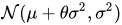
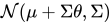
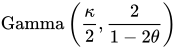
The exponentially tilted measure in many cases has the same parametric form as that of . One-dimensional examples include the normal distribution, the exponential distribution, the binomial distribution and the Poisson distribution.
For example, in the case of the normal distribution, the tilted density is the density. The table below provides more examples of tilted densities.

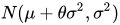
| Original distribution[5][6] | θ-tilted distribution |
|---|---|
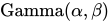


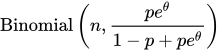

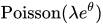





Not every tilted law remains in the same familiar parametric family.[7] For example, if has the Lomax (or Pareto type II) density

then the tilted density is proportional to . It is normalizable for , but it is not generally another Lomax distribution.


In statistical mechanics, the energy of a system in equilibrium with a heat bath has the Boltzmann distribution: , where is the inverse temperature. Exponential tilting then corresponds to changing the temperature: .


Similarly, the energy and particle number of a system in equilibrium with a heat and particle bath has the grand canonical distribution: , where is the chemical potential. Exponential tilting then corresponds to changing both the temperature and the chemical potential.


Advantages
In many cases, the tilted distribution belongs to the same parametric family as the original. This is particularly true when the original density belongs to the exponential family of distributions. This simplifies random variable generation during Monte-Carlo simulations. Exponential tilting may still be useful if this is not the case, though normalization must be possible and additional sampling algorithms may be needed.
In addition, there exists a simple relationship between the original and tilted CGF,
![{\displaystyle \kappa _{\theta }(\eta )=\log(\mathbb {E} _{\theta }[e^{\eta X}])=\kappa (\theta +\eta )-\kappa (\theta ).}](https://wikimedia.org/api/rest_v1/media/math/render/svg/8390d7660e1b835916a6bec6298004a7f069e194)
We can see this by observing that

Thus,
![{\displaystyle {\begin{aligned}\kappa _{\theta }(\eta )&=\log \int e^{\eta x}\,dF_{\theta }(x)\\&=\log \int e^{\eta x}e^{\theta x-\kappa (\theta )}\,dF(x)\\&=\log \mathbb {E} [e^{(\eta +\theta )X-\kappa (\theta )}]\\&=\log(e^{\kappa (\eta +\theta )-\kappa (\theta )})\\&=\kappa (\eta +\theta )-\kappa (\theta ).\end{aligned}}}](https://wikimedia.org/api/rest_v1/media/math/render/svg/6a7d7d060a39dd3d4cbfb5b86e412300f2ed25fa)
Clearly, this relationship allows for easy calculation of the CGF of the tilted distribution and thus the distributions moments. Moreover, it results in a simple form of the likelihood ratio. Specifically,

Properties
- If is the CGF of , then the CGF of the -tilted is
![{\displaystyle \kappa (\eta )=\log \mathrm {E} [\exp(\eta X)]}](https://wikimedia.org/api/rest_v1/media/math/render/svg/1ee5a6011033c909149b7a43cef759975c8dd438)

- This means that the -th cumulant of the tilted is . In particular, the expectation of the tilted distribution is


- .
![{\displaystyle \mathrm {E} _{\theta }[X]={\tfrac {d}{d\eta }}\kappa _{\theta }(\eta )|_{\eta =0}=\kappa '(\theta )}](https://wikimedia.org/api/rest_v1/media/math/render/svg/b8ff58fff0132d21cc54b9860ec023f993a9a29d)
- The variance of the tilted distribution is
- .
![{\displaystyle \operatorname {Var} _{\theta }[X]={\tfrac {d^{2}}{d\eta ^{2}}}\kappa _{\theta }(\eta )|_{\eta =0}=\kappa ''(\theta )}](https://wikimedia.org/api/rest_v1/media/math/render/svg/fc1fbb330b4eee34cf3551a3151217e804ac1dd9)
- Repeated tilting is additive. That is, tilting first by and then is the same as tilting once by .


- If is the sum of independent, but not necessarily identical random variables , then the -tilted distribution of is the sum of each -tilted individually.

- If , then is the Kullback–Leibler divergence
![{\displaystyle \mu =\mathrm {E} [X]}](https://wikimedia.org/api/rest_v1/media/math/render/svg/0ef15cd6033f3004925f007e21b8165092446cc8)

![{\displaystyle D_{\text{KL}}(P\parallel P_{\theta })=\mathrm {E} \left[\log {\tfrac {P}{P_{\theta }}}\right]}](https://wikimedia.org/api/rest_v1/media/math/render/svg/c6f783cc653b281b7802ed5e7c42ca21b704f92c)
- between the tilted distribution and the original distribution of .

- Similarly, since , we have the Kullback-Leibler divergence as
![{\displaystyle \mathrm {E} _{\theta }[X]=\kappa '(\theta )}](https://wikimedia.org/api/rest_v1/media/math/render/svg/b4a188e7aa62eb74bac5b74a99d0fffd8aa60ece)
- .
![{\displaystyle D_{\text{KL}}(P_{\theta }\parallel P)=\mathrm {E} _{\theta }\left[\log {\tfrac {P_{\theta }}{P}}\right]=\theta \kappa '(\theta )-\kappa (\theta )}](https://wikimedia.org/api/rest_v1/media/math/render/svg/9142ac9ddcba1049ea9e563966e5ef2e0ca2f732)
Applications
Rare-event simulation
The exponential tilting of , assuming it exists, supplies a family of distributions that can be used as proposal distributions for acceptance-rejection sampling or importance distributions for importance sampling. One common application is sampling from a distribution conditional on a sub-region of the domain, i.e. . With an appropriate choice of , sampling from can meaningfully reduce the required amount of sampling or the variance of an estimator.


Saddlepoint approximation
The saddlepoint approximation method is a density approximation methodology often used for the distribution of sums and averages of independent, identically distributed random variables that employs Edgeworth series, but which generally performs better at extreme values. From the definition of the natural exponential family, it follows that
- .

Applying the Edgeworth expansion for , we have

![{\displaystyle f_{\theta }({\bar {x}})=\psi (z)(\mathrm {Var} [{\bar {X}}])^{-1/2}\left\{1+{\frac {\rho _{3}(\theta )h_{3}(z)}{6}}+{\frac {\rho _{4}(\theta )h_{4}(z)}{24}}+\cdots \right\},}](https://wikimedia.org/api/rest_v1/media/math/render/svg/ef253d59a36ee308ef1209a44f602e067e096107)
where is the standard normal density of

![{\displaystyle {\begin{aligned}&z={\frac {{\bar {x}}-\kappa _{\bar {x}}'(\theta )}{\kappa _{\bar {x}}''(\theta )}},\\[8pt]&\rho _{n}(\theta )=\kappa ^{(n)}(\theta )\{\kappa ''(\theta )^{n/2}\},\end{aligned}}}](https://wikimedia.org/api/rest_v1/media/math/render/svg/46660ddabc977d9b1a3c38f2d771e79e24849c21)
and are the Hermite polynomials.

When considering values of progressively farther from the center of the distribution, and the terms become unbounded. However, for each value of , we can choose such that


This value of is referred to as the saddle-point, and the above expansion is always evaluated at the expectation of the tilted distribution. This choice of leads to the final representation of the approximation given by

Rejection sampling
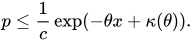
Using the tilted distribution as the proposal, the rejection sampling algorithm prescribes sampling from and accepting with probability
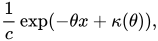
where
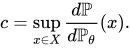
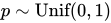
That is, a uniformly distributed random variable is generated, and the sample from is accepted if
Importance sampling
Applying the exponentially tilted distribution as the importance distribution yields the equation
![{\displaystyle \mathbb {E} (h(X))=\mathbb {E} _{\theta }[\ell (X)h(X)],}](https://wikimedia.org/api/rest_v1/media/math/render/svg/8db5a211dd7dacaa61dd88e025e06a064d566d78)
where

is the likelihood function. So, one samples from to estimate the probability under the importance distribution and then multiplies it by the likelihood ratio. Moreover, we have the variance given by


![{\displaystyle \operatorname {Var} (X)=\mathbb {E} [(\ell (X)h(X)^{2}].}](https://wikimedia.org/api/rest_v1/media/math/render/svg/039e4eb29f69d9ce20bcaae959e4e1eed4fa2c52)
Example
Assume independent and identically distributed such that . In order to estimate , we can employ importance sampling by taking




The constant can be rewritten as for some other constant . Then,


![{\displaystyle \mathbb {P} (\sum _{i=1}^{n}X_{i}>na)=\mathbb {E} _{\theta _{a}}\left[\exp\{-\theta _{a}\sum _{i=1}^{n}X_{i}+n\kappa (\theta _{a})\}\mathbb {I} (\sum _{i=1}^{n}X_{i}>na)\right],}](https://wikimedia.org/api/rest_v1/media/math/render/svg/729f1a3f0e2a415f765144b89f6a5b2db6011c72)
where denotes the defined by the saddle-point equation


Stochastic processes and Girsanov’s theorem
For stochastic processes, the analogue of exponential tilting is a change of measure on path space. In the Brownian motion case, let be a standard Brownian motion. For constant ,


is an exponential martingale with expectation one. Defining a new measure by


changes the stochastic drift of Brownian motion: under , the process

is a standard Brownian motion. Thus has drift under the new measure.


More generally, Girsanov’s theorem states that if is an adapted process satisfying suitable integrability conditions, then the stochastic exponential


can be used as a Radon–Nikodym derivative.[10][11] Under the measure defined by ,


is Brownian. If

under , then under the same process may be written as

This is analogous to exponential tilting of a single random variable, but it acts on the distribution of an entire stochastic path rather than only on a fixed-time marginal.
Choice of tilting parameter
Siegmund’s algorithm
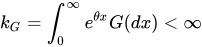
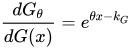
Assume i.i.d. Xs with light tailed distribution and . In order to estimate where , when is large and hence small, the algorithm uses exponential tilting to derive the importance distribution. The algorithm is used in many aspects, such as sequential tests,[12] G/G/1 queue waiting times, and is used as the probability of ultimate ruin in ruin theory. In this context, it is logical to ensure that . The criterion , where is s.t. achieves this. Siegmund’s algorithm uses , if it exists, where is defined in the following way: . It has been shown that is the only tilting parameter producing bounded relative error ().[13]
![{\displaystyle \mathbb {E} [X]>0}](https://wikimedia.org/api/rest_v1/media/math/render/svg/b25741b7d43f5322f7cd18894d60e32cf6cea6a1)






Black-box algorithms
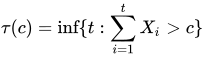
We can only see the input and output of a black box, without knowing its structure. The algorithm is to use only minimal information on its structure. When we generate random numbers, the output may not be within the same common parametric class, such as normal or exponential distributions. An automated way may be used to perform ECM. Let be i.i.d. r.v.’s with distribution ; for simplicity we assume . Define , where are independent (0, 1) uniforms. A randomized stopping time for is then a stopping time w.r.t. the filtration Let further be a class of distributions on with and define by . We define a black-box algorithm for ECM for the given and the given class of distributions as a pair of a randomized stopping time and an measurable r.v. such that is distributed according to for any . Formally, we write this as for all . In other words, the rules of the game are that the algorithm may use simulated values from and additional uniforms to produce an r.v. from .[14]







See also
- Girsanov’s theorem
- Importance sampling
- Rejection sampling
- Monte Carlo method
- Exponential family
- Esscher transform
References
- ^ H.U. Gerber & E.S.W. Shiu (1994). “Option pricing by Esscher transforms”. Transactions of the Society of Actuaries. 46: 99–191.
- ^ Cruz, Marcelo (2015). Fundamental Aspects of Operational Risk and Insurance Analytics. Wiley. pp. 784–796. ISBN 978-1-118-11839-9.
- ^ Butler, Ronald (2007). Saddlepoint Approximations with Applications. Cambridge University Press. pp. 156. ISBN 9780521872508.
- ^ Siegmund, D. (1976). “Importance Sampling in the Monte Carlo Study of Sequential Tests”. The Annals of Statistics. 4 (4): 673–684. doi:10.1214/aos/1176343541.
- ^ Asmussen Soren & Glynn Peter (2007). Stochastic Simulation. Springer. p. 130. ISBN 978-0-387-30679-7.
- ^ Fuh, Cheng-Der; Teng, Huei-Wen; Wang, Ren-Her (2013). “Efficient Importance Sampling for Rare Event Simulation with Applications”. arXiv:1302.0583.
{{cite journal}}: Cite journal requires|journal=(help) - ^ Asmussen, Soren & Glynn, Peter (2007). Stochastic Simulation. Springer. pp. 164–167. ISBN 978-0-387-30679-7
- ^ Butler, Ronald (2007). Saddlepoint Approximations with Applications. Cambridge University Press. pp. 156–157. ISBN 9780521872508.
- ^ Seeber, G.U.H. (1992). Advances in GLIM and Statistical Modelling. Springer. pp. 195–200. ISBN 978-0-387-97873-4.
- ^ Asmussen Soren & Glynn Peter (2007). Stochastic Simulation. Springer. p. 407. ISBN 978-0-387-30679-7.
- ^ Steele, J. Michael (2001). Stochastic Calculus and Financial Applications. Springer. pp. 213–229. ISBN 978-1-4419-2862-7.
- ^ Siegmund, David (1985). Sequential Analysis. Springer-Verlag. ISBN 978-0387961347.
- ^ Asmussen Soren & Glynn Peter, Peter (2007). Stochastic Simulation. Springer. pp. 164–167. ISBN 978-0-387-30679-7.
- ^ Asmussen, Soren & Glynn, Peter (2007). Stochastic Simulation. Springer. pp. 416–420. ISBN 978-0-387-30679-7