Footrot (foot rot) in ruminants refers to various pathological conditions.
In sheep
In sheep, contagious footrot (also hoof rot)[1] is a universally distributed disease (affecting accessorily goats) characterized by chronic contagious epidermatitis of feet, especially in the fore limbs, caused by two anaerobic bacteria, not transferable to bovines.[2]
Next to that contagious condition, there exist a benign footrot with similar lesions in the interdigital skin, but slighter underrunning of the adjacent horn. The disease only occurs in individual sheep.[3]
In cattle
In cattle, the term may cover different conditions.
The terminomogy has been very confusing, and several entities probably exist under such names as footrot (USA) Panaritium (Germany) or panaris (France). The author strongly recommend adoption of the […] definition “interdigital necrobacillosis” (for “Phlegmona interdigitalis”).[4]
The following digital diseases of cattle[5] might have been called “footrot”:
- Interdigital necrobacillosis: an acute severe phlegmon of interdigital connectif tissue, especially in the rear limbs. It is the most frequent disease associated with the word “footrot” in cattle.
- Interdigital dermatitis, also called “scald”: an acute or chronic inflammation of the interdigital skin, without extension to the subcutaneous tissue. Treatment and prevention is based on formalin or copper sulfate foot-bath.[6]
- Interdigital skin hyperplasia: excess of epidermal and hypodermal tissue occupying part of all of interdigital space, especially dorsally in the fore limbs.[7]
- Pododermatitis circumscripta: specific profiferative lesion of the sole-bulb junction, near the axial margin (rear limbs).[8]
- Distal interphalangeal arthritis or septic arthritis of the interphalangeal joint: purulent inflammation of the distal phalangeal joint, often a complication of one of the above cited conditions, especially in the rear limbs.[9]
-
 knee-walking in ovine footrot (benign form)
 -
 partially trimmed hooves of an affected ewe
 -
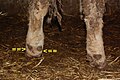 interdigital phlegmon in a steer
 -
 Interdigital skin hyperplasia
 -
 Pododermatitis circumscripta (on both claws)
 -
 distal interphalangeal arthritis
 -
 fistula from distal interphalangeal joint (probe)


References
- ^ referred to as piétin in French and pedero in Spanish.
- ^ Jensen, Rue & Brinton L., Diseases of Sheep, Philadelphia, Lea & Febiger, 1982 (2nd edition), ISBN 0-8121-0836-1, p. 265-267
- ^ https://www.merckvetmanual.com/musculoskeletal-system/lameness-in-sheep/contagious-footrot-in-sheep
- ^ Paul R. Greenough, Finlay J. Maccalum and A. David Weaver, Lameness in cattle, Wright Scientechnica, Bristol, 1982 (1st edition), ISBN 0 85608 030 6, p. 151.
- ^ Lucien Mahin and Abderrazaq Addi, Les maladies digitées des bovins, avec références particulières aux travaux de “l’International Council on Disorders of the Ruminant digit”, Annales de Médecine Vétérinaire, 1982, 126, 597-620.
- ^ Greenough et al, op. cit., p. 158-160.
- ^ Greenough et al, op. cit., p. 162-169.
- ^ Greenough et al, op. cit., p. 174-182.
- ^ Greenough et al, op. cit., p. 197-206.
External links
- “Footrot in cattle and sheep” (PDF). Kansas State University. Retrieved May 1, 2026.
- McKay, Evelyn (September 2024). “Contagious Footrot in Sheep – Musculoskeletal System”. Merck Veterinary Manual. Retrieved May 1, 2026.
- Pezzanite, Lynn; Neary, Mike; Hutchens, Terry. “Footrot in Sheep and Goats” (PDF). Purdue University. Retrieved May 1, 2026.