
In geometry, the heptagonal prism is a prism with heptagonal base. This polyhedron has 9 faces (2 bases and 7 sides), 21 edges, and 14 vertices.[1][2]
Area
The area of a right heptagonal prism with height and with a side length of and apothem is given by:[1]



Volume
The volume is found by taking the area of the base, with a side length of and apothem , and multiplying it by the height , giving the formula:[1]
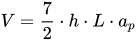
This formula also works for the oblique prism due to the Cavalieri’s principle.
Images
The heptagonal prism can also be seen as a tiling on a sphere:
Related polyhedra
| Family of uniform n-gonal prisms | |||||||||||||
|---|---|---|---|---|---|---|---|---|---|---|---|---|---|
| Prism name | Digonal prism | (Trigonal) Triangular prism |
(Tetragonal) Square prism |
Pentagonal prism | Hexagonal prism | Heptagonal prism | Octagonal prism | Enneagonal prism | Decagonal prism | Hendecagonal prism | Dodecagonal prism | … | Apeirogonal prism |
| Polyhedron image | 
|

|

|

|

|

|

|

|

|

|

|
… | |
| Spherical tiling image | 
|

|

|

|

|

|

|

|
Plane tiling image | 
| |||
| Vertex config. | 2.4.4 | 3.4.4 | 4.4.4 | 5.4.4 | 6.4.4 | 7.4.4 | 8.4.4 | 9.4.4 | 10.4.4 | 11.4.4 | 12.4.4 | … | ∞.4.4 |
| Coxeter diagram |   
|

|

|

|

|

|

|

|

|

|

|
… | 
|
References
- ^ a b c Sapiña, R. “Area and volume calculator of a heptagonal prism” (in Spanish). Problemas y ecuaciones. ISSN 2659-9899. Retrieved June 17, 2020.
- ^ Pugh, Anthony (1976), Polyheda: A Visual Approach, University of California Press, p. 27, ISBN 9780520030565.
External links