In mathematics, the Hermite transform is an integral transform named after the mathematician Charles Hermite that uses Hermite polynomials as kernels of the transform.

The Hermite transform of a function is


The inverse Hermite transform is given by
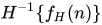

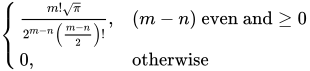
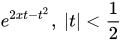
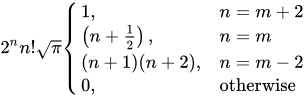
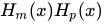
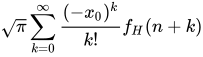
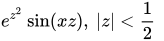
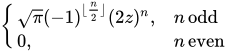
Some Hermite transform pairs
| [1] | |
| [2] | |
| [3] | |
| [4] | |
| [5][6] | |
















![{\displaystyle e^{x^{2}}{\frac {d}{dx}}\left[e^{-x^{2}}{\frac {d}{dx}}F(x)\right]\,}](https://wikimedia.org/api/rest_v1/media/math/render/svg/b2c7d97bfe8587a9904ba8332c64f693b13eba3c)



![{\displaystyle {\sqrt {\pi }}(-1)^{n}\left[2^{2n+1}\Gamma \left(n+{\frac {3}{2}}\right)\right]^{-1}f_{H}(n)g_{H}(n)\,}](https://wikimedia.org/api/rest_v1/media/math/render/svg/81c4c392666d42cce6c9dc6ea75b4c88215bfebc)
![{\displaystyle (1-z^{2})^{-1/2}\exp \left[{\frac {2xyz-(x^{2}+y^{2})z^{2}}{(1-z^{2})}}\right]\,}](https://wikimedia.org/api/rest_v1/media/math/render/svg/103e6fef22d2baa4b64de7f7956c46e8ff9ede7f)


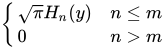
References
- ^ McCully, Joseph Courtney; Churchill, Ruel Vance (1953), Hermite and Laguerre integral transforms : preliminary report
- ^ Feldheim, Ervin (1938). “Quelques nouvelles relations pour les polynomes d’Hermite”. Journal of the London Mathematical Society (in French). s1-13: 22–29. doi:10.1112/jlms/s1-13.1.22.
- ^ Bailey, W. N. (1939). “On Hermite polynomials and associated Legendre functions”. Journal of the London Mathematical Society. s1-14 (4): 281–286. doi:10.1112/jlms/s1-14.4.281.
- ^ Glaeske, Hans-Jürgen (1983). “On a convolution structure of a generalized Hermite transformation” (PDF). Serdica Bulgariacae Mathematicae Publicationes. 9 (2): 223–229.
- ^ Erdélyi et al. 1955, p. 194, 10.13 (22).
- ^ Mehler, F. G. (1866), “Ueber die Entwicklung einer Function von beliebig vielen Variabeln nach Laplaceschen Functionen höherer Ordnung” [On the development of a function of arbitrarily many variables according to higher-order Laplace functions], Journal für die Reine und Angewandte Mathematik (in German) (66): 161–176, ISSN 0075-4102, ERAM 066.1720cj. See p. 174, eq. (18) and p. 173, eq. (13).
Sources
- Erdélyi, Arthur; Magnus, Wilhelm; Oberhettinger, Fritz [in German]; Tricomi, Francesco G. (1955), Higher transcendental functions (PDF), vol. II, McGraw-Hill, ISBN 978-0-07-019546-2, archived from the original (PDF) on 2011-07-14, retrieved 2023-11-09
{{citation}}: ISBN / Date incompatibility (help)