135 °F (57.2 °C). The state park offers free bathing at the State Bath House, where temperatures are moderated to a therapeutic 104 °F (40.0 °C).[3] The petroglyph site at Legend Rock, some 25 miles (40 km) away, is also part of the park.[4] The park is managed by the Wyoming Division of State Parks and Historic Sites.
History

The land on which the state park sits was a cession agreement, and the ceded portion was purchased from the Eastern Shoshone by the federal government in 1896, when Indian Inspector James McLaughlin negotiated a purchase price of $60,000 for a 100-square-mile portion (260 km2) of the Shoshone reservation. A 1-square-mile section (2.6 km2) of that land was released to the state in 1897 which became Wyoming’s first state park, known as Big Horn Hot Springs State Reserve.[5][6]
A small herd of bison was established in 1916.[7]
Features
Designated as the State Bison Herd, the number of bison is maintained at 15 due to the carrying capacity of the pasture.[8] The park features a suspension foot bridge across the Big Horn River, picnic shelters, boat docks, flower gardens, and terraces made of naturally forming travertine (calcium carbonate) caused by a flowing mineral hot spring.[3] The park area encompasses commercial hotels and several state-run and privately operated entities including the Gottsche Rehabilitation Center, Hot Springs County Memorial Hospital, the historic Callaghan Apartments/Plaza Hotel, the Star Plunge waterpark, the Tepee Pools waterpark, and the Wyoming Pioneer Home, a state-run, assisted-living facility.
Gallery
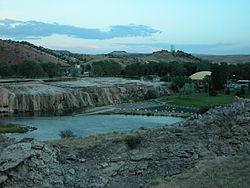 Travertine formation
at Hot Springs State Park Winter view of the suspension footbridge
over the Big Horn River Big Horn Hot Springs, c. 1914
 Two tourists at Big Horn Hot Springs, Thermopolis Wyoming, early 20th century


