| Part of a series of articles about |
| Calculus |
|---|
In calculus, implicit differentiation is a method for finding the derivative of a function that is defined by an equation rather than by an explicit formula. If an equation such as

defines as a function of , at least locally, implicit differentiation treats as a function and differentiates both sides of the equation with respect to . The method is an application of the chain rule.[1]


Implicit differentiation is useful when solving explicitly for one variable is inconvenient, produces several branches, or is not possible in elementary terms. For example, the circle cannot be represented globally as the graph of a single function , but its upper and lower arcs can each be differentiated implicitly.


The method allows for the computation of the tangent line approximation to , given only the function and the point at which the approximation is made, so that no other knowledge of the functional dependence of on is needed. Tangent approximations to surfaces and higher-dimensional manifolds given by an equation or system of equations can be found by similar methods.


Basic formula
Let be a differentiable function of two variables, and suppose that an equation

defines locally as a differentiable function of , near the point . Applying the differential to both sides gives on the curve of interest, and writing the left-hand side in terms of the partial derivatives of : Therefore, evaluating at the point gives[2]: §11.5 provided .



The derivative on the left-hand side of the formula can be interpreted as the slope of the tangent line to the curve defined implicitly by the equation through the given point . The formula is local, in the sense that it gives only the derivative of the branch of the implicit function whose graph contains the point .

Relation with the implicit function theorem
Intuitively, in order to be valid at a point implicit differentiation in the basic formulation requires that the function must genuinely depend on near the point , for otherwise the equation cannot be solved for as a function of at all.
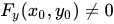
More is actually required: it is clear from the formula that the partial derivative must be non-zero, because it appears in the denominator of the right-hand side of the formula for . While this fact allows one to compute a numerical value, it is not obvious that the numerical value has the advertised meaning: namely, that it be the derivative of a function whose graph is contained on the curve through the point.


The implicit function theorem supplies the missing justification. It asserts as follows: suppose that is a function such that both partial derivatives exist in a disc around , and are continuous throughout the disc. Then if , there is a differentiable function defined in an open interval containing , such that throughout the interval, and whose derivative is given by the implicit differentiation formula at . The function is, moreover, unique on a sufficiently small interval around .[3]




Examples
Example 1
Consider

This equation is easy to solve for y, giving

where the right side is the explicit form of the function y(x). Differentiation then gives dy/dx = −1.
Alternatively, one can totally differentiate the original equation:
![{\displaystyle {\begin{aligned}{\frac {dy}{dx}}+{\frac {dx}{dx}}+{\frac {d}{dx}}(5)&=0\,;\\[6px]{\frac {dy}{dx}}+1+0&=0\,.\end{aligned}}}](https://wikimedia.org/api/rest_v1/media/math/render/svg/bbc6ffe0eb05941c2a2c5c5a76fcfcfe3f07311c)
Solving for dy/dx gives

the same answer as obtained previously.
Example 2
An example of an implicit function for which implicit differentiation is easier than using explicit differentiation is the function y(x) defined by the equation
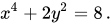
To differentiate this explicitly with respect to x, one has first to get
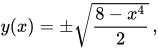
and then differentiate this function. This creates two derivatives: one for y ≥ 0 and another for y < 0.
It is substantially easier to implicitly differentiate the original equation:
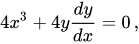
giving
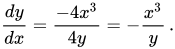
Example 3
Often, it is difficult or impossible to solve explicitly for y, and implicit differentiation is the only feasible method of differentiation. An example is the equation

It is impossible to express y explicitly in radicals as a function of x, and therefore one cannot find dy/dx by explicit differentiation of elementary radical expressions. Using the implicit method, dy/dx can be obtained by differentiating the equation to obtain
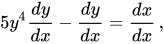
where dx/dx = 1. Factoring out dy/dx shows that
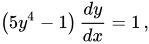
which yields the result
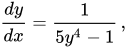
which is defined for
![{\displaystyle y\neq \pm {\frac {1}{\sqrt[{4}]{5}}}\quad {\text{and}}\quad y\neq \pm {\frac {i}{\sqrt[{4}]{5}}}\,.}](https://wikimedia.org/api/rest_v1/media/math/render/svg/02378d424997f05eb51116d1dd6119f4324b729b)
Higher order derivatives
The method of implicit differentiation can be applied to find higher-order derivatives such as the second derivative of the implicitly-defined function at the point of its graph , provided the function is sufficiently smooth at the point.[4]
For example, suppose that the first derivative of has been found, by solving the equation for at .


Applying the second differential to then gives and expanding the left-hand side gives where we have written the second partial derivatives of with repeated subscripts. Since it is the derivatives we are after, . Also, substituting the known expressions for at the point , into the formula (that is where the derivative on the right-hand side is known at the point : ), we can then arrange terms and solve for the second derivative . That is, from we obtain This is understood as at the point , and requires only that the function be twice-differentiable at the point, in addition to the hypothesis . Second-differentiability at the point is true if the first and second partials of exist and are continuous in a disc around the point.


In that case, Clairaut’s theorem implies that the mixed partials are equal , and these terms can then be combined to give


Higher order derviatives (under the requisite smoothness hypotheses) are handled similarly.
References
- ^ Strang, Gilbert; Herman, Edwin (2016). “3.8 Implicit Differentiation”. Calculus Volume 1. OpenStax. ISBN 978-1-938168-02-4.
- ^ Stewart, James (1998). Calculus Concepts And Contexts. Brooks/Cole Publishing Company. ISBN 0-534-34330-9.
- ^ Apostol, Tom M. (1974). “13. Implicit functions and extremum problems”. Mathematical Analysis (2nd ed.). Addison-Wesley. ISBN 978-0-201-00288-1.
- ^ Goursat, Édouard (1904). “II. Implicit Functions; Functional Determinants; Change of Variable”. A Course in Mathematical Analysis. Vol. 1. Translated by Hedrick, Earle Raymond. Boston: Ginn & Company. pp. 35–88.
