In the calculus of finite differences, the indefinite sum (or antidifference operator), denoted by or ,[1][2] is the linear operator that inverts the forward difference operator That is, if , then satisfies the functional equation



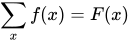


so that applying the forward difference recovers the original function:[3] The operator thus plays the same role for finite differences that the indefinite integral plays for the derivative.

An indefinite sum is not unique: adding any 1-periodic function (satisfying ), the function is also a solution. Therefore, an indefinite sum is unique up to a 1-periodic function instead of up to a constant as the indefinite integral is.


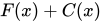

To obtain the unique solution up to a constant , one must impose additional analytic constraints. The Nørlund principal solution is the unique analytic solution that has the minimal possible exponential type (that is, its growth in the imaginary direction on the complex plane is the minimal possible), filtering out any non-constant periodic component.[4] Other methods include higher-order convexity or concavity conditions in real analysis, or using axioms and complex analysis to step back the function’s behavior from a neighborhood of infinity in which it behaves polynomially.
For integer arguments, the indefinite sum naturally extends ordinary summation, turning a discrete sum into a continuous function. Many such extensions are well-known special functions.
Forward and backward difference conventions


The inverse forward difference operator, (), extends the summation up to , typically starting with the iterator at :



Some authors analytically extend summation for which the upper limit is the argument without a shift, typically starting the iterator at :[5][6][7]


In this case, the analytic continuation, , for the sum is a solution of . Stated explicitly, that is:


Which follows from the discrete counterpart:

Some authors use the equivalent form called the telescoping equation:[8]

The lower bounds of the discrete analog for both inverse forward difference and inverse backward difference can be an arbitrary constant other than those listed here, as it is absorbed into the height of the 1-periodic or constant term .
Fundamental theorem of the calculus of finite differences
Indefinite sums can be used to calculate definite sums with the formula:[9]

Alternatively, using the inverse backward difference operator, the relation is:

Examples
The following basic indefinite sums follow from the fundamental properties of the difference operator, where represents an arbitrary 1-periodic function (or a constant if the Nørlund principal solution is assumed):[10]
- Constant:
- Exponential:
- Logarithm:
- Powers:[11]


where are the Bernoulli polynomials (via Abel-Plana, Hurwitz zeta, or as defined by their recurrence; not the definition by generating functions), is the Hurwitz zeta function, and is the digamma function. This is related to the generalized harmonic numbers. Combined with series expansions (such as Taylor series expansions about a point or Laurent series expansions) or partial fraction decomposition, the power formula allows the indefinite summation of many analytic functions (term-wise, through the linearity of the operator).


In the calculus of finite differences, the power rule translates to the Bernoulli polynomials:[12]
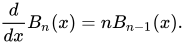
This follows from the fact that is the canonical antidifference of (satisfying ) when the constant is chosen to make the mean over a unit interval zero.[13] In practice, falling factorials are more often used in contexts similar to the power rule.


Falling factorials
Falling factorials provide the discrete analog of the power rule from differential calculus. In infinitesimal calculus, . In the calculus of finite differences, the falling factorial
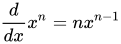

plays the role of , and the forward difference operator satisfies


The indefinite sum of a falling factorial is given by the discrete analog of the power rule for integration:

Equivalently, using the Gamma function:

For the case where , the solution is the digamma function with a shift, , which naturally extends the harmonic numbers.


Example: Sum of the first squares. Using and the indefinite sum formula above,


Applying the fundamental theorem of the calculus of finite differences,

Expanding the falling factorials,

and simplifying yields the formula

Summation by parts
Indefinite summation by parts is the discrete analog of integration by parts. It is derived from the product rule for the forward difference operator.
Product rule. For two functions and , the product rule for the forward difference is:


Introducing the shift operator , defined by , this can be written more compactly as:



Summation by parts. Rearranging the product rule gives:

Taking the indefinite sum of both sides and using the fact that (where is an arbitrary 1‑periodic function) yields the formula for summation by parts:[14][10]


A symmetrical form, also obtained from the product rule, is:

Definite summation by parts. For definite sums from to , the formula becomes:


![{\displaystyle \sum _{k=a}^{b}u(k)\Delta v(k)={\bigl [}u(b+1)v(b+1)-u(a)v(a){\bigr ]}-\sum _{k=a}^{b}v(k+1)\Delta u(k).}](https://wikimedia.org/api/rest_v1/media/math/render/svg/4a74d9e873364c0dacbc4b406831b3e6aba7ac1f)
Example: product of a polynomial and an exponential[15]
Summation by parts is effective for functions like . To find the indefinite sum , let and . Then:


Applying the summation by parts formula:

The remaining sum is elementary:

Hence the indefinite sum (antidifference) is

To evaluate the definite sum from to , we use the fundamental theorem with the forward difference inverse:

Substituting the expression for :
![{\displaystyle {\begin{aligned}\sum _{k=0}^{x}k2^{k}&={\bigl [}(x+1-2)2^{x+1}{\bigr ]}-{\bigl [}(0-2)2^{0}{\bigr ]}\\&=(x-1)2^{x+1}-(-2)\\&=(x-1)2^{x+1}+2.\end{aligned}}}](https://wikimedia.org/api/rest_v1/media/math/render/svg/5171bbe607d9aeb18033c92663e1609edb55f2d5)
Thus, for any non‑negative integer ,

Uniqueness of the principal solution


The functional equation does not have a unique solution. If is a particular solution, then for any function satisfying (i.e., any 1-periodic function), the function is also a solution. Therefore, the indefinite sum operator defines a family of functions differing by an arbitrary 1-periodic component, .


To select the unique principal solution (German: Hauptlösung)[4] up to an additive constant (instead of up to the additive 1-periodic function ) one must impose additional constraints.
Complex analysis (exponential type)

Following the theory developed by Niels Erik Nørlund,[4] the indefinite sum can be uniquely determined for analytic functions by imposing restriction on their growth in the complex plane. Specifically, by imposing minimal growth, the non-constant periodic terms can be filtered out.

The usual formulation assumes that the summand is analytic in a vertical strip containing a portion of the real line. However, when has singularities (including those extending into the imaginary direction), a single vertical strip cannot contain the entire real axis. Instead, these singularities create vertical boundaries that split the domain into disjoint connected components. For example, poles at prevent a single strip from crossing the imaginary axis, splitting the domain at into disjoint connected half-planes.


Nørlund’s theory provides a principal solution in each connected component that contains a segment of the real line. While these infinite vertical strips can be shifted horizontally to evaluate the function, they cannot cross the singularities without the recurrence relation causing the singularities to repeat (e.g. digamma). Thus, each connected component’s principal solution contains no singularities in its respective connected component, but contains singularities that recur outwards into outer disjoint connected components.
The solution that contains the largest defined portion of the discrete sum being extended is then considered the disjoint connected component defining the canonical principal solution. This usually becomes, in practice, the right half-plane.
Suppose is analytic in a vertical strip containing a segment of the real axis, and let be an analytic solution of in that strip. To ensure uniqueness within that strip, require to be of minimal growth, specifically to be of exponential type less than in the imaginary direction. That is, there exist constants and such that as .[16][17]


Let and be two analytic solutions satisfying this growth condition on the same connected component. Their difference is then analytic, 1-periodic (i.e., ), and inherits the same exponential type less than .


Nørlund uses a fundamental result in complex analysis (related to Carlson’s theorem, the Phragmén–Lindelöf principle, and the Paley–Wiener theorem) which states that a non-constant periodic entire function must have exponential type at least .[4] This follows from its Fourier series expansion: if is non-constant, its Fourier series contains a term with , which has type . Since has type strictly less than , it cannot contain any such term and therefore must be constant. Hence, on any fixed connected component where the growth condition holds, the solution is unique up to a constant.


The exponential type less than in the imaginary direction on condition is sufficient but not strictly necessary. Nørlund’s general definition of the principal solution is the analytic solution having Fourier components of the minimal possible exponential type for the given ( of slowest possible growth in the complex plane).[18][4] If has exponential type in imaginary direction, then the principal solution will also have type in that strip, provided it converges. For example, has exponential type ; its principal solution exists and has type , even though .[18][10]


When has exponential type exactly for some non-zero integer in every strip where it is analytic (e.g. has type ; its antidifference contains in the denominator[10]) the principal solution fails to exist (or is undefined everywhere) because it resonates with the kernel of the difference operator:[19][20][21] In all other cases-when is meromorphic and on some vertical strip that contains a segment of the real line, and its exponential type is not an integer multiple of -the principal solution exists and is uniquely determined, up to a constant , on that connected component.


For functions with isolated poles, distinct components must give different branches: the native component provides a pole-free principal solution, and the recurrence propagates the original poles by the step length every neighbouring component, so no principal solution can be analytically continued across the vertical pole lines which correspond to a real part.
For functions with branch-point singularities (e.g. logarithms, positive fractional powers), indefinite sum may merge into one solution on a Riemann surface. In such cases the same principal solution can be valid on multiple strips, and the number of independent principal solutions is equal to the number of connected components of the domain of the indefinite sum after its own branch cuts have been placed.
Example: Partitioning disjoint connected components ()
| ||||||
|---|---|---|---|---|---|---|
|
Consider the meromorphic function . Its poles at split the complex plane into two maximal vertical strips that each contain a segment of the real line: the right half-plane and the left half-plane . We construct the Nørlund principal solution of the backward difference equation with empty-sum normalization on each strip. Right half-plane (). Partial fractions give The digamma function satisfies for all . For the arguments and never hit a non-positive integer, so the identity is valid at every term of the sum: Because , the two terms are complex conjugates, and the expression simplifies to a real function: The non-simplified function is analytic on the whole right half-plane, and . Within this strip the difference equation holds for every in the respective connected component (half-plane). If one attempts to continue across the imaginary axis by the recurrence , poles appear at -integer shifts of the original singularities that lie in the left half-plane. Left half-plane (). Using the reflection , the analogous solution on the left half-plane is For the argument has a positive real part, so it never equals ; the digamma identity applies and the difference equation is satisfied for all in the strip. Again the non-simplified function is analytic on the whole left half-plane. Extending this solution to the right via the recurrence would introduce poles at , which lie in the right half-plane outside the original strip. Summary:
The two expressions are analytic on their respective strips and give distinct principal solutions. The poles of the digamma function, which would violate the identity , are never reached inside the respective domains. However, the recurrence propagates the original singularities of by integer steps, so any attempt to analytically continue one branch into the other component introduces poles. |




![{\displaystyle \sum _{k=1}^{x}{\frac {1}{k^{2}+1}}={\frac {1}{2i}}{\Bigl [}{\bigl (}\psi (x+1-i)-\psi (1-i){\bigr )}-{\bigl (}\psi (x+1+i)-\psi (1+i){\bigr )}{\Bigr ]}.}](https://wikimedia.org/api/rest_v1/media/math/render/svg/32e0f56e9550c37f5cf36f62d78e9de93e2ada5b)





Real analysis (higher‑order convexity and concavity)
In real analysis, the uniqueness condition can be given using higher‑order convexity, generalizing the Bohr-Mollerup theorem. For an integer , a function is called -convex if its divided differences of order are non‑negative, and -concave if those divided differences are non-positive. A function is called eventually -convex (resp. eventually -concave) if there exists such that it is -convex (resp. -concave) on the interval .


Marichal and Zenaïdi proved the following uniqueness theorem, their method requiring the solution to be eventually -convex or -concave.[22][23]
Theorem. Let be an integer and let satisfy . If is an eventually -convex or eventually -concave solution of , then is uniquely determined up to an additive constant. Moreover, for any ,


and the convergence is uniform on bounded subsets of .

Müller–Schleicher axiomatic method
In their paper How to Add a Noninteger Number of Terms,[5] Müller and Schleicher introduced an axiomatic approach to fractional summation with a real or complex number of terms. Their method extends the classical discrete sum

to non-integer and complex upper limits . The definition is built upon six natural axioms:
- Continued Summation: .
- Translation Invariance: .
- Linearity: .
- Empty Sum Condition: (equivalent to the empty sum condition).
- Holomorphy for Monomials: for each , is holomorphic in .
- Right-Shift Continuity: if pointwise as , then ; more generally, if can be approximated by polynomials of fixed degree with , then:


- .

Axioms S1–S4 force the sum to align with the ordinary finite sum when the limits are integers. Axiom S5 forces monomials to behave the same way under the generalization of fractional sums. Axiom S6 is the crucial axiom which allows one to “step back” the asymptotic region to determine the fractional sum in a finite interval. The exact conditions for the method to work are, as stated in the Definition 1.2 of the paper:
Let and . A function will be called fractional summable of degree if the following conditions are satisfied:
- for all
- there exists a sequence of polynomials of fixed degree such that for all
- as
- for every the limit
exists.


In the simplest case when as (i.e., the approximating polynomials are zero), this reduces to:


Symmetry of the principal solution
Following directly from uniqueness, if is a entire function, one can define a unique analytic solution of the backward difference sum, by imposing the conditions that:
- Difference Equation:
- Normalization: (empty sum boundary condition).
- Growth constraint: has the minimal possible exponential type in the imaginary direction.
Under these conditions, satisfies a reflection formula (referred to by Nørlund as Ergänzungssatz, a complementary theorem to uniqueness of the principal solution [Hauptlösung], presenting it as where is the span).[18] From Nørlund’s Ergänzungssatz for the principal solution, one obtains the following symmetry for the inverse backward difference when the summand is odd or even under the condition via direct application (setting ).


Odd functions
If is an odd function () and a principal solution exists, then


which represents a point symmetry about . For example, gives .[18]


Even functions
If is an even function () with a principal solution , then


Proof (odd functions)
|
|---|
|
Assume is odd. Define . Using the difference equation and oddness, so is 1-periodic. Because has minimal exponential type, does as well; by Nørlund’s uniqueness theorem, the 1-periodic function of minimal type must be constant. Hence is constant. Evaluating at with and (oddness) gives , so . Therefore , yielding . |

![{\displaystyle {\begin{aligned}H(x)-H(x-1)&=[F(x)-F(x-1)]-[F(-1-x)-F(-x)]\\&=f(x)-{\bigl [}-f(-x){\bigr ]}=f(x)+f(-x)=0,\end{aligned}}}](https://wikimedia.org/api/rest_v1/media/math/render/svg/ee007100b0a8fa56e11e7491af317df6904ec4e0)


Proof (even functions)
|
|---|
|
Define . Then so is a constant 1-periodic function. Setting gives the constant: . Consequently, |

![{\displaystyle {\begin{aligned}H(x)-H(x-1)&=[F(x)-F(x-1)]+[F(-1-x)-F(-x)]\\&=f(x)+{\bigl [}-f(-x){\bigr ]}=f(x)-f(-x)=0,\end{aligned}}}](https://wikimedia.org/api/rest_v1/media/math/render/svg/0528655ca64a102d3620ce76619a95bb0c8e7b78)


Choice of the constant term
Because the indefinite sum is defined only up to an arbitrary 1-periodic function, the constant must be fixed by an additional condition. Three common choices are the empty sum condition, an integral mean condition that identifies the result with the classical Bernoulli polynomials, and Ramanujan summation.
Empty sum boundary condition
The most direct method forces the indefinite sum to extend the usual discrete sum and to satisfy the empty sum convention. This is the same as


- Inverse backward difference
- corresponds to . The convention makes the sum over an empty interval zero.[5][10]


- Inverse forward difference
- corresponds to . The same convention yields .


These conditions determine the solution uniquely up to an additive constant. For example,[11]

Here, is the constant such that .

Integral mean condition
In the study of Faulhaber’s formula and the Euler–Maclaurin formula, it is convenient to identify the indefinite sum of a monomial with the corresponding Bernoulli polynomial. The Bernoulli polynomials are defined by the generating function
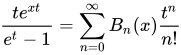
together with the normalization

This property follows from the difference equation and the integration formula , derived by Nørlund[13] and found in standard references.


To match this convention, the constant is fixed by requiring that the solution have zero mean over a unit interval. For the inverse backward difference one may use

and for the inverse forward difference

Example. For , the condition gives . Hence with , consistent with the Bernoulli normalization.


This normalization is not mandatory; in modern treatments the empty sum condition is usually preferred. This is usually used in context of Bernoulli polynomials, the Hurwitz or Riemann zeta functions, generalized harmonic number function, or when dealing with monomials.
Relationship to indefinite products


In the symbolic method developed by Niels Erik Nørlund and L. M. Milne-Thomson, the indefinite product operator serves as the multiplicative analog to the indefinite sum. It is defined by the first order homogeneous equation By taking the logarithm of the product formula, one obtains the telescoping identity .[24] This allows the indefinite product to be expressed through an indefinite sum:


where is an arbitrary periodic function of period 1.[25] This representation is valid provided a branch of the logarithm can be chosen so that is single-valued and its indefinite sum exists. Conversely, an indefinite sum may be represented as the logarithm of an indefinite product:


Gamma function and Gauss Pi function

For , the forward difference indefinite product is the solution of with the empty product normalization alongside Nørlund’s minimal growth. This yields the Gamma function which represents the discrete product


It can also be obtained by taking the Nørlund principal solution to the inverse forward difference: .[10] Exponentiating and choosing the empty product condition to set the constant then yields the Gamma function.
If one instead works with the backward difference indefinite product, satisfying and , the solution is the Gauss Pi function, , which extends directly and represents the discrete product .


The two conventions differ only by a shift of the argument (a property inherited from the relationship between and ): . The minimal imaginary growth condition in each case forces to be a constant , so the principal indefinite product of recovers the classical factorial extensions.


Expansions and definitions
Abel–Plana formula
The indefinite sum can be analytically continued by applying the standard Abel-Plana formula to the finite sum and then analytically continuing the integer limit to the variable . This yields the formula:[7]


This analytic continuation is valid when the conditions for the original formula are met. The sufficient conditions are:[16][17]
- Analyticity: must be analytic in the closed vertical strip between and . The formula provides the analytic solution up to, but not beyond, the nearest singularities of to the line
- Growth: must be of exponential type less than in this strip, satisfying for some , as


Example: Step size generalization
|
|---|
|
Let be a real step size and suppose satisfies the standard Abel–Plana conditions on the appropriate strips. Apply the Abel–Plana formula to the function with upper limit : Now subtract the last term from both sides, because : Simplify the boundary terms: In the real integral, substitute , , limits , : The imaginary part is already in a convenient form; by reordering the terms it becomes: Thus we obtain the step size generalization: where is a -periodic function. The expression satisfies and, with the empty sum convention (or up to another constant convention; being a constant function), defines the Nørlund principal solution where the growth condition on becomes type after the scaling. |


The Abel–Plana formula can be used to obtain the Nørlund principal solution on arbitrary disjoint connected components through the recurrence allowing one to shift the Abel–Plana formula’s domain of convergence, then repeatedly extend out of the original domain of convergence using the known valid domain of (which is known on the starting disjoint connected component) and (which is entirely known), again justified through rearrangement of the equation . This is under condition that a step size length (along the real axis) maximal vertical strip (extending infinitely in the imaginary directions) can be obtained while being singularity free and of less than (where is the step size) exponential type in the imaginary direction on . If such a strip cannot be established one must fall back to Laurent series or Taylor series expansions and sum term-wise.


Newton series
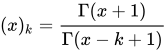
For an entire function of exponential type less than [26] the inverse forward difference operator, , can be expressed by its Newton series expansion: [27][28]


- is the falling factorial.
Bernoulli‑operator series expansion
Formally, the inverse forward difference operator can be expressed in terms of the derivative operator using the exponential generating function of the Bernoulli numbers:[19][20][21]


where are the Bernoulli numbers defined by the generating function . Under this convention .


If is a polynomial, only finitely many terms of the series are non-zero as the finite difference of a monomial is a polynomial of one degree lower (following by induction, finitely many terms are required). For one obtains the antidifference:[20]


where are the Bernoulli polynomials of the first order.[20]
If admits a Maclaurin series expansion , the antidifference of monomials in the series expansion yields the formal series:[21]
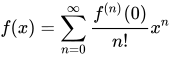

For non‑polynomials this expansion is generally asymptotic.
- Relation to the inverse backward difference
If one instead expands the inverse backward difference operator, (which extends ), it admits to the same expansion, but with in place of .


Euler–Maclaurin formula
The Euler–Maclaurin formula provides an asymptotic expansion for the inverse backward difference when the function is sufficiently smooth. For any positive integer , one has:[6][16]


where are the Bernoulli numbers (, ), and the remainder term is


with the periodized Bernoulli polynomial. The terms with odd vanish, so the sum effectively runs only over even indices. Choosing gives the form


with the remainder

The formula gives the analytic continuation of the discrete sum.
Laplace summation (Gregory summation formula)
Laplace’s summation formula, closely related to the Gregory summation formula, can be seen as the discrete counterpart to the Euler–Maclaurin formula. The inverse forward difference :[29][30][15][31]

- where are the Cauchy numbers of the first kind.

- is the falling factorial.
Truncating the series after terms leaves a remainder that can be expressed as an integral of times a periodic Bernoulli polynomial.[15][31] In the notation of Charles Jordan, Gregory’s formula is:[15]

where the coefficients are the Bernoulli numbers of the second kind. Note the argument is without a shift, aligning with the inverse backward difference.
![{\displaystyle {\begin{aligned}\sum _{x=a}^{z}f(x)&=\int _{a}^{z}f(x)\,dx\\&\quad -\sum _{m=1}^{n}b_{m}{\bigl [}\Delta ^{m-1}f(z)-\Delta ^{m-1}f(a){\bigr ]}\\&\quad -b_{n}\,(z-a)\,\Delta ^{n}f(\xi ),\quad a<\xi <z,\end{aligned}}}](https://wikimedia.org/api/rest_v1/media/math/render/svg/0cdba9a36a095b4087b958f5932d6ebe7c8a6d44)

Applications
The indefinite sum and its principal solution are fundamental to diverse fields, providing an analytic framework for extending discrete problems into the continuous and complex domains. Its applications span the construction of special functions, the regularization of divergent series in quantum field theory (e.g., the Casimir effect), performance analysis in queueing theory, scalar evolution in compilers such as LLVM or the GNU Compiler Collection, and various numerical and symbolic computational methods.
Special functions
Many standard transcendental functions are naturally defined as indefinite sums of elementary terms. Under the Nørlund principal solution—which imposes minimal exponential growth to eliminate arbitrary periodic components—these definitions coincide with the usual analytic continuations.
- The Gamma function follows from [10] and exponentiating to get the indefinite product, which, through the inverse backward difference variant gives the Gauss Pi function, .
- The digamma and more generally polygamma functions are obtained by the indefinite summation of reciprocal powers. From the recurrence [32], one obtains for .
- The power formula yields the Hurwitz zeta function;[11] with the zero-mean convention it reduces to the Bernoulli polynomials .[13]
- The beta function satisfies , meaning that serves as the indefinite sum of with respect to .[33]
- Sums of the form are expressed via the Lerch transcendent:[34]


which generalizes the generalized harmonic numbers. With the empty-sum convention and translating to (which becomes the extension of ), this becomes


Quantum field theory and the Casimir effect
In the mode-summation approach to the Casimir effect, vacuum expectation values involve divergent sums . The Abel–Plana formula—which provides an exact relation between a discrete sum and an integral—is a primary tool for isolating the divergent contribution. By subtracting the integral representation of the infinite-volume contribution, the formula yields a finite, cutoff-independent remainder for the Casimir energy and other observables.[35] For geometries where the eigenfrequencies are zeros of Bessel functions, the ordinary Abel–Plana formula is insufficient. The generalized Abel–Plana formula extends the indefinite sum to meromorphic summands with branch-point singularities and has been directly applied to regularise Casimir energies for spherical and cylindrical shells.[35][36]

Queueing theory and probability
First-order difference equations of the form or arise frequently in the analysis of stochastic queues. The Nørlund principal solution provides an explicit, analytically tractable solution for key performance measures, such as emptiness probabilities, waiting-time distributions, and blocking probabilities, while its minimal-growth condition automatically filters out non-physical, oscillatory 1-periodic components.[37] This framework is used in teletraffic engineering. For instance, the Erlang loss function , which gives the blocking probability for servers, is naturally extended from integral to real trunk counts via the Nørlund sum of its defining recurrence.[38] This analytic continuation enables the computation of continuous derivatives—such as —which are essential for gradient-based sensitivity analysis and optimization of trunk-group sizing in telecommunications networks, as derivatives are otherwise undefined over discrete server counts.[39] Similarly, in transient queue analysis, the Nørlund framework and its associated Euler-Maclaurin expansions allow the construction of simple, uniformly accurate approximations for time-dependent probabilities, such as the emptiness probability for the queue.[40]


Numerical analysis and symbolic summation
The indefinite sum underpins several foundational computational methods:
- The Euler–Maclaurin formula is an asymptotic expansion of , used to accelerate series convergence and to estimate errors in numerical quadrature.[16][6]
- Gosper’s algorithm[41] and Karr’s summation in finite terms[42] find closed-form indefinite sums of hypergeometric terms and are implemented in computer algebra systems.[43][44]
- The Gregory-Laplace summation formula expresses the indefinite sum in terms of finite differences and is particularly useful for numerical integration over equispaced data, providing an efficient alternative to traditional quadrature when high-order differences decay rapidly.[15][31]
Compiler scalar evolution
In compiler optimization, the scalar evolution (SCEV) analysis framework in LLVM[45] and GCC[46] utilizes chains of recurrences to model the values of induction variables inside loops. When a loop variable updates according to a relation of the form , SCEV represents its closed-form expression , where the sum is a finite sum over the loop iteration count. These closed forms allow the compiler to replace repeated computations with direct formulas, enabling strength reduction, loop-invariant code motion, and dependence analysis without iterative re-evaluation of the recurrence.[47]


See also
- Indefinite product
- Time scale calculus
- Faulhaber’s formula
- Special functions
- Analytic continuation
- Bernoulli polynomials
- List of indefinite sums
- Nörlund–Rice integral
- Finite difference
- List of derivatives and integrals in alternative calculi
References
- ^ Man, Yiu-Kwong (1993), “On computing closed forms for indefinite summations”, Journal of Symbolic Computation, 16 (4): 355–376, doi:10.1006/jsco.1993.1053, MR 1263873
- ^ Goldberg, Samuel (1986) [1958]. Introduction to Difference Equations, with Illustrative Examples from Economics, Psychology, and Sociology. New York: Dover Publications. p. 41. ISBN 978-0-486-65084-5. MR 0094249.
If is a function whose first difference is the function , then is called an indefinite sum of and denoted by .
- ^ Kelley, Walter G.; Peterson, Allan C. (2001). Difference Equations: An Introduction with Applications. Academic Press. p. 20. ISBN 0-12-403330-X.
- ^ a b c d e Nörlund, Niels Erik. Vorlesungen über Differenzenrechnung. Springer. pp. 40–44. ISBN 978-3-642-50514-0.
- ^ a b c Markus Müller and Dierk Schleicher, How to Add a Noninteger Number of Terms: From Axioms to New Identities, Amer. Math. Mon. 118(2), 136-152 (2011).
- ^ a b c Candelpergher, Bernard (2017). “Ramanujan Summation of Divergent Series” (PDF). HAL Archives Ouvertes. p. 3. Retrieved 2025-12-07.
- ^ a b Candelpergher, Bernard (2017). “Ramanujan Summation of Divergent Series” (PDF). HAL Archives Ouvertes. p. 23. Retrieved 2025-12-07.
- ^ Algorithms for Nonlinear Higher Order Difference Equations, Manuel Kauers
- ^ “Handbook of discrete and combinatorial mathematics”, Kenneth H. Rosen, John G. Michaels, CRC Press, 1999, ISBN 0-8493-0149-1
- ^ a b c d e f g Jordan, Charles (1960). Calculus of Finite Differences (Second ed.). New York, NY: Chelsea Publishing Company. pp. 104–107.
- ^ a b c Candelpergher, Bernard (2017). “Ramanujan Summation of Divergent Series” (PDF). HAL Archives Ouvertes. pp. 18–23.
- ^ “DLMF: §24.4 Basic Properties ‣ Properties ‣ Chapter 24 Bernoulli and Euler Polynomials”. dlmf.nist.gov. Retrieved 15 June 2026.
- ^ a b c Nörlund, Niels Erik. Vorlesungen über Differenzenrechnung. Springer. p. 19. ISBN 978-3-642-50514-0.
- ^ Kelley, Walter G.; Peterson, Allan C. (2001). Difference Equations: An Introduction with Applications. Academic Press. p. 24. ISBN 0-12-403330-X.
- ^ a b c d e Jordan, Charles (1960). Calculus of Finite Differences (Second ed.). New York, NY: Chelsea Publishing Company. pp. 284–285.
- ^ a b c d “§2.10 Sums and Sequences”. NIST Digital Library of Mathematical Functions. National Institute of Standards and Technology. Retrieved 2025-11-20.
- ^ a b Olver, Frank W. J. (1997). Asymptotics and Special Functions. A K Peters Ltd. p. 290. ISBN 978-1-56881-069-0.
- ^ a b c d Nörlund, Niels Erik. Vorlesungen über Differenzenrechnung. Springer. pp. 73–74. ISBN 978-3-642-50514-0.
- ^ a b Steffensen, J. F. (1950). Interpolation (2nd ed.). New York, NY: Chelsea Publishing Company. p. 192.
- ^ a b c d Milne-Thomson, L. M. (1933). The Calculus of Finite Differences. Macmillan and Co. pp. 139–140.
- ^ a b c Nörlund, Niels Erik. Vorlesungen über Differenzenrechnung. Springer. pp. 142–143. ISBN 978-3-642-50514-0.
- ^ Marichal, Jean‑Luc; Zenaïdi, Naïm (2024). “A generalization of Bohr‑Mollerup’s theorem for higher order convex functions: a tutorial”. Aequationes Mathematicae. 98 (2): 455–481. arXiv:2207.12694. doi:10.1007/s00010-023-00968-9.
- ^ Marichal, Jean‑Luc; Zenaïdi, Naïm (2022). A Generalization of Bohr‑Mollerup’s Theorem for Higher Order Convex Functions. Developments in Mathematics. Vol. 70. Springer. doi:10.1007/978-3-030-95088-0. ISBN 978-3-030-95087-3.
- ^ Nörlund, Niels Erik. Vorlesungen über Differenzenrechnung. Springer. p. 109. ISBN 978-3-642-50514-0.
- ^ Milne-Thomson, L. M. (1933). The Calculus of Finite Differences. Macmillan and Co. pp. 324–325.
- ^ Nörlund, Niels Erik. Vorlesungen über Differenzenrechnung. Springer. p. 237. ISBN 978-3-642-50514-0.
- ^ Newton, Isaac, (1687). Principia, Book III, Lemma V, Case 1
- ^ Iaroslav V. Blagouchine (2018). “Three notes on Ser’s and Hasse’s representations for the zeta-functions” (PDF). Integers (Electronic Journal of Combinatorial Number Theory). 18A: 1–45. arXiv:1606.02044. doi:10.5281/zenodo.10581385.
- ^ Bernoulli numbers of the second kind on Mathworld
- ^ Ferraro, Giovanni (2008). The Rise and Development of the Theory of Series up to the Early 1820s. Springer Science+Business Media, LLC. p. 248. ISBN 978-0-387-73468-2.
- ^ a b c Milne-Thomson, L. M. (1933). The Calculus of Finite Differences. Macmillan and Co. pp. 180–181.
- ^ Abramowitz, Milton; Stegun, Irene A. (2013). Handbook of mathematical functions: with formulas, graphs, and mathematical tables (9. Dover print. ed.). New York, NY: Dover Publ. p. 260. ISBN 978-0486612720. Retrieved 16 June 2026.
- ^ Jagerman, David L. (2000). Difference Equations with Applications to Queues. New York: CRC Press. p. 7. ISBN 978-0-8247-0388-2. Eq. (1.41).
- ^ Olver, Frank W. J. “§25.14 Lerch’s Transcendent”. DLMF. Retrieved 16 June 2026.
- ^ a b Saharian, A. A. (8 August 2007). “The generalized Abel-Plana formula with applications to Bessel functions and Casimir effect”. arXiv:0708.1187 [hep-th].
- ^ Fialkovsky, I. V. (2008). “Modification of Abel-Plana formula for functions with non-integrable branch-points”. Physica Scripta. 78 015012. arXiv:0710.5539. doi:10.1088/0031-8949/78/01/015012.
- ^ Jagerman, David L. (2000). Difference Equations with Applications to Queues. CRC Press. pp. 32–242. ISBN 978-0-8247-0388-2.
- ^ Jagerman, David L. (2000). Difference Equations with Applications to Queues. CRC Press. pp. 119–120. ISBN 978-0-8247-0388-2. Derivation of the continuous extension of the Erlang loss function.
- ^ Jagerman, David L. (2000). Difference Equations with Applications to Queues. CRC Press. pp. 129–131. ISBN 978-0-8247-0388-2. Derivative computation for the Erlang loss function and its approximation.
- ^ Jagerman, David L. (2000). Difference Equations with Applications to Queues. CRC Press. pp. 176–177. ISBN 978-0-8247-0388-2. Approximation sequence method for the M/M/1 transient solution.
- ^ Gosper, R. William (January 1978). “Decision procedure for indefinite hypergeometric summation”. Proceedings of the National Academy of Sciences of the United States of America. 75 (1): 40–42. doi:10.1073/pnas.75.1.40. PMC 411178.
- ^ Karr, Michael (April 1981). “Summation in Finite Terms”. Journal of the ACM. 28 (2): 305–350. doi:10.1145/322248.322255. Retrieved 2026-06-16.
- ^ “SymPy 1.14.0 documentation – Concrete module: gosper_sum”. SymPy. Retrieved 2026-06-16.
- ^ Weisstein, Eric W. “Gosper’s Algorithm”. MathWorld. Retrieved 2026-06-16.
- ^ LLVM Project. “ScalarEvolution.h – The scalar evolution analysis and transformation framework.” https://llvm.org/doxygen/ScalarEvolution_8h_source.html
- ^ GCC Project. “tree-scalar-evolution.h – Scalar evolution analysis.” https://github.com/gcc-mirror/gcc/blob/master/gcc/tree-scalar-evolution.h
- ^ Absar, J. (2018). “Scalar Evolution in LLVM.” LLVM Developers’ Meeting. https://llvm.org/devmtg/2018-04/slides/Absar-ScalarEvolution.pdf


Further reading
- “Difference Equations: An Introduction with Applications”, Walter G. Kelley, Allan C. Peterson, Academic Press, 2001, ISBN 0-12-403330-X
- Markus Müller. How to Add a Non-Integer Number of Terms, and How to Produce Unusual Infinite Summations
- Markus Mueller, Dierk Schleicher. Fractional Sums and Euler-like Identities
- S. P. Polyakov. Indefinite summation of rational functions with additional minimization of the summable part. Programmirovanie, 2008, Vol. 34, No. 2.
- “Finite-Difference Equations And Simulations”, Francis B. Hildebrand, Prenctice-Hall, 1968
External links
- Brian Hamrick: Discrete Calculus (PDF, 70 kB)
- Interactive visualization of the Nörlund principal solution for inverse backward differences. Implements Candelpergher’s analytic continuation (Abel-Plana formula with recurrence) for visualizing Nörlund’s principal solution.