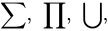
In mathematics, an iterated binary operation is an extension of a binary operation on a set S to a function on finite sequences of elements of S through repeated application.[1] Common examples include the extension of the addition operation to the summation operation, and the extension of the multiplication operation to the product operation. Other operations, e.g., the set-theoretic operations union and intersection, are also often iterated, but the iterations are not given separate names. In print, summation and product are represented by special symbols; but other iterated operators often are denoted by larger variants of the symbol for the ordinary binary operator. Thus, the iterations of the four operations mentioned above are denoted
- and , respectively.

More generally, iteration of a binary function is generally denoted by a slash: iteration of over the sequence is denoted by , following the notation for reduce in Bird–Meertens formalism.

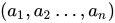

In general, there is more than one way to extend a binary operation to operate on finite sequences, depending on whether the operator is associative, and whether the operator has identity elements.
Definition
Denote by aj,k, with j ≥ 0 and k ≥ j, the finite sequence of length k − j of elements of S, with members (ai), for j ≤ i < k. Note that if k = j, the sequence is empty.
For f : S × S → S, define a new function Fl on finite nonempty sequences of elements of S, where

Similarly, define

If f has a unique left identity e, the definition of Fl can be modified to operate on empty sequences by defining the value of Fl on an empty sequence to be e (the previous base case on sequences of length 1 becomes redundant). Similarly, Fr can be modified to operate on empty sequences if f has a unique right identity.
If f is associative, then Fl equals Fr, and we can simply write F. Moreover, if an identity element e exists, then it is unique (see Monoid).
If f is commutative and associative, then F can operate on any non-empty finite multiset by applying it to an arbitrary enumeration of the multiset. If f moreover has an identity element e, then this is defined to be the value of F on an empty multiset. If f is idempotent, then the above definitions can be extended to finite sets.
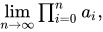
If S also is equipped with a metric or more generally with topology that is Hausdorff, so that the concept of a limit of a sequence is defined in S, then an infinite iteration on a countable sequence in S is defined exactly when the corresponding sequence of finite iterations converges. Thus, e.g., if a0, a1, a2, a3, … is an infinite sequence of real numbers, then the infinite product is defined, and equal to if and only if that limit exists.

Non-associative binary operation
The general, non-associative binary operation is given by a magma. The act of iterating on a non-associative binary operation may be represented as a binary tree.
Basic iterated operations
| Area of mathematics | Sum | Product | ||||||
|---|---|---|---|---|---|---|---|---|
| Name | Operation | Definition | Symbol | Name | Operation | Definition | Symbol | |
| Arithmetic | Summation | Addition | Sum of numbers | Iterated product | Multiplication | Product of numbers | ||
| Set theory | Union of a sequence of sets | Set union | All elements of sets | Intersection of a sequence of sets | Set intersection | Common elements | ||
| Logic | Existential quantifier | Disjunction | Disjunction of statements | Universal quantifier | Conjunction | Conjunction of statements | ||
| Category theory | Coproduct | Disjoint union | Coproduct of objects | Product | Cartesian product | Product of objects | ||


Notation
The iterated binary operation is written as:

Meaning of symbols:
| Symbol | Meaning |
|---|---|
| Iterated binary operation symbol | |
| Index variable | |
| Lower bound | |
| or | Upper bound |
| k-th element |


Example:

General form:

Restricted form:

Infinite version:

Properties
Let be a structure with associative operation :


- Single element:

- Expansion:

- Recursion:

- Right recursion:

- Splitting:

- Permutation invariance:

- Empty product (monoid):

- Idempotence:
- if , then


- Constant sequence:

Identity element and empty set
If is a Monoid, then:

- Empty product = identity element
- Empty sum = 0 (in arithmetic monoids)
Computer science
In functional programming, iterated binary operations correspond to higher-order functions such as fold or reduce.
See also
References
- ^ Saunders MacLane (1971). Categories for the Working Mathematician. New York: Springer-Verlag. p. 142. ISBN 0387900357.
External links
- Bulk action
- Parallel prefix operation Archived 2013-06-03 at the Wayback Machine
- Nuprl iterated binary operationsArchived 2016-03-03 at the Wayback Machine