Jaapi or Japi (Bodo: Khofri) is an Asian conical hat. It is made from tightly woven bamboo and/or cane and tokou paat (Trachycarpus martianus) a large, palm leaf. The word jaapi derives from jaap meaning a bundle of tokou leaves. In the past, plain jaapis were used by ordinary people in Assam and by farmers for protection from the sun, while ornate decorative jaapis were worn as a status symbol by the royalty and nobility. Decorative sorudoi jaapi are made with intricate cloth designs (primarily red, white, green, blue, and black) that are integrated into the weaving. The upper metal component attached to the top of a jaapi is known in Assamese as sula (Assamese: চূলা), described as a metal, cap-like ornament fixed to the top of the jaapi.[1]The Sula of Japis used by royalty and nobles were made of silver and gold.[2] Besides East and Southeast Asia, rain hats, similar to Jaapi, are spread throughout East India and Nepal, including Bengal, Terai, Chhattisgarh and Odisha. Tribes of Arunachal Pradesh like Mishmi and Adi also wear similar traditional headgear made of bamboo or cane.
Rain hat worn in tribal areas of Chattisgarh, similar to Japi.
History
The first historical evidence of the use of the conical hat as a royal item is found in relation to the Chutia kingdom. The medieval Chutia kings used the jaapi as a cultural symbol. The last Chutia king gifted gold and silver embroidered Jaapis (Kup-ngiun-kham) to the Ahom king Suhungmung (1497–1539) as presents in his attempts for a treaty in the year 1523.[3][4][5][6][7][8] After annexing Sadiya in 1524, the Ahom king received a lot of treasure and bounty, which included Jaapis.[9] In the year 1525, the Ahom king gifted some of the silver Jaapis obtained from the Sutiya king and other items, to negotiate peace with the Mongkawng chief Phukloimung, a Shan state in present Kachin State of Upper Myanmar (called Nora in Buranjis) who had attacked Sadiya.[10][11][12] During the Ahom rule, Jaapi-hajiya Khel (guild for making Jaapis) was monopolised by Chutias, which indicate that they were experts in weaving Jaapis.[13] Apart from this, the Baro-Bhuyans of Central Assam are also said to have used Jaapis. As per the Satsari Buranji, the Ahom kings adopted the Tongali, Hasoti and Tokou-patia Japi from the Baro-Bhuyans.[14]
Gallery
Upper metal part of an ancient Varun (Tupi) Japi known as Sula, used during the rule of Sutiya kings, kept in the Gharmora Satra.
Sarudaya jaapi.
A jaapi at Kalakhetra, Guwahati.
Jaapis made in Dhemaji.
Rain hat called Talari worn in Orissa, similar to Japi.
Rain hat in Terai region of Nepal, similar to Japi.
Rain hat, similar to Japi, called Mathal worn in Bengal region.
Cultural symbol
Today the jaapi is an important symbol of Assam and its culture. It is used during Bihu dance, as protection against the elements, offered as a sign of respect in ceremonies, and placed as a decorative item around the house especially in the walls as a welcome sign.[15][16]
Types
Sorudoi japi: Used by women, especially brides.
Bordoi japi: Used by royalty since ancient times (Kamrupa).
Panidoi/Haluwa japi: Used by farmers in fields.
Garakhiya japi: Used by cattle herders.
Pitha japi: Used as hoods, sometimes during cultivation.
^ “Then the Sutiyâ king desired to send silver and gold lipped Jâpi (Kup-ngiun-kham), gold bracelets (Mao-kham), gold basket (Liu-kham), gold ring (Khup-kham), gold bookstand (Khu-tin-kham), gold pirâ (Kham-ku), horse (Ma), elephant (Chang-pai), and two Âroans (Phra-nun) and Xorais (Phun) to the Ahom king.”(Jacquesson:12)
^“The Chutias were engaged in all kind of technical jobs of the Ahom kingdom. For example, the Khanikar Khel (guild of engineers) was always manneed by the Sutiyas. The Jaapi-Hajiya Khel (guild for making Jaapis) was also monopolished by them.”(Dutta 1985:30)

 Upper metal part of an ancient Varun (Tupi) Japi known as Sula, used during the rule of Sutiya kings, kept in the Gharmora Satra.
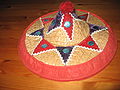 Sarudaya jaapi.
 A jaapi at Kalakhetra, Guwahati.
 Jaapis made in Dhemaji.
 Rain hat called Talari worn in Orissa, similar to Japi.
 Rain hat in Terai region of Nepal, similar to Japi.
 Rain hat, similar to Japi, called Mathal worn in Bengal region.


