| Part of a series on |
| Jainism |
|---|
 |

Jainism, one of the three most ancient Indian religious traditions still in existence, has very small presence (0.01%) in Kerala, in southern India. According to the 2011 India Census, Kerala has only around 4500 Jains, most of whom are found in the Wayanad and Ernakulam districts.[1]
While there is no direct evidence of Jainism in ancient Kerala, it is generally believed that Jain ideas may have spread to at least some parts of the region.[2] Medieval Jain records are mostly found on the borders of Kerala proper, such as in Wayanad in the north-east (on the Deccan Plateau) and in Alathur in the Palghat Gap. Epigraphical evidence suggests that the shrine at “Thirukkunavay”, perhaps located near Kodungallur, was the major Jain temple in Kerala (from c. 9th century CE).[3] In medieval Kerala, Jains are frequently associated with commercial activities.[2]
In Kerala, Jain viharas or temples, like those of Buddhists, Christians, and Muslims, were known as “Pallis”.[4] Some of the Jain temples on the Malabar Coast were incorporated into Hinduism at a later stage. The temple images are worshiped as Hindu gods and are considered part of the Hindu pantheon. Hindus and Jains occasionally worship their deities in the same temple in Kerala.[3][5]
History
Direct evidence for the presence of Jainism in ancient Kerala during the Iron Age/early historical period is absent; however, it is plausible that Jain ideas may have reached at least those regions of Kerala connected by established trade routes.[2]
In medieval Kerala
Medieval Jains in Kerala are often linked with trade activities. The group known as the “Forty Eight Thousand” appears to have been associated with Jain commercial networks in the region.[2]


Ilamko Adikal, who is traditionally credited as the author of the medieval Tamil epic peom Chilappathikaram, was a resident of a legendary Jain vihara called “Kunavayir Kottam”, which some scholars identify with Thirukkunavay or Thrikkana Mathilakam, now known as Mathilakam (Kodungallur), a village near Cochin.[3] Mathilakam was also mentioned as “Gunaka” and “Kunaka” in the medieval period (Kokasandesa, slokas 45-48).[3] Archaeological excavations conducted at Mathilakam in 1970 revealed an 8th-9th century CE foundation, structurally different in shape from standard Hindu temple foundations.[3]
Whether it was the same as the legendary temple at Kunavay or not, epigraphical evidence suggests that the temple at Thirukkunavay was the principal Jain temple in Kerala. It is believed that the so-called “Rules of the Thirukkunavay Temple” served as a model and precedent for other Jain temples along the Malabar Coast. A dating system known as the “Thirukkunavay Era” was also in use during this period.[3] Based on the Thazhekkavu Inscription, it is estimated that the Tirukkunavay Temple was founded in the late 7th or early 8th century CE.[6] By the 15th century, the Tirukkunavay Temple appears to have been converted into a Shiva temple, as indicated in Kokasandesa (slokas 47–48).[3] In the poem, the deity of Kunaka is referred to as “Purari”.[3] The exact location of the temple remains unknown to scholars, and it is likely that the structure was completely destroyed during the late medieval period.[3]
Inscriptions mentioning the Tirukkunavay Temple[3]
- Thiruvannur Inscription (Kozhikode): A medieval Chera inscription attributed to king Raja Raja, dated to 11th century CE. The temple is a now Shiva temple. Notably, it refers to the “Rules of the Thirukkunavay Temple”.[7]
- Alathur (Kothapuram) Inscription (c. 11th century CE): This record mentions the adhikarar of the Lord of Thirukkunavay. Images of Mahavira with the Gandharvas, as well as Parsvanatha, have been discovered at Alathur.[8][9]
- Thazhekkavu Inscription: Found at Thazhekkavu in Poothadi, Wayanad (dated in the 137th year of the Tirukkunavay Era; approximately the 9th century CE).[6]
- Kinalur Inscription (c. 11th century CE): An indirect reference to the Tirukkunavay Temple, mentioning Arappan Kunchi, the chieftain of Kurumbranad.[10]
Kallil, near Perumbavoor, appears to have been a old Jain temple. Reliefs or icons of Mahavira, Sidhayika, Padmavati (worshiped as the Bhagavati), and Parsvanatha can be found in the Kallil cave temple.[3] At Palliyara Kavu Bhagavati Temple in Paruvasseri, near Peechi, a Jain image is still worshipped as Lord Vishnu.[3]
Koodalmanikyam Temple in Irinjalakuda is believed to have been a Jain temple. It is assumed that it was dedicated to Digambara Bharateswara.[11][5] In Bangramanjeshwar in Kasaragod, two ancient Jain bastis continue to serve a small number of Jain families in the area.[5]

Jainism in modern Kerala
Some scholars argue that Bhagavati, a popular Hindu deity, was assimilated from Jain traditions. It is also suggested that snake worship, which is widespread in Kerala, may have been influenced by Jain belief systems. In addition, Jainism is believed to have influenced the architecture of traditional temples and mosques in Kerala.[5]
Old Jain families are found in the Wayanad and Kasaragod regions of northern Kerala. A few Jain Gujarati business families live in Alappuzha and Mattancherry.[5]
Some Jain temples located in modern-day Kerala are: Anantnath Swami Temple (Puliyarmala Jain Temple) in Puliyarmala, outside Kalpetta; Jain Temple, Kidanganad, Wayanad; Jainimedu Jain Temple; Kattil Madam Temple; Jain temple, Alappuzha; Kallil Temple in Perumbavoor; Kochi Jain temple, Mattancherry; Shri Vasupujya Swami Jain Temple, Srinivasa Mallan Road, Kochi; Cochin Digambar Jain Mandir, Panampilly Nagar, Kochi; Chathurmukha Basati, Manjeshwar; and Parswanatha Basati, Manjeshwar.
Photo gallery
-

-
-
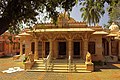
 Vishnugudi Jain Basadi (Wayanad)
 -

-

-
 Manjeshwara Jain Temple (Kasaragod)
 -

-
 Shri Vasupujya Swami Jain Temple (Ernakulam)
 -
 Jain image, Kidanganad Basti (Wayanad)


See also

References
- ^ “Census – Kerala (2011)”. Census India. Registrar General and Census Commissioner of India. 2011.
- ^ a b c d Gurukkal, Rajan; Varier, Raghava (2020) [2018]. History of Kerala: Prehistoric to the Present. Hyderabad: Orient Blackswan. pp. 58 and 102-103.
- ^ a b c d e f g h i j k l Narayanan, M. G. S. (2013) [1972]. Perumals of Kerala. Thrissur (Kerala): CosmoBooks. pp. 340–42 and 356-58.
- ^ Menon, A. Sreedhara (2022) [1967]. A Survey of Kerala History. Kottayam: DC Books. p. 135.
- ^ a b c d e Menon, A. Sreedhara (2022) [1967]. A Survey of Kerala History. Kottayam: DC Books. pp. 84–85.
- ^ a b Narayanan, M. G. S. (2013) [1972]. Perumals of Kerala. Thrissur (Kerala): CosmoBooks. pp. 340–42 and 474.
- ^ Narayanan, M. G. S. (2013) [1972]. Perumals of Kerala. Thrissur (Kerala): CosmoBooks. pp. 340-42 and 465.
- ^ Narayanan, M. G. S. (2013) [1972]. Perumals of Kerala. Thrissur (Kerala): CosmoBooks. pp. 340-42 and 495.
- ^ Gurukkal, Rajan; Varier, Raghava (2020) [2018]. History of Kerala: Prehistoric to the Present. Hyderabad: Orient Blackswan. pp. 107–108.
- ^ Narayanan, M. G. S. (2013) [1972]. Perumals of Kerala. Thrissur (Kerala): CosmoBooks. pp. 340–42 and 484.
- ^ Menon, A. Sreedhara (1978). Cultural Heritage of Kerala: An Introduction. Cochin: East West Publications.
External links
- Amma, B. Padmakumari (2008). Jain and Buddhist Centres in Kerala. Kuppam: Dravidian University.
- Varier, M. R. Raghava (2016). Jainamatham Keralathil. Kottayam: Sahithya Pravarthaka Co-operative Society.
See also : Jain temples in North America | |
| Bihar | |
| Delhi | |
| Gujarat | |
| Jharkhand | |
| Karnataka | |
| Kerala | |
| Madhya Pradesh | |
| Maharashtra | |
| Nagaland | |
| Odisha | |
| Rajasthan | |
| Tamil Nadu | |
| Telangana | |
| Uttar Pradesh | |
| West Bengal | |


| Gods | |||||
|---|---|---|---|---|---|
| Philosophy | |||||
| Branches |
| ||||
| Practices | |||||
| Literature | |||||
| Symbols | |||||
| Ascetics | |||||
| Scholars | |||||
| Community |
| ||||
| Jainism in |
| ||||
| Jainism and | |||||
| Dynasties and empires | |||||
| Related | |||||
| Lists | |||||
| Navboxes | |||||
