In mathematics, the K-function, typically denoted K(z), is a generalization of the hyperfactorial to complex numbers, similar to the generalization of the factorial to the gamma function.
Definition
There are multiple equivalent definitions of the K-function.
The direct definition:
![{\displaystyle K(z)=(2\pi )^{-{\frac {z-1}{2}}}\exp \left[{\binom {z}{2}}+\int _{0}^{z-1}\ln \Gamma (t+1)\,dt\right].}](https://wikimedia.org/api/rest_v1/media/math/render/svg/92baaaf4dc396046aef97cda91dd4f102aa06973)
Definition via
![{\displaystyle K(z)=\exp {\bigl [}\zeta '(-1,z)-\zeta '(-1){\bigr ]}}](https://wikimedia.org/api/rest_v1/media/math/render/svg/12668025758db5c6b204ac5b1f43c1e8e05785a5)
where ζ′(z) denotes the derivative of the Riemann zeta function, ζ(a,z) denotes the Hurwitz zeta function and

Definition via polygamma function:[1]
![{\displaystyle K(z)=\exp \left[\psi ^{(-2)}(z)+{\frac {z^{2}-z}{2}}-{\frac {z}{2}}\ln 2\pi \right]}](https://wikimedia.org/api/rest_v1/media/math/render/svg/527eb0c1daf22e5bb0b92ff2ff331e64b68f597e)
Definition via balanced generalization of the polygamma function:[2]
![{\displaystyle K(z)=A\exp \left[\psi (-2,z)+{\frac {z^{2}-z}{2}}\right]}](https://wikimedia.org/api/rest_v1/media/math/render/svg/e7e5a0771140cd752c427198127287d5cc8b0466)
where A is the Glaisher constant.
It can be defined via unique characterization, similar to how the gamma function can be uniquely characterized by the Bohr-Mollerup Theorem:
Let be a solution to the functional equation , such that there exists some , such that given any distinct , the divided difference . Such functions are precisely , where is an arbitrary constant.[3]



![{\displaystyle f[x_{0},x_{1},x_{2},x_{3}]\geq 0}](https://wikimedia.org/api/rest_v1/media/math/render/svg/8c0cd26e190d4f5b18250e540cf85b9a25d78d8d)


Properties
For α > 0:

Let
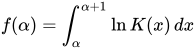
Differentiating this identity now with respect to α yields:

Applying the logarithm rule we get
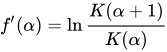
By the definition of the K-function we write
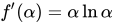
And so

Setting α = 0 we have
![{\displaystyle \int _{0}^{1}\ln K(x)\,dx=\lim _{t\rightarrow 0}\left[{\tfrac {1}{2}}t^{2}\left(\ln t-{\tfrac {1}{2}}\right)\right]+C\ =C}](https://wikimedia.org/api/rest_v1/media/math/render/svg/b8e8c9ffa5aadcb54c1d1df9e5a769e78d7fa08a)
Functional equations
The K-function is closely related to the gamma function and the Barnes G-function. For all complex ,


Multiplication formula
Similar to the multiplication formula for the gamma function:

there exists a multiplication formula for the K-Function involving Glaisher’s constant:[4]

Integer values
For all non-negative integers,where is the hyperfactorial.


The first values are
References
- ^ Adamchik, Victor S. (1998), “PolyGamma Functions of Negative Order”, Journal of Computational and Applied Mathematics, 100 (2): 191–199, doi:10.1016/S0377-0427(98)00192-7, archived from the original on 2016-03-03
- ^ Espinosa, Olivier; Moll, Victor Hugo (2004) [April 2004], “A Generalized polygamma function” (PDF), Integral Transforms and Special Functions, 15 (2): 101–115, doi:10.1080/10652460310001600573, archived (PDF) from the original on 2023-05-14
- ^ Marichal, Jean-Luc; Zenaïdi, Naïm (2024). “A Generalization of Bohr-Mollerup’s Theorem for Higher Order Convex Functions: a Tutorial” (PDF). Bitstream. 98 (2): 455–481. arXiv:2207.12694. doi:10.1007/s00010-023-00968-9. Archived (PDF) from the original on 2023-04-05.
- ^ Sondow, Jonathan; Hadjicostas, Petros (2006-10-16). “The generalized-Euler-constant function γ(z) and a generalization of Somos’s quadratic recurrence constant”. Journal of Mathematical Analysis and Applications. 332: 292–314. arXiv:math/0610499. doi:10.1016/j.jmaa.2006.09.081.