Kalinjar is a fortress-city in Banda district[1] of Uttar Pradesh, India. It was ruled by several dynasties, including the Guptas, the Vardhana dynasty, the Chandelas, Solankis of Rewa, Mughals and the Marathas.
The fortress has several temples dating back to the Gupta dynasty of the 3rd–5th centuries. It is strategically located on an isolated rocky hill at the end of the Vindhya Range, overlooking the plains of Bundelkhand.[2]
Kalinjar Fort[3] is located on the Vindhya mountain range in Banda district. The fort is famous for its strong walls and massive gates. It houses several ancient temples, among which a Shiva temple holds special significance. The Neelkanth Mahadev Temple of Kalinjar is considered very ancient and sacred. According to legend, it is believed that Lord Shiva consumed the poison that emerged during the churning of the ocean (Samudra Manthan) at this very place. Every year, a fair is held here on the occasion of Kartik Purnima.
Name
Kalinjar was historically known as Kālañjara, from Sanskrit kāla, meaning “time”. The 17th-century Mahābhārata commentator Nīlakaṇṭha Caturdhara interpreted the name as “one who destroys or subdues [the effects of] time”. At least later on, this was connected to Shiva‘s role as the lord of time; for example, Kalinjar is mentioned in the opening lines of the Rauravasūtrasaṃgraha as the abode of Sadāśiva, “the lord of time… the creator of time, the knower of time”.[4]: 280, 282
History
Kalinjar was already an important pilgrimage centre in early times. It is mentioned three times in the Mahābhārata: twice in the Tīrthayātrāparva in Book 3 and once in the list of tīrthas in Book 13. The first reference in Book 3 describes Kālañjara as “a famous place where one should bathe at the Devahrada” and says that if one dies by performing prāyopaveśa (self-starvation at the end of life when old and ailing) at Kālañjara, one’s ātman rises straight up to heaven. The second mention identifies Kālañjara as the site of Hiraṇyabindu, the ashram (spiritual retreat) of the revered sage Agastya. The reference in Book 13 mentions another place called Ṣaṣṭihrada at Kālañjara. These verses indicate the presence of one or more sacred pools at Kalinjar, which could refer to any of the many natural pools on the mountain. However, there is no indication in the Mahābhārata of any sort of connection with Shiva.[4]: 280
Another early mention is in the Harivaṃśa, which is considered an appendix to the Mahābhārata. The Harivaṃśa contains a story of seven brahmins who are reborn at Kālañjara as seven deer who, after living lives devoted to dharma, remember their past lives at Kālañjara and die by performing prāyopaveśa. They are then reborn as cakravākas in a place called Sariddvīpa. This episode may be depicted at Kalinjar at a site called Mṛgadhārā, on the south side of the fort, where there are images of seven deer along with some Gupta-period inscriptions in the rock. These seven deer are also referred to in the local Kālañjaramahātmyā.[4]: 280–1
By the Gupta period, Kalinjar had definitely become a site of Shiva worship: two terracotta seals from this period, found at Bhita near Allahabad, mention the name Kālañjara along with depictions of lingas, indicating the presence of a Shiva temple here. By the time of the Skanda Purāṇa's composition, Kalinjar had become a major centre of Shaivism: Kālañjara is included in the Skanda Purāṇa's list of Shiva’s abodes, which says, “One who has seen the liṅga at Mount Kālañjara, the dwelling of Umāpati, obtains the result of an aśvamedha and reaches Rudraloka.” The Skanda Purāṇa also includes the story of the seven brahmins reincarnated as deer, albeit with some minor changes. The Skanda Purāṇa also contains the story of Shiva saving his devotee Śveta from death and making him one of his gaṇas (divine attendants); although this story is usually set at Kalinjar, most recensions of the Skanda Purāṇa do not mention Kalinjar explicitly, instead referring to it as “Krodheśvara”, a name not used elsewhere. Two recensions of the Skanda Purāṇa, though, do explicitly describe this episode as taking place at Kālañjara. Several other Purāṇas also contain this story, such as the Kūrma Purāṇa, Liṅga Purāṇa, and the Viṣṇudharmottara Purāṇa.[4]: 280–3
Kalinjar is also included in the pañcāṣṭaka lists of Shaiva pilgrimage sites, which appear in many tantric sources (mostly from the Śaiva Siddhānta tradition), as well as the pre-tantric Śivadharmaśāstra. A pre-Angkorian inscription from Prasat Preah Theat in Cambodia also refers to a linga called “Kālañjaleśvara”, which is probably a reference to Kalinjar.[4]: 282
Mythology
Kalinjar finds its mention in ancient Hindu mythological texts. According to Hindu legends, it is said that after the Samudra manthan, when Shiva consumed poison that turned his throat blue, he came to Kalinjar and defeated the kaal i.e. achieved victory over death. This is the reason why Shiva temple at Kalinjar is called Neelkanth (blue-throated). Since then, the hill has been considered a holy site.[5][6]
Early history
Kalinjar has also been mentioned in Buddhist literature, particularly in the travelogues of Buddha. The Chedi dynasty ruled here during the time of Gautama Buddha (563–480 BC). Following this, it was absorbed into the Maurya Empire and came to be known as Vindhya-Atavi.[7]
The fort eventually came under the rule of the Shunga dynasty and the Pandu dynasty. In the Prayag Prasathi inscription of the Allahabad Pillar this region is mentioned by the name Vindhya Atavi. The Fort was in the control of the Gurjara Pratiharas, and remained until the rule of Nagabhatta II. Chandela rulers used to be their Mandalik kings. The mention of Kalinjar is found in almost every text or inscription of that time.[8]
Medieval period
According to the 16th century Persian historian Firishta, the town of Kalinjar was established by one Kedar Raja in the 7th century. Rastrakutas later seized the fortress. The fort came to prominence during the Chandela rule. According to Chandela-era legends, the fort was built by a Chandela ruler.[9] The Chandela rulers used the title Kalanjaradhipati (lit. ‘Lord of Kalanjara‘), which shows their importance to the fort.[10]
In 1023, Mahmud of Ghazni attacked and received a tribute from Kalinjar,[11][12] Mughal emperor Babur captured the fort in 1526, when his forces drove away Raja Hasan Khan Mewatpatti. It was also the place where Sher Shah Suri met his death in 1545, when he was mortally wounded by a gunpowder explosion from one of his own cannons, with his soldiers capturing the fort before his death.[13][14][15] In 1569, Akbar captured the fort and it was under Mughal rule until its capture by the Marathas. Kalinjar played a prominent part in history down to the time of the Revolt of 1857, when it was held by a small British garrison. Both the fort and the town, which stands at the foot of the hill, are of interest to the antiquary on account of the remains of temples, sculptures, inscriptions, and caves.[2]

In the early 18th century, the fort was captured by the Peshwa Bajirao after defeating the Mughal general Bangash Khan of Allahabad. In order to stop the Mughals from entering Bundelkhand again, he established a Maratha light infantry huzurat of 5000 under the command of Sardar Ram Singh Bhatt, Yashwantrao Bhatt, Parshuram Bhau Bundela, Bhaskar Pandit, and Sheshrao Pant Bundela, all veterans of war and Maratha class one generals. In due course of time, the Marathas conquered the nearby territories and expanded to the Bengal frontiers. They inflicted a crushing defeat on Awadh ally Nawab of Rampur and Ala Vardi Khan.[citation needed]
The fort was used to levy chauth to nearby territories like Benares, Mirzapur, Pratapgarh, Kunda, and Bundela.
Colonial period
In 1803, the Peshwa was involved in direct skirmishes with the East India Company in which he was defeated. In the Treaty of Surji-Anjangaon, Peshwa Bajirao II ceded Bundelkhand to the East India Company after his defeat in the Second Anglo-Maratha war. The fort came under the management of the East India Company in 1805–06. The Old Bhatt royalty was expatriated and was granted separate sanads of Kirwi, Attra, Chitrakut Mathond, and Khurand.
The fort was placed under the pre-Maratha constitution of Bundela – Jhijhotiya Chubes. However, during the first War of Independence in 1857, The Old Bhatta Aristocracy recaptured the fort driving Bundela back to Ajaygarh. In 1858, the British attacked the fort but the people at large resisted and fought a tough battle with Major Hugh Rose. A long drawn siege ensued in which almost 800 British and 3000 Indians were killed. This proved to be the toughest battlefield in Bundelkhand where English suffered maximum casualties. The English with the help of the states of Panna and Rewa captured this fort on 4 May 1858. The Last Bhatta Peshwas surrendered and were sent to Rewa as prisoners. Kalinjar subah was distributed in between Bundela, Rewa Solanki and Chaubes of Rajaula. The fort was decommissioned and its buildings were demolished, to prevent any further maratha garrisoning at Kalinjar, thus ending the legacy of this fort. The total chauth collection was estimated at 40 lakh shahi mohars. The Naukahai campaign of Rewa and Chunar Fort, was launched directly from Kalinjar in which the Sohagpur Amarkantak and Shahdol paragana were attached to Peshwa territories. Almost all the occupants of the fort were moon worshipers and are called Chandravanshi clans of Kshatriya, Brahmanas, Kalchuries and Yadavas.[citation needed]
In 1812, the British troops marched into Bundelkhand, and after a long battle, they were able to annex the fort. The British seizure of Kalinjar proved to be a great watershed, transferring the legacy of the old aristocracy into the hands of the new bureaucracy of officials, who showed their loyalty to British imperialism by damaging the captured fort. The damages caused to the fort can still be seen on its walls and open spaces.[citation needed]
Structures in the Fort
Following structures have been identified in the fort.[3]

- 1. Alam /Alamgiri Darwaz
- 2. Ganesh Darwaza
- 3. Chandi/Chauburji Darwaza
- 4. Budhabhadra Darwaza
- 5. Gate leading to Balkhandi Mahadeo
- 6. Hanuman Darwaza
- 7. Hanuman Kund
- 8. Lal Darwaza
- 9. Bada Darwaza
- 10. Bhairon Kund
- 11. Sita Sej
- 12. Sita Kund
- 13. Patal Ganga
- 14. Pandu Kund
- 15. Budhbhadra talao (“Budhi Budha/Burhiya)
- 16. Pani ki Aman_ kund
- 17. Bhagwan Sej
- 18. Sidh ki Gupha
- 19. Koth Tirth
- 20. Raja Aman Singh Palace
- 21. Islam Shah mosque
- 22. Sanichar Talao
- 23. Qanati mosque I
- 24. Graveyard
- 25. Tomb
- 26. Tomb
- 27. ‘Rani Mahal’ & ‘Venkat Biihari Mandir’
- 28. Rang Mahal
- 29. Bijli Talao
- 30. Ram Katora talao (“Ramna”)
- 31. Dak Bungalow I
- 32.Taliyya Talao
- 33. Parmardi Deva Gate of Nilkantha Temple
- 34. Nilkantha Temple
- 35. Mrigdhara
- 36. Bhairon ka Jhirka
- 37. Panna Gate
Transport links
Air
The nearest airport is at Khajuraho, 100 km (62 mi) away but has limited connectivity. Kanpur Airport which is well connected with metropolitan cities of India is 175 km (109 mi) and 4 hours drive from Kalinjar.[5]
Rail
The nearest railway station is at Atarra 36 km (22 mi) away, on the Banda-Satna route, 65 km (40 mi) from Banda Railway Station.[5]
Road
The Kalinjar fort is linked by road to all the important centres in the region with regular bus services. Some of the major road distances are: Chitrakoot, 78 km (48 mi); Banda, 65 km (40 mi); Khajuraho, 130 km (81 mi); and Prayagraj, 205 km (127 mi).[5]
Gallery
-
 Pillared building at one corner of Kalinjar Fort
 -
 Kuvera riding on his vehicle, near temple of Nilkanth
 -
 Architectural details from temple of Nilkanth
 -
 Kurma avatar
 -
 Varaha avatar
 -
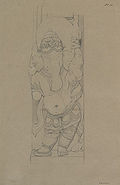 Sculpture of Ganesh from temple of Nilkanth
 -
 Neelkanth Mandir view from top
 -
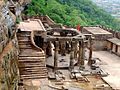 Temple in the Fort
 -
 Fort (inside view)
 -
 Pillar inside Rani Palace, Kalinjar Fort
 -
 Gateway of Nilakanth temple in Kalinjar fort
 -
 Gajasursamharamurti and Parvati bas-relief, Kalinjar Fort


See also
References
- ^ “Kalinjar Fort | District Banda, Government of Uttar Pradesh | India”. Archived from the original on 15 September 2021. Retrieved 15 September 2021.
- ^ a b One or more of the preceding sentences incorporates text from a publication now in the public domain: Chisholm, Hugh, ed. (1911). “Kalinjar“. Encyclopædia Britannica. Vol. 15 (11th ed.). Cambridge University Press. p. 642.
- ^ a b Rezavi, Syed Ali Nadeem. “Kalinjar”. Internet Archive. Proceeding of Indian History Congress. Retrieved 23 March 2026.
- ^ a b c d e Bisschop, Peter C. (2013). “Two Pre-Chandella Inscriptions from Kālañjara”. Indo-Iranian Journal. 56 (3/4): 279–94. Retrieved 19 April 2026.
- ^ a b c d “Kalinjar Fort”. Govt of Uttar Pradesh.
- ^ Safvi, Rana (19 March 2017). “Peace and belonging in an ancient land”. The Hindu. Archived from the original on 15 September 2021. Retrieved 15 September 2021.
- ^ पाण्डेय, विमल चन्द्र, प्राचीन भारत का इतिहास, मेरठ, १९८३-८४, पृ.६३
- ^ पौराणिक एवं ऐतिहासिक ग्रन्थों में वर्णित कालिंजर Archived 2017-03-01 at the Wayback Machine। कालिंजर-षष्टम अध्याय।(पीडीएफ) कु.रमिता- शोध कार्य।शोध पर्यवेक्षक:प्रो.बी.एन.राय।ज.लाल नेहरु महाविद्यालय, बांदा।२१ अगस्त, २००१।
- ^ Edwin Felix T. Atkinson (1874). Statistical, descriptive and historical account of the North-western Provinces of India, ed. by E.T. Atkinson [and others]. pp. 449–451.
- ^ Finbarr Barry Flood (2009). Objects of Translation: Material Culture and Medieval “Hindu-Muslim” Encounter. Princeton University Press. p. 80. ISBN 978-0-691-12594-7.
- ^ Iqtidar Alam Khan, Ganda Chandella, Historical Dictionary of Medieval India, (Scarecrow Press, 2007), 66.
- ^ Raj Kumar, History Of The Chamar Dynasty : (From 6th Century A.D. To 12th Century A.D.), (Kalpaz Publications, 2008), 127.
- ^ Mikaberidze, Alexander (22 July 2011). Conflict and Conquest in the Islamic World: A Historical Encyclopedia [2 volumes]: A Historical Encyclopedia. ABC-CLIO. p. 830. ISBN 978-1-59884-337-8. Archived from the original on 16 November 2023. Retrieved 30 October 2023.
- ^ Ali Khan, Zulfiqar (1925). Sher Shah Suri, Emperor of India. Civil and Military Gazette Press. p. 100.
- ^ Chandra, Satish (2007). History of Medieval India: 800–1700. Orient BlackSwan. p. 220. ISBN 978-81-250-3226-7. Archived from the original on 10 March 2023. Retrieved 30 October 2023.


| National | |
|---|---|
| Other | |
