
Kroj (Czech pronunciation: [ˈkroj]; plural: kroje) is a folk costume worn by Czechs and Slovaks. Gothic influence is seen in tying shawls and kerchiefs on the head. Fine pleats and gathered lace collars typify the Renaissance era. From Baroque bell-shaped skirts to delicate Slavic patterns, these folk costumes show the complex growth of Czech and Slovak traditions.
Types
Kroje had many regional variants with typical decorations and/or colours. There are three basic types of kroj:
- the simple one, used in everyday life that looks very similar in all regions.
- the celebration one, used for Sunday masses, feasts etc.
- the wedding one – used only by a bride or a groom. As it was not reasonable to have a one-purpose clothing, it was often a celebration one upgraded by typical wedding accessories.
A full women’s kroje set usually consists of a basic linen undergarment, several petticoats (number depending on the region), a skirt, an apron, a blouse, a vest, and some kind of long-sleeved coat or jacket for the colder seasons as well as a shawl. In some places the vest and skirt are attached together as one piece. A married woman’s kroje would also include a ‘cap’, a piece of decorated fabric that served to cover the hair after marriage. All usually include a basic headscarf to cover the hair with. This signified marriage, but was also used as sun protection for the head while working outdoors, and to cover a woman’s head while in church. Some kroje also include jewellery: strings of pearls and/or glass beads are particularly prolific, and some localities also used small seed beads.
During a wedding, a woman may also wear a ‘parta’, a type of wedding headdress that usually includes items like flowers (sometimes made of paper or wax), sequins, coins, beads, ribbons, or colourful dyed wool. After the wedding ceremony, this headdress is removed and replaced with the married woman’s cap and headscarf. This symbolizes the transition of a young woman from unmarried to married.
Men’s kroje usually consist of a basic lower-body linen undergarment, pants, shirt, vest, coat or jacket, hat, and belt. The pants and shirt could include regional embroidery and decorative elements. The cut of the men’s shirts and vests tend to differ from the woman’s, and are usually bigger in length and width. The placement and type of embroidery may also differ. Men’s kroje are percieved as having less ornamentation, but this depends on region and affected by the type of work that a man might do for a living. Men spent more time working outdoors or travelling long distances for work, so clothing had to be practical, easily repairable, and resistant to the elements. Like women, the men’s celebration and wedding kroje were usually more ornate and decorative in style and often included elements like traditional tools and weapons. Both men and women wore either leather boots (for those who could afford them), lace-up shoes made of leather (krpce), or simply bare feet.
Kroje are often made from natural fabrics and materials, such as linen, hemp, cotton and wool. They were originally coloured with natural dyes coming from plants and food, and many of the ornamentations and embroidery styles come from nature inspired motifs, like native flora and fauna, as well as pre-christian symbolism. The materials were often handspun and woven on a traditional loom, but wealthier families could buy them instead. When manufactured cloth became available to more people, materials such as brocades, velvet, and satins became more popular, particularly for wedding and celebration kroje and especially in regions closer to urban centres and cities where coming by such fabrics was easier and less costly. In the rural regions, natural handspun fabrics were cheaper and therefore many of those costumes still retain the use of hand-woven elements.
In some areas, an indigo batik resist dyeing was used to produce women’s skirts, which produced beautiful white patterns on a deep-blue fabric and could be achieved by a resist-dyeing technique that used specialized plates and a wax resist paste. Wax-resist dyeing was a familiar technique for many peasants in this part of Europe, because it is also used to decorate easter eggs in areas of Slovakia, Poland and Ukraine. This type of fabric became incredibly popular and examples of this technique can be found in a large number of villages, particularly in Slovakia. Skirts in general often feature heavy pleating and shaping, which served to reduce fabric visibility, increase warmth, but also produces a beautiful effect during traditional dances where the skirt fans out widely when a woman spins or turns. There is usually a section of the front piece of the skirt that remains unpleated, because it is normally covered by the apron. While the length of young women’s skirts became much shorter during the inter and post-second World War period, traditionally they were longer (although not as long as the skirts for older women). The bell-shaped skirt is also a relatively recent development, it evolved during the Baroque period and replaced the longer Renaissance style skirt that had a somewhat straighter shape. This skirt style can still be seen in some mountainous areas inhabitad by Gorals and Rusyns.
While sewing patterns for kroje remain relatively structurally similar across Central and Eastern Europe due to the way fabric was produced and cut, the decorative elements of each one are often distinct, with each village maintaining its’ own style of ornamentation and embroidery. Features like pleating, lace, buttons, embroidery, beads and ribbons are used not only to identify the region one is from, but convey specific meanings about the status of the person who is wearing it. For example, whether the wearer is single, married, with or without children, the economic status of the family, etc. Kroje or pieces of it were also often repaired and passed down from older to younger family members, making it sometimes possible to identify not just the village or micro-region a person came from, but also to whom they were related to in this place. Ethnic minority groups within Czech and Slovak modern borders often also carry their own unique style of kroje ornamentation. Therefore, kroje is not just necessarily a ‘costume’, but an important ethnographic resource that holds a wealth of information about the wearer and the maker.
Kroje are no longer worn by people in the Czech Republic and Slovakia often, usually reserving them for feasts and celebrations, or folklore festivals.
Kroje started being replaced by modern clothing during the 19th century: it started in bigger cities, and towns and villages followed. It began in more industrial places in Bohemia with men specifically, so in old photos it is possible to see a father in a suit, but a mother (and possibly children) in a kroj. The last regions where kroje were worn on everyday or almost everyday basis were regions near the border between Moravia and Slovakia – Moravian Slovakia, Horňácko, Moravian Wallachia – where old women could be seen wearing kroje even in the second half of 20th century.
Gallery
-
 A couple wearing traditional Bohemian kroj from Prácheňsko area
 -
 The folk costume of kroj seen in Vlčnov in Moravian Slovakia
 -
 Kroje from Moravian Wallachia
 -
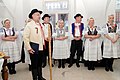 Folk costumes of Slovakia
 -
 Slovak kroj from the Hont region
 -
 Czech Americanized kroj from Ennis, Texas, 1976


Sources
- A promotional brochure from the National Czech & Slovak Museum & Library[1]