[4][5] It is made from fish and sago flour and seasoned with salt and sugar. It is slightly greyish and gives off a fishy taste and smell which becomes more prominent as it cools down after frying.[6]
Origin and background
The fish cracker has its origin in the area of the east coast of West Malaysia, specifically Terengganu,[7] where it was created by Malay fishermen as a way to preserve fish during the monsoon season.[8] The word lekor means “circumference” in the Terengganu Malay dialect, which replaces the spelling “ar” with “or” at the end of the syllable.[9] Therefore, the meaning of keropok lekor is a “circular cracker” or “to roll”.[9] Within the states of Terengganu as well as Kelantan, the snack has been a profound symbol of local Malay cultural identity.[10]
Preparation
It is usually made by grinding fish from the species of ikan tamban (silver-stripe round herring), sardine (Sardinella aurita) or selayang (Rastrelliger kanagurta) or vegetables into a paste, mixing it with either sago or tapioca starch, salt, sugar as well as monosodium glutamate (MSG) and then deep-frying it.[11] It comes in three main forms: lekor goreng (long and chewy), lekor rebus (steamed), and lekor keping (thin and crispy), divided into either fried or steamed.[12] The former are sausage-shaped and fried, with a chewy texture, whereas the latter is boiled. Keropok lekor should not be confused with keropok keping. The snack is eaten with special homemade chilli blends that are particular to Terengganu and sold there;[4] though modern innovations like adding mayonnaise and cheese sauce (the combination known locally as “keropok cheese”) may also be available.[8]
Gallery
 Lekor cut into pieces.
 A freshly made lekor in Gadong, Brunei.
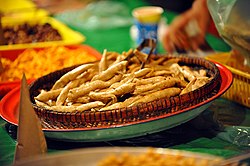 Freshly fried lekor being sold at a gerai (Malay traditional stalls).
 A plate of lekor with a dipping sauce.


See also


References
- ↑ (Mohd Tamsir et al. 2021, p. 77)
- ↑ “KEROPOK LEKOR” [LEKOR CRACKERS]. National Department for Culture and Arts, Malaysia. 2016. Archived from the original on 8 December 2017. Retrieved 8 December 2017.
- ↑ “Keropok Lekor”. Fat Secret, Australia. Archived from the original on 18 June 2026. Retrieved 18 June 2026.
- 1 2 “KEROPOK LEKOR” [LEKOR CRACKERS]. Tourism Terengganu. Archived from the original on 18 June 2026. Retrieved 20 August 2013.
- ↑ “Fish Crackers”. Department of Fisheries, Malaysia. Archived from the original on 16 August 2014. Retrieved 22 May 2014.
- ↑ Nana (22 June 2009). “Keropok Lekor, Anyone?” (Malaysia Footsteps ed.). Archived from the original on 22 May 2014. Retrieved 22 May 2014 – via Tourism Malaysia.
- ↑ “Keropok lekor”. TasteAtlas. Archived from the original on 18 June 2026. Retrieved 18 June 2026.
- 1 2 Magenthiran, Lavanyah. “Keropok Lekor: The Savory Malaysian Fish Snack”. Munch Malaysia. Archived from the original on 18 June 2026. Retrieved 18 June 2026.
- 1 2 Abu Bakar & Hanafiah 2018, p. 2.
- ↑ Osman, Ling & Abdul Salam 2025, p. 38.
- ↑ (Mohd Tamsir et al. 2021, p. 78)
- ↑ “Keropok lekor” [Lekor crackers]. Beautiful Terengganu. Archived from the original on 18 June 2026. Retrieved 18 June 2026.
Bibliography
- Abu Bakar, Muhamad Rafiq; Hanafiah, Muammar Ghaddafi (2018). “Perusahaan Keropok Lekor Makanan Tradisi Melayu Terengganu” [Lekor Crackers Industry Traditional Malay Food Terengganu] (PDF). Jurnal Wacana Sarjana (in Malay). 2 (3): 1–7. Archived (PDF) from the original on 18 September 2023 – via UKM Journal Article Repository.
- Mohd Tamsir, Marina; Ramli, Nurul Shazini; Ab Rashid, Nor Khaizura Mahmud; Shukri, Radhiah; Ismail-Fitry, Mohammad Rashedi (2021). “COMPARISON OF BOILING, STEAMING, AIR FRYING, DEEP-FRYING, MICROWAVING AND OVEN-COOKING ON QUALITY CHARACTERISTICS OF KEROPOK LEKOR (MALAYSIAN FISH SAUSAGE)”. Malaysian Applied Biology. 50 (3): 77–85. doi:10.55230/mabjournal.v50i3.2000. Archived from the original on 19 June 2026 – via UKM Journal Article Repository.
- Osman, Muhammad Redzuan; Ling, Leong Lai; Abdul Salam, Norlida (2025). “Keropok Lekor: Exploring Tradition, Innovation, and Challenges” (PDF). Journal of Science and Management Research. 15 (1): 33–48. eISSN 2600-738X. Archived (PDF) from the original on 19 June 2026 – via Widad University College.

| Foods |
|  |
|---|---|---|
| By location | ||
| Mobile catering | ||
| Lists |
| |