| Lists of folk music traditions |
|---|
This is a list of Asian folk music traditions, with styles, dances, instruments and other related topics. The term folk music can not be easily defined in a precise manner; it definitions depending on the author, and on audience and context within a work. Similarly, the term traditions in this context does not connote any strictly defined criteria. Music scholars, journalists, audiences, record industry individuals, politicians, nationalists and demagogues may often have occasion to address which fields of folk music are distinct traditions based along racial, geographic, linguistic, religious, tribal or ethnic lines, and all such peoples will likely use different criteria to decide what constitutes a “folk music tradition”. This list uses the same general categories used by mainstream, primarily English-language, scholarly sources, as determined by relevant statements of fact and the internal structure of works.
These traditions may coincide entirely, partially or not at all with geographic, political, linguistic or cultural boundaries. Very few, if any, music scholars would claim that there are any folk music traditions that can be considered specific to a distinct group of people and with characteristics undiluted by contact with the music of other peoples; thus, the folk music traditions described herein overlap in varying degrees with each other.
Central and Northern Asia
-
 A doshpuluur, a traditional Tuvan instrument
 -
 Traditional Uzbek music and dance
 -
 A Turkish mandolin-banjo
 -
 A Turkish baglama
 -
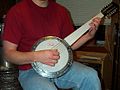 A Turkish cümbüş


South Asia
-
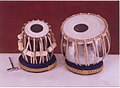 The tabla, an Indian drum

Southeast Asia
East Asia
| Country | Elements | Dance | Instrumentation | Other topics |
|---|---|---|---|---|
| Ainu | rekuhkara – upopo – yukar | bear ceremony | Ainu fiddle – mukkuri – pararayki – tonkori | |
| China | Chinese opera – chuigushou – Guandong – jiangnan sizhu – nanguan | banhu – bawu – dizi – erhu – gaohu – gong – guan – guqin – guzheng – huqin – konghou – mangtong – pipa – ruan – sheng – suona – xiao – xindi – xun – yangqin – zhonghu – zhongruan | shijing – yuefu | |
| Japan | biwa – koto – shakuhachi – shamisen – taiko | |||
| Korea | chongak – jeongak – nongak – pansori – pungmul – salpuri – sanjo – sinawi – | ajaeng – buk – daegeum – danso – gayageum – geomungo – haegeum – janggu – piri – taepyeongso | ||
| Ryukyuan/ Okinawan | koten – min’yō – uzagaku – warabe uta – yunta | eisā – kachāshī | fue – hyōshigi – kūchō – kutu – pāranku – sanba – sanshin | |
| Tibetan[22] | hua’er – lhamo – lu | sword dance | dramnyen – dung chen – gyümang – lingbu – piwang – rag-dung – rgya-gling | Ge-sar – Gelgpa |
| Yunnan | baisha xiyue – dongjing – | lezuo | bawu – hulusi – hulusheng – lusheng – mabu – tuhu |
References
- Broughton, Simon; Mark Ellingham, eds. (2000). Rough Guide to World Music (First ed.). London: Rough Guides. ISBN 1-85828-636-0.
- Karolyi, Otto (1998). Traditional African & Oriental Music. Penguin Books. ISBN 0-14-023107-2.
- Killius, Rolf (2006). Ritual Music and Hindu Rituals of Kerala. B.R. Rhythms. ISBN 81-88827-07-X.
- Kinney, Troy & Margaret West (1935). The Dance: Its Place in Art and Life. Tudor Publishing.
- Manuel, Peter (1988). Popular Musics of the Non-Western World. New York: Oxford University Press. ISBN 0-19-505342-7.
- Philip V. Bohlman; Bruno Nettl; Charles Capwell; Thomas Turino; Isabel K. F. Wong (1997). Excursions in World Music (Second ed.). Prentice Hall. ISBN 0-13-230632-8.
- Fujie, Linda; James T. Koetting; David P. McAllester; David B. Reck; John M. Schechter; Mark Slobin; R. Anderson Sutton (1992). Jeff Todd Titan (ed.). Worlds of Music: An Introduction to the Music of the World’s Peoples (Second ed.). New York: Schirmer Books. ISBN 0-02-872602-2.
- “International Dance Glossary”. World Music Central. Archived from the original on February 7, 2006. Retrieved April 3, 2006.
Notes
- ^ Hagopian, Harold, “The Sorrowful Sound” in the Rough Guide to World Music, pgs. 332 – 337
- ^ a b c d e f Sultanova, Razia and Simon Broughton, “Bards of the Golden Road”, in the Rough Guide to World Music, pgs. 24 – 32
- ^ Includes the music of Tuva; Rees, Helen, with Zhang Xingrong and Li Wei, “Sounds of the Frontiers”, in the Rough Guide to World Musics, pg. 44 – 48; Pegg, Carole, “Sixty Horses in My Herd”, in the Rough Guide to World Music, pgs. 189 – 197
- ^ Manuel, Popular Musics, pgs. 163 – 165
- ^ Broughton, Simon and Tatiana Didenko, “Music of the People” in the Rough Guide to World Music, pgs. 248 – 254
- ^ Broughton, Simon, “Kings and Queens of the Road” in the Rough Guide to World Music, pgs. 146 – 158
- ^ a b c d e f g h i j Hunt, Ken and Simon Broughton, “Everything Is Left Behind” in the Rough Guide to World Music, pgs. 94 – 101
- ^ The Rough Guide refers to dandiya as on “folk-based”
- ^ World Music Central Archived 2006-07-11 at the Wayback Machine
- ^ a b Tingey, Carol, “The Hills Are Alive”, in the Rough Guide to World Music, pgs. 196 – 202
- ^ World Music Central Archived 2006-07-11 at the Wayback Machine; Hunt, Ken and Simon Broughton, “Everything Is Left Behind” in the Rough Guide to World Music, pgs. 94 – 101
- ^ Ganhewa, Lalith, “Sounds of Serendipity”, in the Rough Guide to World Music, pgs. 230 – 234
- ^ Sutton, R. Anderson, “Asia/Indonesia” in Worlds of Music, pgs. 266 – 317
- ^ a b c d Munan, Heidi, “Music at the Crossroads”, in the Rough Guide to World Music, pgs. 175 – 182
- ^ Clewley, John, “Beyond Our Khaen”, in the Rough Guide to World Music, pgs. 170 – 174
- ^ Manuel, Popular Musics, pgs. 207, 213; Bass, Colin, “No Risk – No Fun!”, in the Rough Guides to World Music, pg. 131 – 142
- ^ a b c Clewley, John, “Songs for Living”, in the Rough Guide to World Music, pgs. 241 – 253
- ^ Clewley, John, “Heavenly Dancers”, in the Rough Guide to World Music, pgs. 20 – 23
- ^ Clewley, John, “Beyond Our Khaen”, in the Rough Guide to World Music, pgs. 170 – 174; Clewley, John, “Songs for Living”, in the Rough Guide to World Music, pgs. 241 – 253
- ^ Manuel, Popular Musics, pg. 200; Blackburn, Philip, “Ancient Rock Music”, in the Rough Guide to World Music, pgs. 262 – 269
- ^ Blackburn notes that nhac dan toc cai bien is a form of “modernised folk music (that) has only been traditional since 1956, when the Hanoi Conservatory of Music was founded and the teaching of folk music was deliberately “improved” (quotes in original).
- ^ Rees, Helen, with Zhang Xingrong and Li Wei, “Sounds of the Frontiers”, in the Rough Guide to World Musics, pgs. 44 – 48; Trewin, Mark, “Raising the Roof”, in the Rough Guide to World Musics, pgs. 254 – 261; Karolyi, pgs. 176, 179