| Part of a series on |
| Punjabis |
|---|
 |
 Punjab portal |
Majha (romanized: Mājhā; Punjabi pronunciation: [mäˑ˩˥.dʒˑäː]; from “mañjhlā” lit. ‘middle‘)[note 1][1] is a region located in the central parts of the historical Punjab region, presently split between the republics of Pakistan and India.[2] It extends north from the right banks[note 2] of the river Beas, and reaches as far north as left bank of the river Ravi.[2]
The Majha region was partitioned between India and Pakistan in 1947. It includes four districts of Indian state of Punjab — Amritsar, Tarn Taran, Gurdaspur, and Pathankot. In the Pakistani province of Punjab, the Majha region proper includes Lahore and Kasur districts. However, it is not uncommon to include the districts of Gujranwala (including Hafizabad and Wazirabad), Sialkot (including Narowal) and Sheikhupura (including Nankana Sahib) — located in the Upper Rachna Doab — in the Majha area as well.[1][3]

People of the Majha region are given the demonym “Mājhī” or “Majhail”. Most inhabitants of the region speak the Majhi dialect, which is the basis of the standard register of the Punjabi language in Indian Punjab.[4] The most populous city in the area is Lahore on the Pakistani side, and Amritsar on the Indian side of the border. Majha is also the birthplace of Sikhism.[1]
Geography and culture

The Majha region includes four districts of the Indian state of Punjab — Amritsar, Tarn Taran, Gurdaspur, and Pathankot and the districts of Lahore and Kasur in the Pakistani province of Punjab in the Bari Doab. However, it is not uncommon to include the districts of Gujranwala (including Hafizabad and Wazirabad), Sialkot (including Narowal) and Sheikhupura (including Nankana Sahib) — located in the Upper Rachna Doab — in the Majha area as well.[1][5]
The Majha region is called the “Sword Arm of the Country”, due to it contributing disproportionately to the officer as well as orderly ranks of the armies of both India and Pakistan.[6] The Sikh Empire was founded in the Majha region, and so the region is also sometimes referred to as “the cradle of the brave Sikhs”.[7]
Tourist attractions
- Wagah-Attari border ceremony, border ceremony between India and Pakistan
India
- List of tourist attractions in Amritsar
- Gurdwara Sri Tarn Taran Sahib, Tarn Taran
- Harike Pattan bird sanctuary, Tarn Taran
- Ranjit Sagar Dam, Pathankot
Pakistan
- List of tourist attractions in Lahore
- Gurdwara Darbar Sahib Kartarpur, Kartarpur
- Gurdwara Janam Asthan, Nankana Sahib
- Hiran Minar, Sheikhupura
- Changa Manga forest, Kasur
Photo gallery
-

-
-
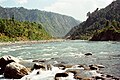
 Emperor Akbar crowning platform, Kalanaur, Gurdaspur
 -

-
-
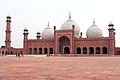
 Lahore Fort, Lahore
 -
 Lahore Museum, Lahore
 -

-
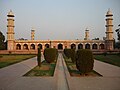 Tomb of Jahangir, Lahore


See also
- Doaba, cultural region in Punjab, India
- Bar, cultural region in Punjab, Pakistan
- Pothwar, cultural region in Punjab, Pakistan
- Malwa, cultural region in Punjab, India
- Poadh, cultural region in India
- The Punjab Doabs, geographic regions in Punjab
Notes
References
- ^ a b c d e Singh, Harbans, ed. (2011). “MĀJHĀ”. The Encyclopedia Of Sikhism. Vol. III M–R (Third ed.). Punjabi University Patiala. pp. 23–24. ISBN 978-8-1-7380-349-9.
- ^ a b Arora, Mohit; Gujarati, Ashwin; Chandel, Sumita; Pateriya, Brijendra (12 July 2023). “Assessment of River Water Dynamics and Optically Active Water Quality Parameters Over Punjab, Based on Cloud Computing Approach”. In Rai, Praveen Kumar (ed.). Advances in Water Resource Planning and Sustainability. Springer Nature. p. 43. ISBN 978-981-99-3660-1.
Majha is the region located in the central parts of the historical Punjab and is split between India and Pakistan. It is situated between the right bank of the river Beas and left bank of the river Ravi. Majha Region in Indian Punjab has four districts, viz., Amritsar, Gurdaspur, Tarn Taran, and Pathankot.
- ^ Sharamā, Rādhā (2000). Peasantry and the State: Early Nineteenth Century Punjab. K.K. Publishers and Distributors. p. 10. ISBN 978-81-86912-03-4.
- ^ Advanced Centre for Technical Development of Punjabi Language, Literature and Culture, Punjabi University, Patiala Punjabi University, Patiala.
- ^ Sharamā, Rādhā (2000). Peasantry and the State: Early Nineteenth Century Punjab. K.K. Publishers and Distributors. p. 10. ISBN 978-81-86912-03-4.
- ^ Mahmood, Cynthia Keppley (1996). Fighting for Faith and Nation: Dialogues with Sikh Militants (Contemporary Ethnography), p. 153. Philadelphia, University of Pennsylvania.
- ^ Sandhu, Gulzar Singh (2004). Gods on Trial and Other Stories, p. 132. Diamond Pocket Books. ISBN 8128808087
| Topics |  | |
|---|---|---|
| Administration | ||
| Culture |
| |
| Divisions |
| |
| Districts | ||
| Major cities | ||

| International | |
|---|---|
| National | |
