Shri Manguesh temple is Hindu temple in India, located at Mangueshi in Priol, Ponda taluk, Goa.[1] It is at a distance of 1 km from Mardol close to Nagueshi, 21 km from Panaji the capital of Goa,[1] and 26 km from Margao. Shree Mangueshi is the Kuldeva (family deity) of Saraswat Brahmins and other gotras. Shrimad Swamiji of Shri Kavale Math is Spiritual chief Of Shri Manguesh Saunsthan, Mangueshi. This temple is one of the largest and most frequently visited temples in Goa.[2]
From 2011, temple prescribed a dress code, to keep the sanctity of the temple premise.[3]
Legend
According to folklore, Lord Shiva left Mount Kailash after losing a game of dice to his wife Goddess Parvati and settled in the jungles of Kushasthali (modern-day Cortalim). When Parvati came searching for him, Shiva transformed into a tiger to frighten her. Terrified, Parvati cried out, Trahi Mam Girisha! (“Save me, O Lord of the Mountains!”). Shiva immediately returned to his original form. The phrase “Mam Girisha” eventually evolved into the name Manguesh.
History
This temple was originally located in Kushasthali (present-day Cortalim), a village in Mormugão which fell to the Portuguese in 1543. In the year 1560, when the Portuguese started Christian conversions in Mormugao taluka, the Saraswat Brahmins of Kaundinya Gotra and Vatsa Gotra moved the Mangesh idol from the original site at Kushasthali on the banks of the river Aghanashini (Zuari) (Sancoale) to its present location at Mangueshi in Priol village of Atrunja Taluka, which was then ruled by the Hindu kings of Sonde of Antruz Mahal (Ponda), to be more secure.[4]
Since the shift, the temple has been rebuilt and renovated twice during the Maratha rule and again in 1890. The final renovation took place in 1973, when a golden kalasha (holy vessel) was fitted atop the tallest dome of the temple.[1]
The original site was a very simple structure, and the current structure was only built under the Maratha Empire, some 150 years after it had been moved. The Peshwas donated the village of Mangeshi to the temple in 1739 on the suggestion of their Sardar, Shri Ramchandra Malhar Sukhtankar, who was a staunch devotee of Shri Mangesh. Just a few years after it was built, this area fell into Portuguese authority in 1763.[5] By then, the Portuguese had lost their initial religious zeal and had been repeatedly defeated by the Marathas and had become quite tolerant of other religions, and so, this structure remained untouched.[6]
Deities
Main Deity

The main temple is dedicated to Shiva as Manguesh. The god is worshipped here as a Shiva linga. [1]
He is the Kuladevata of the Goud Saraswat Brahmins of Vatsa and Koundinya Gotras.[7]
Other deities
The complex also has shrines of other deities in the temple, including Nandi, Ganesha, Parvati and the Gramapurusha Deva Sharma of the Vatsa gotra. The subsidiary shrines to the rear of the main building house Devtas like Mulakeshwar, Virabhadra, Shantadurga, Lakshmi Narayan, Surya, Garuda and Kala Bhairav.
Legend
The Mangesh Linga is said to have been created in the Himalayas on Mount Mangireesh (Mongir) on the banks of the river Bhagirathi by the creator deity Brahma, from where the Saraswat Brahmins brought it to Trihotrapuri in Bihar. They carried the linga to Gomantaka and settled at Mormugao, on the banks of the Zuari river, at Kushasthali (modern day Cortalim) and initially established the temple there, before the Portuguese invasions forced the linga to be moved again to its current location in Manguesh.[citation needed]
Temple complex
The temple architecture consists of several domes, pilasters and balustrades. There is a prominent Nandi idol and a beautiful seven-storeyed deepastambha (lamp tower), which stands inside the temple complex in Saraswat Architectural style. The temple also has a magnificent water tank, which is believed to be the oldest part of the temple.[8]
The Sabha Mandapa is a spacious hall that accommodates over 500 people. The decor includes the chandeliers of the nineteenth century. The central part of the Sabha Mandapa leads to the Garbha Griha (main sanctum), where the Manguesh idol is enshrined.
Rituals
Daily rituals
Like most temples in Goa, Mangueshi Temple has a large number of pujas being performed daily. Every morning, Shodashopachara pujas, namely Abhisheka, Laghurudra and Maharudra, are performed. This is followed by Maha-Aarti at noon and Panchopachara pooja at night.
Every Monday, the procession idol of Manguesh is taken out for a procession in a palanquin (pallaki) accompanied by music before the evening Aarti.[citation needed]
Festivals
The annual festivals include Rama Navami, Akshaya Tritiya, Anant Vritotsava, Navaratri, Dussehra, Diwali, Magha Poornima Festival (Jatrotsav) and Mahashivaratri. Magha Poornima Festival begins on Magha Shukla Saptami and ends on Magha Poornima (full moon night of the Magha month).[9]
Gallery
| Part of a series on |
| Hinduism |
|---|
 |

-
 View Of the Temple on a cloudy day
 -
 Night View
 -
 A photo showing the Gopuram, temple and Deep Stambha.
 -
 Shri Mangirish Math, located near the entrance path towards the temple
 -
 Entrance towards Shri Mangueshi Temple
 -
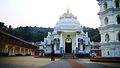 View of the Shri Mangueshi Temple from the front
 -
 View of the Shri Mangeshi Temple water tank
 -
 Shri Mangeshi Temple Rath (Temple Chariot)


See also
References
- ^ a b c d Department of Tourism, Government of Goa, India – Manguesh Temple, Priol
- ^ David Abram (2003). Goa. Rough Guides. pp. 107–. ISBN 978-1-84353-081-7.
- ^ “Goa temple bans entry of foreigners, others impose dress code”. NDTV.com.
- ^ “Shri Mangesh Devasthan”.
- ^ Teotonio R. De Souza (1 January 1989). Essays in Goan History. Concept Publishing Company. pp. 20–. ISBN 978-81-7022-263-7.
- ^ Manekar, Kamla (2003). Culture and Religious Traditions in Temples of Goa. Publication Division, Ministry of Information and Broadcasting, Government of India. pp. 45–52. ISBN 81-230-1161-X.
- ^ Baidyanath Saraswati (1984). The Spectrum of the Sacred: Essays on the Religious Traditions of India. Concept Publishing Company. pp. 138–. GGKEY:SPH4CJ0Y60Z.
- ^ Amelia Thomas; Amy Karafin (2009). Goa and Mumbai. Lonely Planet. pp. 134–. ISBN 978-1-74104-894-0.
- ^ “Welcome to Shri Mangeshi’s Devasthan on the Internet!”. www.shrimangesh.org. Archived from the original on 4 December 2004.