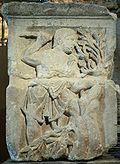
Nabia (or Navia) was a goddess of the Pre-Roman peoples of the Iberian Peninsula, although she also had an extended cult during the Roman occupation of the peninsula.[1][3]
Nabia was worshipped in many places on the Iberian Peninsula, sometimes in very different ways, leading some historians to suggest that “Nabia” was just a common word used by different peoples to refer to their deities (a theory questioned by others).[4][page needed] Due to the uncertainty of her nature, she is sometimes interpreted as a water deity,[1][2] other times she is associated with valleys, forests and hills,[5] and she’s further seen as the goddess of fertility, health, and abundance.[1][6]
Her name, including variations, is attested in 28 inscriptions as of 2025.[7]
References
- ^ a b c d Byghan, Yowann (2026-05-14). Goddesses of the World: From Prehistory to Modern Cultures and Religions. McFarland. p. 54. ISBN 978-1-4766-9981-3.
- ^ a b Ferreira, Daniela Filipa de Freitas (2022). Os Deuses foram honrados : o contributo da epigrafia votiva para o entendimento das manifestações religiosas no contexto da ocupação romana da Beira Interior Portuguesa (in Portuguese). Universidade do Porto. Faculdade de Letras. doi:10.21747/978-989-9082-09-0/deu. ISBN 978-989-9082-09-0.
- ^ Estudios sobre la tabula siarensis, Anejos de Archivo Español de Arqueología IX, Madrid, 1988, p. 264.
- ^ MELENA, José L. Un ara votiva romana en el Gaitán, Cáceres, 1984.
- ^ Los Dioses de la Hispania Céltica, Madrid, 2002.[page needed]
- ^ “Um balneário com 3 mil anos”. Público (in Portuguese). 2007-03-27. Archived from the original on 2023-04-26.
- ^ Ruiz, José María Vallejo; González-Rodríguez, M.ª Cruz (2025). “De dioses y hombres: teónimos, grupos humanos y topónimos en el occidente hispano romano” [About Gods and Men: Theonyms, Human Groups and Place Names in the Roman Hispanic West]. Palaeohispanica (in Spanish). 25: Actas del XV Coloquio de Lenguas y Culturas Paleohispánicas: 581–600 [583]. doi:10.36707/palaeohispanica.v25i1.701.
Further reading
- Olivares Pedreño, Juan Carlos. “El culto a Nabia en Hispania y las diosas polifuncionales indoeuropeas“. In: Lucentum, ISSN-e 1989-9904, Nº 17-18, 1998-1999, págs. 229-242. ISSN 0213-2338.
- Prósper, Blanca María. “El nombre de la diosa lusitana Nabia y el problema del betacismo en las lenguas del occidente peninsular“. In: Ilu 2 (1997): 141-149.