

Norman architecture is the style of Romanesque architecture developed by the Normans in the 11th and 12th centuries. In particular the term is traditionally used for English Romanesque architecture. The Normans introduced large numbers of castles, and at the same time monasteries, churches and cathedrals, in a style characterised by rounded arches and heavy proportions compared to other regional variations of the style. The style was developed in Normandy, and brought to England and Wales after the Norman Conquest. It was also used later by Anglo-Norman settlers in Ireland, and by Scottish rulers adopting English fashions. The Normans also conquered Sicily and southern Italy, but the architecture they used there was distinct from that of Normandy and Britain, as it blended local Islamic and Byzantine influences.[1]
Name
The use of term “Norman” to refer to architecture may have originated with eighteenth-century antiquarians, but its usage in a sequence of styles has been attributed to Thomas Rickman in his 1817 work An Attempt to Discriminate the Styles of English Architecture from the Conquest to the Reformation. In this work he used the labels “Norman, Early English, Decorated, and Perpendicular”. The more inclusive term “Romanesque” was used of the Romance languages in English by 1715,[2] and was applied to architecture of the eleventh and twelfth centuries from 1819.[3] The style is also referred to as ‘Anglo-Norman’, reflecting the substantial English contributions to its development.

History
Normandy
Viking invaders (‘Northmen’) arrived at the mouth of the river Seine in Normandy in 911, at a time when Franks were fighting on horseback and Frankish lords were building castles. Over the next century the population of the territory ceded to the Vikings (now called Normans) adopted these customs as well as Christianity and the langue d’oïl. Norman barons built timber castles on earthen mounds, beginning the development of motte-and-bailey castles, and great stone churches in the Romanesque style of the Franks. By 950, they were building stone keeps. The Normans were among the most travelled peoples of Europe, exposing them to a wide variety of cultural influences which became incorporated in their art and architecture. They elaborated on the early Christian basilica plan. Their churches were originally longitudinal with side aisles and an apse. They then began to add towers, as at the Church of Saint-Étienne at Caen, in 1067. This would eventually form a model for the larger English cathedrals some 20 years later, after they had invaded and conquered England.
England and Wales

In England, Norman nobles and bishops had influence before the Norman Conquest of 1066, and Norman influences affected late Anglo-Saxon architecture. Edward the Confessor was brought up in Normandy and in 1042 brought masons to work on the first Romanesque building in England, Westminster Abbey. This building was entirely replaced in the 13th century, but from excavations and a depiction in the Bayeux Tapestry something of its form is known. It appears to have been derived from that of Jumièges, in Normandy. In 1051 he brought in Norman knights who built “motte” castles as a defence against the Welsh.

Barring these early exceptions. Romanesque architecture was introduced to England after the Norman Conquest of 1066. The Normans gradually replaced every English bishop except for Wulfstan of Worcester, rebuilt every English cathedral, starting with Canterbury after a fire in 1067, and almost every monastic church, and built hundreds of new parish churches. They cemented their rule with a series of castles, to protect the new aristocracy. However, there was overlap between Anglo-Saxon and Norman architecture, as some Saxon masons worked in misunderstood versions of contemporary French architecture (as at Great Paxton and St Bene’t’s, Cambridge), while some Saxon features continued to be used by local masons after the Conquest (like triangular arches in the gatehouse of Exeter Castle).[4][5] As few minor buildings have documentary evidence for dating, it is possible that many ‘Saxon’ churches, e.g. in Norfolk, are in fact ‘Saxo-Norman‘, i.e. they post-date the Conquest.[6]
After a fire damaged Canterbury Cathedral in 1174 William of Sens, a French master mason, introduced the new Gothic architecture from France. Around 1191 Wells Cathedral and Lincoln Cathedral brought in the English Gothic style, and Romanesque architecture had virtually disappeared by the early 13th century.
Scotland

Scotland also came under early Norman influence with Norman nobles at the court of King Macbeth around 1050. Malcolm III overthrew him with English and Norman assistance, and his queen, Margaret, encouraged the church. The Benedictine order founded a monastery at Dunfermline. Her sixth and youngest son, who became King David, built St. Margaret’s Chapel at the start of the 12th century. He founded a series of large abbeys near the English border, of which Jedburgh and Kelso still retain significant Norman work. He may also have built the large stone keep at Carlisle Castle, which was then part of Scotland. In contrast to the imposing abbeys, the only large Scottish cathedral to have survived from Norman times is Kirkwall on Orkney, which was under Norwegian control.
Ireland

The Normans first landed in Ireland in 1169, though the Irish were already building Hiberno-Romanesque churches, such as Cormac’s Chapel on the Rock of Cashel. Within five years earthwork castles were springing up, and in a further five, work was beginning on some of the earliest of the great stone castles. For example, Hugh de Lacy built a motte-and-bailey castle on the site of the present day Trim Castle, County Meath, which was attacked and burned in 1173 by the Irish king Ruaidrí Ua Conchobair. De Lacy, however, then constructed a stone castle in its place, which enclosed over three acres within its walls, and this could not be burned down by the Irish. The years between 1177 and 1310 saw the construction of some of the greatest of the Norman castles in Ireland. The Normans settled mostly in an area in the east of Ireland, later known as the Pale, and among other buildings they constructed were Swords Castle in Fingal (North County Dublin) and Carrickfergus Castle in County Antrim.[7] The term ‘Norman’ is also sometimes used to refer to castles like Dublin and Limerick, but architecturally these are Gothic, not Romanesque.
Features

Norman arches are semicircular in form. Early examples have plain, square edges; later ones are often enriched with zig-zag and roll mouldings.[8] The arches are supported on massive columns, generally either formed of clusters of smaller shafts or cylindrical, sometimes with incised decoration (most famously at Durham Cathedral); occasionally, square-section piers are found. Main doorways have a succession of receding semicircular arches, termed orders, often decorated with mouldings, typically of chevron or zig-zag design; sometimes there is a tympanum under the arch, which may feature sculpture representing a Biblical scene. Carving can also be found on capitals, which were usually of cushion form; the finest English capital carving is in the crypt of Canterbury Cathedral.[9] Norman windows are mostly small and narrow, generally of a single round-headed light; but sometimes, especially in a bell tower, divided by a shaft into two lights.[10] While most Norman buildings are now bare stone, they would have been plastered and painted. Norman murals survive at several churches including Canterbury Cathedral, St Albans Cathedral, Chaldon, Ickleton and the group of Sussex churches referred to as the Lewes group.[11]
The buildings show massive proportions in simple geometries using small bands of sculpture. The cruciform churches often had deep chancels and a square crossing tower which has remained a feature of English ecclesiastical architecture.
Transitional style

As master masons developed the style and experimented with ways of overcoming the geometric difficulties of groin vaulted ceilings, they introduced features such as the pointed arch that were later characterised as being Gothic in style. Architectural historians and scholars consider that a style must be assessed as an integral whole rather than an aggregate of features, and while some include these developments within the Norman or Romanesque styles, others describe them as ‘Transitional’ or “Norman–Gothic Transitional”. Examples include St Davids Cathedral, Ripon Cathedral, Cartmel Priory, the west end of Worcester Cathedral, and many Cistercian abbey churches like Byland, Fountains, Kirkstall and Roche.
Examples
Normandy
- Abbaye aux Dames, Caen
- Abbaye aux Hommes, Caen
- Cerisy Abbey
- Jumièges Abbey
- Lessay Abbey
- Mont-Saint-Michel
-
 Abbaye aux Hommes, Caen
 -
 Cerisy Abbey
 -
Jumiegès Abbey church
-
 Mont-St-Michel nave


England and Wales
Ecclesiastical
- Bury St Edmunds Abbey, Suffolk (11th-12th centuries); ruins and tower
- Holy Sepulchre, Cambridge (c.1130), a rare round church
- Canterbury Cathedral, Kent (1070-1126): crypt, outer walls of east end and many monastic buildings
- Carlisle Cathedral (from 1122): truncated nave and transepts
- Castle Acre Priory, Norfolk (consecrated 1146 or 1148)
- Chepstow Priory, Monmouthshire (from 1072): nave
- Christchurch Priory, Hampshire (from 1094): nave and transepts
- St Botolph’s Priory, Colchester, Essex (from c.1093)
- Dunstable Priory, Bedfordshire (from 1132): nave
- Durham Cathedral (from 1093) was the first to employ a ribbed vault system with pointed arches
- Ely Cathedral, Cambridgeshire (1083–1109): nave, transepts and south-west transept
- Exeter Cathedral, Devon (from 1133): towers
- Gloucester Cathedral (from c.1089) much reclad in the 14th century)
- Hereford Cathedral (from 1079): nave, choir and south transept
- St Mary the Virgin, Iffley, Oxfordshire (1170)
- Kilpeck Church, Herefordshire (c.1140)
- Malmesbury Abbey, Wiltshire: nave
- Margam Abbey, Glamorgan (from 1147): nave
- St Michael with St Mary’s Church, Melbourne, Derbyshire (from c.1133), cruciform church of the bishops of Carlisle
- St Swithun’s, Nately Scures, Hampshire (1175), a single-cell apsidal church
- St Peter’s Church, Northampton (c.1150), a basilican church
- Norwich Cathedral, Norfolk (1096–1145)
- Peterborough Cathedral, Cambridgeshire (from 1118)
- Rochester Cathedral, Kent (c.1080-1130): nave, west front and Gundulf’s Tower
- Romsey Abbey, Hampshire (c.1130)
- St Albans Cathedral, Hertfordshire (from c.1077)
- St Bartholomew the Great, Smithfield (from 1123), London, choir
- St Germans Priory, Cornwall (12th century): west front
- St John’s Chapel (c. 1078), Tower of London
- Selby Abbey Yorkshire (from 1069): nave and north transept
- Southwell Minster, Nottinghamshire (1108-c.1150)
- Tewkesbury Abbey, Gloucestershire (c. 1102)
- St Peter’s Church, Tickencote, Rutland (mid-12th century): chancel
- Waltham Abbey, Essex (c.1090-c.1150): nave
- Winchester Cathedral, Hampshire (from 1079): crypt, transepts, tower, chapter house and the bones of the nave
- Worcester Cathedral (from 1084): crypt and chapter house
- Worksop Priory, Nottinghamshire (from 1103): nave
-
 12th century capital at Canterbury Cathedral
 -
 12th century fresco at Canterbury Cathedral
 -
 Three-cell church of Kilpeck
 -
 Norwich Cathedral ambulatory
 -
 Peterborough Cathedral nave, with original ceiling
 -
 Rochester Cathedral west door
 -
 St Albans Cathedral crossing and transepts
 -
 Southwell Cathedral West Front
 -
 Tewkesbury Abbey tower
 -
 Tickencote Church, chancel arch
 -
 Worcester Cathedral crypt


Castles
- Bamburgh Castle: keep, ruined chapel and inner ward
- Castle Rising Castle, keep and gatehouse
- Chepstow Castle: 11th century great tower or ceremonial hall
- Colchester Castle, the largest and oldest stone keep in England[12][13]
- Dover Castle: keep, inner ward and parts of outer ward
- Durham Castle: lower chapel, Pudsey’s hall and gatehouse
- Exeter Castle (also known as Rougemont): 11th century gatehouse
- Hedingham Castle: keep
- Ludlow Castle: gatehouse-keep and inner ward
- Newcastle Castle: keep
- Norwich Castle: keep
- Oxford Castle: tower and rebuilt chapel crypt of 1074
- Portchester Castle: two-phase tower keep and inner ward
- Richmond Castle: 11th century curtain walls and hall, and 12th century tower keep
- Rochester Castle: keep and curtain walls
- Scarborough Castle: keep
- Trematon Castle, shell keep and curtain
- White Tower, Tower of London
-
 Castle Rising Castle: keep entrance
 -
 Chapel inside Dover Castle keep
 -
 Hedingham Castle: keep interior
 -
 Richmond Castle: 11th century hall with 12th century keep behind
 -
 Rochester Castle keep
 -
 The White Tower
 -
 Trematon Castle: shell keep and gatehouse


Domestic architecture
- Boothby Pagnell Manor, Lincolnshire
- Christchurch Castle, Constable’s House
- Hereford Bishop’s Palace, timber hall of 1179
- Jew’s House, Lincoln
- Moyse’s Hall Museum, Bury St Edmunds, Suffolk (c. 1180)[14]
- Oakham Castle, Rutland
- St Mary’s Guildhall, Lincoln
- School of Pythagoras, Cambridge (late 12th century)
- Westminster Hall (1097, but much rebuilt in the 14th century)
-
 Jew’s House, Lincoln
 -
 Oakham Castle, Transitional hall
 -
 St Mary’s Guildhall, Lincoln


Other secular buildings and structures
- The Barley Barn, Cressing Temple, Essex (c.1220, but still using early carpentry methods)
- Elvet Bridge, Durham (c.1160)
- Fountains Abbey watermill (1130s-50s)
- Grandpont Causeway, Oxford (11th century)
- Grange Barn, Coggeshall, Essex (12th or 13th century)
-
 The Barley Barn, Cressing Temple
 -
 Elvet Bridge
 -
 Fountains Mill


Scotland
- Dalmeny parish church (from about 1130)
- Dunfermline Abbey, Dunfermline (founded about 1070 by St Margaret)
- Jedburgh Abbey, Jedburgh (founded about 1138 by David I)
- Kelso Abbey
- Kirkliston Parish Church, Edinburgh (late 12th century)
- St Athernase Church, Leuchars (12th century)
- St Magnus Cathedral, Kirkwall (from about 1137)
- St Margaret’s Chapel, Edinburgh Castle (early 12th century)
- St Rule’s Church, St Andrews
- Whithorn Cathedral
-
 Leuchars Church: arcading
 -
 Kirkwall Cathedral: nave
 -
 St Rule’s Church, with St Andrews Cathedral behind
 -
 Dunfermline Abbey: north aisle


Ireland
- Carrickfergus Castle, Co. Antrim
- Trim Castle, Co. Meath
Neo-Norman

Neo-Norman architecture is a type of Romanesque Revival architecture based on Norman Romanesque architecture. The style was regarded as being less suitable than the Gothic for churches, but was often used for buildings requiring a heavy massiveness, like prisons. Examples include Penrhyn Castle in Wales, the church of St Mary and St Nicholas, Wilton, Lewes Prison and the Natural History Museum.
There is sometimes confusion, especially in North America, between this style and revivalist versions of vernacular or later architecture of Normandy, such as the “Norman farmhouse style” popular for larger houses.
Gallery
-
 The early Norman transept of Winchester Cathedral
 -
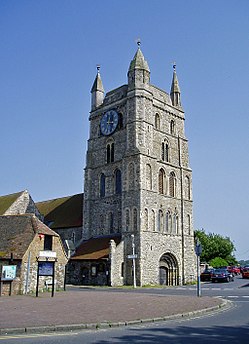 New Romney church tower, an example of English Norman architecture
 -
 St Bees Priory, Cumbria, west door, c. 1160
 -
 Norman Tower, Bury St Edmunds, Suffolk, c. 1120–1148
 -
 Arches in the crossing of the Church of St Lawrence, Alton, Hampshire, c. 1070–1100
 -
 Archway in St Leonard’s church, Hythe, Kent
 -
 Archway in St John the Baptist Church, Halesowen, West Midlands, England c. 1090


See also

References
- ^ Reilly, Lisa (2020). The Invention of Norman Visual Culture: Art, Politics, and Dynastic Ambition. Cambridge: Cambridge University Press. ISBN 9781108488167.
- ^ OED “Romanesque”: in French a letter of 1818 by Charles-Alexis-Adrien Duhérissier de Gerville seems to be the first
- ^ OED same entry; in French by Gerville’s friend Arcisse de Caumont in his Essaie sur l’architecture du moyen âge, particulièrement en Normandie, 1824.
- ^ Bradley, Simon; Pevsner, Nikolaus (2014). Cambridgeshire (3rd ed.). New Haven: Yale University Press. p. 288. ISBN 978 0 300 20596 1.
- ^ Goodall, John (2011). The English Castle. New Haven: Yale University Press. pp. 60–61. ISBN 978-0-300-11058-6.
- ^ Flannery, Julian (2016). Fifty English Steeples. London: Thames & Hudson. p. 59. ISBN 978-0-500-34314-2.
- ^ Castles in Ireland Feudal Power in a Gaelic World. by Tom McNeill. (London, 1997) ISBN 978-0-415-22853-4
- ^ Bell, Edward (December 1888). “On the Distinction Between Romanesque and Gothic”. The Archaeological Review. 2 (4): 237–251. JSTOR 44245200.
- ^ Clifton-Taylor, Alec (1967). The Cathedrals of England. London: Thames & Hudson. pp. 64–65.
- ^ Bloxam, Matthew Holbeche (1841). The Principles of Gothic Ecclesiastical Architecture. Oxford: John Henry Parker. pp. 52–57.
- ^ Park, David (1984). “The ‘Lewes Group’ of Wall Paintings in Sussex”. In Allen Brown, R. (ed.). Anglo-Norman Studies VI: Proceedings of the Battle Conference 1983. Martlesham: Boydell & Brewer. pp. 200–237.
- ^ Crummy, Philip (1997) City of Victory; the story of Colchester – Britain’s first Roman town. Published by Colchester Archaeological Trust (ISBN 1 897719 04 3)
- ^ Denney, Patrick (2004) Colchester. Published by Tempus Publishing (ISBN 978-0-7524-3214-4)
- ^ “Moyse’s Hall museum”. Moyseshall.org. Retrieved 2011-06-11.
Sources and literature
- Clapham, Alfred William (1934), English Romanesque Architecture after the Conquest, Oxford
{{citation}}: CS1 maint: location missing publisher (link) - Clifton-Taylor, Alec (1967), The Cathedrals of England, London
{{citation}}: CS1 maint: location missing publisher (link) - Cook, George Henry (1957), The English Cathedrals through the Centuries, London
{{citation}}: CS1 maint: location missing publisher (link) - Escher, Konrad (1929), Englische Kathedralen, Zürich
{{citation}}: CS1 maint: location missing publisher (link) - Fernie, Eric (2000), The Architecture of Norman England, Oxford
{{citation}}: CS1 maint: location missing publisher (link) - Pevsner, Nikolaus; Fleming, John; Honour, Hugh (1971) [1966], Lexikon der Weltarchitektur, München
{{citation}}: CS1 maint: location missing publisher (link) - Wagner-Rieger, Renate (1953), “Studien zur mittelalterlichen Architektur Englands”, Wiener Kunstwiss. Blätter, Jg. 2
- Short, Ernest H. (2005), Norman Architecture in England
- Webb, Geoffrey (1956), “Architecture in Britain: The Middle Ages”, Pelican History of Art, London
External links
- CRSBI (The Corpus of ROMANESQUE SCULPTURE in Britain and Ireland) website
- The Normans, a European People (archived copy).
| Styles |  | |
|---|---|---|
| Buildings and structures | ||
| By location | ||
| Other | ||