Nova Varoš (Serbian Cyrillic: Нова Варош, pronounced [nɔ̂v̞aː v̞ǎːrɔʃ]) is a town and municipality located in the Zlatibor District of southwestern Serbia. The municipality of Nova Varoš has a population of 13,507, while the town of Nova Varoš itself has a population of 7,542 inhabitants.
History
Nova Varoš was founded in the middle of the 16th century. It is associated with the name of Skender Pasha of Genoa. When Skender-pasha, travelling from Bosnia to the Ottoman capital of Constantinople (1530), stopped with his entourage on the plateau below the mountain Zlatar and was delighted with the beauty of this wooded area and the intoxicating smell of pine, he ordered a town to be built there. Settlements soon sprang up on the site of today’s Nova Varoš. It was called Skender-pašina palanka (Skender-pasha’s Palanka). When it grew to close to 2,000 houses, “a fire broke out and burned the palace to the ground” (Evliya Çelebi). Most of the inhabitants stayed there and built a new town which they called Nova Kasaba, which in Serbian means Nova Varoš.
Geography
Nova Varoš is located in southwest Serbia, the main road that connects the north of the country the Montenegrin coast. It is situated at 1000 meters above sea level, and below the northern slopes of mountain Zlatar. Nova Varoš is located in the Dinaric mountain range. North of town is mountain Murtenica, while the south mountain Zlatar.
Climate
Nova Varoš has an oceanic climate (Köppen climate classification: Cfb).
Demographics
According to the last official census done in 2022, the Municipality of Nova Varoš has 13,507 inhabitants. Population density on the territory of the municipality is 23 inhabitants per square kilometer.
Ethnic groups
In 1991, the population of the municipality was composed of: Serbs and Montenegrins (89.20%), Muslims (8.5%) and others.
In 2002, the population of the municipality was composed of: Serbs (18,001) (90.1%), Bosniaks (1,028) (5.1%), ethnic Muslims (502) (2.5%) and others. Most of those who in 1991 census declared themselves as Muslims by ethnicity, in the next census in 2002 declared themselves as Bosniaks, while the smaller number of them still declare themselves as Muslims by ethnicity.
Ethnic composition of the municipality according to 2011 and 2022 censuses:
| Census 1991 | Census 2011 | Census 2022[5] | ||||
|---|---|---|---|---|---|---|
| Ethnic group | Population | % | Population | % | Population | % |
| Serbs | 19,284 | 88.4% | 14,899 | 89.6% | 11,901 | 88.1% |
| Bosniaks | 1,857 | 8.5% | 788 | 4.7% | 673 | 5% |
| Muslims | 526 | 3.1% | 308 | 2.3% | ||
| Yugoslavs | 348 | 1.6% | 37 | 0.2% | 40 | 0.3% |
| Montenegrins | 173 | 0.8% | 31 | 0.2% | 9 | 0.07% |
| Others | 150 | 0.7% | 357 | 2.1% | 576 | 4.2% |
| Total | 21,812 | 16,638 | 13,507 | |||
Settlements
Aside from the town of Nova Varoš, the municipality includes the following settlements:
Economy
The following table gives a preview of total number of registered people employed in legal entities per their core activity (as of 2018):[6]
| Activity | Total |
|---|---|
| Agriculture, forestry and fishing | 61 |
| Mining and quarrying | 13 |
| Manufacturing | 817 |
| Electricity, gas, steam and air conditioning supply | 110 |
| Water supply; sewerage, waste management and remediation activities | 66 |
| Construction | 75 |
| Wholesale and retail trade, repair of motor vehicles and motorcycles | 356 |
| Transportation and storage | 253 |
| Accommodation and food services | 188 |
| Information and communication | 27 |
| Financial and insurance activities | 31 |
| Real estate activities | – |
| Professional, scientific and technical activities | 59 |
| Administrative and support service activities | 17 |
| Public administration and defense; compulsory social security | 288 |
| Education | 220 |
| Human health and social work activities | 190 |
| Arts, entertainment and recreation | 54 |
| Other service activities | 35 |
| Individual agricultural workers | 151 |
| Total | 3,010 |
Culture
Gallery
 Town Hall
 Nova Varoš Cultural Center
 Town center
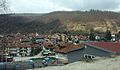 Town buildings
 Orthodox Church
 Nova Varoš Mosque
 Uvac Lake


Notable people
- Gavrilo I, Serbian Patriarch
- Petar Bojović, military commander and field marshal
- Ljubinko Drulović, former footballer, 2013 European U19 Championship winning manager
- Nemanja Nedović, basketball player, silver medalist at the 2016 Summer Olympics
- Vladimir Otašević, footballer
- Bojana Lečić, 2011 Miss Serbia
- Ivan Šaponjić, footballer
See also
References
- ↑ “Municipalities of Serbia, 2006”. Statistical Office of Serbia. Retrieved 2010-11-28.
- ↑ “2022 Census of Population, Households and Dwellings: Ethnicity (data by municipalities and cities)” (PDF). Statistical Office of Republic Of Serbia, Belgrade. April 2023. ISBN 978-86-6161-228-2. Retrieved 2023-04-30.
- ↑ “Climate: Nova Varoš, Serbia”. Climate-Data.org. Retrieved 14 February 2018.
- ↑ “2011 Census of Population, Households and Dwellings in the Republic of Serbia” (PDF). stat.gov.rs. Statistical Office of the Republic of Serbia. Retrieved 11 January 2017.
- ↑ “Population by nationality and gender”. Statistical Office of Republic of Serbia.
- ↑ “MUNICIPALITIES AND REGIONS OF THE REPUBLIC OF SERBIA, 2019” (PDF). stat.gov.rs. Statistical Office of the Republic of Serbia. 25 December 2019. Retrieved 28 December 2019.
External links


| International | |
|---|---|
| National | |
