Welcome to the Germany Portal!
Willkommen im Deutschland-Portal!

|

|

| |
Germany (German: Deutschland), officially the Federal Republic of Germany (German: Bundesrepublik Deutschland), is a country in Central and Western Europe, lying between the Baltic Sea and the North Sea to the north with the Alps to the south. It borders Denmark to the north, Poland and the Czech Republic to the east, Austria and Switzerland to the south, France to the southwest, and Luxembourg, Belgium and the Netherlands to the west.
Germany includes 16 constituent states, covers an area of 357,596 square kilometres (138,069 sq mi) and has a largely temperate seasonal climate. With over 83 million inhabitants, it is the second most populous state of Europe after Russia, the most populous state lying entirely in Europe, as well as the most populous member state of the European Union. Germany is a very decentralized country. Its capital and most populous city is Berlin, while Frankfurt serves as its financial capital and has the country’s busiest airport.
In 1871, Germany became a nation-state when most of the German states unified into the Prussian-dominated German Empire. After World War I and the Revolution of 1918–19, the Empire was replaced by the parliamentary Weimar Republic. The Nazi seizure of power in 1933 led to World War II and the Holocaust. After the end of World War II in Europe and a period of Allied occupation, two new German states were founded: West Germany, formed from the American, British, and French occupation zones, and East Germany, formed from the western part of the Soviet occupation zone, reduced by the newly established Oder-Neisse line. Following the Revolutions of 1989 that ended communist rule in Central and Eastern Europe, the country was reunified on 3 October 1990.
Germany is a federal parliamentary republic led by a chancellor. It is a great power with the largest economy in Europe. As a global leader in several industrial, scientific and technological sectors, it is a major trading nation. The Federal Republic of Germany was a founding member of the European Economic Community in 1957 and the European Union in 1993. Read more…
Selected article

The Unionskirche (Union Church) is the active Protestant parish church of Idstein, a town in the Rheingau-Taunus district in the German state of Hesse. Idstein was a residence of the counts of Nassau. The church building in the center of the historic Altstadt (old town) dates back to the 14th century when it was built as a collegiate church. It became Lutheran during the Reformation. Its interior was adapted in the 17th century to become a Lutheran Predigt- und Hofkirche (sermon and court church). The most prominent decoration in the church is the series of 38 paintings by the Flemish painter Michael Angelo Immenraedt, an exponent of Flemish Baroque painting, and others. They follow a program of biblical scenes.
The church was named Unionskirche in 1917 to commemorate the union of Lutheran and Reformed Protestants in the Duchy of Nassau in August 1817, the first of its kind (before the Prussian Union in September of the same year). The Unionskirche is a recognized monument under the Hague Convention. The Protestant congregation uses it, and it is open to other institutions as a concert venue, including concerts of the Rheingau Musik Festival. It features an organ built in 1912 by Walcker Orgelbau and retaining the historic case dating back to 1783.
The church was restored from 2012 to 2017, completed for 500 years since the Reformation and 200 years since the Union. The restoration was awarded the Hessischer Denkmalschutzpreis (Hessian monument preservation prize). (Full article…)
Selected picture
-


Bamberg Cathedral Credit: Unknown authorBamberg Cathedral in 1880 -
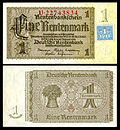 The Rentenmark was a currency introduced on 15 November 1923 in Weimar Germany after the value of the previous currency had been destroyed by hyperinflation.
The banknote shown at left was printed in 1937 or later. It bears an adhesive coupon attached by the East German government in 1948, extending its validity while new East German mark banknotes were being printed. -
 Photo credit: Daniel SchwenSparrenburg Castle, located in Bielefeld, Germany, as seen from the western lawn. The castle was constructed between 1240 and 1250 by the Counts of Ravensberg. The castle has been rebuilt many times. Although often under siege, it was never stormed. After extensive restoration work, the castle now presents itself as an imposing historic site.
 -
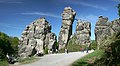 Photo credit: Daniel SchwenThe Externsteine, a distinctive rock formation located in the Teutoburger Wald region of northwestern Germany, are a popular tourist attraction. Stairs and a small bridge connecting two of the rocks lead to the top.
 -
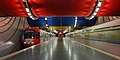 Photograph credit: Martin FalbisonerThe underground station Rochusplatz on the Cologne Stadtbahn, a light rail system in the German city of Cologne. The station entrance is at the junction of Venloer Straße with Äußere Kanalstraße in the district of Ehrenfeld. It was opened in 1992 and consists of a mezzanine and one island platform with two rail tracks. The station was previously known as Äußere Kanalstraße, but was renamed to its present title on 15 December 2019. The system uses pairs of K5000/K5200 units built by Bombardier Transportation, which are almost identical to the M5000 trams used by Metrolink in Manchester, England.
 -
 Photograph credit: Nicola Perscheid; restored by Adam CuerdenPaul von Hindenburg (2 October 1847 – 2 August 1934), was a German general and statesman who led the Imperial German Army during World War I. In 1925, he returned to public life to become the second elected president of the Weimar Republic. While he was personally opposed to Adolf Hitler and his Nazi Party, he nonetheless played a major role in the political instability that resulted in their rise to power, ultimately agreeing to appoint Hitler as Chancellor of Germany in January 1933 after the Nazis had become the largest party in the Reichstag. This 1914 photograph of Hindenburg in military uniform was taken by the German photographer Nicola Perscheid.
 -
 Photo credit: Daniel SchwenThe interior of the Neue Wache, the central memorial of Germany for victims of war and tyranny. Located in Berlin, the building was originally built as a guardhouse, and has been used as a war memorial since 1931. The statue, Mother with her Dead Son is directly under the oculus, and so is exposed to the rain, snow and cold, symbolising the suffering of civilians during World War II.
 -
 Design credit: German New Guinea Company; photographed by the National Numismatic CollectionGerman New Guinea was a German colonial protectorate established in 1884 in the northeastern part of the island of New Guinea and several nearby island groups. The German New Guinea Company was founded in Berlin by Adolph von Hansemann and a syndicate of German bankers for the purpose of colonizing and exploiting the protectorate’s resources. This gold coin, worth 20 New Guinean marks, was issued by the German New Guinea Company in 1895, and is now part of the National Numismatic Collection at the Smithsonian Institution.
 -
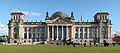 Photo: Matthew FieldThe Reichstag building is a historical edifice in Berlin, Germany, constructed to house the Reichstag, parliament of the German Empire. It was opened in 1894 and housed the Reichstag until 1933, when it was severely damaged in a fire. After German reunification it underwent a reconstruction, completed in 1999, and now houses the modern Bundestag.
 -
 Photochrom: Detroit Publishing Co.
Restoration: Lise BroerAn 1890s photochrom print of Dresden, the capital city of Saxony in Germany, with Dresden Frauenkirche (left), Augustus Bridge (centre), and Katholische Hofkirche (right) visible. Dresden in the early 20th century was a leading European centre of culture and science, but suffered heavy damage due to an Allied bombing on February 13, 1945. -
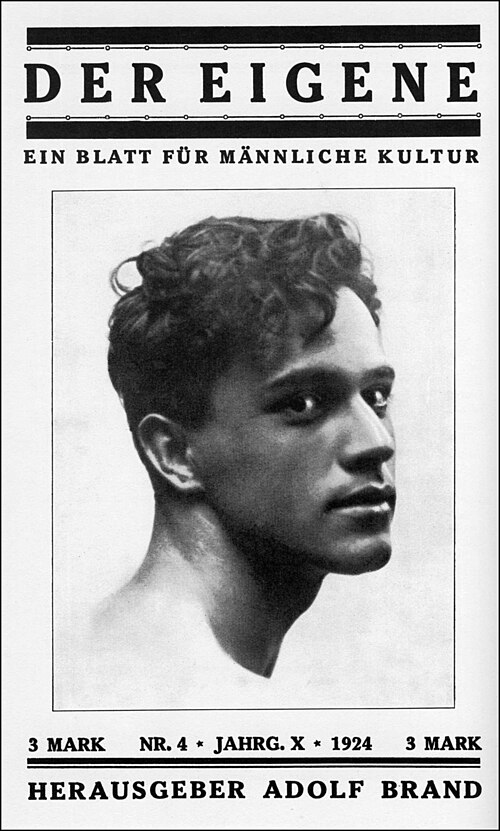
Cover of “Der Eigene”, vol. 10 (1924-25), no. 4 Der Eigene was the first gay journal in the world, published from 1896 to 1932 by Adolf Brand in Berlin. -
 Painting credit: Albert BierstadtAlbert Bierstadt (1830–1902) was a German-American painter best known for his lavish, sweeping landscapes of the American West, such as this oil-on-canvas painting, entitled Among the Sierra Nevada, California, created in 1868. He painted the landscape in his Rome studio, and exhibited it in Berlin and London before shipping it to the United States. His choice of grandiose subjects was matched by his entrepreneurial flair; his exhibitions of individual works were accompanied by promotion, ticket sales, and, in the words of one critic, a “vast machinery of advertisement and puffery”. This work is in the collection of the Smithsonian American Art Museum.
 -

Speicherstadt in Hamburg Credit: Dietmar RabichSpeicherstadt in Hamburg, June 2016 -
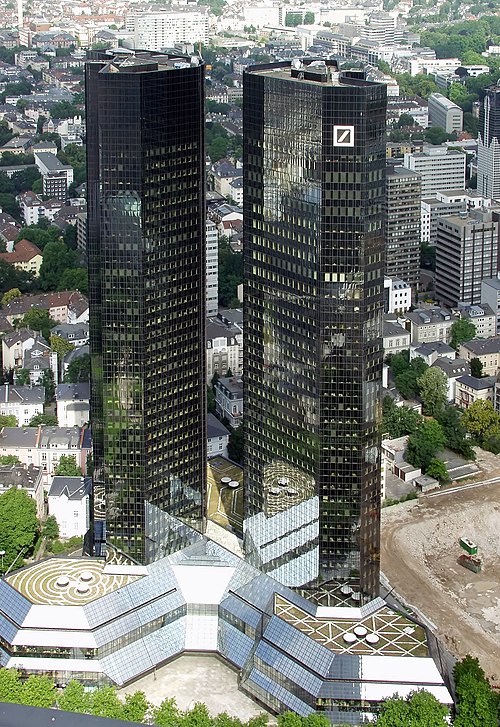
The Deutsche Bank Twin Towers in Frankfurt -

Castle Blankenhain, Crimmitschau, Germany Credit: André KarwathBlankenhain Castle is an open-air museum and castle near Crimmitschau, a large district town in the Saxon landkreis of Zwickauer Land, Germany. -
 Photo credit: Andreas TilleThe Chicago based, German architect Helmut Jahn is best known for his efficiently designed modernist office blocks. Whilst many of these glass and steel buildings don’t stand out from the crowd, some of his most eye-catching projects, such as the Sony Center in Berlin, with its tent-like roof covering the central Forum, border on post-modernism.
 -

Buldern Castle in Buldern, Dülmen Buldern Castle in Buldern, DülmenCredit: Dietmar Rabich -
 Wanderer above the Sea of Fog is an 1818 painting by Caspar David Friedrich, a German Romantic. It has been read as a metaphor for the uncertainty of the future.
 -
 Banknote design credit: Deutsch-Ostafrikanische Bank; photographed by Andrew ShivaThe rupie was the unit of currency of German East Africa between 1890 and 1916. During World War I, the colony was cut off from Germany as a result of a wartime blockade and the colonial government needed to create an emergency issue of banknotes. Paper made from linen or jute was initially used, but because of wartime shortages, the notes were later printed on commercial paper in a variety of colours, wrapping paper, and in one instance, wallpaper. This twenty-rupie banknote was issued in 1915, and is now part of the National Numismatic Collection at the Smithsonian Institution.
Other denominations:
‘”`UNIQ–templatestyles-00000017-QINU`”‘ -
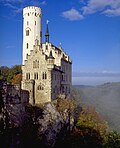 Photo credit: Andreas TilleLichtenstein Castle is a fairy-tale castle located near Honau in the Swabian Alb, Baden-Württemberg, Germany. Although there have been previous castles on the site, the current castle was constructed by Duke Wilhelm of Urach in 1840 after being inspired by Wilhelm Hauff‘s novel Lichtenstein. The romantic Neo-Gothic design of the castle was created by the architect Carl Alexander Heideloff.
 -
-
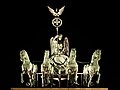 Close-up of the quadriga (four-horse chariot) on top of the Brandenburg Gate in Berlin (Germany) at night. The sculpture was produced by Johann Gottfried Schadow in 1793. The word quadriga may refer to the chariot alone, the four horses without it, or the combination. All modern quadrigas are based on the Horses of Saint Mark, a Roman or Greek sculpture which is the only surviving ancient quadriga.


Related portals
- Parent portals


- Regional


- History
 Holy Roman Empire (900–1806)
 East Germany (1949–1990)


- Neighbouring countries


Anniversaries for June 16

- 1801 – Birth of mathematician Julius Plücker
- 1804 – Death of composer Johann Adam Hiller
- 1900 – Opening of the Elbe-Lübeck Canal
- 1972 – RAF terrorist Ulrike Meinhof is captured in Langenhagen
- 1977 – Death of rocket scientist Wernher von Braun
Did you know…

- … that Beethoven’s “Tremate, empi, tremate” was not performed for ten years after it was written?
- … that the 1935 Free City of Danzig parliamentary election was seen as a setback for the Nazi Party, even though it won an absolute majority of seats?
- … that every year in July, a whole German town is taken over by the Rudolstadt Festival and swept up in “folk fever”?
- … that the pianist Alide Topp (pictured) once responded to claims that women lacked the “biceps of a man” for great music by stating she broke her pianos as well as any man?
- … that Bernhard Waldenfels discussed “black holes of everyday life” in a book subtitled Challenges of Phenomenology?
- … that Agostino Steffani missed the 1709 premiere of his opera Amor vien dal destino because he was in Rome mediating between the pope and the emperor?
- … that Ruth Wagner, the minister of culture in Hesse from 1999 to 2003, was nicknamed Mother Courage of Hesse?
- … that mathematician Grete Hermann wrote political philosophy articles for Der Funke and Sozialistische Warte under various pseudonyms during the German resistance to Nazism?
Selected cuisines, dishes and foods

Maultaschen (German: [ˈmaʊ̯lˌtaʃn̩] ⓘ; singular Maultasche , lit. ‘mouth pockets‘) are large meat-filled dumplings in Swabian cuisine. They consist of sheets of pasta dough filled with minced meat, smoked meat, spinach, bread crumbs and onions, and flavored with herbs and spices such as black pepper, parsley and nutmeg. Maultaschen are typically 8–12 centimetres (3–4+1⁄2 inches) across. They are square or rectangular in shape.
On 22 October 2009, the European Union recognized Maultaschen (Schwäbische Maultaschen or Schwäbische Suppenmaultaschen) as a Protected Geographical Indication (PGI) and remarked that the dish is significant to the cultural heritage of Swabia. This measure provides protection to the integrity of the dish, mandating that genuine Maultaschen are only produced in Swabia, a historical region that was incorporated into the modern German states of Baden-Württemberg and Bavaria. (Full article…)Topics
Categories

Things you can do

A list of articles needing cleanup associated with this project is available. See also the tool’s wiki page and the index of WikiProjects.
Here are some tasks you can do. Please remove completed tasks from the list.
- Requests: German Archaeological Institute at Rome, Deutsche Familienversicherung, Hermann Bachmann (Journalist), Dietlof von Arnim-Boitzenburg, Rolf von Bargen, Hennes Bender, Eduard Georg von Bethusy-Huc, Rolf Brandt (1886–1953), Jan Philipp Burgard, Rudolf Epp, Lisa Feller, Georg Gafron, Ferdinand Heribert von Galen, Gundula Gause, Wolfgang von Geldern, Karl-Heinz Hagen, Herbert Helmrich, Nils von der Heyde, Monty Jacobs (1875–1945), Siegfried Kauder, Klimbim Matze Knop, Wolfgang Kryszohn, Claus Larass, Isidor Levy (1852–1929), Richard Lewinsohn (1894-1968), Markus Löning, Tobias Mann, Julius Meyer (Kunsthistoriker), Mathias Müller von Blumencron ,Günther Nonnenmacher, Nord bei Nordwest, Günter von Nordenskjöld, Anke Plättner, Hans Heinrich X. Fürst von Pless, Günter Prinz, Ulrich Reitz, Hans Sauer (inventor), Franz August Schenk von Stauffenberg, Paul Schlesinger (1878-1928), Hajo Schumacher, Der Seewolf (1971), Otto Theodor von Seydewitz, Christoph Sieber (comedian), Dorothea Siems, Werner Sonne, Udo zu Stolberg-Wernigerode, Christoph Strässer, Karl Trimborn, Joseph von Utzschneider, Hedda von Wedel, Jürgen Wieshoff, Hans Wilhelmi, Dietmar Wischmeyer, Doris Wittner (1880-1937), Alexandra Würzbach
- Unreferenced: especially Unreferenced BLPs
- Cleanup: 53541 issues in total as of 2024-03-03
- Translate: Articles needing translation from German Wikipedia
- Stubs: the largest stub category is Category:German history stubs; see also 108 articles in Category:German MEP stubs
- Update: Deutsches Wörterbuch
- Portal maintenance: Update News, Did you know, announcements and the todo list
- Orphans:
Orphaned articles in Germany

- Photo: Take/Add requested photographs
- Help assess the quality of 843 unassessed articles
Associated Wikimedia
The following Wikimedia Foundation sister projects provide more on this subject:
-
 Commons
Free media repository -
 Wikidata
Free knowledge base -
 Wikiquote
Collection of quotations -
 Wikisource
Free-content library -
 Wikiversity
Free learning tools -
 Wikivoyage
Free travel guide -
 Wiktionary
Dictionary and thesaurus


-

-

-

-

-

-

-

-

-

-

-
 Random portal
 -


