Introduction

Outer space, or simply space, is the expanse that exists beyond Earth’s atmosphere and between celestial bodies. It contains ultra-low levels of particle densities, constituting a near-perfect vacuum of predominantly hydrogen and helium plasma, permeated by electromagnetic radiation, cosmic rays, neutrinos, magnetic fields and dust. The baseline temperature of outer space, as set by the background radiation from the Big Bang, is 2.7 kelvins (−270 °C; −455 °F).
The plasma between galaxies is thought to account for about half of the baryonic (ordinary) matter in the universe, having a number density of less than one hydrogen atom per cubic metre and a kinetic temperature of millions of kelvins. Local concentrations of matter have condensed into stars and galaxies. Intergalactic space takes up most of the volume of the universe, but even galaxies and star systems consist almost entirely of empty space. Most of the remaining mass-energy in the observable universe is made up of an unknown form, dubbed dark matter and dark energy.
Outer space does not begin at a definite altitude above Earth’s surface. The Kármán line, an altitude of 100 km (62 mi) above sea level, is conventionally used as the start of outer space in space treaties and for aerospace records keeping. Certain portions of the upper stratosphere and the mesosphere are sometimes referred to as “near space“. The framework for international space law was established by the Outer Space Treaty, which entered into force on 10 October 1967. This treaty precludes any claims of national sovereignty and permits all states to freely explore outer space. Despite the drafting of UN resolutions for the peaceful uses of outer space, anti-satellite weapons have been tested in Earth orbit.
The concept that the space between the Earth and the Moon must be a vacuum was first proposed in the 17th century after scientists discovered that air pressure decreased with altitude. The immense scale of outer space was grasped in the 20th century when the distance to the Andromeda Galaxy was first measured. Humans began the physical exploration of space later in the same century with the advent of high-altitude balloon flights. This was followed by crewed rocket flights and, then, crewed Earth orbit, first achieved by Yuri Gagarin of the Soviet Union in 1961. The economic cost of putting objects, including humans, into space is very high, limiting human spaceflight to low Earth orbit and the Moon. On the other hand, uncrewed spacecraft have reached all of the known planets in the Solar System. Outer space represents a challenging environment for human exploration because of the hazards of vacuum and radiation. Microgravity has a negative effect on human physiology that causes both muscle atrophy and bone loss. (Full article…)
Selected article

243 Ida is an asteroid in the Koronis family of the main belt. It was discovered on 29 September 1884 by Johann Palisa and named after a nymph from Greek mythology. Later telescopic observations categorized Ida as an S-type asteroid, the most numerous type in the inner asteroid belt. On 28 August 1993, Ida was visited by the spacecraft Galileo, bound for Jupiter. It was the second asteroid to be visited by a spacecraft and the first found to possess a satellite. Like all main-belt asteroids, Ida’s orbit lies between the planets Mars and Jupiter. Its orbital period is 4.84 years, and its rotation period is 4.63 hours. Ida has an average diameter of 31.4 km (19.5 mi). It is irregularly shaped and elongated, and apparently composed of two large objects connected together in a shape reminiscent of a croissant. Its surface is one of the most heavily cratered in the Solar System, featuring a wide variety of crater sizes and ages. Ida’s moon, Dactyl, was discovered by mission member Ann Harch in images returned from Galileo. It was named after creatures which inhabited Mount Ida in Greek mythology. Data returned from the flyby pointed to S-type asteroids as the source for the ordinary chondrite meteorites, the most common type found on the Earth’s surface.
Selected picture
-
 NGC 4414 is an unbarred spiral galaxy about 62 million light-years away in the constellation Coma Berenices. It is a flocculent spiral galaxy, with short segments of spiral structure but without the dramatic well-defined spiral arms of a grand design spiral. NGC 4414 is a very isolated galaxy, with no signs of past interactions with other galaxies.
 -
 Image credit: Dave JarvisAn illustration of relative astronomical orders of magnitude, starting with the terrestrial planets of the Solar System in image 1 (top left) and ending with the largest known star, VY Canis Majoris, at the bottom right. The biggest celestial body in each image is shown on the left of the next frame.
 -


Color-composite image of the Pleiades from the Digitized Sky Survey Credit: NASA, ESA, AURA/Caltech, Palomar ObservatoryThe Pleiades (also known as M45 or the Seven Sisters) is an open cluster in the constellation of Taurus. It is among the nearest to the Earth of all open clusters, probably the best known and certainly the most striking to the naked eye. -
 Image credit: United States Geological SurveyA composite image of Olympus Mons on Mars, the tallest known volcano and mountain in the Solar System. This image was created from black-and-white imagery from the USGS‘s Mars Global Digital Image Mosaic and color imagery acquired from the 1978 visit of Viking 1.
 -
 Six beryllium mirror segments of the James Webb Space Telescope (JWST) undergoing a series of cryogenic tests at NASA’s Marshall Space Flight Center in Huntsville, Alabama. The JWST is a planned space telescope that is a joint collaboration of 20 countries. It will orbit the Sun approximately 1,500,000 km (930,000 mi) beyond the Earth, around the L2 Lagrange point. It is expected to launch in December 2021.
 -
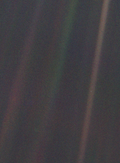 Pale Blue Dot is the name given to this 1990 photo of Earth taken from Voyager 1 when its vantage point reached the edge of the Solar System, a distance of roughly 3.7 billion miles (6 billion kilometres). Earth can be seen as a blueish-white speck approximately halfway down the brown band to the right. The light band over Earth is an artifact of sunlight scattering in the camera’s lens, resulting from the small angle between Earth and the Sun. Carl Sagan came up with the idea of turning the spacecraft around to take a composite image of the Solar System. Six years later, he reflected, “All of human history has happened on that tiny pixel, which is our only home.”
 -
 Image credit: SeavAn animated image showing the apparent retrograde motion of Mars in 2003 as seen from Earth. All the true planets appear to periodically switch direction as they cross the sky. Because Earth completes its orbit in a shorter period of time than the planets outside its orbit, we periodically overtake them, like a faster car on a multi-lane highway. When this occurs, the planet will first appear to stop its eastward drift, and then drift back toward the west. Then, as Earth swings past the planet in its orbit, it appears to resume its normal motion west to east.
 -
 Map credit: Ignace-Gaston PardiesIgnace-Gaston Pardies (1636–1673) was a French Catholic priest and scientist. His celestial atlas, entitled Globi coelestis in tabulas planas redacti descriptio, comprised six charts of the night sky and was first published in 1674. The atlas uses a gnomonic projection so that the plates make up a cube of the celestial sphere. The constellation figures are drawn from Uranometria, but were carefully reworked and adapted to a broader view of the sky. This is the second plate from a 1693 edition of Pardies’s atlas, featuring constellations including Pegasus and Andromeda, visible in the northern sky.
 -

Orion Nebula A composite photo of the Orion Nebula, the closest region of star formation to Earth. It is composed of 520 separate images and NASA calls it “one of the most detailed astronomical images ever produced”. The nebula is located below Orion‘s Belt and is visible to the naked eye at night. It is one of the most scrutinized and photographed objects in the night sky, and is among the most intensely-studied celestial features. -
 Photo credit: Mars Reconnaissance OrbiterFalse-color Mars Reconnaissance Orbiter image of a side of the Chasma Boreale, a canyon in the polar ice cap of the Planum Boreum (north pole of Mars). Light browns are layers of surface dust, greys and blues are layers of water and carbon dioxide ice. Regular geometric cracking is indicative of higher concentrations of water ice.
The Planum Boreum’s permanent ice cap has a maximum depth of 3 km (1.9 mi). It is roughly 1200 km (750 mi) in diameter, an area equivalent to about 1½ times the size of Texas. The Chasma Boreale is up to 100 km (62.5 mi) wide and features scarps up to 2 km (1.25 mi) high. For a comparison, the Grand Canyon is approximately 1.6 km (1 mi) deep in some places and 446 km (279 mi) long but only up to 24 km (15 mi) wide. -

Planet Mars Credit: NASAMars, the fourth planet from the Sun, is named after the Roman god of war because of its blood red color. Mars has two small, oddly-shaped moons, Phobos and Deimos, named after the sons of the Greek god Ares. At some point in the future Phobos will be broken up by gravitational forces. The atmosphere on Mars is 95% carbon dioxide. In 2003 methane was also discovered in the atmosphere. Since methane is an unstable gas, this indicates that there must be (or have been within the last few hundred years) a source of the gas on the planet. -
 Photo: Adam EvansThe Andromeda Galaxy is a spiral galaxy approximately 2.5 million light-years away. The image, created using a hydrogen-alpha filter, also shows Messier objects 32 and 110, as well as NGC 206 and the star Nu Andromedae. On December 15, 1612, German astronomer Simon Marius became the first person to describe the galaxy using a telescope.
 -
 Photo: Yuri Beletsky, ESOA laser shoots towards the centre of the Milky Way from the Very Large Telescope facility in Chile, to provide a laser guide star, a reference point in the sky for the telescope’s adaptive optics (AO) system. AO technology improves the performance of optical systems by reducing the effect of atmospheric distortion. AO was first envisioned by Horace W. Babcock in 1953, but did not come into common usage until advances in computer technology during the 1990s made the technique practical.
 -
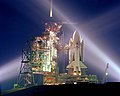 A timed exposure of the first Space Shuttle mission, STS-1. The shuttle Columbia stands on launch pad A at Kennedy Space Center, the night before launch. The objectives of the maiden flight were to check out the overall Shuttle system, accomplish a safe ascent into orbit and to return to Earth for a safe landing.
 -
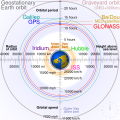 Animation credit: CmgleeThis is an animation showing geocentric satellite orbits, to scale with the Earth, at 3,600 times actual speed. The second-outermost (shown in grey) is a geostationary orbit, 35,786 kilometres (22,236 miles) above Earth’s equator and following the direction of Earth’s rotation, with an orbital period matching the planet’s rotation period (a geosynchronous orbit). An object in such an orbit will appear to occupy a fixed position in the sky. Some 300 kilometres (190 miles) farther away is the graveyard orbit (brown), used for satellites at the end of their operational lives. Nearer to the Earth are the orbits of navigational satellites, such as Galileo (turquoise), BeiDou (beige), GPS (blue) and GLONASS (red), in medium Earth orbits. Much closer to the planet, and within the inner Van Allen belt, are satellites in low Earth orbit, such as the Iridium satellite constellation (purple), the Hubble Space Telescope (green) and the International Space Station (magenta).
 -
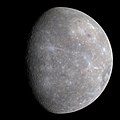 Mercury is the smallest and closest to the Sun of the eight planets in the Solar System. It has no known natural satellites. The planet is named after the Roman deity Mercury, the messenger to the gods.
 -

Earth “The Blue Marble“ is a famous photograph of Earth. NASA officially credits the image to the entire Apollo 17 crew — Eugene Cernan, Ronald Evans and Jack Schmitt — all of whom took photographic images during the mission. Apollo 17 passed over Africa during daylight hours and Antarctica is also illuminated. The photograph was taken approximately five hours after the spacecraft’s launch, while en route to the Moon. Apollo 17, notably, was the last manned lunar mission; no humans since have been at a range where taking a “whole-Earth” photograph such as “The Blue Marble” would be possible. -

Astronaut Steve Robinson on a spacewalk, August 2005 Credit: NASAExtra-vehicular activity (EVA) is work done by an astronaut away from the Earth and outside of his or her spacecraft. EVAs may be made outside a craft orbiting Earth (a spacewalk) or on the surface of the Moon (a moonwalk). Shown here is Steve Robinson on the first EVA to perform an in-flight repair of the Space Shuttle (August 3 2005). -
 Photo credit: NASAThe Eagle Nebula (also known as Messier Object 16, M16 or NGC 6611) is a young open cluster of stars. The nebula is an active region of star formation. Light from the bright, hot, young stars near the centre of the cluster illuminate the clouds of hydrogen gas and dust still collapsing to form new stars.
As projected on the sky, the Eagle Nebula lies in the constellation of Serpens Cauda. In three dimensions, it is relatively close to the Solar System being some 7,000 light years away on the edge of the Sagittarius Arm, the next nearest spiral arm towards the centre of the Milky Way.
In fact, when the picture is not coloured, is only red colored, the “Eagle” can be seen as a dark spot in the center of the nebula. -
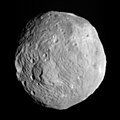
The asteroid 433 Eros was named after the Greek god of love Eros. This S-type asteroid is the second-largest near-Earth asteroid. This image shows the view looking from one end of the asteroid across the gouge on its underside and toward the opposite end.
-
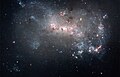 Photograph: NASA, ESA, A. Aloisi (STScI/ESA), and The Hubble Heritage (STScI/AURA)-ESA/Hubble CollaborationAn image of NGC 4449, highlighting its qualities as a starburst galaxy. NGC 4449, an irregular galaxy in the constellation Canes Venatici located about 12 million light years from Earth, has a rate of star formation twice that of the Milky Way‘s satellite galaxy, the Large Magellanic Cloud. Interactions with nearby galaxies are thought to have influenced this star formation.
 -

Space Shuttle Atlantis launch plume The launch of Space Shuttle Atlantis on STS-98, February 7 2001, at sunset. The sun is behind the camera, and the shape of the plume is cast across the vault of the sky, intersecting the rising full moon. The top portion of the plume is bright because it is illuminated directly by the sun; the lower portions are in the Earth’s shadow. After launch, the shuttle must engage in a pitch and roll program so that the vehicle is below the external tank and SRBs, as evidenced in the plume trail. The vehicle climbs in a progressively flattening arc, because achieving low orbit requires much more horizontal than vertical acceleration.


Space-related portals


General images
-

-
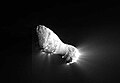 Comet 103P/Hartley (2010) (from Space exploration)
 -
 Zodiacal light caused by cosmic dust. (from Cosmic dust)
 -
 Spatial density of LEO space debris by altitude, according to 2011 a NASA report to the United Nations Office for Outer Space Affairs (from Space debris)
 -
 A micrometeoroid left this crater on the surface of Space Shuttle Challenger‘s front window on STS-7. (from Space debris)
 -
 Voyager 1 is the first artificial object to reach the interstellar medium. (from Interstellar medium)
 -
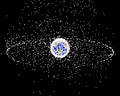 A computer-generated map of objects orbiting Earth, as of 2005. About 95% are debris, not working artificial satellites (from Outer space)
 -
A laser-guided observation of the Milky Way Galaxy at the Paranal Observatory in Chile in 2010 (from Outline of space science)
-
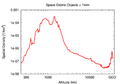 Spatial density of space debris by altitude according to ESA MASTER-2001, without debris from the Chinese ASAT and 2009 collision events (from Space debris)
 -

-
 A proposed timeline of the origin of space, from physical cosmology (from Outline of space science)
 -
 Gabbard diagram of debris from the disintegration of the third stage of a Chinese Long March 4 booster (from Space debris)
 -
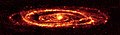 Cosmic dust of the Andromeda Galaxy as revealed in infrared light by the Spitzer Space Telescope. (from Cosmic dust)
 -
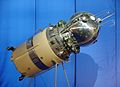 Model of a Russian Vostok spacecraft (from Space exploration)
 -
 Debris density in low Earth orbit (from Space debris)
 -
 Astronomers used the James Webb Space Telescope to image the warm dust around a nearby young star, Fomalhaut, to study the first asteroid belt ever seen outside the Solar System in infrared light. (from Cosmic dust)
 -
 Near-Earth space showing the low-Earth (blue), medium Earth (green), and high Earth (red) orbits. The last extends beyond the radius of geosynchronous orbits (from Outer space)
 -
 Tupan Patera on Jupiter’s moon Io (from Space exploration)
 -
 Crew quarters on Zvezda, the base ISS crew module (from Space exploration)
 -
 Surface of Mars by the Spirit rover (2004) (from Space exploration)
 -
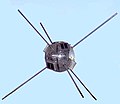 Vanguard 1 is expected to remain in orbit until at least the year 2250. (from Space debris)
 -
 Concept art for a NASA Vision mission (from Space exploration)
 -
 Delta-v’s in km/s for various orbital maneuvers (from Space exploration)
 -
 Illustration of a satellite breaking up into multiple pieces at higher altitudes (from Space debris)
 -
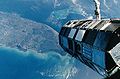 The Long Duration Exposure Facility (LDEF) is an important source of information on small-particle space debris. (from Space debris)
 -
 Baker–Nunn cameras were widely used to study space debris. (from Space debris)
 -
 Conventional anti-satellite weapons such as the SM-3 missile remain legal under the law of armed conflict, even though they create hazardous space debris (from Outer space)
 -
 Interstellar medium and astrosphere meeting (from Interstellar medium)
 -
 Illustration of Earth’s atmosphere gradual transition into outer space (from Outer space)
 -
 For the first time, the NASA / ESA / Canadian Space Agency / James Webb Space Telescope has observed the chemical signature of carbon-rich dust grains at redshift z ≈ 7, which is roughly equivalent to one billion years after the birth of the Universe, this observation suggests exciting avenues of investigation into both the production of cosmic dust and the earliest stellar populations in our Universe. (from Cosmic dust)
 -
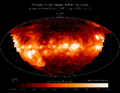 The distribution of ionized hydrogen (known by astronomers as H II from old spectroscopic terminology) in the parts of the Galactic interstellar medium visible from the Earth’s northern hemisphere as observed with the Wisconsin Hα Mapper (Haffner et al. 2003). (from Interstellar medium)
 -
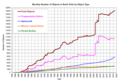 Objects in Earth orbit including fragmentation debris, November 2020, NASA: ODPO (from Space debris)
 -
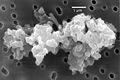 Porous chondrite dust particle (from Cosmic dust)
 -
 Artistic image of a rocket lifting from a Saturn moon (from Space exploration)
 -
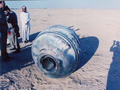 Saudi officials inspect a crashed PAM-D module in January 2001. (from Space debris)
 -
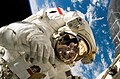 Astronaut Piers Sellers during the third spacewalk of STS-121, a demonstration of orbiter heat shield repair techniques (from Outline of space science)
 -
 Growth of tracked objects in orbit and related events; efforts to manage outer space global commons have so far not reduced the total amount of debris or the growth of objects in orbit. (from Space debris)
 -
 The diversity found in the different types and scales of astronomical objects make the field of study increasingly specialized. (from Outline of space science)
 -
 Collision on Launch Avoidance lead to delayed spacecraft launches to avoid potential conjunctions/collisions during launch. Seen here is a Collision Avoidance analysis that mandated a four-minute delay for the launch of SPADEX in 2024. (from Space debris)
 -
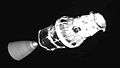
 Apollo Command Service Module in lunar orbit (from Space exploration)
 -
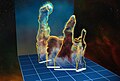 Three-dimensional structure in Pillars of Creation. (from Interstellar medium)
 -
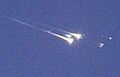 Space debris identified as WT1190F, burning up in a fireball over Sri Lanka (from Space debris)
 -

-
 Concept for a space-based solar power system to beam energy down to Earth (from Outer space)
 -
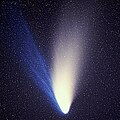 The sparse plasma (blue) and dust (white) in the tail of comet Hale–Bopp are being shaped by pressure from solar radiation and the solar wind, respectively.
 -
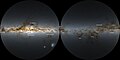 Structure of galactic space of the Milky Way, as viewed from the Solar System, with dark nebulas (white text) and star clouds (black text) labeled (from Outer space)
 -
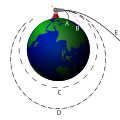 Newton’s cannonball, an illustration of how objects can “fall” in a curve around the planet (from Outer space)
 -
 Infographic showing the space debris situation in different kinds of orbits around Earth (from Space debris)
 -
 Artist’s impression of dust formation around a supernova explosion. (from Cosmic dust)
 -
 Atmospheric attenuation in dB/km as a function of frequency over the EHF band. Peaks in absorption at specific frequencies are a problem, due to atmosphere constituents such as water vapor (H2O) and carbon dioxide (CO2). (from Interstellar medium)
 -
Timeline of the expansion of the universe, where space is represented schematically at each time by circular sections. On the left, the dramatic expansion of inflation; at the center, the expansion accelerates (artist’s concept; neither time nor size are to scale) (from Outer space)
-
 View from International Space Station, showing the yellow-green airglow of Earth’s ionosphere with the Milky Way in the background. (from Outer space)
 -
 Debris impacts on Mir's solar panels degraded their performance. The damage is most noticeable on the panel on the right, which is facing the camera with a high degree of contrast. Extensive damage to the smaller panel below is due to impact with a Progress spacecraft rather than space debris. (from Space debris)
 -
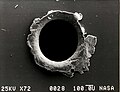 View of an orbital debris hole made in the panel of the Solar Max satellite (from Space debris)
 -
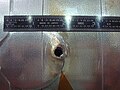 Space Shuttle Endeavour had a major impact on its radiator during STS-118. The entry hole is about 5.5 mm (0.22 in), and the exit hole is twice as large. (from Space debris)
 -
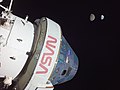 Earth and the Moon as seen from cislunar space on the 2022 Artemis 1 mission (from Outer space)
 -

-
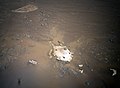 Perseverance’s backshell sitting upright on the surface of Jezero Crater (from Space debris)
 -
 Smooth chondrite interplanetary dust particle. (from Cosmic dust)
 -
 This light-year-long knot of interstellar gas and dust resembles a caterpillar. (from Interstellar medium)
 -
-
 Map showing the Sun located near the edge of the Local Interstellar Cloud and Alpha Centauri about 4 light-years away in the neighboring G-Cloud complex (from Interstellar medium)
 -
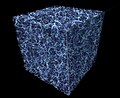 Distribution of Matter in a cubic section of the universe. The blue fiber-like structures represent matter, while the empty regions show the cosmic voids (from Outer space)
 -
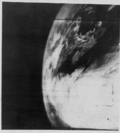 First television image of Earth from space, taken by TIROS-1 (1960) (from Space exploration)
 -
 A MESSENGER image from 18,000 km showing a region about 500 km across (2008) (from Space exploration)
 -
 NASA computer-generated image of growth of space debris (from Space debris)
 -
 A dusty trail from the early Solar System to carbonaceous dust today. (from Cosmic dust)
 -
 The famous Earthrise photo, the first of its kind taken by a human (from Outer space)
 -
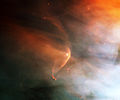 Bow shock formed by the magnetosphere of the young star LL Orionis (center) as it collides with the Orion Nebula flow
 -
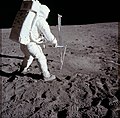
 Astronaut Buzz Aldrin had a personal Communion service when he first arrived on the surface of the Moon. (from Space exploration)
 -
 Because of the hazards of a vacuum, astronauts must wear a pressurized space suit while outside their spacecraft.
 -
 South is up in the first image of Earth taken by a person, probably by Bill Anders (during the 1968 Apollo 8 mission) (from Outer space)
 -
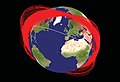 Known orbit planes of Fengyun-1C debris one month after the weather satellite’s disintegration by the Chinese ASAT (from Space debris)
 -
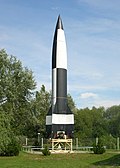
-
 After reentry, Delta 2 second stage pieces were found in South Africa. (from Space debris)
 -
-
 Reconstruction of solar activity over 11,400 years. Period of equally high activity over 8,000 years ago marked. (from Space climate)
 -
-
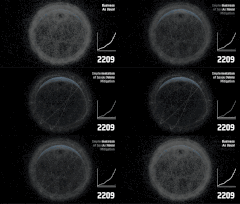 A computer-generated animation by the European Space Agency representing space debris in low earth orbit at the current rate of growth compared to mitigation measures being taken (from Space debris)
 -
 A wide field view of outer space as seen from Earth’s surface at night. The interplanetary dust cloud is visible as the horizontal band of zodiacal light, including the false dawn (edges) and gegenschein (center), which is visually crossed by the Milky Way (from Outer space)
 -
 Major elements of 200 stratospheric interplanetary dust particles. (from Cosmic dust)
 -
Gabbard diagram of almost 300 pieces of debris from the disintegration of the five-month-old third stage of the Chinese Long March 4 booster on 11 March 2000 (from Space debris)
-
 The original Magdeburg hemispheres (left) used to demonstrate Otto von Guericke’s vacuum pump (right)
 -
 Apollo 16 LEM Orion, the Lunar Roving Vehicle and astronaut John Young (1972) (from Space exploration)


Did you know (auto-generated)

- … that, for the Space 220 Restaurant, Disney reached out to NASA engineers to understand what a space elevator might look like?
- … that some severe environmental impacts of the invasion of Ukraine can be seen from space?
- … that the space industry of India has supported the launch of more than 100 domestic satellites and more than 300 foreign satellites?
- … that Nature’s Fynd, producer of microbe-based meat substitutes, is working with NASA to develop a bioreactor for use in space travel?
- … that Louis W. Roberts was among the highest ranking African-American space program staff at NASA while the Apollo program was underway?
Space news
2026 in space | |||
|---|---|---|---|
| Space probe and telescope launches  |
|    | |
| Impact events | |||
| Selected NEOs | |||
| Discoveries |
| ||
| Comets | |||
| Space exploration |
| ||

Upcoming spaceflight launches
Astronomical events

Topics
| Biology |
|  | ||||
|---|---|---|---|---|---|---|
| Environment | ||||||
| Society | ||||||
| Technology |
| |||||


2020 in space | ||
|---|---|---|
| Space probe launches |
|    |
| Impact events | ||
| Selected NEOs |
| |
| Exoplanets |
| |
| Discoveries |
| |
| Comets | ||
| Space exploration |
| |
2019 in space | ||
|---|---|---|
| Space probe launches |
|    |
| Impact events |
| |
| Selected NEOs | ||
| Exoplanets |
| |
| Discoveries |
| |
| Comets | ||
| Space exploration |
| |
2018 in space | ||
|---|---|---|
| Space probe launches |
|    |
| Impact events | ||
| Selected NEOs | ||
| Exoplanets | ||
| Discoveries |
| |
| Novae |
| |
| Comets | ||
| Space exploration |
| |
2017 in space | ||
|---|---|---|
| Space probe launches |
|    |
| Impact events | ||
| Selected NEOs | ||
| Exoplanets | ||
| Discoveries | ||
| Comets | ||
| Space exploration |
| |
2016 in space | ||
|---|---|---|
| Space probe launches |
|    |
| Impact events | ||
| Selected NEOs | ||
| Exoplanets |
| |
| Discoveries |
| |
| Novae | ||
| Comets | ||
| Space exploration | ||
2015 in space | ||||||
|---|---|---|---|---|---|---|
| Space probe launches |
|    | ||||
| Impact events | ||||||
| Selected NEOs | ||||||
| Exoplanets | ||||||
| Discoveries |
| |||||
| Comets | ||||||
| Space exploration | ||||||
Categories

Wikimedia
The following Wikimedia Foundation sister projects provide more on this subject:
-
 Commons
Free media repository -
 Wikidata
Free knowledge base -
 Wikiquote
Collection of quotations -
 Wikisource
Free-content library -
 Wikiversity
Free learning tools -
 Wiktionary
Dictionary and thesaurus


