The Agriculture Portal
-

 Panoramic view of Ötlingen from the southeast; the hilly landscape is typical for the region of Markgräflerland


Agriculture is the practice of cultivating the soil, planting, raising, and harvesting both food and non-food crops, as well as livestock production. Broader definitions also include forestry and aquaculture. Agriculture was a key factor in the rise of sedentary human civilization, whereby farming of domesticated plants and animals created food surpluses that enabled people to live in the cities. While humans started gathering grains at least 105,000 years ago, nascent farmers only began planting them around 11,500 years ago. Sheep, goats, pigs, and cattle were domesticated around 10,000 years ago. Plants were independently cultivated in at least 11 regions of the world. In the 20th century, industrial agriculture based on large-scale monocultures came to dominate agricultural output.
As of 2021, small farms, of which the vast majority are one hectare (about 2.5 acres) or smaller, produce about one-third of the world’s food. Moreover, five of every six farms in the world consist of fewer than 2 hectares (4.9 acres) and take up only around 12% of all agricultural land. In terms of total land use, large farms are dominant. While only 1% of all farms globally are greater than 50 hectares (120 acres), they encompass more than 70% of the world’s farmland. Further, nearly 40% of all global agricultural land is found on farms larger than 1,000 hectares (2,500 acres).
Farms and farming greatly influence rural economics and greatly shape rural society, affecting both the direct agricultural workforce and broader businesses that support the farms and farming populations.
The major agricultural products can be broadly grouped into foods, fibers, fuels, and raw materials (such as rubber and timber). Food classes include cereals (grains), vegetables, fruits, cooking oils, meat, milk, eggs, and fungi. Global agricultural production amounts to approximately 11 billion tonnes of food, 32 million tonnes of natural fibers and 4 billion m3 of wood. However, around 14% of the world’s food is lost from production before reaching the retail level.
Modern agronomy, plant breeding, agrochemicals such as pesticides and fertilizers, and technological developments have sharply increased crop yields, but also contributed to ecological and environmental damage. Selective breeding and modern practices in animal husbandry have similarly increased the output of meat, but have raised concerns about animal welfare and environmental damage. Environmental issues include contributions to climate change, depletion of aquifers, deforestation, antibiotic resistance, and other agricultural pollution. Agriculture is both a cause of and sensitive to environmental degradation, such as biodiversity loss, desertification, soil degradation, and climate change, all of which can cause decreases in crop yield. Genetically modified organisms are widely used, although some countries ban them. (Full article…)
Selected article

Poultry is the second most widely eaten meat in the world, accounting for about 30% of meat production worldwide, after pork at 38%.
Chicken meat contains about two to three times as much polyunsaturated fat than most types of red meat when measured as weight percentage. (Full article…)
Selected image

Did you know…
General images
-
 Noria wheels to lift water for irrigation and household use were among the technologies introduced to Europe via Al-Andalus in the medieval Islamic world. (from History of agriculture)
 -
 Garton’s catalogue from 1902 (from Plant breeding)
 -
 Native millet, Panicum decompositum, was planted and harvested by Indigenous Australians in eastern central Australia. (from History of agriculture)
 -
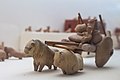 Clay and wood model of a bull cart carrying farm produce in large pots, Mohenjo-daro. The site was abandoned in the 19th century BC. (from History of agriculture)
 -
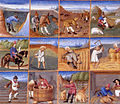 Agricultural calendar, c. 1470, from a manuscript of Pietro de Crescenzi (from History of agriculture)
 -
 A Northern Song era (960–1127 AD) Chinese watermill for dehusking grain with a horizontal waterwheel (from History of agriculture)
 -
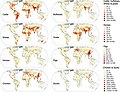 Global distribution data for cattle, buffaloes, horses, sheep, goats, pigs, chickens and ducks in 2010 (from Livestock)
 -
 Agricultural scenes of threshing, a grain store, harvesting with sickles, digging, tree-cutting and ploughing from Ancient Egypt. Tomb of Nakht, 15th century BC. (from History of agriculture)
 -
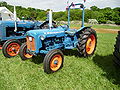 A Fordson Dexta tractor with a rollover protection structure bar retro-fitted. (from Agricultural safety and health)
 -
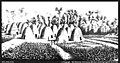 Wichita village of grass houses surrounded by maize fields in the United States. (from History of agriculture)
 -
 Selective breeding enlarged desired traits of the wild cabbage plant (Brassica oleracea) over hundreds of years, resulting in dozens of today’s agricultural crops. Cabbage, kale, broccoli, and cauliflower are all cultivars of this plant. (from Plant breeding)
 -
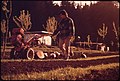 An organic farmer, California, 1972 (from History of agriculture)
 -

-
 Livestock production requires large areas of land.
 -
 Agricultural research on potato plants (from Plant breeding)
 -
 Origin and dispersal of domestic livestock species in the Fertile Crescent (dates Before Present). (from History of agriculture)
 -
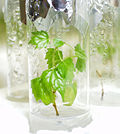 In vitro-culture of Vitis (grapevine), Geisenheim Grape Breeding Institute (from Plant breeding)
 -
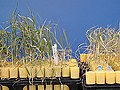 The Yecoro wheat (right) cultivar is sensitive to salinity, plants resulting from a hybrid cross with cultivar W4910 (left) show greater tolerance to high salinity (from Plant breeding)
 -
 Magnified 100X, and stained with H&E (hematoxylin and eosin) staining technique, this light photomicrograph of brain tissue reveals the presence of prominent spongiotic changes in the cortex, and loss of neurons in a case of variant Creutzfeldt-Jakob disease (vCJD). (from Agricultural safety and health)
 -

-
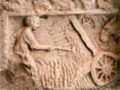 Roman harvesting machine, a vallus, from a Roman wall in Belgium, which was then part of the province of Gallia Belgica (from History of agriculture)
 -
 This Australian road sign uses the less common term “stock” for livestock. (from Livestock)
 -
 Chronological dispersal of Austronesian peoples across the Indo-Pacific (from History of agriculture)
 -
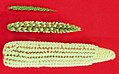 The creation of maize from teosinte (top), maize-teosinte hybrid (middle), to maize (bottom) (from History of agriculture)
 -

-

-

-
 The agriculturalist Charles ‘Turnip’ Townshend introduced four-field crop rotation and the cultivation of turnips. (from History of agriculture)
 -
 Norman Borlaug, father of the Green Revolution of the 1970s, is credited with saving over a billion people worldwide from starvation. (from History of agriculture)
 -
 Goat family with one-week-old kid (from Livestock)
 -
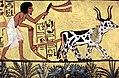 Ploughing with a yoke of horned cattle in Ancient Egypt. Painting from the burial chamber of Sennedjem, c. 1200 BC. (from History of agriculture)
 -
 Sumerian harvester’s sickle, 3000 BC, made from baked clay (from History of agriculture)
 -
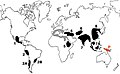 Centres of origin identified by Nikolai Vavilov in the 1930s. Area 3 (grey) is no longer recognised as a centre of origin, and Papua New Guinea (red, ‘P’) was identified more recently. (from History of agriculture)
 -
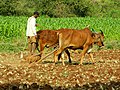 An Indian farmer with a rock-weighted scratch plough pulled by two oxen. Similar ploughs were used throughout antiquity. (from History of agriculture)
 -
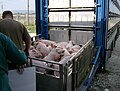 Pigs being loaded into their transport (from Livestock)
 -
 Agriculture terraces were (and are) common in the austere, high-elevation environment of the Andes. (from History of agriculture)
 -
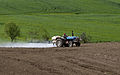 Pesticide application for chemical control of nematodes in a sunflower planted field. Karaisalı, Adana – Turkey. (from Agricultural safety and health)
 -
 Biomass distribution of humans, livestock, and other animals (from Livestock)
 -

-
 The Occupational Safety & Health Administration logo. (from Agricultural safety and health)
 -
 Bt-toxins in genetically modified peanut leaves (bottom) protect from damage by corn borers (top). (from History of agriculture)
 -
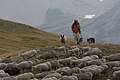 Sheep in Écrins National Park (France) (from Livestock)
 -
 Jethro Tull‘s seed drill, invented in 1701 (from History of agriculture)
 -

-

-
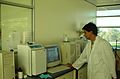 Modern facilities in molecular biology are now used in plant breeding. (from Plant breeding)


Related portals


Topics


Categories

Things you can do

- – When a task is completed, please remove it from the list.
WikiProjects

Associated Wikimedia
The following Wikimedia Foundation sister projects provide more on this subject:
-
 Commons
Free media repository -
 Wikibooks
Free textbooks and manuals -
 Wikidata
Free knowledge base -
 Wikinews
Free-content news -
 Wikiquote
Collection of quotations -
 Wikisource
Free-content library -
 Wikiversity
Free learning tools -
 Wiktionary
Dictionary and thesaurus


Agriculture journals

- Agronomy Journal – the American Society of Agronomy
- Agronomy for Sustainable Development Journal
- European Journal of Agronomy
- Journal of Agronomy and Crop Science
- Journal of Organic Systems
- Agriculture, Ecosystems & Environment
- Agriculture and Human Values
- Computers and Electronics in Agriculture
- Precision Agriculture
- Experimental Agriculture
- Journal of Integrative Agriculture
- Journal of the Science of Food and Agriculture
- Renewable Agriculture and Food Systems
- Biological Agriculture & Horticulture
See also:


