The Computer Programming Portal

Computer programming or coding is the composition of sequences of instructions, called programs, that computers can follow to perform tasks. It involves designing and implementing algorithms, step-by-step specifications of procedures, by writing code in one or more programming languages. Programmers typically use high-level programming languages that are more easily intelligible to humans than machine code, which is directly executed by the central processing unit. Proficient programming usually requires expertise in several different subjects, including knowledge of the application domain, details of programming languages and generic code libraries, specialized algorithms, and formal logic.
Auxiliary tasks accompanying and related to programming include analyzing requirements, testing, debugging (investigating and fixing problems), implementation of build systems, and management of derived artifacts, such as programs’ machine code. While these are sometimes considered programming, often the term software development is used for this larger overall process – with the terms programming, implementation, and coding reserved for the writing and editing of code per se. Sometimes software development is known as software engineering, especially when it employs formal methods or follows an engineering design process. (Full article…)
Selected articles –
-
 Information privacy, also known as data privacy or data protection, is the relationship between the collection and dissemination of data, technology, the public expectation of privacy, contextual information norms, and the legal and political issues surrounding them.
Various types of personal information often come under privacy concerns. Privacy concerns exist wherever personally identifiable information or other sensitive information is collected, stored, used, and finally destroyed or deleted – in digital form or otherwise. Improper or non-existent disclosure control can be the root cause for privacy issues. Informed consent mechanisms including privacy policies and dynamic consent are important in communicating to data subjects the different uses of their personally identifiable information. (Full article…) -
Margaret Elaine Hamilton (née Heafield; born August 17, 1936) is an American computer scientist. She directed the Software Engineering Division at the MIT Instrumentation Laboratory, where she led the development of the on-board flight software for NASA‘s Apollo Guidance Computer for the Apollo program. She later founded two software companies, Higher Order Software in 1976 and Hamilton Technologies in 1986, both in Cambridge, Massachusetts.
Hamilton has published more than 130 papers, proceedings, and reports, about sixty projects, and six major programs. She coined the term “software engineering“, stating, “I began to use the term ‘software engineering’ to distinguish it from hardware and other kinds of engineering, yet treat each type of engineering as part of the overall systems engineering process.”
On November 22, 2016, Hamilton received the Presidential Medal of Freedom from president Barack Obama for her work leading to the development of on-board flight software for NASA’s Apollo Moon missions. (Full article…) -
Structured Query Language (SQL) (pronounced /ˌɛsˌkjuˈɛl/ S-Q-L; or alternatively as /ˈsiːkwəl/ ⓘ “sequel”) is a domain-specific language used to manage data, especially in a relational database management system (RDBMS). It is particularly useful in handling structured data, i.e., data incorporating relations among entities and variables.
Introduced in the 1970s, SQL offered two main advantages over older read–write APIs such as ISAM or VSAM. Firstly, it introduced the concept of accessing many records with one single command. Secondly, it eliminates the need to specify how to reach a record, i.e., with or without an index.
Originally based upon relational algebra and tuple relational calculus, SQL consists of many types of statements, which may be informally classed as sublanguages, commonly: data query language (DQL), data definition language (DDL), data control language (DCL), and data manipulation language (DML). (Full article…) -
Paul Gardner Allen (January 21, 1953 – October 15, 2018) was an American businessman, computer programmer, and investor. He co-founded Microsoft Corporation with his childhood friend Bill Gates in 1975, which was followed by the microcomputer revolution of the 1970s and 1980s. Allen was ranked as one of the richest people in American history by Forbes, with an estimated net worth of $20.3 billion at the time of his death in October 2018.
Allen quit from day-to-day work at Microsoft in early 1983 after a Hodgkin lymphoma diagnosis, remaining on its board as vice-chairman. He and his sister, Jody Allen, founded Vulcan Inc. in 1986, a privately held company that managed his business and philanthropic efforts. At the time of his death, he had a multi-billion dollar investment portfolio, including technology and media companies, scientific research, real estate holdings, private space flight ventures and stakes in other sectors. He owned the Seattle Seahawks of the National Football League and the Portland Trail Blazers of the National Basketball Association, and was part-owner of the Seattle Sounders FC of Major League Soccer. Under the Allen Estate’s helm, the Seahawks won Super Bowl XLVIII, LX, and made it to two other Super Bowls (XLIX, XL). In 2000 he resigned from his position on Microsoft’s board and assumed the post of senior strategy advisor to the company’s management team.
Allen founded the Allen Institutes for Brain Science, Artificial Intelligence, and Cell Science, as well as companies like Stratolaunch Systems and Apex Learning. He gave more than $2 billion to causes such as education, wildlife and environmental conservation, the arts, healthcare and community services. In 2004, he funded the first crewed private spaceplane with SpaceShipOne. He received numerous awards and honors and was listed among the Time 100 Most Influential People in the World in 2007 and 2008. He also discovered the wrecks of various famous warships, like the IJN Musashi and USS Indianapolis. (Full article…) -

R is a programming language for statistical computing and data visualization. It has been widely adopted in the fields of data mining, bioinformatics, data analysis, and data science.
The core R language is extended by a large number of software packages, which contain reusable code, documentation, and sample data. Some of the most popular R packages are in the tidyverse collection, which enhances functionality for visualizing, transforming, and modelling data, as well as improves the ease of programming (according to the authors and users).
R is free and open-source software distributed under the GNU General Public License. The language is implemented primarily in C, Fortran, and R itself. Precompiled executables are available for the major operating systems (including Linux, MacOS, and Microsoft Windows). (Full article…) -

C# (/ˌsiː ˈʃɑːrp/ see SHARP) is a general-purpose high-level programming language supporting multiple paradigms. C# encompasses static typing, strong typing, lexically scoped, imperative, declarative, functional, generic, object-oriented (class-based), and component-oriented programming disciplines.
The principal designers of the C# programming language were Anders Hejlsberg, Scott Wiltamuth, and Peter Golde from Microsoft. It was first widely distributed in July 2000 and was later approved as an international standard by Ecma (ECMA-334) in 2002 and ISO/IEC (ISO/IEC 23270 and 20619) in 2003. Microsoft introduced C# along with .NET Framework and Microsoft Visual Studio, both of which are, technically speaking, closed-source. At the time, Microsoft had no open-source products. Four years later, in 2004, a free and open-source project called Mono began, providing a cross-platform compiler and runtime environment for the C# programming language. A decade later, Microsoft released Visual Studio Code (code editor), Roslyn (compiler), and the unified .NET platform (software framework), all of which support C# and are free, open-source, and cross-platform. Mono also joined Microsoft, but was not merged into .NET.
As of November 2025, the most recent stable version of the language is C# 14. (Full article…) -
Charles Babbage (/ˈbæbɪdʒ/; 26 December 1791 – 18 October 1871) was an English polymath. A mathematician, philosopher, inventor and mechanical engineer, Babbage originated the concept of a digital programmable computer.
Babbage is considered by some to merit the title of “father of the computer“. He is credited with inventing the first mechanical computer, the difference engine, that eventually led to more complex electronic designs, though all the essential ideas of modern computers are to be found in his analytical engine, programmed using a principle openly borrowed from the Jacquard loom. As part of his computer work, he also designed the first computer printers. He had a broad range of interests in addition to his work on computers, covered in his 1832 book Economy of Manufactures and Machinery. He was an important figure in the social scene in London, and is credited with importing the “scientific soirée” from France with his well-attended Saturday evening soirées. His varied work in other fields has led him to be described as “pre-eminent” among the many polymaths of his century.
Babbage, who died before the complete successful engineering of many of his designs, including his Difference Engine and Analytical Engine, remained a prominent figure in the ideating of computing. Parts of his incomplete mechanisms are on display in the Science Museum in London. In 1991, a functioning difference engine was constructed from the original plans. Built to tolerances achievable in the 19th century, the success of the finished engine indicated that Babbage’s machine would have worked. (Full article…) -
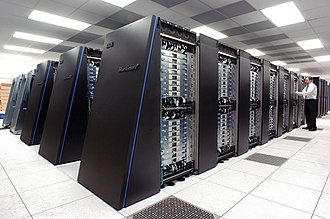
Large supercomputers such as IBM’s Blue Gene/P are designed to heavily exploit parallelism.
Parallel computing is a type of computation in which many calculations or processes are carried out simultaneously. Large problems can often be divided into smaller ones, which can then be solved at the same time. There are several different forms of parallel computing: bit-level, instruction-level, data, and task parallelism. Parallelism has long been employed in high-performance computing, but has gained broader interest due to the physical constraints preventing frequency scaling. As power consumption (and consequently heat generation) by computers has become a concern in recent years, parallel computing has become the dominant paradigm in computer architecture, mainly in the form of multi-core processors.
In computer science, parallelism and concurrency are two different things: a parallel program uses multiple CPU cores, each core performing a task independently. On the other hand, concurrency enables a program to deal with multiple tasks even on a single CPU core; the core switches between tasks (i.e. threads) without necessarily completing each one. A program can have both, neither or a combination of parallelism and concurrency characteristics.
Parallel computers can be roughly classified according to the level at which the hardware supports parallelism, with multi-core and multi-processor computers having multiple processing elements within a single machine, while clusters, MPPs, and grids use multiple computers to work on the same task. Specialized parallel computer architectures are sometimes used alongside traditional processors, for accelerating specific tasks. (Full article…) -
Stephen Gary Wozniak (/ˈwɒzniæk/; born August 11, 1950), also known by his nickname Woz, is an American technology entrepreneur, electrical engineer, computer programmer, and inventor. In 1976, he co-founded Apple Computer (now Apple Inc.) with his early business partner Steve Jobs. Through his work at Apple in the 1970s and 1980s, he is widely recognized as one of the most prominent pioneers of the personal computer revolution.
In 1975, Wozniak started developing the Apple I into the computer that launched Apple when he and Jobs first began marketing it the following year. He was the primary designer of the Apple II, introduced in 1977, known as one of the first highly successful mass-produced microcomputers, while Jobs oversaw the development of its foam-molded plastic case and early Apple employee Rod Holt developed its switching power supply.
With human–computer interface expert Jef Raskin, Wozniak had a major influence over the initial development of the original Macintosh concepts from 1979 to 1981, when Jobs took over the project following Wozniak’s brief departure from the company due to a traumatic airplane accident. After permanently leaving Apple in 1985, Wozniak founded CL 9 and created the first programmable universal remote, released in 1987. He then pursued several other business and philanthropic ventures throughout his career, focusing largely on technology in K–12 schools, which involved a 1990 initiative to place computers in schools in the former Soviet Union. (Full article…) -

Erlang (/ˈɜːrlæŋ/ UR-lang) is a general-purpose, concurrent, functional high-level programming language, and a garbage-collected runtime system. The term Erlang is used interchangeably with Erlang/OTP, or Open Telecom Platform (OTP), which consists of the Erlang runtime system, several ready-to-use components (OTP) mainly written in Erlang, and a set of design principles for Erlang programs.
The Erlang runtime system is designed for systems with these traits:- Distributed
- Fault-tolerant
- Soft real-time
- Highly available, non-stop applications
- Hot swapping, where code can be changed without stopping a system.
-

A Blender screenshot displaying Suzanne, a 3D test model
Computer graphics (CG) deals with generating images and art with the aid of computers. Computer graphics is a core technology in digital photography, film, video games, digital art, cell phone and computer displays, and many specialized applications. A great deal of specialized hardware and software has been developed, with the displays of most devices being driven by computer graphics hardware. It is a vast and recently developed area of computer science. The phrase was coined in 1960 by computer graphics researchers Verne Hudson and William Fetter of Boeing. It is often abbreviated as CG, or typically in the context of film as computer generated imagery (CGI). The non-artistic aspects of computer graphics are the subject of computer science research.
Computer graphics is responsible for displaying art and image data effectively and meaningfully to the consumer. It is also used for processing image data received from the physical world, such as photo and video content. Computer graphics development has had a significant impact on many types of media and has revolutionized animation, movies, advertising, and video games in general. (Full article…) -
Kotlin (/ˈkɒtlɪn/) is a cross-platform, statically typed, general-purpose high-level programming language with type inference. Kotlin is designed to interoperate fully with Java, and the Java virtual machine (JVM) version of Kotlin’s standard library depends on the Java Class Library.
However, type inference allows for more concise syntax. Kotlin mainly targets the JVM, but also compiles to JavaScript (e.g., for frontend web applications using React) or native code via LLVM (e.g., for native iOS apps sharing business logic with Android apps). JetBrains bears language development costs, while the Kotlin Foundation protects the Kotlin trademark.
On 7 May 2019, Google announced Kotlin had become its preferred language for Android app developers. Since the release of Android Studio 3.0 in October 2017, Kotlin has been included as an alternative to the standard Java compiler. The Android Kotlin compiler emits Java 8 bytecode by default (which runs in any later JVM), but allows targeting Java 9 up to 24, for optimizing, or allows for more features; it has bidirectional record class interoperability support for JVM, introduced in Java 16, considered stable as of Kotlin 1.5.
Kotlin has support for the web with Kotlin/JS, through an intermediate representation-based backend that has been declared stable since version 1.8, released in December 2022. Kotlin/Native (e.g., Apple silicon support) has been declared stable since version 1.9.20, released in November 2023. (Full article…) -
Linus Benedict Torvalds (born 28 December 1969) is a Finnish and American software engineer who is the creator and lead developer of the Linux kernel since 1991. He also created the distributed version control system Git.
Torvalds was one of the recipients of the 2012 Millennium Technology Prize “in recognition of his creation of a new open source operating system for computers leading to the widely used Linux kernel“. He is also the recipient of the 2014 IEEE Computer Society Computer Pioneer Award and the 2018 IEEE Masaru Ibuka Consumer Electronics Award. (Full article…) -
C++ is a high-level, general-purpose programming language created by Danish computer scientist Bjarne Stroustrup. First released in 1985 as an extension of the C programming language, adding object-oriented (OOP) features, it has since expanded significantly over time adding more OOP and other features; as of 1997/C++98 standardization, C++ has added functional features, in addition to facilities for low-level memory manipulation for systems like microcomputers or to make operating systems like Linux or Windows, and even later came features like generic programming (through the use of templates). C++ is usually implemented as a compiled language, and many vendors provide C++ compilers, including the Free Software Foundation, LLVM, Microsoft, Intel, Embarcadero, Oracle, and IBM.
C++ was designed with systems programming and embedded, resource-constrained software and large systems in mind, with performance, efficiency, and flexibility of use as its design highlights. C++ has also been found useful in many other contexts, with key strengths being software infrastructure and resource-constrained applications, including desktop applications, video games, servers (e.g., e-commerce, web search, or databases), and performance-critical applications (e.g., telephone switches or space probes).
C++ is standardized by the International Organization for Standardization (ISO), with the latest standard version ratified and published by ISO in October 2024 as ISO/IEC 14882:2024 (informally known as C++23). The C++ programming language was initially standardized in 1998 as ISO/IEC 14882:1998, which was then amended by the C++03, C++11, C++14, C++17, and C++20 standards. The next C++23 standard superseded these with new features and an enlarged standard library. Before the initial standardization in 1998, C++ was developed by Stroustrup at Bell Labs since 1979 as an extension of the C language; he wanted an efficient and flexible language similar to C that also provided high-level features for program organization. Since 2012, C++ has been on a three-year release schedule with C++29 as the next planned standard. (Full article…) -
In computing, a compiler is software that translates computer code written in one programming language (the source language) into another language (the target language). The name “compiler” is primarily used for programs that translate source code from a high-level programming language to a low-level programming language (e.g., assembly language, object code, or machine code) to create an executable program.
There are many different types of compilers which produce output in different useful forms. A cross-compiler produces code for a different central processing unit (CPU) or operating system than the one on which the cross-compiler itself runs. A bootstrap compiler is often a temporary compiler, used for compiling a more permanent or better optimized compiler for a language.
Related software include decompilers, programs that translate from low-level languages to higher-level ones; programs that translate between high-level languages, usually called source-to-source compilers or transpilers; language rewriters, usually programs that translate the form of expressions without a change of language; and compiler-compilers, compilers that produce compilers (or parts of them), often in a generic and reusable way so as to be able to produce many differing compilers. (Full article…)


Selected images
-
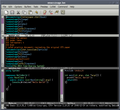
 A view of the GNU nano Text editor version 6.0
 -
 An IBM Port-A-Punch punched card
 -
 This image (when viewed in full size, 1000 pixels wide) contains 1 million pixels, each of a different color.
 -
 GNOME Shell, GNOME Clocks, Evince, gThumb and GNOME Files at version 3.30, in a dark theme
 -
-

-
 A head crash on a modern hard disk drive
 -
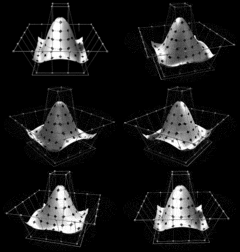 Animation of a Non-uniform rational B-spline surface. Modeled and rendered in Cobalt.
 -
 Partial view of the Mandelbrot set. Step 1 of a zoom sequence: Gap between the “head” and the “body” also called the “seahorse valley”.
 -
 Stephen Wolfram is a British-American computer scientist, physicist, and businessman. He is known for his work in computer science, mathematics, and in theoretical physics.
 -
 Ada Lovelace was an English mathematician and writer, chiefly known for her work on Charles Babbage‘s proposed mechanical general-purpose computer, the Analytical Engine. She was the first to recognize that the machine had applications beyond pure calculation, and to have published the first algorithm intended to be carried out by such a machine. As a result, she is often regarded as the first computer programmer.
 -
 Margaret Hamilton standing next to the navigation software that she and her MIT team produced for the Apollo Project.
 -
 A lone house. An image made using Blender 3D.
 -
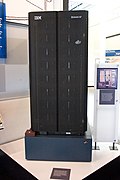 Deep Blue was a chess-playing expert system run on a unique purpose-built IBM supercomputer. It was the first computer to win a game, and the first to win a match, against a reigning world champion under regular time controls. Photo taken at the Computer History Museum.
 -
 Bill Gosper‘s Glider Gun in action
 -
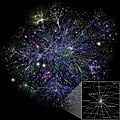 Partial map of the Internet based on the January 15, 2005 data found on opte.org. Each line is drawn between two nodes, representing two IP addresses. The length of the lines are indicative of the delay between those two nodes. This graph represents less than 30% of the Class C networks reachable by the data collection program in early 2005.
 -
 Grace Hopper at the UNIVAC keyboard, c. 1960. Grace Brewster Murray: American mathematician and rear admiral in the U.S. Navy who was a pioneer in developing computer technology, helping to devise UNIVAC I. the first commercial electronic computer, and naval applications for COBOL (common-business-oriented language).
 -
 Output from a (linearised) shallow water equation model of water in a bathtub. The water experiences 5 splashes which generate surface gravity waves that propagate away from the splash locations and reflect off of the bathtub walls.


Did you know? –

- … that the 2024 psychological horror game Mouthwashing utilises non-diegetic scene transitions that mimic glitches and crashes?
- … that both Thackeray and Longfellow bought paintings by Fanny Steers?
- … that NATO was once targeted by a group of “gay furry hackers“?
- … that Perfectly Imperfect's social media platform has a main feed that is presented in reverse chronological order and is not algorithmically curated?
- … that Hans-Joachim Hacker worked at a state-owned food processing plant before joining the Volkskammer and Bundestag?
- … that Tennyson once quoted Catullus 96 to Thackeray while they dined?
Subcategories

WikiProjects

- There are many users interested in computer programming, join them.
Computer programming news
- 3 May 2026 –
- The Russian Ministry of Industry and Trade will restrict supplies of popular computers starting 27 May 2026. (Reporter)
- 15 April 2026 –
- Shoe company Allbirds announces it will be pivoting to providing computing infrastructure for artificial intelligence, with plans to rename itself to “NewBird AI”. The company’s shares rose nearly 600% on the news. (CNBC)
Topics


| Fields |
| ||||||
|---|---|---|---|---|---|---|---|
| Concepts |
| ||||||
| Orientations | |||||||
| Models |
| ||||||
| Related fields | |||||||


Related portals


Associated Wikimedia
The following Wikimedia Foundation sister projects provide more on this subject:
-
 Commons
Free media repository -
 Wikidata
Free knowledge base -
 Wikiquote
Collection of quotations -
 Wikisource
Free-content library -
 Wikiversity
Free learning tools -
 Wiktionary
Dictionary and thesaurus


