As a human endeavor, engineering has existed since ancient times, starting with the six classic simple machines. Examples of large-scale engineering projects from antiquity include impressive structures like the pyramids, elegant temples such as the Parthenon, and water conveyances like hulled watercraft, canals, and the Roman aqueduct. Early machines were powered by humans and animals, then later by wind. Machines of war were invented for siegecraft. In Europe, the scientific and industrial revolutions advanced engineering into a scientific profession and resulted in continuing technological improvements. The steam engine provided much greater power than animals, leading to mechanical propulsion for ships and railways. Further scientific advances resulted in the application of engineering to electrical, chemical, and aerospace requirements, plus the use of new materials for greater efficiencies.
The word engineering is derived from the Latiningenium. Engineers typically follow a code of ethics that favors honesty and integrity, while being dedicated to public safety and welfare. Engineering tasks involve finding optimal solutions based on constraints, with testing and simulations being used prior to production. When a deployed product fails, forensic engineering is used to determine what went wrong in order to find a fix. Much of this product lifecycle management is now assisted with computer software, from design to testing and manufacturing. At larger scales, this process is normally funded by a company, multiple investors, or the government, so a knowledge of economics and business practices is needed. (Full article…)
An engineer is a practitioner of engineering. The word engineer (Latiningeniator, Ir is the term and or title of an engineer in countries like Belgium, The Netherlands, and Indonesia) is derived from the Latin words ingeniare (“to contrive, devise”) and ingenium (“cleverness”). The foundational qualifications of a licensed professional engineer typically include a four-year bachelor’s degree in an engineering discipline, or in some jurisdictions, a master’s degree in an engineering discipline plus four to six years of peer-reviewed professional practice (culminating in a project report or thesis) and passage of engineering board examinations. (Full article…)
A protest group was formed to resist the proposed construction, and attracted support from the botanist and environmental campaigner David Bellamy. Despite the opposition, planning permission was granted in 2005 and construction began in 2007. Although work on the project was hampered by harsh weather, difficult terrain, and previous mining activity, the wind farm was officially opened on 25 September 2008 after “years of controversy”, at a cost of £50 million. (Full article…)
Credit: National Institute of Standards and Technology’s Manufacturing Engineering
Computer-integrated manufacturing (CIM) is the manufacturing approach of using computers to control the entire production process. This integration allows individual processes to exchange information with each other and initiate actions. Although manufacturing can be faster and less error-prone by the integration of computers, the main advantage is the ability to create automated manufacturing processes. Typically CIM relies on closed-loop control processes, based on real-time input from sensors. It is also known as flexible design and manufacturing.
Little Boy was developed by Lieutenant CommanderFrancis Birch‘s group at the Los Alamos Laboratory. It was the successor to a plutonium-fueled gun-type fission design, Thin Man, which was abandoned in 1944 after technical difficulties were discovered. Little Boy used a charge of cordite to fire a hollow cylinder (the “bullet”) of highly enriched uranium through an artillery gun barrel into a solid cylinder (the “target”) of the same material. The design was highly inefficient: the weapon used on Hiroshima contained 64 kilograms (141 lb) of uranium, but less than a kilogram underwent nuclear fission. Unlike the implosion design developed for the Trinity test and the Fat Man bomb design that was used against Nagasaki, which required sophisticated coordination of shaped explosive charges, the simpler but inefficient gun-type design was considered almost certain to work, and was never tested prior to its use at Hiroshima. (Full article…)
Image 2
Fizeau–Foucault apparatus may refer to either of two nineteenth-century experiments to measure the speed of light:
Beryl May DentMIEE (10 May 1900 – 9 August 1977) was an English mathematical physicist, technical librarian, and a programmer of early analogue and digital computers to solve electrical engineering problems. She was born in Chippenham, Wiltshire, the eldest daughter of schoolteachers. The family left Chippenham in 1901, after her father became head teacher of the then recently established Warminster County School. In 1923, she graduated from the University of Bristol with First Class Honours in applied mathematics. She was awarded the Ashworth Hallett scholarship by the university and was accepted as a postgraduate student at Newnham College, Cambridge.
She returned to Bristol in 1925, after being appointed a researcher in the Physics Department at the University of Bristol, with her salary being paid by the Department of Scientific and Industrial Research. In 1927, John Lennard-Jones was appointed Professor of Theoretical physics, a chair being created for him, with Dent becoming his research assistant in theoretical physics. Lennard‑Jones pioneered the theory of interatomic and intermolecular forces at Bristol and she became one of his first collaborators. They published six papers together from 1926 to 1928, dealing with the forces between atoms and ions, that were to become the foundation of her master’s thesis. Later work has shown that the results they obtained had direct application to atomic force microscopy by predicting that non-contact imaging is possible only at small tip-sample separations. (Full article…)
Image 4
ODB++ is a proprietary CAD-to-CAM data exchange format used in the design and manufacture of electronic devices. Its purpose is to exchange printed circuit board design information between design and manufacturing and between design tools from different EDA/ECAD vendors. It was originally developed by Valor Computerized Systems, Ltd. (acquired in 2010 by Mentor Graphics which was later acquired by Siemens in 2016) as the job description format for their CAM system.
ODB stands for open database, but its openness is disputed, as discussed below. The ‘++’ suffix, evocative of C++, was added in 1997 with the addition of component descriptions. There are two versions of ODB++: the original (now controlled by Mentor) and an XML version called ODB++(X) that Valor developed and donated to the IPC organization in an attempt to merge GenCAM (IPC-2511) and ODB++ into Offspring (IPC-2581). (Full article…)
Image 5
Myers in 1903
Carl Edgar Myers (1842–1925) was an American aeronautical engineer. He was born at March 2, 1842 at Herkimer, New York, to Abram H. and Eliza Ann (Cristman) Myers. At various times in his life, he was employed as carpenter, mechanician, plumber, electrician and chemist, banker, and photographer. After 1878, he focused on aeronautical engineering. He became known as the inventor of new or improved systems for generating gases, and as the constructor of hydrogen balloons and airships, including the aerial velocipede, gas kite, sky-cycle and electrical aerial torpedo. He married Mary Breed Hawley on November 8, 1871.
Myers, after spending two years hiring professional balloonists to test his designs, Myers went up in a balloon himself. (Full article…)
Project Alberta was formed in March 1945, and consisted of 51 United States Army, Navy, and civilian personnel, including one British scientist. Its mission was three-fold. It first had to design a bomb shape for delivery by air, then procure and assemble it. It supported the ballistic testing work at Wendover Army Air Field, Utah, conducted by the 216th Army Air Forces Base Unit (Project W-47), and the modification of B-29s to carry the bombs (Project Silverplate). After completion of its development and training missions, Project Alberta was attached to the 509th Composite Group at North Field, Tinian, where it prepared facilities, assembled and loaded the weapons, and participated in their use. (Full article…)
Image 7
The Churchill Machine Tool Company Limited began as the manufacturing subsidiary of the machine tool importers Charles Churchill & Company Limited founded in the early 1900s by US-born Charles Churchill (1837–1916). Created out of the personal bankruptcy of Charles Churchill, the company developed to become one of the largest British importers of machine tools from the United States and a major manufacturer of such tools, initially under licence and later of its own development.
The original business importing American machine tools into Britain began with Charles Churchill as sole proprietor and later as a partnership with two others. It became a limited company in 1889. In 1906 a separate company, The Churchill Machine Tool Co Ltd, was established with the purpose of adapting tools imported by Charles Churchill & Co. The former expanded, producing American tools under licence and then manufactured tools of its own design, in particular precision surface grinders and similar engineering machinery. In 1918 The Churchill Machine Tool Co relocated its factories onto a single site at Broadheath, near Altrincham. (Full article…)
The tubes were constructed using the shield method and are each 6,550 feet (2,000 m) long and 15.5 feet (4.7 m) wide. The interiors are lined with cast-iron “rings” formed with concrete. The tubes descend 91 to 95 feet (28 to 29 m) below the mean high water level of the East River, with a maximum gradient of 3.1 percent. During the tunnel’s construction, a house at 58 Joralemon Street in Brooklyn was converted into a ventilation building and emergency exit. (Full article…)
Edmundo Gómez Moreno (born 17 February 1991), known professionally as Raymix, is a Mexican musician and aerospace engineer. Nicknamed El Rey de la Electrocumbia (“The King of Electrocumbia”), he started his music career in the early 2010s as part of the trance project Light & Wave, alongside two other Mexican musicians. Their song “Feeling the City” was featured on A State of Trance, a radio show Armin van Buuren hosts. In 2013, Raymix participated in an educational internship at NASA, where he contributed to the development of a satellite.
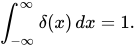
Schematic representation of the Dirac delta function by a line surmounted by an arrow. The height of the arrow is usually meant to specify the value of any multiplicative constant, which will give the area under the function. The other convention is to write the area next to the arrowhead. In mathematical analysis, the Dirac delta function (or distribution), also known as the unit impulse, is a generalized function on the real numbers, whose value is zero everywhere except at zero, where it is infinite, and whose integral over the entire real line is equal to one. Thus it can be represented heuristically assuch that
Since no function has this property, modelling the delta “function” rigorously involves the use of limits or, as is common in mathematics, measure theory and the theory of distributions. (Full article…)
Image 12
The 2009 North Korean nuclear test was the underground detonation of a nuclear device conducted on Monday, 25 May 2009 by North Korea. This was its second nuclear test, the first test having taken place in October 2006. Following the nuclear test, Pyongyang also conducted several missile tests. A scientific paper later estimated the yield as 2.35 kilotons.
Meticulous naval inventories show that HMS Beagle carried a total of at least 34 recorded chronometers on its three main survey voyages from 1826 to 1843, and 22 on the second voyage with Darwin on board, when they had a dedicated cabin. Some were Navy property and others were on loan from the manufacturers, as well as six on the second voyage owned by the captain, Robert FitzRoy. Both of the two known survivors from the second voyage are owned by the British Museum (the second is registration No. CAI.1743). (Full article…)
Introduced in 2003, HDMI largely replaced older analog video standards such as composite video, S-Video, and VGA in consumer electronics. It was developed based on the CEA-861 standard, which was also used with the earlier Digital Visual Interface (DVI). HDMI is electrically compatible with DVI video signals, and adapters allow interoperability between the two without signal conversion or loss of quality. Adapters and active converters are also available for connecting HDMI to other video interfaces, including the older analog formats, as well as digital formats such as DisplayPort. (Full article…)
The Castaing machine is a device used to add lettering and decoration to the edge of a coin. Such lettering was necessitated by counterfeiting and edge clipping, which was a common problem resulting from the uneven and irregular hammered coinage. When Aubin Olivier introduced milled coinage to France, he also developed a method of marking the edges with lettering which would make it possible to detect if metal had been shaved from the edge. This method involved using a collar, into which the metal flowed from the pressure of the press. This technique was slower and more costly than later methods. France abandoned milled coinage in favour of hammering in 1585.
England experimented briefly with milled coinage, but it wasn’t until Peter Blondeau brought his method of minting coins there in the mid-seventeenth century that such coinage began in earnest in that country. Blondeau also invented a different method of marking the edge, which was, according to him, faster and less costly than the method pioneered by Olivier. Though Blondeau’s exact method was secretive, numismatists have asserted that it likely resembled the later device invented by Jean Castaing. Castaing’s machine marked the edges by means of two steel rulers, which, when a coinage blank was forced between them, imprinted legends or designs on its edge. Castaing’s device found favour in France, and it was eventually adopted in other nations, including Britain and the United States, but it was eventually phased out by mechanised minting techniques. (Full article…)
Image 6Design of a turbine requires collaboration of engineers from many fields, as the system involves mechanical, electro-magnetic and chemical processes. The blades, rotor and stator as well as the steam cycle all need to be carefully designed and optimized. (from Engineering)
Image 8The application of the steam engine allowed coke to be substituted for charcoal in iron making, lowering the cost of iron, which provided engineers with a new material for building bridges. This bridge was made of cast iron, which was soon displaced by less brittle wrought iron as a structural material. (from Engineering)
Image 9Hoover Dam is regarded as a major accomplishment in civil engineering (from Engineering)
Image 24Archimedes is regarded as one of the leading scientists in classical antiquity whose ideas have underpinned much of the practice of engineering. (from Engineer)
Image 25A drawing for a steam locomotive. Engineering is applied to design, with emphasis on function and the utilization of mathematics and science. (from Engineering)
This list was generated from these rules. Questions and feedback are always welcome! The search is being run daily with the most recent ~14 days of results. Note: Some articles may not be relevant to this project.

 Featured articles are displayed here, which represent some of the best content on English Wikipedia.




 Commons
 Wikibooks
 Wikidata
 Wikinews
 Wikiquote
 Wikisource
 Wikiversity
 Wiktionary


 Random portal


