
The Fashion Portal
 | |

| |
Fashion is a term used interchangeably to describe the creation of clothing, footwear, accessories, cosmetics, and jewellery of different cultural aesthetics and their mix and match into outfits that depict distinctive ways of dressing (styles and trends) as signifiers of social status, self-expression, and group belonging. As a multifaceted term, fashion describes an industry, designs, aesthetics, and trends.
The term ‘fashion’ originates from the Latin word ‘Facere,’ which means ‘to make,’ and describes the manufacturing, mixing, and wearing of outfits adorned with specific cultural aesthetics, patterns, motifs, shapes, and cuts, allowing people to showcase their group belongings, values, meanings, beliefs, and ways of life. Given the rise in mass production of commodities and clothing at lower prices and global reach, reducing fashion’s environmental impact and improving sustainability has become an urgent issue among politicians, brands, and consumers. (Full article…)
Selected article –
The dress was a 2015 online viral phenomenon centred on a photograph of a dress. Viewers disagreed on whether the dress was blue and black or white and gold. The phenomenon revealed differences in human colour perception and became the subject of scientific investigations into neuroscience and vision science.
The phenomenon originated in a photograph of a dress posted on the social networking platform Facebook. The dress was black and blue, but the conditions of the photograph caused many to perceive it as white and gold, creating debate. Within a week, more than ten million tweets had mentioned the dress. The retailer of the dress, Roman Originals, reported a surge in sales and produced a one-off version in white and gold sold for charity. (Full article…)
Core topics –

A uniform is a variety of costume worn by members of an organization while usually participating in that organization’s activity. Modern uniforms are most often worn by armed forces and paramilitary organizations such as police, emergency services, security guards, in some workplaces and schools, and by inmates in prisons. In some countries, some other officials also wear uniforms in their duties; such is the case of the Commissioned Corps of the United States Public Health Service or the French prefects. For some organizations, such as police, it may be illegal for non-members to wear the uniform. (Full article…)
Featured picture –

A photo of two maiko (apprentice geisha), with the typical make-up clearly visible, leaving portions of the nape uncovered. This is done to accentuate what is a traditionally erotic area. The white face make-up is supposed to resemble a mask, and a line of bare skin around the hairline helps create that illusion. Established geisha generally wear full white face makeup characteristic of maiko only during special performances.
Did you know… –

- … that the Théâtre de la Mode is an exhibit of small-scale fashion mannequins (examples pictured) crafted by Paris fashion designers to help revive the French fashion industry after World War II?
- … that Polish model and fashion designer Joanna Horodyńska has presented a TV program while lying in a foam-filled bath tub, and posed three times for Playboy?
- … that Polish fashion blogger Glamourina participated in the Warsaw Fashion Weekend?
Selected biography –
Harold Stanley Marcus (April 20, 1905 – January 22, 2002) was president (1950–1972) and later chairman of the board (1972–1976) of the luxury retailer Neiman Marcus in Dallas, Texas, which his father and aunt had founded in 1907. During his tenure at the company, he also became a published author, writing his memoir Minding the Store and also a regular column in The Dallas Morning News. After Neiman Marcus was sold to Carter Hawley Hale Stores, Marcus initially remained in an advisory capacity to that company, but later began his own consulting business, which continued until his death. He served his local community as an avid patron of the fine arts and as a civic leader. In a chapter titled “Mr. Stanley”—the name by which Marcus was known locally for decades—in his 1953 work Neiman-Marcus, Texas, Frank X. Tolbert called him “Dallas’s most internationally famous citizen” and worthy of being called “the Southwest’s No. 1 businessman-intellectual.”
Marcus introduced many of the innovations for which Neiman-Marcus became known, creating a national award for service in fashion and hosting art exhibitions in the store itself, as well as weekly fashion shows and an annual Fortnight event highlighting a different foreign country for two weeks each year. He established the Neiman-Marcus Christmas Catalogue, which became famous for extravagant “His and Hers” gifts such as airplanes and camels. Marcus prided himself on his staff’s ability to provide service and value for each client, often citing his father’s dictum, “There is never a good sale for Neiman Marcus unless it’s a good buy for the customer.” (Full article…)
General images
-
 Dress attributed to Charles Frederick Worth for Elisabeth of Austria painted by Franz Xaver Winterhalter (from History of fashion design)
 -
 Moslema in style fashion show at PWTC. (from Islamic fashion)
 -
 Moslema in style fashion show in Kuala Lumpur (from Islamic fashion)
 -
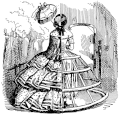 Fashion sketching before live runway presentation (from Fashion show)
 -
 Paris fashion and runway at the turn of the century (from Fashion show)
 -
 Young generation – main target of Islamic Fashion market. (from Islamic fashion)
 -
 Example of an elaborate stage set used for the Chanel Haute Couture Fall-Winter 2011 show (from Fashion show)
 -
 Garment factory workers in Bangladesh, in 2013. (from Clothing industry)
 -

-
 Fashionable Hollywood actress Louise Brooks (from History of fashion design)
 -

-
 Liu Wen, a supermodel, walking the catwalk as she models fashions by designer Diane von Fürstenberg at New York Fashion Week in 2013 (from Fashion show)
 -
 Clothing factory in Buryatia, Russia (from Clothing industry)
 -
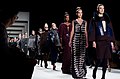 Haute couture fashion models walking the catwalk at the Carolina Herrera show during New York Fashion Week in 2014 (from Fashion show)
 -
 Models on the runway at São Paulo Fashion Week, 2017 (from Fashion show)
 -
 Example image of a poodle skirt. (from History of fashion design)
 -
 Finnish actress Elina Salo presenting clothes designed by Vuokko Nurmesniemi at a fashion show in the Helsinki Botanical Garden in 1958 (from Fashion show)
 -
 Fashionable lady of the era: portrait by Giovanni Boldini (1845–1931) showing Elizabeth Wharton Drexel in 1905. (from History of fashion design)


More Did you know (auto generated)

- … that chemist Betty Lou Raskin said in 1958 that society was wasting the “brainpower” of women, and blamed the media for making the mink coat the “symbol of female success” and not the lab coat?
- … that Shushu/Tong is a brand that creates fashion collections inspired by magical girl anime such as Puella Magi Madoka Magica?
- … that Lady Gaga referenced Alexander McQueen’s game of fashion chess for The Mayhem Ball?
- … that Alexander McQueen pioneered the use of digitally engineered prints in fashion with Natural Dis-tinction Un-natural Selection (examples pictured)?
- … that in Icelandic folklore, the Yule cat eats people who do not receive new clothing for Christmas?
- … that the ependytes, originally a Persian male tunic, became a luxury fashion statement in classical Athens, where it was worn by women and children?
Selected quote –

Related portals


Topics

Featured content


Categories

Things you can do
- Fill out the red links on Portal:Fashion/Selected anniversaries
Wikimedia
The following Wikimedia Foundation sister projects provide more on this subject:
-
 Commons
Free media repository -
 Wikibooks
Free textbooks and manuals -
 Wikidata
Free knowledge base -
 Wikinews
Free-content news -
 Wikiquote
Collection of quotations -
 Wikisource
Free-content library -
 Wikiversity
Free learning tools -
 Wiktionary
Dictionary and thesaurus


