Welcome to the Germany Portal!
Willkommen im Deutschland-Portal!

|

|

| |
Germany (German: Deutschland), officially the Federal Republic of Germany (German: Bundesrepublik Deutschland), is a country in Central and Western Europe, lying between the Baltic Sea and the North Sea to the north with the Alps to the south. It borders Denmark to the north, Poland and the Czech Republic to the east, Austria and Switzerland to the south, France to the southwest, and Luxembourg, Belgium and the Netherlands to the west.
Germany includes 16 constituent states, covers an area of 357,596 square kilometres (138,069 sq mi) and has a largely temperate seasonal climate. With over 83 million inhabitants, it is the second most populous state of Europe after Russia, the most populous state lying entirely in Europe, as well as the most populous member state of the European Union. Germany is a very decentralized country. Its capital and most populous city is Berlin, while Frankfurt serves as its financial capital and has the country’s busiest airport.
In 1871, Germany became a nation-state when most of the German states unified into the Prussian-dominated German Empire. After World War I and the Revolution of 1918–19, the Empire was replaced by the parliamentary Weimar Republic. The Nazi seizure of power in 1933 led to World War II and the Holocaust. After the end of World War II in Europe and a period of Allied occupation, two new German states were founded: West Germany, formed from the American, British, and French occupation zones, and East Germany, formed from the western part of the Soviet occupation zone, reduced by the newly established Oder-Neisse line. Following the Revolutions of 1989 that ended communist rule in Central and Eastern Europe, the country was reunified on 3 October 1990.
Germany is a federal parliamentary republic led by a chancellor. It is a great power with the largest economy in Europe. As a global leader in several industrial, scientific and technological sectors, it is a major trading nation. The Federal Republic of Germany was a founding member of the European Economic Community in 1957 and the European Union in 1993. Read more…
Selected article

Michael Schumacher (born 3 January 1969) is a German former racing driver who competed in Formula One from 1991 to 2006 and from 2010 to 2012. Schumacher won a record-setting seven Formula One World Drivers’ Championship titles, tied by Lewis Hamilton in 2020, and—at the time of his retirement—held the records for most wins (91), pole positions (68), and podium finishes (155), while he maintains the record for most fastest laps (77), among others.
Born in Hürth to a working-class family, Schumacher began competitive kart racing aged four in a pedal kart built from discarded parts. After a successful karting career—culminating in his victory at the European Championship in 1987—Schumacher graduated to junior formulae. He dominated Formula König in his debut season, before graduating to German Formula Three in 1989, where he finished third. He won the title in 1990, also claiming the Macau Grand Prix and becoming a race-winner in the World Sportscar Championship with Sauber Mercedes. Schumacher made his debut Formula One appearance with Jordan at the Belgian Grand Prix in 1991; his qualifying performance saw Benetton sign him for the remainder of the season. In 1992, he achieved his maiden victory in Belgium amongst several podiums, which he repeated at the Portuguese Grand Prix in 1993. Schumacher won his maiden World Drivers’ Championship with eight victories in 1994, following a collision with his rival Damon Hill at the last race of the season. He won a further nine Grands Prix as he defended his title in 1995. (Full article…)
Selected picture
-
 Photo credit: Karsten DörreA twilight panorama of Regensburg, Bavaria, Germany with the 12th century bridge Steinerne Brücke and Regensburg Cathedral on the left and the river Danube in the foreground. Located at the confluence of the Danube and Regen rivers, the first settlements in the area date to the Stone Age. A Roman fort was constructed in 179. In contrast to almost all other major German cities, Regensburg had little damage from Allied air raids in World War II and thus has an almost intact medieval city center, which is listed as a UNESCO World Heritage Site.
 -
 Banknote design credit: Deutsch-Ostafrikanische Bank; photographed by Andrew ShivaThe rupie was the unit of currency of German East Africa between 1890 and 1916. During World War I, the colony was cut off from Germany as a result of a wartime blockade and the colonial government needed to create an emergency issue of banknotes. Paper made from linen or jute was initially used, but because of wartime shortages, the notes were later printed on commercial paper in a variety of colours, wrapping paper, and in one instance, wallpaper. This five-rupie banknote was issued in 1915, and is now part of the National Numismatic Collection at the Smithsonian Institution.
Other denominations:
‘”`UNIQ–templatestyles-00000017-QINU`”‘ -


Hohenzollern Bridge and Cologne Cathedral Credit: Thomas RobbinThe Hohenzollern Bridge crossing the Rhine in Cologne, Germany, with the Cologne Cathedral in the background. The bridge is a tied-arch railway bridge, as well as a pedestrian bridge. Originally built in 1911, it survived numerous Allied bombings in World War II, only to be destroyed by German engineers as the war drew to a close. Reconstruction began soon after and the bridge was opened to pedestrian traffic in 1948 and completely opened in 1959. -
 German war bond posterPoster: Lucian Bernhard; restoration: BellhallaA 1917 poster by Lucian Bernhard intended to sell war bonds in Germany. The caption, roughly translated, is “This is how your money helps you fight! Turned into submarines, it keeps enemy shells away! That’s why you should subscribe to war bonds!” Mostly excluded from international financial markets during World War I, Germany was largely limited to domestic borrowing. The bond drives proved extremely successful, raising approximately 100 billion marks in funds.
 -
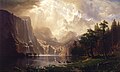 Painting credit: Albert BierstadtAlbert Bierstadt (1830–1902) was a German-American painter best known for his lavish, sweeping landscapes of the American West, such as this oil-on-canvas painting, entitled Among the Sierra Nevada, California, created in 1868. He painted the landscape in his Rome studio, and exhibited it in Berlin and London before shipping it to the United States. His choice of grandiose subjects was matched by his entrepreneurial flair; his exhibitions of individual works were accompanied by promotion, ticket sales, and, in the words of one critic, a “vast machinery of advertisement and puffery”. This work is in the collection of the Smithsonian American Art Museum.
 -

The Einstein Tower in Potsdam Credit: Astrophysikalisches Institut PotsdamThe Einstein Tower, a solar observatory in Potsdam -
 Painting credit: Karl Friedrich SchinkelKarl Friedrich Schinkel (1781–1841) was a Prussian architect and city planner. He was one of the most prominent architects in Germany and designed both Neoclassical and Neo-Gothic buildings, the most famous of which are found in and around Berlin. He was also a painter and a designer of furniture and stage sets.
This oil-on-canvas painting, entitled Castle by the River, was created by Schinkel in 1820. As an artist, his architectural talent shone through, and his buildings and landscapes are carefully drafted and meticulously executed. The painting is in the collection of the Alte Nationalgalerie in Berlin. -

Wind beeches on the Schauinsland in the Black Forest Wind beeches on the Schauinsland in the Black ForestCredit: Richard Fabi -
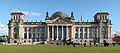 Photo: Matthew FieldThe Reichstag building is a historical edifice in Berlin, Germany, constructed to house the Reichstag, parliament of the German Empire. It was opened in 1894 and housed the Reichstag until 1933, when it was severely damaged in a fire. After German reunification it underwent a reconstruction, completed in 1999, and now houses the modern Bundestag.
 -
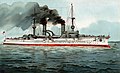 Illustration: Hugo Graf; restoration: Adam CuerdenSMS Fürst Bismarck was Germany’s first armored cruiser, built for the Kaiserliche Marine before the turn of the 20th century and launched in 1900. Named for the German statesman Otto von Bismarck, the ship was primarily intended for colonial duties. She served in this capacity as part of the East Asia Squadron until she was relieved in 1909, at which point she returned to Germany. The ship was rebuilt between 1910 and 1914, and after the start of World War I, she was briefly used as a coastal defense ship. She proved inadequate to this task, and so she was withdrawn from active duty and served as a training ship for engineers until the end of the war. Fürst Bismarck was decommissioned in 1919 and sold for scrap.
 -
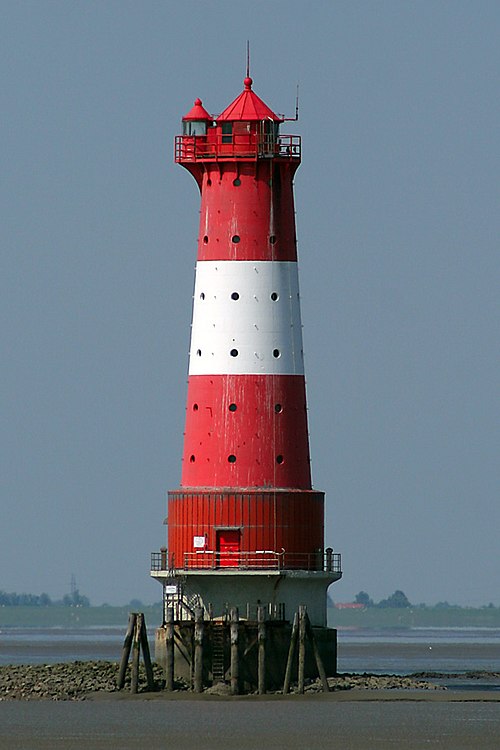
Lighthouse Arngast in the Jade Bight Lighthouse Arngast in the Jade BightCredit: Tom Kurpjuweit -
 Photograph: Thomas WolfThe Bode Museum on Museum Island in Berlin, Germany, named after its founding director, is a museum of antiquities including sculpture, Byzantine art and numismatics. Designed by Ernst von Ihne and completed in 1904, the building was restored extensively from 1997 to 2006.
 -

Church of Peace in Sanssouci Park Credit: Wolfgang StaudtThe Church of Peace in the Marly Gardens, Sanssouci Park -
 Photo credit: Chris 73The Cathedral of Magdeburg (known as Magdeburger Dom in German) is the first gothic cathedral in Germany and with a height of 104 m the highest cathedral in Eastern Germany. The current cathedral was constructed over the period of 300 years starting from 1209, and the completion of the steeples took place only in 1520. In 2004 a funding drive for a new organ that was started in 1997 was completed, collecting 2 Million Euro. The new organ has been ordered from a company near Potsdam, constructing a 36 ton instrument with 93 registers and approximately 5000 pipes. The construction is planned to be completed in 2007, and the new organ will hopefully be used for the first time in 2008.
 -
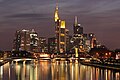 The night skyline of Frankfurt, showing the Commerzbank Tower (centre) and the Maintower (right of centre). Frankfurt is the fifth-largest city in Germany, and the surrounding Frankfurt Rhein-Main Region is Germany’s second-largest metropolitan area.
 -
 Banknote: Allied-occupied Germany (image courtesy of the National Numismatic Collection, National Museum of American History)A one Deutsche Mark banknote issued by Allied-occupied Germany and circulated by the United States Army Command in 1948. This was the first of three issues of West German currency introduced that year. The Mark remained the official currency of West Germany until German reunification in 1990, then the official currency of Germany until the adoption of the euro in 2002.
 -
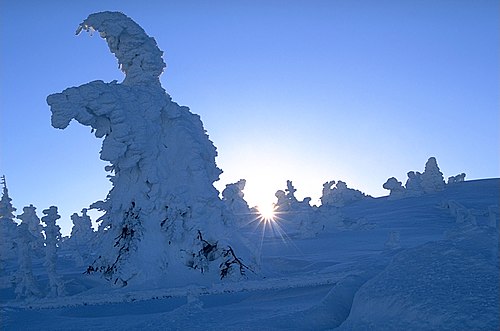
Snowed trees on the Brocken Credit: Andreas TilleSnowed trees on the Brocken -
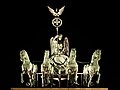 Close-up of the quadriga (four-horse chariot) on top of the Brandenburg Gate in Berlin (Germany) at night. The sculpture was produced by Johann Gottfried Schadow in 1793. The word quadriga may refer to the chariot alone, the four horses without it, or the combination. All modern quadrigas are based on the Horses of Saint Mark, a Roman or Greek sculpture which is the only surviving ancient quadriga.
 -
 Map credit: Lencer and NordNordWestA general map, showing the geography of Germany, the seventh largest country in Europe and the second most populous. Located in Central Europe, Germany is second only to Russia in the number of borders it shares with other European countries (9).
 -

Speicherstadt in Hamburg Credit: Dietmar RabichSpeicherstadt in Hamburg, June 2016 -
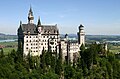 Photo credit: SofteisSchloss Neuschwanstein (“new swan stone castle”) in southwest Bavaria is one of Germany’s most popular tourist destinations. Construction was started by King Ludwig II and took 17 years. After his death in 1886, the castle was opened to the public. During World War II, many valuable items (all stolen) were stored at the castle, destined for Adolf Hitler‘s personal collection.
 -
 Design credit: German New Guinea Company; photographed by the National Numismatic CollectionGerman New Guinea was a German colonial protectorate established in 1884 in the northeastern part of the island of New Guinea and several nearby island groups. The German New Guinea Company was founded in Berlin by Adolph von Hansemann and a syndicate of German bankers for the purpose of colonizing and exploiting the protectorate’s resources. This gold coin, worth 20 New Guinean marks, was issued by the German New Guinea Company in 1895, and is now part of the National Numismatic Collection at the Smithsonian Institution.


Related portals
- Parent portals


- Regional


- History
 Holy Roman Empire (900–1806)
 East Germany (1949–1990)


- Neighbouring countries


Anniversaries for June 16

- 1801 – Birth of mathematician Julius Plücker
- 1804 – Death of composer Johann Adam Hiller
- 1900 – Opening of the Elbe-Lübeck Canal
- 1972 – RAF terrorist Ulrike Meinhof is captured in Langenhagen
- 1977 – Death of rocket scientist Wernher von Braun
Did you know…

- … that Beethoven’s “Tremate, empi, tremate” was not performed for ten years after it was written?
- … that the 1935 Free City of Danzig parliamentary election was seen as a setback for the Nazi Party, even though it won an absolute majority of seats?
- … that every year in July, a whole German town is taken over by the Rudolstadt Festival and swept up in “folk fever”?
- … that the pianist Alide Topp (pictured) once responded to claims that women lacked the “biceps of a man” for great music by stating she broke her pianos as well as any man?
- … that Bernhard Waldenfels discussed “black holes of everyday life” in a book subtitled Challenges of Phenomenology?
- … that Agostino Steffani missed the 1709 premiere of his opera Amor vien dal destino because he was in Rome mediating between the pope and the emperor?
- … that Ruth Wagner, the minister of culture in Hesse from 1999 to 2003, was nicknamed Mother Courage of Hesse?
- … that mathematician Grete Hermann wrote political philosophy articles for Der Funke and Sozialistische Warte under various pseudonyms during the German resistance to Nazism?
Selected cuisines, dishes and foods

Topics
Categories

Things you can do

A list of articles needing cleanup associated with this project is available. See also the tool’s wiki page and the index of WikiProjects.
Here are some tasks you can do. Please remove completed tasks from the list.
- Requests: German Archaeological Institute at Rome, Deutsche Familienversicherung, Hermann Bachmann (Journalist), Dietlof von Arnim-Boitzenburg, Rolf von Bargen, Hennes Bender, Eduard Georg von Bethusy-Huc, Rolf Brandt (1886–1953), Jan Philipp Burgard, Rudolf Epp, Lisa Feller, Georg Gafron, Ferdinand Heribert von Galen, Gundula Gause, Wolfgang von Geldern, Karl-Heinz Hagen, Herbert Helmrich, Nils von der Heyde, Monty Jacobs (1875–1945), Siegfried Kauder, Klimbim Matze Knop, Wolfgang Kryszohn, Claus Larass, Isidor Levy (1852–1929), Richard Lewinsohn (1894-1968), Markus Löning, Tobias Mann, Julius Meyer (Kunsthistoriker), Mathias Müller von Blumencron ,Günther Nonnenmacher, Nord bei Nordwest, Günter von Nordenskjöld, Anke Plättner, Hans Heinrich X. Fürst von Pless, Günter Prinz, Ulrich Reitz, Hans Sauer (inventor), Franz August Schenk von Stauffenberg, Paul Schlesinger (1878-1928), Hajo Schumacher, Der Seewolf (1971), Otto Theodor von Seydewitz, Christoph Sieber (comedian), Dorothea Siems, Werner Sonne, Udo zu Stolberg-Wernigerode, Christoph Strässer, Karl Trimborn, Joseph von Utzschneider, Hedda von Wedel, Jürgen Wieshoff, Hans Wilhelmi, Dietmar Wischmeyer, Doris Wittner (1880-1937), Alexandra Würzbach
- Unreferenced: especially Unreferenced BLPs
- Cleanup: 53541 issues in total as of 2024-03-03
- Translate: Articles needing translation from German Wikipedia
- Stubs: the largest stub category is Category:German history stubs; see also 108 articles in Category:German MEP stubs
- Update: Deutsches Wörterbuch
- Portal maintenance: Update News, Did you know, announcements and the todo list
- Orphans:
Orphaned articles in Germany

- Photo: Take/Add requested photographs
- Help assess the quality of 843 unassessed articles
Associated Wikimedia
The following Wikimedia Foundation sister projects provide more on this subject:
-
 Commons
Free media repository -
 Wikidata
Free knowledge base -
 Wikiquote
Collection of quotations -
 Wikisource
Free-content library -
 Wikiversity
Free learning tools -
 Wikivoyage
Free travel guide -
 Wiktionary
Dictionary and thesaurus


-

-

-

-

-

-

-

-

-

-

-
 Random portal
 -


