The Nuclear Technology Portal
Introduction

- Nuclear technology is technology that involves the nuclear reactions of atomic nuclei. Among the notable nuclear technologies are nuclear reactors, nuclear medicine and nuclear weapons. It is also used, among other things, in smoke detectors and gun sights. (Full article…)
- Nuclear power is the use of nuclear reactions to produce electricity. Nuclear power can be obtained from nuclear fission, nuclear decay and nuclear fusion reactions. Presently, the vast majority of electricity from nuclear power is produced by nuclear fission of uranium and plutonium in nuclear power plants. Nuclear decay processes are used in niche applications such as radioisotope thermoelectric generators in some space probes such as Voyager 2. Reactors producing controlled fusion power have been operated since 1958 but have yet to generate net power and are not expected to be commercially available in the near future. (Full article…)
- A nuclear weapon is an explosive device that derives its destructive force from nuclear reactions, either nuclear fission (fission or atomic bomb) or a combination of fission and nuclear fusion reactions (thermonuclear weapon), producing a nuclear explosion. Both bomb types release large quantities of energy from relatively small amounts of matter. Nine sovereign states are believed to possess nuclear weapons as of 2026: United States, Russia, the United Kingdom, France, China, India, Pakistan, North Korea, and Israel. (Full article…)
General images –
-
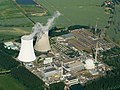
-
 The basics of the Teller–Ulam design for a hydrogen bomb: a fission bomb uses radiation to compress and heat a separate section of fusion fuel. (from Nuclear weapon)
 -
 Drawing of the first artificial reactor, Chicago Pile-1 (from Nuclear fission)
 -
 A Minuteman III ICBM test launch from Vandenberg Space Force Base, United States. MIRVed land-based ICBMs are considered destabilizing because they tend to put a premium on striking first. (from Nuclear weapon)
 -
 Death rates per unit of electricity production for different energy sources (from Nuclear power)
 -
 Anti-nuclear weapons protest march in Oxford, 1980 (from Nuclear weapon)
 -
 The “curve of binding energy”: A graph of binding energy per nucleon of common isotopes. (from Nuclear fission)
 -
 The Calder Hall nuclear power station in the United Kingdom, the world’s first commercial nuclear power station (from Nuclear power)
 -
 Reactor decay heat as a fraction of full power after the reactor shutdown, using two different correlations. To remove the decay heat, reactors need cooling after the shutdown of the fission reactions. A loss of the ability to remove decay heat caused the Fukushima accident. (from Nuclear power)
 -
 Fission product yields by mass for thermal neutron fission of uranium-235, plutonium-239, a combination of the two typical of current nuclear power reactors, and uranium-233, used in the thorium cycle (from Nuclear fission)
 -
 An example of an induced nuclear fission event. A neutron is absorbed by the nucleus of a uranium-235 atom, which in turn splits into fast-moving lighter elements (fission products) and free neutrons. Though both reactors and nuclear weapons rely on nuclear chain reactions, the rate of reactions in a reactor is much slower than in a bomb. (from Nuclear reactor)
 -
 This view of downtown Las Vegas shows a mushroom cloud in the background. Scenes such as this were typical during the 1950s. From 1951 to 1962 the government conducted 100 atmospheric tests at the nearby Nevada Test Site. (from Nuclear weapon)
 -

-
 Following the 2011 Fukushima Daiichi nuclear disaster, the world’s worst nuclear accident since 1986, 50,000 households were displaced after radiation leaked into the air, soil and sea. Radiation checks led to bans of some shipments of vegetables and fish. (from Nuclear power)
 -
 Overhead view of the core of the RA-3 Research and Production Reactor (CNEA, Argentina) (from Nuclear reactor)
 -

-
 Edward Teller, often referred to as the “father of the hydrogen bomb” (from Nuclear weapon)
 -
 The nuclear fission display at the Deutsches Museum in Munich. The table and instruments are originals, but would not have been together in the same room. (from Nuclear fission)
 -
 Scaled-down model of TOPAZ nuclear reactor (from Nuclear reactor)
 -
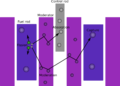 In thermal nuclear reactors (LWRs in specific), the coolant acts as a moderator that must slow the neutrons before they can be efficiently absorbed by the fuel. (from Nuclear reactor)
 -
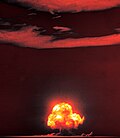 The Trinity test of the Manhattan Project was the first detonation of a nuclear weapon, which led J. Robert Oppenheimer to recall verses from the Hindu scripture Bhagavad Gita: “If the radiance of a thousand suns were to burst at once into the sky, that would be like the splendor of the mighty one ”… “I am become Death, the destroyer of worlds”. (from Nuclear weapon)
 -
 The US has been counting on private industry to lead in fusion power, while more recently China’s government has made fusion a national priority. In 2025, $2.1 billion was poured into a single Chinese state-owned fusion company, an amount two and a half times the U.S. Energy Department’s annual fusion budget. (from Nuclear power)
 -
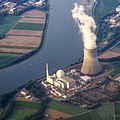 The Leibstadt Nuclear Power Plant in Switzerland (from Nuclear power)
 -
 The first nuclear weapons were gravity bombs, such as the “Fat Man” weapon dropped on Nagasaki, Japan. They were large and could only be delivered by heavy bomber aircraft (from Nuclear weapon)
 -
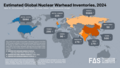 The number of nuclear warheads by country in 2024, based on an estimation by the Federation of American Scientists (from Nuclear weapon)
 -
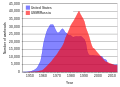 The USSR and United States nuclear weapon stockpiles throughout the Cold War until 2015, with a precipitous drop in total numbers following the end of the Cold War in 1991. (from Nuclear weapon)
 -
Induced fission reaction. A neutron is absorbed by a uranium-235 nucleus, turning it briefly into an excited uranium-236 nucleus, with the excitation energy provided by the kinetic energy of the neutron plus the forces that bind the neutron. The uranium-236, in turn, splits into fast-moving lighter elements (fission products) and releases several free neutrons, one or more “prompt gamma rays” (not shown) and a (proportionally) large amount of kinetic energy. (from Nuclear fission)
-
 UN vote on adoption of the Treaty on the Prohibition of Nuclear Weapons on July 7, 2017YesNoDid not vote(from Nuclear weapon)
 -
 Mushroom cloud from the explosion of Castle Bravo, the largest nuclear weapon detonated by the US, in 1954 (from Nuclear weapon)
 -
 Montage of an inert test of a United States Trident SLBM (submarine launched ballistic missile), from submerged to the terminal, or re-entry phase, of the multiple independently targetable reentry vehicles (from Nuclear weapon)
 -
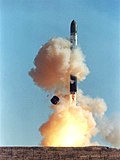 A demilitarized, commercial launch of the Russian Strategic Rocket Forces R-36 ICBM; also known by the NATO reporting name: SS-18 Satan. Upon its first fielding in the late 1960s, the SS-18 remains the single highest throw weight missile delivery system ever built. (from Nuclear weapon)
 -
 Ukrainian workers use equipment provided by the US Defense Threat Reduction Agency to dismantle a Soviet-era missile silo. After the end of the Cold War, Ukraine and the other non-Russian, post-Soviet republics relinquished Soviet nuclear stockpiles to Russia. (from Nuclear weapon)
 -
 Life-cycle greenhouse gas emissions of electricity supply technologies, median values calculated by IPCC (from Nuclear power)
 -
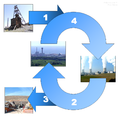 The nuclear fuel cycle begins when uranium is mined, enriched, and manufactured into nuclear fuel (1), which is delivered to a nuclear power plant. After use, the spent fuel is delivered to a reprocessing plant (2) or to a final repository (3). In nuclear reprocessing, 95% of spent fuel can potentially be recycled to be returned to use in a power plant (4). (from Nuclear power)
 -
The Chicago Pile, the first artificial nuclear reactor, built in secrecy at the University of Chicago in 1942 during World War II as part of the US’s Manhattan Project (from Nuclear reactor)
-
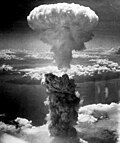 The mushroom cloud of the atomic bomb dropped on Nagasaki, Japan, on 9 August 1945 rose over 12 kilometres (7.5 mi) above the bomb’s hypocenter. An estimated 39,000 people were killed by the atomic bomb, of whom 23,145–28,113 were Japanese factory workers, 2,000 were Korean slave laborers, and 150 were Japanese combatants. (from Nuclear fission)
 -
 The Torness nuclear power station – an AGR (from Nuclear reactor)
 -
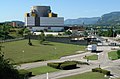 The Superphénix, closed in 1998, was one of the few FBRs (from Nuclear reactor)
 -
 Proportions of the isotopes uranium-238 (blue) and uranium-235 (red) found in natural uranium and in enriched uranium for different applications. Light water reactors use 3–5% enriched uranium, while CANDU reactors work with natural uranium. (from Nuclear power)
 -
 The multi-mission radioisotope thermoelectric generator (MMRTG), used in several space missions such as the Curiosity Mars rover (from Nuclear power)
 -
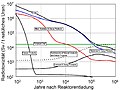 Activity of spent UOx fuel in comparison to the activity of natural uranium ore over time (from Nuclear power)
 -

-
 Over 2,000 nuclear explosions have been conducted in over a dozen different sites around the world. Red Russia/Soviet Union, blue France, light blue United States, violet Britain, yellow China, orange India, brown Pakistan, green North Korea and light green (territories exposed to nuclear bombs). The black dot indicates the location of the Vela incident. (from Nuclear weapon)
 -
 Ballistic missile submarines have been of great strategic importance for the United States, Russia, and other nuclear powers since they entered service in the Cold War, as they can hide from reconnaissance satellites and fire their nuclear weapons with virtual impunity. (from Nuclear weapon)
 -
 Anti-nuclear protest near nuclear waste disposal centre at Gorleben in northern Germany (from Nuclear power)
 -

-
 A comparison of levelized cost of energy (LCOE) over time for nuclear power and other sources. While wind turbines and solar panels can be mass-produced and thus enjoy learning curve effects, nuclear are almost always one-of-a-kind projects due to the limited number of reactors being built. The source of this chart, Our World in Data notes that the costs presented here is the global average, and these costs were driven up by 2 projects in the United States. The organization recognises that the median cost of the most exported and produced nuclear energy facility in the 2010s the South Korean APR1400, remained “constant”, including in export. (from Nuclear power)
 -
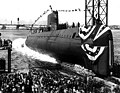 The launching ceremony of USS Nautilus January 1954. In 1958 it would become the first vessel to reach the North Pole. (from Nuclear power)
 -
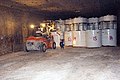 Nuclear waste flasks generated by the United States during the Cold War are stored underground at the Waste Isolation Pilot Plant (WIPP) in New Mexico. The facility is seen as a potential demonstration for storing spent fuel from civilian reactors. (from Nuclear power)
 -
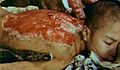 A photograph of Sumiteru Taniguchi‘s back injuries taken in January 1946 by a US Marine photographer (from Nuclear weapon)
 -
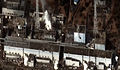 Three of the reactors at Fukushima I overheated, causing the coolant water to dissociate and led to the hydrogen explosions. This along with fuel meltdowns released large amounts of radioactive material into the air. (from Nuclear reactor)
 -
-
 The first light bulbs ever lit by electricity generated by nuclear power at EBR-1 at Argonne National Laboratory-West (now the Idaho National Laboratory), December 20, 1951. (from Nuclear power)
 -
 Olkiluoto 3 under construction in 2009. It was the first EPR, a modernized PWR design, to start construction. (from Nuclear power)
 -
 Primary coolant system showing reactor pressure vessel (red), steam generators (purple), pressurizer (blue), and pumps (green) in the three coolant loop Hualong One pressurized water reactor design (from Nuclear reactor)
 -
 The Ikata Nuclear Power Plant, a pressurized water reactor that cools by using a secondary coolant heat exchanger with a large body of water, an alternative cooling approach to large cooling towers (from Nuclear power)
 -
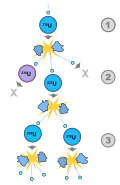 A schematic nuclear fission chain reaction. 1. A uranium-235 atom absorbs a neutron and fissions into two new atoms (fission fragments), releasing three new neutrons and some binding energy. 2. One of those neutrons is absorbed by an atom of uranium-238 and does not continue the reaction. Another neutron is simply lost and does not collide with anything, also not continuing the reaction. However, the one neutron does collide with an atom of uranium-235, which then fissions and releases two neutrons and some binding energy. 3. Both of those neutrons collide with uranium-235 atoms, each of which fissions and releases between one and three neutrons, which can then continue the reaction. (from Nuclear fission)
 -
 Some of the Chicago Pile Team, including Enrico Fermi (leftmost man front row) and Leó Szilárd (rightmost man middle row) (from Nuclear reactor)
 -
 The stages of binary fission in a liquid drop model. Energy input deforms the nucleus into a fat “cigar” shape, then a “peanut” shape, followed by binary fission as the two lobes exceed the short-range nuclear force attraction distance, and are then pushed apart and away by their electrical charge. In the liquid drop model, the two fission fragments are predicted to be the same size. The nuclear shell model allows for them to differ in size, as usually experimentally observed. (from Nuclear fission)
 -
 Nuclear fuel assemblies being inspected before entering a pressurized water reactor in the United States (from Nuclear power)
 -
 The two basic fission weapon designs (from Nuclear weapon)
 -
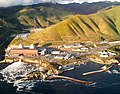 Diablo Canyon – a PWR (from Nuclear reactor)
 -
 Animation of a Coulomb explosion in the case of a cluster of positively charged nuclei, akin to a cluster of fission fragments. Hue level of color is proportional to (larger) nuclei charge. Electrons (smaller) on this time-scale are seen only stroboscopically and the hue level is their kinetic energy. (from Nuclear fission)
 -
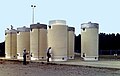 Dry cask storage vessels storing spent nuclear fuel assemblies (from Nuclear power)
 -
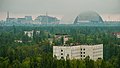 The town of Pripyat abandoned since 1986, with the Chernobyl plant and the Chernobyl New Safe Confinement arch in the distance (from Nuclear power)
 -

-
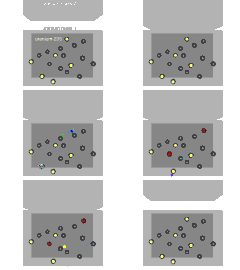 A visual representation of an induced nuclear fission event where a slow-moving neutron is absorbed by the nucleus of a uranium-235 atom, which fissions into two fast-moving lighter elements (fission products) and additional neutrons. Most of the energy released is in the form of the kinetic velocities of the fission products and the neutrons. (from Nuclear fission)
 -
 Protest in Bonn against the nuclear arms race between the US/NATO and the Warsaw Pact, 1981 (from Nuclear weapon)
 -
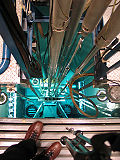 NC State‘s PULSTAR Reactor is a 1 MW pool-type research reactor with 4% enriched, pin-type fuel consisting of UO2 pellets in zircaloy cladding (from Nuclear reactor)
 -
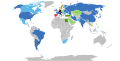 The status of nuclear power globally (click for legend) (from Nuclear power)
 -
 The now decommissioned United States’ Peacekeeper missile was an ICBM developed to replace the Minuteman missile in the late 1980s. Each missile, like the heavier lift Russian SS-18 Satan, could contain up to ten nuclear warheads (shown in red), each of which could be aimed at a different target. A factor in the development of MIRVs was to make complete missile defense difficult for an enemy country. (from Nuclear weapon)
 -
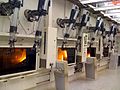 Most waste packaging, small-scale experimental fuel recycling chemistry and radiopharmaceutical refinement is conducted within remote-handled hot cells. (from Nuclear power)
 -
 Soviet OTR-21 Tochka missile. Capable of firing a 100-kiloton nuclear warhead a distance of 185 km (from Nuclear weapon)
 -
 Typical composition of uranium dioxide fuel before and after approximately three years in the once-through nuclear fuel cycle of a LWR (from Nuclear power)
 -
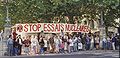 Demonstration against nuclear testing in Lyon, France, in the 1980s (from Nuclear weapon)
 -
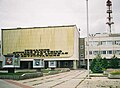 The Ignalina Nuclear Power Plant – a RBMK type (closed 2009) (from Nuclear reactor)


Selected article –

Many contemporary uses of uranium exploit its unique nuclear properties. Uranium is used in nuclear power plants and nuclear weapons because it is the only naturally occurring element with a fissile isotope – uranium-235 – present in non-trace amounts. However, because of the low abundance of uranium-235 in natural uranium (which is overwhelmingly uranium-238), uranium needs to undergo enrichment so that enough uranium-235 is present. Uranium-238 is fissionable by fast neutrons and is fertile, meaning it can be transmuted to fissile plutonium-239 in a nuclear reactor. Another fissile isotope, uranium-233, can be produced from natural thorium and is studied for future industrial use in nuclear technology. Uranium-238 has a small probability for spontaneous fission or even induced fission with fast neutrons; uranium-235, and to a lesser degree uranium-233, have a much higher fission cross-section for slow neutrons. In sufficient concentration, these isotopes maintain a sustained nuclear chain reaction. This generates the heat in nuclear power reactors and produces the fissile material for nuclear weapons. The primary civilian use for uranium harnesses the heat energy to produce electricity. Depleted uranium (238U) is used in kinetic energy penetrators and armor plating.
The 1789 discovery of uranium in the mineral pitchblende is credited to Martin Heinrich Klaproth, who named the new element after the recently discovered planet Uranus. Eugène-Melchior Péligot was the first person to isolate the metal, and its radioactive properties were discovered in 1896 by Henri Becquerel. Research by Otto Hahn, Lise Meitner, Enrico Fermi and others, such as J. Robert Oppenheimer starting in 1934 led to its use as a fuel in the nuclear power industry and in Little Boy, the first nuclear weapon used in war. An ensuing arms race during the Cold War between the United States and the Soviet Union produced tens of thousands of nuclear weapons that used uranium metal and uranium-derived plutonium-239. Dismantling of these weapons and related nuclear facilities is carried out within various nuclear disarmament programs and costs billions of dollars. Weapon-grade uranium obtained from nuclear weapons is diluted with uranium-238 and reused as fuel for nuclear reactors. Spent nuclear fuel forms radioactive waste, which mostly consists of uranium-238 and poses a significant health threat and environmental impact. (Full article…)
Selected picture –

Did you know?
- … that the 1991 Andover tornado narrowly avoided hitting two warplanes equipped with nuclear warheads?
- … that the mountain cottontail is abundant in the Hanford Site, a decommissioned nuclear production complex?
- … that Jeya Wilson invited New Zealand prime minister David Lange to debate the moral indefensibility of nuclear weapons at the Oxford Union?
- … that John D. Hoffman of the Special Engineer Detachment was awarded the Soldier’s Medal, the US Army’s highest non-combat decoration and the only one given to a member of the Manhattan District?
- … that sabotage in World War II involved delaying the Nazi nuclear program, derailing trains, freeing Jews, and … explosive rats?
- … that the British National Hospital Service Reserve trained volunteers to carry out first aid in the aftermath of a nuclear or chemical attack?
Related WikiProjects

Things you can do
|
|
Here are some Open Tasks :
|

Selected biography –

Seaborg spent most of his career as an educator and research scientist at the University of California, Berkeley, serving as a professor, and, between 1958 and 1961, as the university’s second chancellor. He advised ten US presidents—from Harry S. Truman to Bill Clinton—on nuclear policy and was Chairman of the United States Atomic Energy Commission from 1961 to 1971, where he pushed for commercial nuclear energy and the peaceful applications of nuclear science. Throughout his career, Seaborg worked for arms control. He was a signatory to the Franck Report and contributed to the Limited Test Ban Treaty, the Nuclear Non-Proliferation Treaty and the Comprehensive Test Ban Treaty. He was a well-known advocate of science education and federal funding for pure research. Toward the end of the Eisenhower administration, he was the principal author of the Seaborg Report on academic science, and, as a member of President Ronald Reagan‘s National Commission on Excellence in Education, he was a key contributor to its 1983 report “A Nation at Risk“.
Seaborg was the principal or co-discoverer of ten elements: plutonium, americium, curium, berkelium, californium, einsteinium, fermium, mendelevium, nobelium and element 106, then called unnilhexium, which while he was still living, was named seaborgium in his honor. He said about this naming, “This is the greatest honor ever bestowed upon me—even better, I think, than winning the Nobel Prize. Future students of chemistry, in learning about the periodic table, may have reason to ask why the element was named for me, and thereby learn more about my work.” He also discovered more than 100 isotopes of transuranium elements and is credited with important contributions to the chemistry of plutonium, originally as part of the Manhattan Project where he developed the extraction process used to isolate the plutonium fuel for the implosion-type atomic bomb. Early in his career, he was a pioneer in nuclear medicine and discovered isotopes of elements with important applications in the diagnosis and treatment of diseases, including iodine-131, which is used in the treatment of thyroid disease. In addition to his theoretical work in the development of the actinide concept, which placed the actinide series beneath the lanthanide series on the periodic table, he postulated the existence of super-heavy elements in the transactinide and superactinide series.
After sharing the 1951 Nobel Prize in Chemistry with Edwin McMillan, he received approximately 50 honorary doctorates and numerous other awards and honors. The list of things named after Seaborg ranges from the chemical element seaborgium to the asteroid 4856 Seaborg. He was the author of numerous books and 500 journal articles, often in collaboration with others. He was once listed in the Guinness Book of World Records as the person with the longest entry in Who’s Who in America. (Full article…)
Nuclear technology news
- 15 April 2026 – North Korea and weapons of mass destruction
- International Atomic Energy Agency director general Rafael Grossi reports increased activity at multiple nuclear facilities in North Korea, including the Nyongbyon site, indicating expanded capacity to produce nuclear weapons. (AFP via ABS-CBN News)
- 12 April 2026 – Middle Eastern crisis
- U.S. vice president JD Vance, who led the American delegation in the ceasefire talks, says that the two sides have not reached a deal to end the war, with disagreement over nuclear weapon development, and that the U.S. made its “final and best offer” and stated “We’ll see if the Iranians accept it”. (Al Jazeera) (NBC News)
- Pakistani sources say that the major disagreements during the talks were Iran’s nuclear program, missile program, restrictions in the Strait of Hormuz, and calls for a ceasefire in Lebanon. (MENA via The New Arab)
- 4 April 2026 – Middle Eastern crisis
- Russia evacuates 198 more staff from Iran’s Bushehr Nuclear Power Plant as an airstrike kills an Iranian security guard at the plant. (Reuters)
Related portals


Related topics
| |||||||||||||||||||||||||||||||||||||||||||||||||||||||
| |||||||||||||||||||||||||||||||||||||||||||||||||||||||


Fusion power, processes and devices | |||||||||||||||||||||||||||||||||||||||||||||||||||||
|---|---|---|---|---|---|---|---|---|---|---|---|---|---|---|---|---|---|---|---|---|---|---|---|---|---|---|---|---|---|---|---|---|---|---|---|---|---|---|---|---|---|---|---|---|---|---|---|---|---|---|---|---|---|
| Core topics |
| ||||||||||||||||||||||||||||||||||||||||||||||||||||
| Processes, methods |
| ||||||||||||||||||||||||||||||||||||||||||||||||||||
| Devices, experiments |
| ||||||||||||||||||||||||||||||||||||||||||||||||||||


Types of nuclear fusion reactor | |
|---|---|
by confinement | |
| Magnetic | |
| Inertial | |
| Other | |


Types of nuclear fission reactor | |||||||||||||||
|---|---|---|---|---|---|---|---|---|---|---|---|---|---|---|---|
| Light water | |||||||||||||||
| Heavy water by coolant |
| ||||||||||||||
| |||||||||||||||
None (fast-neutron) |
| ||||||||||||||
| Others | |||||||||||||||

Subcategories

Associated Wikimedia
The following Wikimedia Foundation sister projects provide more on this subject:
-
 Commons
Free media repository -
 Wikibooks
Free textbooks and manuals -
 Wikidata
Free knowledge base -
 Wikinews
Free-content news -
 Wikiquote
Collection of quotations -
 Wikisource
Free-content library -
 Wikiversity
Free learning tools -
 Wiktionary
Dictionary and thesaurus


-

-

-

-

-

-

-

-

-

-

-
 Random portal
 -


