The Opera Portal

Opera is an art form in which singers and musicians perform a dramatic work (called an opera) which combines a text (called a libretto) and a musical score. Opera is part of the Western classical music tradition. Opera incorporates many of the elements of spoken theatre, such as acting, scenery and costumes and sometimes includes dance. The performance is typically given in an opera house, accompanied by an orchestra or smaller musical ensemble.
Opera started in Italy at the end of the 16th century (with Jacopo Peri‘s lost Dafne, produced in Florence around 1597), and was championed by Claudio Monteverdi with works such as L’Orfeo. It soon spread through the rest of Europe: Schütz in Germany, Lully in France, and Purcell in England all helped to establish their national traditions in the 17th century. However, in the 18th century, Italian opera continued to dominate most of Europe, except France, attracting foreign composers such as Handel. Opera seria was the most prestigious form of Italian opera, until Gluck reacted against its artificiality with his “reform” operas in the 1760s. Today the most renowned figure of late 18th century opera is Mozart, who began with opera seria but is most famous for his Italian comic operas, especially The Marriage of Figaro, Don Giovanni, and Così fan tutte, as well as The Magic Flute, a landmark in the German tradition.
The first third of the 19th century saw the highpoint of the bel canto style, with Rossini, Donizetti and Bellini all creating works that are still performed today. It also saw the advent of Grand Opera typified by the works of Meyerbeer. The mid to late 19th century is considered by some a golden age of opera, led by Wagner in Germany and Verdi in Italy. This ‘golden age’ developed through the verismo era in Italy and contemporary French opera through to Puccini and Strauss in the early 20th century. During the 19th century, parallel operatic traditions emerged in Central and Eastern Europe, particularly in Russia and Bohemia. The 20th century saw many experiments with modern styles, such as atonality and serialism (Schoenberg and Berg), Neo-Classicism (Stravinsky), and Minimalism (Philip Glass and John Adams). With the rise of recording technology, singers such as Enrico Caruso became known to audiences beyond the circle of opera fans. Operas were also performed on (and written for) radio and television.
| More about Opera… |
Selected article

Featured picture

In this month

- 3 June 1875 – Georges Bizet, the composer of Carmen, died in Bougival, France, at the age of 36.
- 4 June 1966 – Italian mezzo-soprano, Cecilia Bartoli, was born in Rome.
- 6 June 1928 – Die ägyptische Helena by Richard Strauss had its world premiere at the Dresden Semperoper.
- 11 June 1913 – The popular American mezzo-soprano, Risë Stevens, was born in New York City.
- 13 June 1801 – Vienna’s Theater an der Wien was officially inaugurated. Amongst the world premieres which have taken place there are Beethoven‘s Fidelio and Franz Lehár‘s The Merry Widow.
- 14 June 1884 – The celebrated Irish tenor, John McCormack (pictured), was born in Athlone.
- 21 June 1868 – Richard Wagner‘s Die Meistersinger von Nürnberg had its world premiere at the National Theatre Munich conducted by Hans von Bülow.
- 22 June 1910 – British tenor, Sir Peter Pears, was born in Farnham, Surrey. He created the leading tenor roles in Benjamin Britten‘s Peter Grimes, Albert Herring, Billy Budd, The Turn of the Screw and Death in Venice.
Selected biography

Selected quote

Selected audio
From Giacomo Puccini‘s Manon Lescaut, sung by Enrico Caruso in 1913.
Did you know?

- … that composer Egidio Duni (pictured) was particularly influential in creating a new genre of opera which blended Italian opera elements with traditional French ones?
- … that Vivaldi‘s opera Griselda is based on the folklore character Griselda as told by Giovanni Boccaccio in the The Decameron?
- … that Anthony, Charles, Cecilia, Isabella, Sr., Isabella, Jr., Esther, Elizabeth, and Polly Young were part of an English family of musicians that included several professional opera singers and organists in the 17th and 18th centuries?
Related portals


WikiProjects
- Parent projects
WikiProject Arts • WikiProject Music • WikiProject Theatre

- Main project
- Descendant projects
WikiProject Richard Wagner • WikiProject Gilbert and Sullivan
- Similar projects
WikiProject Classical music • WikiProject Composers
What are WikiProjects?
Main topics
Opera history: Origins of opera • Italian opera • Opera in German • French opera • Opera in English • Polish opera • Russian opera • Hungarian opera • Armenian opera • Opera in Latin America

Opera genres: Azione teatrale · Ballad opera · Comédie en vaudevilles · Comédie mêlée d’ariettes · Dramma giocoso · Dramma per musica · Farsa · Festa teatrale · Género chico · Grand Opera · Music Drama · Opéra-ballet · Opera buffa · Opéra bouffe · Opéra bouffon · Opéra comique · Opéra féerie · Opera semiseria · Opera seria · Operetta · Pastorale héroïque · Romantische Oper · Savoy opera · Semi-opera · Singspiel · Spieloper · Tragédie en musique · Verismo · Zarzuela · Zeitoper
Opera terms: Aria · Aria di sorbetto · Arioso · Bel canto · Breeches role · Burletta · Cabaletta · Cadenza · Cantabile · Castrato · Cavatina · Chest voice · Claque · Coloratura · Comprimario · Convenienze · Coup de glotte · Da capo aria · Diva · Entr’acte · Fach · Falsetto · Fioritura · Gesamtkunstwerk · Head voice · Intermezzo · Kammersänger · Leitmotif · Legato · Libretto · Literaturoper · Mad scene · Maestro · Melodrama · Melodramma · Monodrama · Messa di voce · Opera house · Passaggio · Portamento · Prima donna · Prompter · Recitative · Regietheater · Répétiteur · Sitzprobe · Spinto · Sprechgesang · Squillo · Stagione · Surtitles · Tessitura · Timbre · Vibrato
Opera voices: Baritenor · Baritone · Bass · Bass-baritone · Coloratura soprano · Contralto · Countertenor · Dramatic soprano · Haute-contre · Lyric soprano · Mezzo-soprano · Soprano · Soubrette · Spinto soprano · Tenor · Tenore contraltino · Tenore di grazia
Opera lists: Opera topics • List of operas by composer • Important operas • Major opera composers • Opera librettists • Opera houses • Opera companies • Opera festivals • Opera directors • Operetta composers • Orphean operas • Zarzuela composers • Opera genres • Operas set in the Crusades • The Record of Singing • Bayreuth canon
Featured content

Featured articles
 Agrippina (opera)
- L’Ange de Nisida
- L’Arianna
- The Bartered Bride
- Hector Berlioz
- Georges Bizet
- Benjamin Britten
- Alan Bush
- Carmen
- Claude Debussy
- English National Opera
- Falstaff (opera)
- Kathleen Ferrier
- Gianni Schicchi
- Handel’s lost Hamburg operas
- His Majesty’s Theatre, London
- L’incoronazione di Poppea
- Lost operas by Claudio Monteverdi
- Jules Massenet
- Felix Mendelssohn
- André Messager
- Claudio Monteverdi
- Carl Nielsen
- Nixon in China
- Noye’s Fludde
- Jacques Offenbach
- L’Orfeo
- Orpheus in the Underworld
- Les pêcheurs de perles
- Francis Poulenc
- Maurice Ravel
- Rhinemaidens
- Nikolai Rimsky-Korsakov
- Rinaldo (opera)
- Il ritorno d’Ulisse in patria
- Gioachino Rossini
- The Royal Opera
- Camille Saint-Saëns
- Bedřich Smetana
- Charles Villiers Stanford
- Igor Stravinsky
- Pyotr Ilyich Tchaikovsky
- Michael Tippett
- Tosca
- Richard Wagner
- William Walton
Featured lists
Good articles
 Marian Anderson
- W. H. Auden
- Maxim Berezovsky
- Helena Braun
- Ferruccio Busoni
- Richard D’Oyly Carte
- The Castafiore Emerald
- Soňa Červená
- Patrice Chéreau
- Erik Chisholm
- Graham Clark (tenor)
- Ryland Davies
- Doctor Ox’s Experiment (opera)
- John Thomas Douglass
- Ernest II, Duke of Saxe-Coburg and Gotha
- The Fairy-Queen
- Fatinitza
- Fire Shut Up in My Bones
- Mirella Freni
- Éva Gauthier
- Johanna Geisler
- Alexander Goehr
- Stephen Gould (tenor)
- Grant Park Music Festival
- Grounded (opera)
- Edita Gruberová
- Robert Hale (bass-baritone)
- Cecelia Hall (mezzo-soprano)
- Julius Harrison
- Magdalena Hinterdobler
- Jahrhundertring
- Leoš Janáček
- Enriqueta Legorreta
- Berit Lindholm
- The Maiden in the Tower
- Giacomo Meyerbeer
- Beatriz Michelena
- Tamara Milashkina
- Nabucco
- Nausicaa (opera)
- Jessye Norman
- Opera in Ukraine
- Orfeo ed Euridice
- Sergei Prokofiev
- Maria Radner
- Robert le diable
- Gabriele Schnaut
- Franz Schubert
- Johann Strauss II
- Twice Through the Heart
- Béatrice Uria-Monzon
- Va tacito e nascosto
- Giuseppe Verdi
- Claude Vivier
- Wales Millennium Centre
- Welsh National Opera
- Portia White
- Steuart Wilson
- Rachel Yakar
Featured pictures
-
 1899 poster of Mme. M. Sissieretta Jones
 -
 Adolphe-Joseph-Louis Alizard from Le Charivari
 -
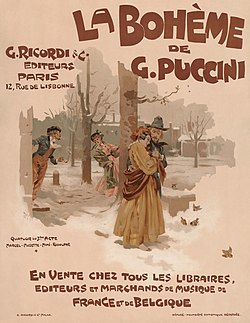 Advertisement for the music score of La Bohème, 1895
 -
 Aida poster colors fixed
 -
 Al quartiere latino, bozzetto di Adolf Hohenstein per La Bohème (1896) – Archivio Storico Ricordi ICON000086 – Restoration
 -
 Albert Pierre-René Maignan – Jules Massenet – Ariane
 -
 Albert Reiss LOC ggbain-25651
 -
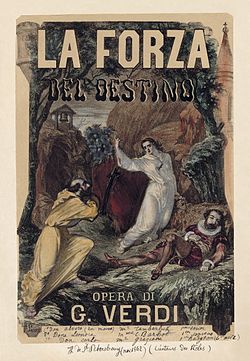 Alexandre Charles Lecocq – Giuseppe Verdi – La forza del destino
 -
 Alexandre Fragonard – Scène de L’orage (Barbier de Séville)
 -
 Alexandre Lacauchie – Gilbert Duprez as Gaston in Verdi’s Jérusalem
 -
 Alfredo Edel – Jules Massenet – Le mage
 -
 Alice Neilsen’s production of Victor Herbert’s The Fortune Teller
 -
 Amilcare Ponchielli (before 1886) – Archivio Storico Ricordi FOTO000794 – Restoration
 -
 Amédée Forestier – Illustrated London News – Gilbert and Sullivan – Ruddygore (Ruddigore)
 -
 Anna Fernqvist, rollporträtt – SMV – H1 122 – Restoration
 -
 Atelier Nadar – Fly scene from Offenbach’s Orphée aux enfers with Jeanne Granier as Eurydice and Eugène Vauthier as Jupiter, 1887 revival, wide-angle shot
 -
 Atelier Nadar – Galli-Marié in Bizet’s Carmen
 -
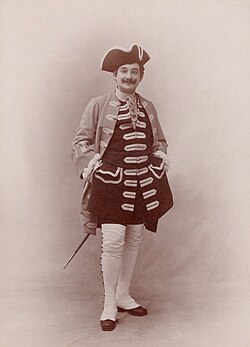 Atelier Nadar – Jacques Isnardon, Vaudeville
 -
 Auguste François-Marie Gorguet – poster for the première performance of Édouard Lalo’s Le roi d’Ys (1888)
 -
 Barbier, Jules, Nadar, Gallica
 -
 Blanche Roosevelt by Napoleon Sarony
 -
 Boris Kustodiev – Portrait of Fyodor Chaliapin – Google Art Project
 -
 Carl Nielsen c. 1908 – Restoration
 -
 Carloz Schwabe – Vincent d’Indy’s Fervaal
 -
 Cavalleria Rusticana – Alfio and Turiddu embrace
 -
 Cavalleria Rusticana – Santuzza and Turiddu outside the church
 -
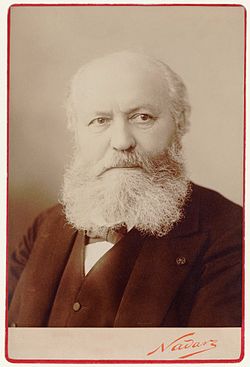 Charles Gounod (1890) by Nadar
 -
 Charles Motte – Rossini et Georges IV – la soirée de Brighton
 -
 Charles-Antoine Cambon – La Esmeralda, Act 3, Scene 2 set
 -
 Charles-Antoine Cambon – La Esmeralda, Act III, Scene 1 set design (Version 2)
 -
 Charles-Antoine Cambon – Set design for Act V, Scene 2 of Fromental Halévy’s La reine de Chypre
 -
 Charles-Antoine Cambon – Set design for the première of Rossini’s Robert Bruce, Act III, Scene 3
 -
 Cherubini, Luigi – Medea – Restoration
 -
 Christine Nilsson Nadar
 -
 Colette and Maurice Ravel’s L’enfant et les sortilèges, 1st scene
 -
 Colette and Maurice Ravel’s L’enfant et les sortilèges, 2nd scene
 -
 Collina presso Nagasaki, bozzetto di Alexandre Bailly, Marcel Jambon per Madama Butterfly (1906) – Archivio Storico Ricordi ICON000079 – Restoration
 -
 Composer Rossini G 1865 by Carjat – Restoration
 -
 Cover to Doris Waltz by P. Bucalossi after Alfred Cellier – Art by Nicholas Hanhart
 -
 Célestin Nanteuil – Jules Massenet – Don César de Bazan
 -
 Dudley Hardy – Poster for Basil Hood and Arthur Sullivan’s The Rose of Persia
 -
 Dudley Hardy – Poster for His Majesty
 -
 Edmond Cavé 1844 Ingres – NY Met Museum of Art
 -
 Elliott & Fry – photograph W. S. Gilbert
 -
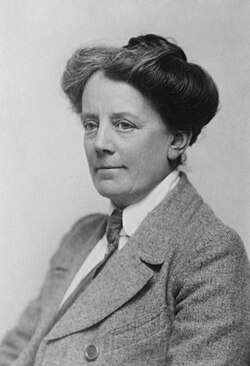 Ethel Smyth
 -
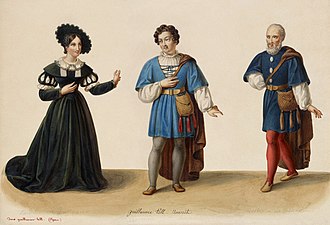 Eugène Du Faget – Costume designs for Guillaume Tell – 1-3. Laure Cinti-Damoreau as Mathilde, Adolphe Nourrit as Arnold Melchtal, and Nicolas Levasseur as Walter Furst
 -
 Eugène Du Faget – Costume designs for Les Huguenots – 2. Julie Dorus-Gras as Marguerite, Adolphe Nourrit as Raoul, and Cornélie Falcon as Valentine
 -
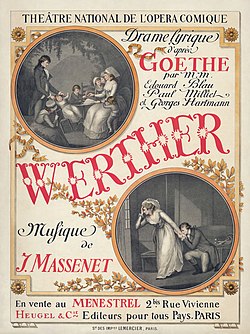 Eugène Grasset – Jules Massenet – Werther
 -
 Falka – Weir Collection
 -
 Falstaff 3
 -
 Fausta Labia, porträtt – SMV – H5 028 – Restoration
 -
 François-Joseph Bélanger – Set design for Gluck’s Alceste
 -
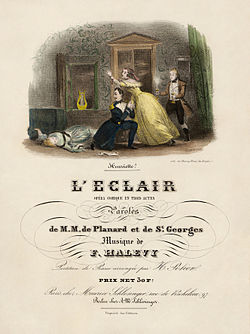 Fromental Halévy, L’Éclair score cover – Restoration
 -
 Georges Rochegrosse – Henry Février – Henri Cain and Louis Payen after Victorien Sardou – Gismonda
 -
 Georges Rochegrosse – Jules Massenet – Roma
 -
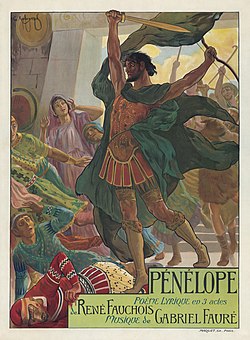 Georges Rochegrosse – Poster for Gabriel Fauré’s Pénélope (1913)
 -
 Georges Rochegrosse – Poster for the prèmiere of Claude Debussy and Maurice Maeterlinck’s Pelléas et Mélisande
 -
 Georges Rochegrosse’s poster for Jules Massenet’s Don Quichotte
 -
 Geraldine Ulmar in Gilbert and Sullivan’s The Mikado – photograph only
 -
 Giacomo Puccini (1924) – Archivio Storico Ricordi FOTO003293 – Restoration
 -
 Gilbert Duprez & Rosine Stoltz in Donizetti’s La Favorite
 -
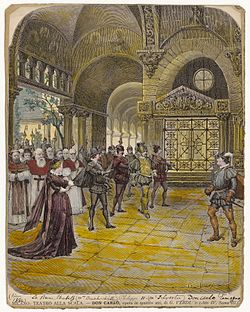 Giuseppe Barberis – Carlo Cornaglia – Giuseppe Verdi’s Don Carlo at La Scala
 -
 Giuseppe Verdi, Giovanna d’Arco, Vocal Score – Restoration
 -
 Giuseppe Verdi, La traviata title page – Restoration
 -
 Giuseppe Verdi, Lombardi alla prima crociata. Libretto, 1843 – Restoration
 -
 Giuseppe Verdi, Rigoletto, Vocal score illustration by Roberto Focosi – Restoration
 -
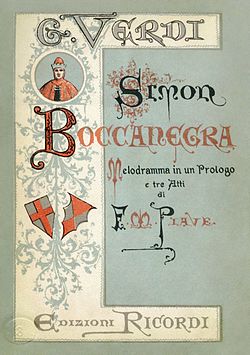 Giuseppe Verdi, Simon Boccanegra first edition libretto for the 1881 revision of the opera – Restoration
 -
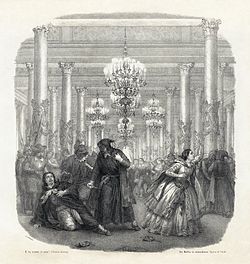 Giuseppe Verdi, Un Ballo in maschera, Vocal score frontispiece – restoration
 -
 H. M. Brock – Gilbert and Sullivan – D’Oyly Carte Opera Company Ruddigore revival 1921
 -
 H. M. Brock – Poster for Iolanthe
 -
 H.J. Whitlock – Photograph of Arthur Sullivan
 -
 H.M.Brock – Poster for Gilbert and Sullivan’s The Sorcerer (1919)
 -
 Haydée, ou Le secret Act II – Philippe Chaperon
 -
 Hector Berlioz, Béatrice et Bénédict score title page – Restoration
 -
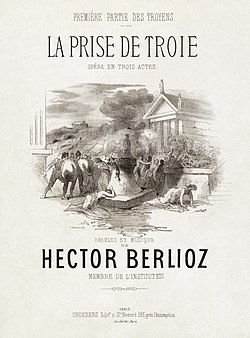 Hector Berlioz, La Prise de Troie score cover – Restoration
 -
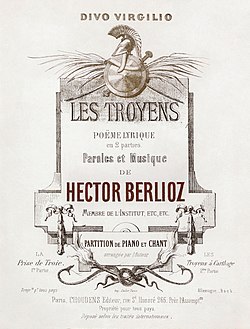 Hector Berlioz, Les Troyens vocal score cover – Restoration
 -
 Hector Berlioz, Les Troyens à Carthage vocal score cover – Restoration
 -
 Henri C. R. Presseq – Camille Erlanger – Le juif polonais
 -
 Henry Atwell Thomas – Franz von Suppé – Fatinitza
 -
 Il signor Tambourossini – Delaroche
 -
 Il trovatore by Luigi Morgari
 -
 Illustrated London News – Giuseppe Verdi’s Attila at Her Majesty’s Theatre, London
 -
 Iolanthe piano transcriptions by Ernst Perabo
 -
 Ivor Novello
 -
 Jacques Offenbach – A. Jannin – Robinson Crusoé
 -
 Jacques Offenbach by Nadar
 -
 Jean de Paleologu – Jules Massenet – Sapho
 -
 Jeremiah Gurney – Photograph of Euphrosyne Parepa-Rosa
 -
 Johann Strauss II by Fritz Luckhardt
 -
 John Phillip Sousa – De Wolf Hopper – El Capitan1
 -
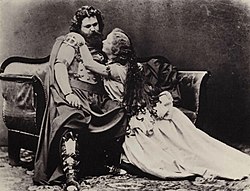 Joseph Albert – Ludwig und Malwine Schnorr von Carolsfeld – Tristan und Isolde, 1865f
 -
 Jules Massenet – Le Cid 2e Acte, 3e Tableau – L’Illustration
 -
 Jules Massenet – Le Cid 3e Acte, 6e Tableau – L’Illustration
 -
 Jules Massenet by Eugène Pirou
 -
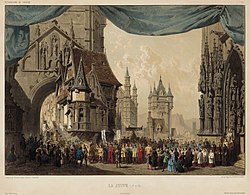 La Juive Act 1 set 1835 – Restoration
 -
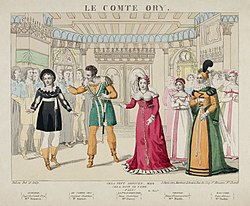 Le comte Ory – Dubois & chez Martinet – Final scene
 -
 Lilly Walleni in Daria at Kungliga Operan 1907 – SMV – NV059
 -
 Louis Guéymard as Robert le Diable by Gustave Courbet – The Metropolitan Museum of Art 436015 (cropped)
 -
 Lucy Arbell as Queen Amahelli in Massenet’s Bacchus, wide view
 -
 Lucy Arbell in Massenet’s Thérèse
 -
 Lucy Arbell photographed by Paul Nadar
 -
 Luigi Verardi after Dominico Ferri – Gaetano Donizetti – Carrefour de St Jean et Paul. Dans l’Opéra Marino Faliero
 -
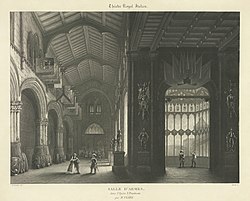 Luigi Verardi after Dominico Ferri – Vincenzo Bellini – Théatre Royal Italien. Salle d’armes dans l’Opéra I Puritani
 -
 M. Browne – Herbert Railton – Sydney Grundy – Arthur Sullivan – Haddon Hall
 -
 Mademoiselle Maupin de l’Opéra (Julie d’Aubigny)
 -
 Mademoiselle Priola de l’Opéra Comique, rôle de Javotte dans “Le Roi l’a dit” de Delibes
 -
 Magna Lykseth in Tristan och Isolde at Kungliga Operan 1909 – SMV – GL164
 -
 Marcel Jambon – Giuseppe Verdi – Otello Act I set design model
 -
 Maria Carrara Verdi, Barberina Strepponi, Giuseppe Verdi, Giuditta Ricordi, Teresa Stolz, Umberto Campanari, Giulio Ricordi, Leopoldo Metlicovitz (1900) – Archivio storico Ricordi FOTO003107 – Restoration
 -
 Marian Anderson
 -
 Maritana – Nov 22 1845 Illustrated London News
 -
 Max Brückner – Otto Henning – Richard Wagner – Final scene of Götterdämmerung
 -
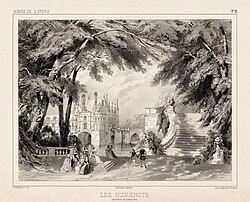 Meyerbeer – Les Huguenots – Décor Acte II
 -
 Michael William Balfe – Atelier Nadar
 -
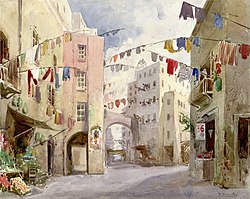 Napoli, strada Acquaquilia, bozzetto di Riccardo Salvadori per A Basso Porto (1894) – Archivio Storico Ricordi ICON002556
 -
 Nelly Martyl by Jean Reutlinger (Image 10715)
 -
 Opernhaus Zürich – Sechseläutenplatz 2013-08-31 18-30-40
 -
 Paul Maurou – Poster for Edmond Audran’s Gillette de Narbonne
 -
 Percy Anderson – Poster for The Duchess of Dantzic
 -
 Philippe Chaperon – Meyerbeer – Les Huguenots Act I (1896)
 -
 Philippe Chaperon – Rigoletto
 -
 Philippe Chaperon – Set design for Act V in the première of Victorin Joncières’ Dimitri
 -
 Philippe Chaperon by Atelier Nadar
 -
 Pierre Gaveaux by Edmé Quenedey (1821)
 -
 Pierre-Auguste Lamy (?) – Les contes d’Hoffmann by Jacques Offenbach, Giulietta act
 -
 Pierre-Auguste Lamy (?) – Les contes d’Hoffmann by Jacques Offenbach, Olympia act
 -
 Pierre-Auguste Lamy (?) – Les contes d’Hoffmann by Jacques Offenbach, prologue
 -
 Pierre-Luc-Charles Cicéri – Act III set design for the première production of Daniel Auber’s Gustave III
 -
 Pierre-Luc-Charles Cicéri – Eugène Cicéri – Philippe Benoist – Adolphe Jean Baptiste Bayot – Décorations de théâtre, Robert le diable, 3e act
 -
 PikiWiki Israel 13773 AIDA AT MASADA 2011
 -
 Portrait of Madame Dugazon (Louise Rosalie Lefèvre), in the title rôle of Nina (Scene V)
 -
 Poster for Burnand and Sullivan’s Cox and Box – Royal Gallery of Illustration
 -
 Poster for Gilbert and Clay’s Ages Ago at the Royal Gallery of Illustration
 -
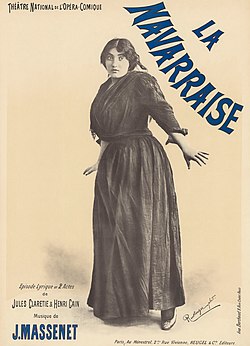 Poster for Jules Massenet’s La Navarraise with Emma Calvé in the rôle of Anita
 -
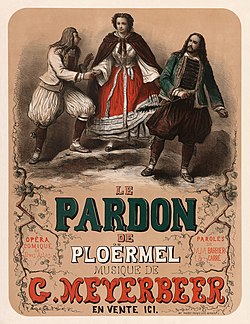 Poster for Le pardon de Ploërmel 1859
 -
 Poster for The Lucky Star (1899) by Dudley Hardy
 -
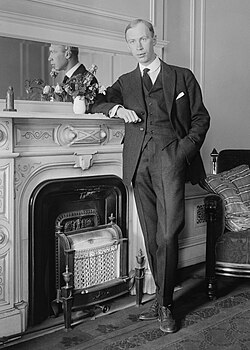 Prokofieff (i.e. Prokofiev) LCCN2014708419 Crop 2
 -
 Prudent-Louis Leray – Poster for the première of Georges Bizet’s Carmen
 -
 Robert Jacob Hamerton – Poster for A Sensation Novel
 -
 Robert Jacob Hamerton – Poster for F. C. Burnand and Arthur Sullivan’s The Contrabandista
 -
 Rosa Raisa (1917) – Archivio Storico Ricordi FOTO002701 – Restoration
 -
 Set design by Philippe Chaperon for Act1 sc2 of Aida by Verdi 1871 Cairo – Gallica – Restored
 -
 Set design by Philippe Chaperon for Act4 sc2 of Aida by Verdi 1880 Paris
 -
 Souvenir advertisement for Princess Ida by Alice Havers – Page 1
 -
 Souvenir program for the première production of Gilbert and Sullivan’s Patience – Cover
 -
 Strauss, Richard – Ariadne auf Naxos – Restoration
 -
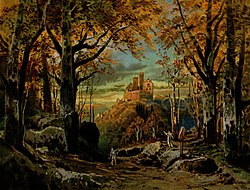 Tavola 5, bozzetto di Gebrüder Brückner per Tannhäuser (s.d.) – Archivio Storico Ricordi ICON011721 – Restoration, crop
 -
 Teatro Municipal de São Paulo 8
 -
 Teresa Brambilla by Antoine Maurin (1845)
 -
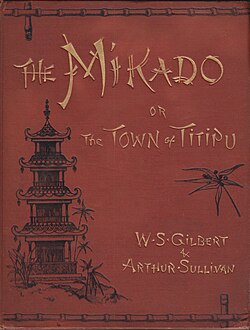 The Mikado Chappell Vocal Score cover (c.1895)
 -
 Thespis – Illustrated London News Jan 6 1872
 -
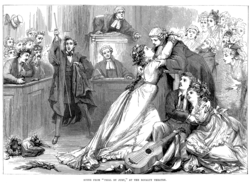 Trial by Jury – Chaos in the Courtroom
 -
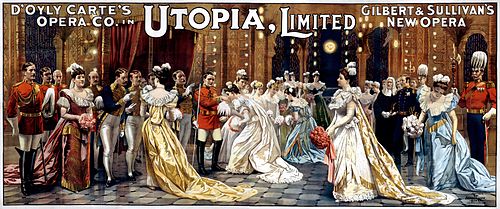 Utopia Limited Poster
 -
 Vasta spianata presso Courtray, bozzetto di Giuseppe Palanti per Edgar (s.d.) – Archivio Storico Ricordi ICON000128 B
 -
 Verdi conducting Aida in Paris 1880 – Gallica – Restoration
 -
 Wally (soprano), figurino di Adolf Hohenstein per La Wally (1892) – Archivio Storico Ricordi ICON004639 – Restoration
 -
 Wilhelm – Costume design for Arac, Gunon, and Scynthius (Princess Ida, 1884)
 -
 Édouard de Reszke by Nadar (BPL Hale Coll)
 -
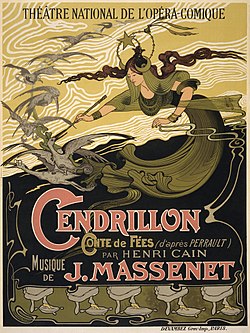 Émile Bertrand – Jules Massenet – Cendrillon poster


Featured portals

Featured topics

Categories

Things you can do

|
|
Associated Wikimedia
The following Wikimedia Foundation sister projects provide more on this subject:
-
 Commons
Free media repository -
 Wikidata
Free knowledge base -
 Wikiquote
Collection of quotations -
 Wikisource
Free-content library -
 Wikiversity
Free learning tools -
 Wiktionary
Dictionary and thesaurus


