| Main | Topics and categories | Tasks and projects |
The Politics portal

Politics is the set of activities that are associated with making decisions in groups, or other forms of power relations among individuals, such as the distribution of status or resources. The branch of social science that studies politics and government is referred to as political science.
Politics may be used positively in the context of a “political solution” which is compromising and non-violent, or descriptively as “the art or science of government”, but the word often also carries a negative connotation. The concept has been defined in various ways, and different approaches have fundamentally differing views on whether it should be used extensively or in a limited way, empirically or normatively, and on whether conflict or co-operation is more essential to it.
A variety of methods are deployed in politics, which include promoting one’s own political views among people, negotiation with other political subjects, making laws, and exercising internal and external force, including warfare against adversaries. Politics is exercised on a wide range of social levels, from clans and tribes of traditional societies, through modern local governments, companies and institutions up to sovereign states, to the international level.
In modern states, people often form political parties to represent their ideas. Members of a party often agree to take the same position on many issues and agree to support the same changes to law and the same leaders. An election is usually a competition between different parties.
A political system is a framework which defines acceptable political methods within a society. The history of political thought can be traced back to early antiquity, with seminal works such as Plato‘s Republic, Aristotle‘s Politics, Confucius‘s political manuscripts and Chanakya‘s Arthashastra. (Full article…)
Selected article

The women’s poll tax repeal movement was a movement in the United States, predominantly led by women, that attempted to secure the abolition of poll taxes as a prerequisite for voting in the Southern states. The movement began shortly after the ratification in 1920 of the Nineteenth Amendment to the United States Constitution, which granted suffrage to women. Before obtaining the right to vote, women were not obliged to pay the tax, but shortly after the Nineteenth Amendment became law, Southern states began examining how poll tax statutes could be applied to women. For example, North and South Carolina exempted women from payment of the tax, while Georgia did not require women to pay it unless they registered to vote. In other Southern states, the tax was due cumulatively for each year someone had been eligible to vote.
Featured picture

David Ben-Gurion (born David Grün; 16 October 1886 – 1 December 1973) was the primary national founder of the State of Israel and the first Prime Minister of Israel. Adopting the name of Ben-Gurion in 1909, he rose to become the preeminent leader of the Jewish community in British-ruled Mandatory Palestine from 1935 until the establishment of the State of Israel in 1948, which he led until 1963 with a short break in 1954–55.
 Featured lists –

-

The governor of Washington is the head of government of Washington and commander-in-chief of the state’s military forces. The officeholder has a duty to enforce state laws, the power to either approve or veto bills passed by the Washington Legislature and line-item veto power to cancel specific provisions in spending bills. The Washington governor may also convene the legislature on “extraordinary occasions”.
Washington Territory had 14 territorial governors from its organization in 1853 until the formation of the state of Washington in 1889. Territorial governors were appointed by the president of the United States. Elisha P. Ferry had the longest term of eight years and went on to become the state’s first governor. William H. Wallace was appointed governor but never took office due to being elected as the territory’s congressional delegate. George Edward Cole was appointed governor and took office, but his appointment was never ratified by the U.S. Senate and he was replaced as governor after four months. (Full article…) -
The Supreme Court of Canada is the highest court of Canada. It was established by the Parliament of Canada through the Supreme and Exchequer Court Act of 1875. Since 1949, the Court has been the final court of appeal in the Canadian justice system. Originally composed of six justices (the Chief Justice of Canada and five puisne justices), the Court was expanded to seven justices by the creation of an additional puisne justice position in 1927, and then to nine justices by the creation of two more puisne justice positions in 1949.
The justices are appointed by the governor general on the advice of the prime minister. When a chief justice leaves office, the vacancy is traditionally filled by elevating an incumbent puisne justice to the position, which requires a separate appointment process. The first six justices of the Court were all appointed in 1875 by Governor General the Earl of Dufferin, on the advice of Prime Minister Alexander Mackenzie. (Full article…) -
The prime minister of the United Kingdom is the principal minister of the crown of His Majesty’s Government, and the head of the British Cabinet.
There is no specific date for when the office of prime minister first appeared, as the role was not created but rather evolved over time through a merger of duties. The term was regularly, if informally, used by Robert Walpole by the 1730s. It was used in the House of Commons as early as 1805, and it was certainly in parliamentary use by the 1880s, although did not become the official title until 1905, when Henry Campbell-Bannerman was prime minister. (Full article…) -

President George Washington appointed 9 justices to the Supreme Court and 28 judges to United States district courts.
United States President George Washington appointed 39 Article III United States federal judges during his presidency, which lasted from April 30, 1789, to March 4, 1797. The first group of Washington’s appointments—two justices of the Supreme Court of the United States and ten district court judges—began service two days after Congress passed the Judiciary Act of 1789, which formally established the federal judiciary. Washington’s last court appointee received his commission twelve days before the end of Washington’s presidency.
As the first president, Washington was responsible for appointing the entire Supreme Court; he appointed a record eleven justices, including two Chief Justices who were confirmed from outside the Court, and one former Justice named as Chief Justice by a recess appointment, but not ultimately confirmed to the position. Additionally, Washington nominated Robert H. Harrison, who declined to serve, and nominated William Cushing for elevation to Chief Justice, who likewise declined. (Full article…) -
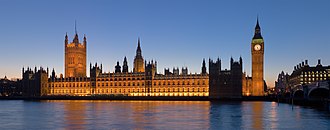
The Palace of Westminster, meeting place of the House of Commons and the House of Lords
This is a list of people who have addressed both Houses of the United Kingdom Parliament at the same time. Although English and later British monarchs have jointly addressed the House of Commons and the House of Lords on several occasions since the 16th century, the first foreign dignitary to do so was French President Albert Lebrun in March 1939. The list excludes the speeches given by (or on behalf of) the Sovereign at the State Opening of Parliament and at the close of each parliamentary session.
Only four people besides the reigning monarch at the time have addressed both Houses together on more than one occasion. Nelson Mandela addressed Members of the Commons and the Lords in 1993 and in 1996 as President of South Africa. Mikhail Gorbachev addressed the Houses as a secretary of the Communist Party of the Soviet Union and a foreign delegate of the Soviet Union in 1984 and again, in 1993, on behalf of the Inter-Parliamentary Union. Shimon Peres addressed the Houses as Prime Minister of Israel in 1986 and as President in 2008. Volodymyr Zelenskyy addressed the Houses as President of Ukraine, the first to address in the Chamber (albeit via remote video link from Ukraine), in 2022 during the Russian invasion of Ukraine. (Full article…) -
The governor of Wisconsin is the head of government of Wisconsin and the commander-in-chief of the state’s army and air forces. The governor has a duty to enforce state laws, and the power to either approve or veto bills passed by the Wisconsin Legislature, to convene the legislature, and to grant pardons, except in cases of treason and impeachment.
Forty-four individuals have held the office of governor of Wisconsin since the state’s admission to the Union in 1848, one of whom—Philip La Follette—served non-consecutive terms. Nelson Dewey, the first governor, took office on June 7, 1848. The longest-serving governor was Tommy Thompson, who took office on January 5, 1987, and resigned on February 1, 2001, a total of 14 years and 28 days. Arthur MacArthur Sr. had the shortest term: he was governor for a total of just 5 days—from March 21 to 25, 1856. The current governor is Tony Evers, a Democrat who took office on January 7, 2019. (Full article…) -
The Song dynasty (960–1279) was an imperial dynasty of China that succeeded the period referred to as Five Dynasties and Ten Kingdoms period (907–960) and preceded the Yuan dynasty (1271–1368), which conquered the Song dynasty in 1279. The conventional division into the Northern Song dynasty (960–1127) and Southern Song dynasty (1127–1279) is created by the conquest of northern China by the Jin dynasty (1115–1234) in 1127 and the consequent shift of the capital from Bianjing (present-day Kaifeng) in the north to Lin’an (present-day Hangzhou) in the south.
Below is a complete list of Song emperors, including their temple names, posthumous names, given names, and era names. The dynasty was founded by Zhao Kuangyin, who became Emperor Taizu (r. 960–976) and concluded with the death of Zhao Bing (r. 1278–1279). The last emperor of the Northern Song was Emperor Qinzong (r. 1126–1127), while the first Southern Song emperor was Emperor Gaozong (r. 1127–1162). (Full article…) -

The president of India is the head of state of the Republic of India and the supreme commander of the Indian Armed Forces. The president is referred to as the first citizen of India. Although vested with these powers by the Constitution of India, the position is largely a ceremonial one and executive powers are de facto exercised by the prime minister.
The president is elected by the Electoral College composed of elected members of the parliament houses, the Rajya Sabha and the Lok Sabha, and also members of the Vidhan Sabha, the state legislative assemblies. Presidents may remain in office for a tenure of five years, as stated by article 56, part V, of the Constitution of India. In the case where a president’s term of office is terminated early or during the absence of the president, the vice president assumes office. By article 70 of part V, the parliament may decide how to discharge the functions of the president where this is not possible, or in any other unexpected contingency. (Full article…) -
The governor of the State of Hawaii is the head of government of Hawaii, and commander-in-chief of the state’s military forces. The governor has a duty to enforce state laws; the power to either approve or veto bills passed by the Hawaii Legislature; the power to convene the legislature; and the power to grant pardons, except in cases of treason and impeachment.
Of the eight governors of the state, two have been elected to three terms, four have been elected to two terms, and one has been elected to one term. No state governor has yet resigned or died in office, nor did any territorial governor die in office. George Ariyoshi was the first Asian American to be governor of any U.S. state. The current governor is Democrat Josh Green, who took office on December 5, 2022. (Full article…) -
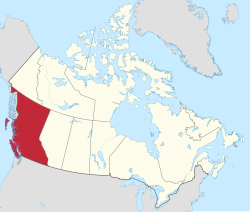
Location of British Columbia in Canada
British Columbia is the third-most populous province in Canada, with 5,000,879 residents as of 2021, and is the second-largest in land area, at 920,687 km2 (355,479 mi2). British Columbia’s 161 municipalities cover only 11 percent of the province’s land mass yet are home to 89 percent of its population. A municipality is a local government incorporated by the province allowing a community to govern itself and to provide and regulate local services. These services typically include, but are not limited to, the provision of drinking water, sewers, roads, fire protection, street lights, garbage/recycling collection, land use planning, building inspection, and parks.
Within their limited jurisdictions, municipalities are autonomous, responsible and accountable to their citizens and to the province. Their powers and responsibilities are regulated through the Local Government Act, the Community Charter, and, in the case of Vancouver, the Vancouver Charter. They have the power of a natural person, the power to expropriate, and the power to establish and enforce bylaws. They are able to raise funds through property taxes and user fees, and borrow a limited amount through the Municipal Finance Authority of British Columbia to pay for capital costs. (Full article…) -
Seal of the United States Congress
Over 20 graduates of the United States Naval Academy (USNA) have served as members of the United States Congress as legislators in the United States Senate or United States House of Representatives or in their home nation. The Naval Academy is an undergraduate college in Annapolis, Maryland, with the mission of educating and commissioning officers for the Navy and Marine Corps. The Academy is often referred to as Annapolis, while sports media refer to the Academy as “Navy” and the students as “Midshipmen”; this usage is officially endorsed. During the latter half of the 19th century and the first decades of the 20th, the United States Naval Academy was the primary source of U.S. Navy and Marine Corps officers, with the Class of 1881 being the first to provide officers to the Marine Corps. Graduates of the Academy are also given the option of entering the United States Army or United States Air Force. Most Midshipmen are admitted through the congressional appointment system. The curriculum emphasizes various fields of engineering.
This list is drawn from graduates of the Naval Academy who became members of Congress or its equivalent in their native country. The Academy was founded in 1845 and graduated its first class in 1846. The first alumnus to graduate and go on to become a member of Congress was John Buchanan Robinson, who graduated from the Class of 1868. As of March 2009, three alumni are members of Congress: Senator John McCain (class of 1958), Senator James H. Webb, Jr. (class of 1968), and Representative Joe Sestak (class of 1974). Roilo Golez (class of 1970) served as a Congressman in his native country, the Philippines. (Full article…) -

Kathy Hochul has been governor since August 24, 2021. She is the first woman to hold the position.
The governor of New York is the head of government of the U.S. state of New York, the head of the executive branch of New York’s state government, and the commander-in-chief of the state’s military forces. The officeholder has a duty to enforce state laws, to convene the New York State Legislature, the power to either approve or veto bills passed by the legislature, as well as to grant pardons, except in cases of treason and impeachment.
Fifty-seven people have served as state governor, four of whom served non-consecutive terms (George Clinton, DeWitt Clinton, Horatio Seymour, and Al Smith); the official numbering lists each governor only once. There has only been one female governor so far: Kathy Hochul. This numbering includes one acting governor: the lieutenant governor who filled the vacancy after the resignation of the governor, under the 1777 Constitution. The list does not include the prior colonial governors nor those who have acted as governor when the governor was out of state, such as Lieutenant Governor Timothy L. Woodruff during Theodore Roosevelt’s vice presidential campaign in 1900, or Acting Speaker of the New York State Assembly Moses M. Weinstein, who acted as governor for 10 days in 1968 while the governor, the lieutenant governor and the senate majority leader were out of the state, attending the Republican National Convention in Miami. (Full article…) -
The position of president of the National Rifle Association of America (NRA) is a symbolic figurehead role, which dates back to the organization’s foundation in New York on November 17, 1871. Founded by George Wood Wingate and William Conant Church, two Union veterans dismayed by the lack of shooting skills among recruits, the rifle association voted to have Union general Ambrose Burnside as its first president. Church succeeded Burnside as the second president of the organization, and Wingate became the tenth in 1886. Traditionally, the first vice president is elevated to president when the position becomes open while the second vice president is similarly promoted, but this practice has not always been followed.
Throughout its history, presidents have served purposes and effects including providing the NRA greater legitimacy; holders of the office have also intentionally provoked outrage and condemnation. Since the 1990s, some NRA presidents have made controversial statements such as when James W. Porter II referred to Barack Obama, whose administration he perceived as hostile to gun rights, as a “fake president” and when Charlton Heston proclaimed to gun control advocates that they could only have his firearm after taking it “from my cold, dead hands.” (Full article…) -

Gavin Newsom, the 40th and current governor of California
The governor of California is the head of government of California, whose responsibilities include making annual State of the State addresses to the California State Legislature, submitting the budget, and ensuring that state laws are enforced. The governor is also the commander-in-chief of the state’s military forces. The current governor is Gavin Newsom, who has been in office since 2019. 39 people have served as governor, over 40 distinct terms. Many have been influential nationwide in areas far-flung from state politics. Leland Stanford founded Stanford University in 1891. Earl Warren, later chief justice of the United States, won an election with the nominations of the three major parties – the only person to run essentially unopposed for governor of California. Ronald Reagan, who was president of the Screen Actors Guild and later president of the United States, and Arnold Schwarzenegger both came to prominence through acting. Gray Davis, the 37th governor of California, was the second governor in American history to be recalled by voters. The shortest tenure was that of Milton Latham, who served only five days before being elected to fill a vacant United States Senate seat. The longest tenure is that of Jerry Brown, who served as governor from 1975 to 1983 and again from 2011 to 2019, the only governor to serve non-consecutive terms. He is the son of former governor Pat Brown who served from 1959 to 1967. (Full article…) -

Map of the counties of colonial Connecticut, 1766.
There are eight counties in the U.S. state of Connecticut.
Four of the counties – Fairfield, Hartford, New Haven and New London – were created in 1666, shortly after the Connecticut Colony and the New Haven Colony combined. Windham and Litchfield counties were created later in the colonial era, while Middlesex and Tolland counties were created after American independence (both in 1785). Six of the counties are named for locations in England, where many early Connecticut settlers originated; Fairfield County was named after the salt marshes that bordered the coast, while New Haven County was named for the New Haven Colony. (Full article…)


Selected quote

Selected biography

Eli Daniel Bebout (born October 14, 1946) is an American athlete and politician who served in the Wyoming House of Representatives from a multi-member district in Fremont County and the 55th district from 1987 to 2001, and later served in the Wyoming Senate from the 26th district 2007 to 2021, as a member of the Democratic and Republican parties. He was the first person to serve as both Speaker of the Wyoming House of Representatives and President of the Wyoming Senate.
Did you know (auto-generated) –

- … that Romanian adventure novelist N. D. Popescu-Popnedea “generate[d] laughter” with his deposition at a political assassin’s trial?
- … that Framoi Bérété founded a political party with Ahmed Sékou Touré, but later lost his seat in parliament to another party founded by Sékou Touré?
- … that political philosophers focus on desirable norms, while political scientists concentrate on empirical descriptions?
- … that Checheyigen's political acumen ensured that her family became one of the most powerful in the Mongol Empire?
- … that 42 years after Jilly Cooper‘s How to Stay Married was first published, she described it as “terribly politically incorrect”?
- … that Yemeni president Ali Abdullah Saleh may have facilitated the killing of a political rival through a United States airstrike?
More did you know…

- …that the first phase of Mitt Romney’s 2012 U.S. presidential campaign was announced via a video message?
- …that “Tippecanoe and Tyler too” (campaign banner pictured) was called the “Marseillaise” of the 1840 United States presidential election?
- …that the events of Polish October together with Hungarian November shook the Eastern Bloc in 1956 and set the course for the Revolutions of 1989?
- …that the current constitution of Nicaragua, the ninth in the country’s history, was the final step in the institutionalization of the Sandinista regime?
- …that Caedwalla of Wessex conquered southeast England during his brief 7th century reign?
- …that during the Sixth Congress of the Cuban Communist Party, Raúl Castro proposed term limits for the country’s leaders?
In this month
- April 1, 1979 – Iran‘s government becomes an Islamic Republic by a 98% vote, overthrowing the Shah officially.
- April 9, 1948 – the period known as La Violencia begins with the assassination of Colombian Liberal Party leader Jorge Eliécer Gaitán. For the next ten years Liberals, Communists and Conservatives would fight each other in the conflict.
- April 9, 2003 – Government of Saddam Hussein overthrown by American forces in Iraq.
- April 19, 2006 – Han Myung-sook becomes South Korea‘s first female Prime Minister.
- April 24, 2005 – Presidential elections in Togo return Faure Gnassingbe to power two months after he was installed by the military following the death of his father, Gnassingbé Eyadéma.
- April 28, 1937 – Saddam Hussein, the President of Iraq was born.
- April 30, 1945 – Adolf Hitler and his wife Eva Braun, commit suicide as the Red Army approached the Führerbunker in Berlin. Karl Dönitz succeeds Hitler as President of Germany; Joseph Goebbels succeeds Hitler as Chancellor of Germany.
News and Current events

- August 11: 4 local government areas in New South Wales, Australia locked down after COVID-19 case
- August 11: Australia: AstraZeneca vaccine access expanded by Victorian government
- August 1: Australia: Victorian lockdown lifted
- July 29: Tunisia’s president dismisses prime minister, suspends parliament
- July 25: Australia: Wikinews interviews Reg Kidd, mayor of the City of Orange, about COVID-19 lockdown and local government
- July 23: South Australia enters week-long lockdown to contain COVID-19 Delta variant spread
- July 21: Technological University Dublin senior lecturer Dr Lorcan Sirr speaks to Wikinews on housing market in Ireland
- July 21: Three rural councils in New South Wales, Australia enter 7-day lockdown
- July 21: Australia: Victoria lockdown extended by a week with 85 active cases recorded
- July 15: California governor signs new state budget, eligible Californians to get stimulus payments
Topics and categories
General images
-
 A world map distinguishing countries of the world as federations (green) from unitary states (blue), a work of political science (from Political science)
 -
 Candlelight protest against South Korean President Park Geun-hye in Seoul, South Korea, January 2017 (from Political corruption)
 -
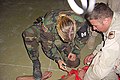 US Military Police officer restraining and sedating prisoner while a soldier holds him down (from Political corruption)
 -
 Malaysia’s former Prime Minister Najib Razak was found guilty in the corruption trial over the multi-billion-dollar 1MDB scandal. He is currently serving his sentence in Kajang Prison. (from Political corruption)
 -
 Elizabeth Warren and Bernie Sanders campaigning for extended US Medicare coverage in 2017. (from Health politics)
 -
 Montenegro’s former president Milo Đukanović is often described as having strong links to Montenegrin mafia. (from Political corruption)
 -

-
 A memorial to the Great Famine (Ireland), a famine event in Ireland that faced elongated suffering from the UK’s domestic policy failures at the time under the Prime Ministers Sir Robert Peel and Lord John Russell. (from Health politics)
 -
 Detail from Corrupt Legislation (1896) by Elihu Vedder. Library of Congress Thomas Jefferson Building, Washington, D.C. (from Political corruption)
 -
 Savka Dabčević-Kučar, Croatian Spring participant; Europe’s first female prime minister (from Civil and political rights)
 -
 Division of the world according to Haushofer’s pan-regions doctrine (from Geopolitics)
 -
 Reformers like the American Joseph Keppler depicted the Senate as controlled by the giant moneybags, who represented the nation’s financial trusts and monopolies. (from Political corruption)
 -
 The logo and slogan for change.org (from Politics and technology)
 -
 Russia handing over the symbolic relay baton for the hosting rights of the 2022 FIFA World Cup to Qatar in June 2018 (from Political corruption)
 -
 World map with the concepts of Heartland and Rimland applied (from Geopolitics)
 -

-
 This is the divide of the different political parties in Estonia where in the 2013 elections, over 133,000 people (roughly 21.2% of participating voters) voted over the Internet. The 2013 elections were also the first elections to allow vote verification with mobile devices. (from Politics and technology)
 -
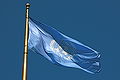 The Flag of the United Nations flying at United Nations Plaza in the Civic Center, San Francisco, California. The UN is one of the key organizations in the process of the political globalization. (from Political globalization)
 -

-
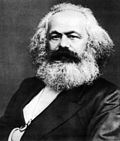 Karl Marx and his theory of Communism, developed with Friedrich Engels, proved to be one of the most influential political ideologies of the 20th century. (from History of political thought)
 -
 Sir Halford Mackinder’s Heartland concept showing the situation of the “pivot area” established in the Theory of the Heartland. He later revised it to mark Northern Eurasia as a pivot while keeping area marked above as Heartland. (from Geopolitics)
 -
 Countries with politicians, public officials or close associates implicated in the Panama Papers leak on April 15, 2016 (from Political corruption)
 -

-
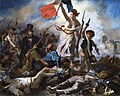 Eugène Delacroix’s Liberty Leading the People (1830, Louvre), a painting created at a time where old and modern political philosophies came into violent conflict. (from History of political thought)
 -
 Ferdinand Marcos (pictured with his daughter Imee) was a Philippine dictator and kleptocrat. His regime was infamous for its corruption. (from Political corruption)
 -
 American lobbyist and businessman Jack Abramoff was at the center of an extensive corruption investigation. (from Political corruption)
 -
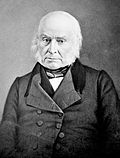 The sixth president of the United States, John Quincy Adams‘ “corrupt bargain” of 1824 is an example of patronage. (from Political corruption)
 -
-
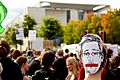 Protesters in support of American whistleblower Edward Snowden, Berlin, Germany, August 2014 (from Political corruption)
 -


Related portals


Associated Wikimedia
The following Wikimedia Foundation sister projects provide more on this subject:
-
 Commons
Free media repository -
 Wikibooks
Free textbooks and manuals -
 Wikidata
Free knowledge base -
 Wikinews
Free-content news -
 Wikiquote
Collection of quotations -
 Wikisource
Free-content library -
 Wikiversity
Free learning tools -
 Wiktionary
Dictionary and thesaurus


