-

 Looking southwest from Ben_Lawers.
 -
 Loch Lubnaig seen from the path to Ben Ledi.
 -
 Loch Leven near Glencoe village.
 -
 The Culloden Viaduct near to Culloden battlefield.
 -


| Main Page | Selected articles 1 | Selected articles 2 | Selected biographies | Selected quotes | Selected pictures | Featured Content | Categories & Topics |
Introduction
 |

|
|

| ||
Scotland (Scots: Scotland; Scottish Gaelic: Alba) is a country that is part of the United Kingdom, consisting of the northern part of the island of Great Britain and adjacent islands, principally in the archipelagos of the Hebrides and the Northern Isles. In 2022, the country’s population was about 5.4 million. Its capital city is Edinburgh, whilst Glasgow is the largest and the most populous of the cities of Scotland. Scotland borders England to the south, the Atlantic Ocean to the north and west, the North Sea to the east, and the Irish Sea to the south-west. In the Scottish Parliament, 129 members represent 73 constituencies. The Scottish Government is the executive arm of the devolved government, headed by the first minister, who chairs the cabinet and is responsible for government policy and international engagement.
The Kingdom of Scotland emerged as a sovereign state in the 9th century. Independence from England was maintained partly through an alliance with France. In 1603, James VI succeeded to the thrones of England and Ireland, forming a personal union of the three kingdoms. On 1 May 1707, Scotland and England combined to create the new Kingdom of Great Britain, with the Parliament of Scotland subsumed into the Parliament of Great Britain. In 1999, a Scottish Parliament was re-established, and has devolved authority over many areas of domestic policy. The country has its own distinct legal system, education system and religious history, which have all contributed to the continuation of Scottish culture and national identity. Scottish English and Scots are the most widely spoken languages in the country, existing on a dialect continuum with each other. Scottish Gaelic speakers can be found all over Scotland, but the language is largely spoken natively by communities within the Hebrides; Gaelic speakers now constitute less than 2% of the total population, although state-sponsored revitalisation attempts have led to a growing community of second language speakers.
The mainland of Scotland is broadly divided into three regions: the Highlands, a mountainous region in the north and north-west; the Lowlands, a flatter plain across the centre of the country; and the Southern Uplands, a hilly region along the southern border. The Highlands are the most mountainous region of the British Isles and contain its highest peak, Ben Nevis, at 4,413 feet (1,345 m). The region also contains many lakes, called lochs; the term is also applied to the many saltwater inlets along the country’s deeply indented western coastline. The geography of the many islands is varied. Some, such as Mull and Skye, are noted for their mountainous terrain, while Tiree and Coll are flatter.
Selected article

The National Museum of Scotland (Scottish Gaelic: Taigh-tasgaidh Nàiseanta na h-Alba) in Edinburgh, Scotland, is a museum of Scottish history and culture.
It was formed in 2006 with the merger of the new Museum of Scotland, with collections relating to Scottish antiquities, culture and history, and the adjacent Royal Scottish Museum (opened in 1866 as the Edinburgh Museum of Science and Art, renamed in 1904, and for the period between 1985 and the merger named the Royal Museum of Scotland or simply the Royal Museum), with international collections covering science and technology, natural history, and world cultures. The two connected buildings stand beside each other on Chambers Street, by the junction with the George IV Bridge, in central Edinburgh. The museum is part of National Museums Scotland and admission is free.
The two buildings retain distinctive characters: the Museum of Scotland is housed in a modern building opened in 1998, while the former Royal Museum building was begun in 1861 and partially opened in 1866, with a Victorian Venetian Renaissance façade and a grand central hall of cast iron construction that rises the full height of the building, designed by Francis Fowke and Robert Matheson. This building underwent a major refurbishment and reopened on 29 July 2011 after a three-year, £47 million project to restore and extend the building led by Gareth Hoskins Architects along with the concurrent redesign of the exhibitions by Ralph Appelbaum Associates.
The National Museum incorporates the collections of the former National Museum of Antiquities of Scotland. As well as the national collections of Scottish archaeological finds and medieval objects, the museum contains artefacts from around the world, encompassing geology, archaeology, natural history, science, technology, art, and world cultures. The sixteen new galleries reopened in 2011 include 8,000 objects, 80% of which were not previously on display. One of the more notable exhibits is the stuffed body of Dolly the sheep, the first successful cloning of a mammal from an adult cell. Other highlights include Ancient Egyptian exhibitions, one of Sir Elton John‘s extravagant suits, the Jean Muir Collection of costume and a large kinetic sculpture named the Millennium Clock. A Scottish invention that is a perennial favourite with children visiting as part of school trips is the Scottish Maiden, an early beheading machine predating the French guillotine. (… Read the full article)
Selected quotes
-

” … A scot is a man who keeps the Sabbath and everything else he can lay his hands on … ”
— Chic Murray
” … Adversity is sometimes hard upon a man; but for one man who can stand prosperity, there are a hundred that will stand adversity … ”
— Thomas Carlyle -
” … A wise man, therefore, proportions his belief to the evidence … ”
— David Hume
” … The surest way to get a thing in this life is to be prepared for doing without it, to the exclusion even of hope … ”
— Jane Welsh Carlyle -
” … A good gulp of whisky at bedtime – it’s not scientific but it helps … ”
— Sir Alexander Fleming
” … I have been trying all my life to like Scotchmen, and am obliged to desist from the experiment in despair … ”
— Charles Lamb -
” … It is a vain hope to make people happy by politics … ”
— Thomas Carlyle
” … We are never happy; we can only remember that we were so once … ”
— Alexander McCall Smith -
” … One sometimes finds what one is not looking for … ”
— Sir Alexander Fleming
” … I have found you an argument; I am not obliged to find you an understanding … ”
— James Boswell -
” … Every line of strength in American history is a line coloured with Scottish blood … ”
— Woodrow Wilson
” … The result of our present enquiry is that we find no vestige of a beginning, no prospect of an end … ”
— James Hutton on the immensity of geological time at the Royal Society of Edinburgh -
” … Maxims are the condensed good sense of nations … ”
— James Mackintosh
” … Who thinks the law has anything to do with justice? It’s what we have because we can’t have justice … ”
— William McIlvanney -
” … The Eleventh Commandment: Thou shalt not be found out … ”
— George Whyte-Melville
” … For God’s sake give me the young man who has brains enough to make a fool of himself … ”
— Robert Louis Stevenson -
” … Old and young, we are all on our last cruise … ”
— Robert Louis Stevenson
” … None of Nature’s landscapes are ugly so long as they are wild … ”
— John Muir -
” … You ought to be roasted alive, though even then you would not be to my taste … ”
— J. M. Barrie speaking to George Bernard Shaw
” … We are often unable to tell people what they need to know because they want to know something else … ”
— George MacDonald -
” … Biography: One of the new terrors of death … ”
— John Arbuthnot
” … It requires a surgical operation to get a joke well into a Scotch understanding … ”
— Sydney Smith
-
” … If something’s neither here nor there, where the hell is it? … ”
— Chic Murray
” … The artist cannot attain to mastery in his art unless he is endowed in the highest degree with the faculty of invention … ”
— Charles Rennie Mackintosh -
” … There are only two types of music: rock and roll … ”
— Alex Harvey
” … A man willing to work, and unable to find work, is perhaps the saddest sight that Fortune’s inequality exhibits under this sun … ”
— Thomas Carlyle -
” … The Scots are steadfast – not their clime … ”
— Thomas Crawford
” … We do have the greatest fans in the world but I’ve never seen a fan score a goal … ”
— Jock Stein -
” … Custom, then, is the great guide of human life … ”
— David Hume
” … Perpetual devotion to what a man calls his business, is only to be sustained by perpetual neglect of many other things … ”
— Robert Louis Stevenson -
” … Whaur’s yer Wullie Shakespeare noo? … ”
—Anonymous
(Patriotic shout from an audience member at the 1st Edinburgh performance of the John Home tragedy Douglas)
” … Law is the reflection of the spirit of a people, and so long as the Scots are conscious that they are a people, they must preserve their law … ”
— Robin Cook -
” … Those who bring sunshine into the lives of others cannot keep it from themselves … ”
— J. M. Barrie
” … Speech is human, silence is divine, yet also brutish and dead: therefore we must learn both arts … ”
— Thomas Carlyle -
” … Talk that does not end in any kind of action is better suppressed altogether … ”
— Thomas Carlyle
” … Surplus wealth is a sacred trust which its possessor is bound to administer in his lifetime for the good of the community … ”
— Andrew Carnegie -
” … Few delights can equal the presence of one whom we trust utterly … ”
— George MacDonald
” … The real price of every thing, what every thing really costs to the man who wants to acquire it, is the toil and trouble of acquiring it … ”
— Adam Smith -
” … No laws, however stringent, can make the idle industrious, the thriftless provident, or the drunken sober … ”
— Samuel Smiles
” … It is a great mortification to the vanity of man, that his utmost art and industry can never equal the meanest of nature’s productions, either for beauty or value … ”
— David Hume -
” … He uses statistics as a drunken man uses lamp posts — for support rather than illumination … ”
— Andrew Lang
” … We come here with no peaceful intent, but ready for battle, determined to avenge our wrongs and set our country free.
Let your masters come and attack us: we are ready to meet them beard to beard … ”
— William Wallace -
” … Golf is an indispensable adjunct to high society … ”
— Andrew Carnegie
” … We are bought and sold for English gold. Such a parcel of rogues in a nation … ”
— Robert Burns -
” … Jimmy Hill is to football what King Herod was to babysitting … ”
— Tommy Docherty
” … Maybe that’s why in England you have better horses, and in Scotland we have better men … ”
— James Boswell responding to Samuel Johnson
(“In England we wouldn’t think of eating oats. We only feed them to horses.”) -
” … He’s very clever, but sometimes his brains go to his head … ”
— Margot Asquith speaking of F. E. Smith
” … When we try to pick out anything by itself, we find it hitched to everything else in the Universe … ”
— John Muir -
” … Burns of all poets is the most a Man … ”
— Dante Gabriel Rossetti
” … No great man lives in vain. The history of the world is but the biography of great men … ”
— Thomas Carlyle

In the news

- 23 May 2026 – 2025–26 Scottish Cup
- 2026 Scottish Cup final
- In association football, Celtic beat second-tier Dunfermline Athletic 3–1 to win a record-extending 43th Scottish Cup title and complete the double this season. (BBC Sport) (ESPN)
- 8 May 2026 – 2026 United Kingdom local elections
- 2026 Scottish Parliament election, 2026 Senedd election
- The Labour Party concedes defeat in Wales with Plaid Cymru and Reform UK making significant gains, while the nationalist Scottish National Party claims victory in Scotland. (BBC News) (Reuters)
- 7 May 2026 – 2026 United Kingdom local elections
- 2026 Scottish Parliament election, 2026 Senedd election
- Voters in England elect six mayors and 5,066 council seats across 136 councils. In Scotland, voters elect 129 seats to the Scottish Parliament. In Wales, voters elect 96 seats to the Senedd. (BBC News) (The Guardian)
Selected biography

Sir Robert Alexander Watson-Watt (13 April 1892 – 5 December 1973) was a Scottish radio engineer and pioneer of radio direction finding and radar technology.
Watt began his career in radio physics with a job at the Meteorological Office, where he began looking for accurate ways to track thunderstorms using the radio waves given off by lightning. This led to the 1920s development of a system later known as high-frequency direction finding (HFDF or “huff-duff”). Although well publicized, the system’s enormous military potential was not developed until the late 1930s. Huff-duff allowed operators to determine the location of an enemy radio transmitter in seconds and it became a major part of the network of systems that helped defeat the threat of German U-boats during World War II. It is estimated that huff-duff was used in about a quarter of all attacks on U-boats.
In 1935, Watt was asked to comment on reports of a German death ray based on radio. Watt and his assistant Arnold Frederic Wilkins quickly determined it was not possible, but Wilkins suggested using radio signals to locate aircraft at long distances. This led to a February 1935 demonstration of signals from a BBC short-wave transmitter bounced off a Handley Page Heyford aircraft. Watt led the development of a practical version of this device, which entered service in 1938 under the code name Chain Home. This system provided the vital advance information that helped the Royal Air Force in the Battle of Britain.
After the success of his invention, Watson Watt was sent to the U.S. in 1941 to advise on air defence after Japan’s attack on Pearl Harbor. He returned and continued to lead radar development for the War Office and Ministry of Supply. He was elected a Fellow of the Royal Society in 1941, knighted in 1942 and awarded the US Medal for Merit in 1946. (… Read the full article)
Selected picture
-

36-inch telescope at the Royal Observatory, Edinburgh
36-inch telescope at the Royal Observatory on Blackford Hill, Edinburgh, the location of the UK Astronomy Technology Centre (UK ATC).
Photo credit: Science and Technology Facilities Council -

Aerial view of Pennan village
Pennan (Scots: Peenan) is a small village in Aberdeenshire] consisting of a small harbour and a single row of homes. Pennan became famous for representing the fictional village of Ferness, being one of the main locations for the film Local Hero.
Photo credit: Tadpolefarm -

Eilean Glas lighthouse
Eilean Glas Lighthouse, built by engineer Thomas Smith, was one of the original four lights to be commissioned by the Commissioners of the Northern Lights and the first in the Hebrides (the others were Kinnaird Head, Mull of Kintyre and North Ronaldsay).
Photo credit: Richard Baker -

Edinburgh Castle
Edinburgh Castle is a fortress which dominates the skyline of the city of Edinburgh, from its position atop the volcanic Castle Rock. Human habitation of the site is dated back as far as the 9th century BC, although the nature of early settlement is unclear. There has been a royal castle here since at least the reign of King David in the 12th century, and the site continued to be a royal residence until the Union of the Crowns in 1603.
Photo credit: Saffron_Blaze -

The Queens View, Loch Tummel
Loch Tummel (Scottish Gaelic: Loch Teimhil) is a long, narrow loch, 7 kilometres north west of Pitlochry in Perth and Kinross. A well known view over the loch and the surrounding countryside (with Schiehallion in the background) is the ‘Queen’s View’ from the north shore, which Queen Victoria made famous in 1866.
Photo credit: Paul Hermans -
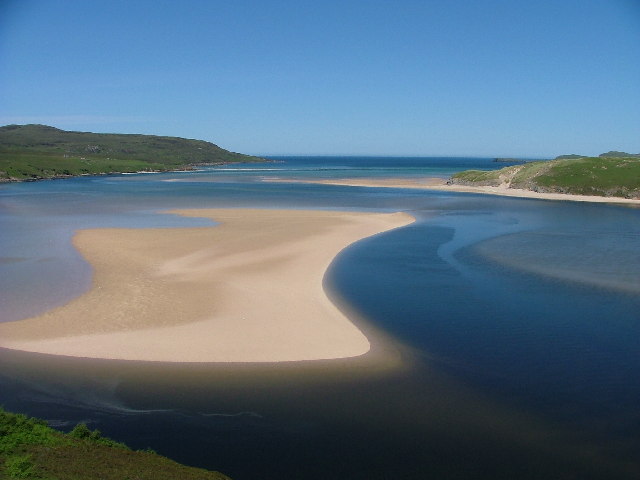
Kyle of Durness
Durness (Scottish Gaelic: Diùirnis) is a huge but remote parish in the northwestern Highlands, encompassing all the land between the Moine to the East (separating it from Tongue parish) and the Gualin to the West (separating it from Eddrachilis).
Photo credit: Neil Booth -
-

Aerial viewof the bridge over the River Garry, Perthshire
Autumnal colours seen in an aerial view of the bridge over the River Garry, Perthshire.
Photo credit: Ian Dick -

Arbroath Harbour
Arbroath or Aberbrothock (Scottish Gaelic: Obair Bhrothaig) is a former royal burgh on the North Sea coast, around 16 miles (25.7 km) ENE of Dundee and 45 miles (72.4 km) SSW of Aberdeen. It is the largest town in the council area of Angus. and has a population of 22,785.
Photo credit: Karen Vernon -

Atlantic Puffins at Sumburgh Head, Shetland -

The supply boat Good Shepherd III is tied up on the jetty on Fair Isle, 1974
Fair Isle (from Old Norse Frjóey) (Scottish Gaelic: Eileann nan Geansaidh) is an island off Scotland, lying around halfway between Shetland and the Orkney Islands. The most remote inhabited island in the United Kingdom, it is famous for its bird observatory and a traditional style of knitting.
Photo credit: Julian Paren -

The Falkirk Wheel.
The Falkirk Wheel, named after the nearby town of Falkirk, is a rotating boat lift connecting the Forth and Clyde Canal with the Union Canal. The wheel raises boats by 24 metres (79 ft).
Photo credit: User:SeanMack -

Cells of Life, a landform by Charles Jencks at Jupiter Artland
Cells of Life, a landform by Charles Jencks at Jupiter Artland, a contemporary sculpture park and art gallery outside the city of Edinburgh.
Photo credit: Allan Pollok-Morris -
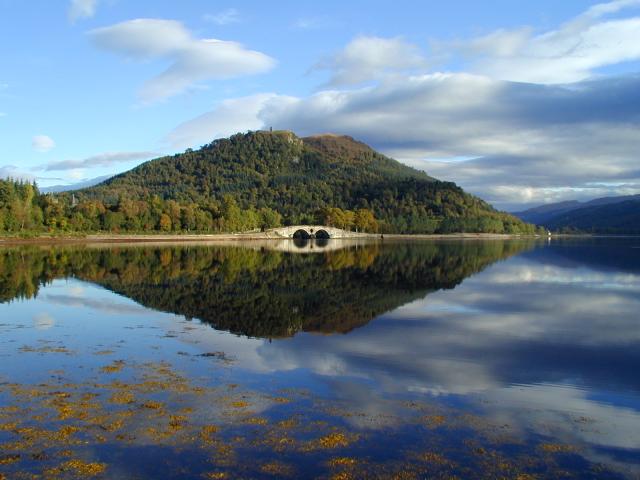
Inveraray Bridge on Loch Fyne
Loch Fyne (Scottish Gaelic: Loch Fìne, meaning “Loch of the Vine or Wine”, is a sea loch on the west coast of Argyll and Bute. Although there is no evidence for grapes growing there, it was more metaphorical, such as meaning that the River, Abhainn Fìne, was a well-respected river.
Photo credit: Michael Parry -

Luskentyre Beach, Lewis and Harris, The Outer Hebrides -

View over Edinburgh, with the Dugald Stewart Monument in the foreground
Calton Hill is a hill in central Edinburgh, just to the east of the New Town. The hill is home to several iconic monuments and buildings: the National Monument, Nelson’s Monument, the Dugald Stewart Monument, the Royal High School, the Robert Burns Monument, the Political Martyrs’ Monument and the City Observatory.
Photo credit: Andrewyuill -

Mousa Broch, Shetland Islands
A broch is an Iron Age drystone hollow-walled structure of a type found only in Scotland. Brochs belong to the classification “complex atlantic roundhouse” devised by Scottish archaeologists in the 1980s. Their origin is a matter of some controversy.
Photo credit: Otter -

Cape Wrath Peninsula
Cape Wrath (Scottish Gaelic: Am Parbh, known as An Carbh in Lewis) is a cape in the Durness parish of the county of Sutherland in the Highlands of Scotland, and is the most north-westerly point in Great Britain.
Photo credit: RealSnowhunter -

Dean Village, Edinburgh -

View of Oban and harbour
Oban (Scottish Gaelic: An t-Òban) (meaning “The Little Bay”) is a resort town within the council area of Argyll and Bute. Oban Bay is a near perfect horseshoe bay, protected by the island of Kerrera, and beyond Kerrera is Mull. To the north is the long low island of Lismore, and the mountains of Morvern and Ardgour.
Photo credit: Josi -
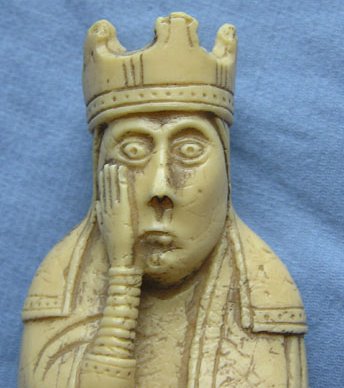
Detail of the Queen from the Lewis chessmen
The Lewis chessmen (named after their find-site) belong to some of the few complete medieval chess sets that have survived until today. The chessmen are believed to have been made in Norway, perhaps by craftsmen in Trondheim (where similar pieces have been found), sometime during the 12th century.
Photo credit: Finlay McWalter -
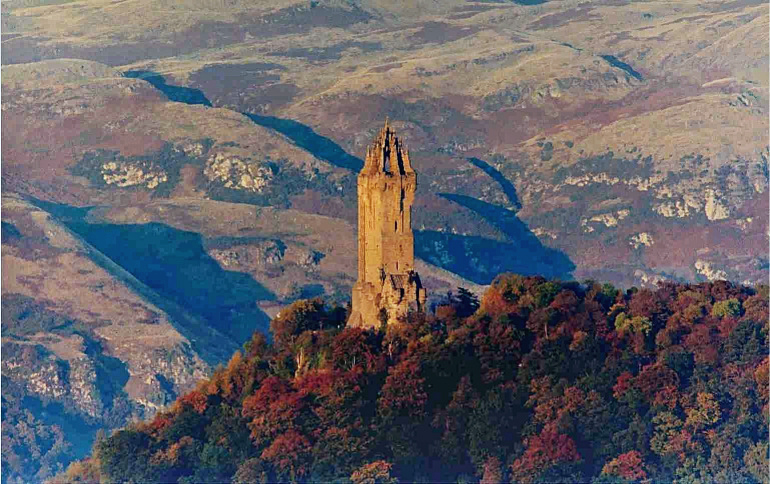
The Wallace Monument
The Wallace Monument is a sandstone tower, built in the Victorian Gothic style. It stands on the summit of Abbey Craig, a volcanic crag above Cambuskenneth Abbey, from which Wallace was said to have watched the gathering of the army of English king Edward I, just before the Battle of Stirling Bridge.
Photo credit: Ray Mann -
-

The Skating Minister.
The Reverend Robert Walker Skating on Duddingston Loch, better known by its truncated title The Skating Minister, is an oil painting by Sir Henry Raeburn in the National Gallery of Scotland in Edinburgh.
Credit: Sir Henry Raeburn (1790s painting) -

St Ninian’s Isle
The tied island of St Ninian’s Isle is joined to the Shetland Mainland by the largest tombolo in the UK.
Photo credit: ThoWi


Did You Know…

- … that the Scottish judge Lord Duthie served as an officer in the Royal Naval Reserve?
- … that Colin Mackay, the political editor at Scottish Television, was “very sad” when Colin MacKay, the political editor at Scottish Television, died?
- … that the Scottish painter Carole Gibbons had her first US exhibition in her eighties?
- … that Jewish tartans have been made for the Jewish community of Scotland?
- … that a lane behind a tenement in Edinburgh is decorated as a Wild West town?
- … that the Scottish invasion of England in 1648 was defeated by an army less than half their size?
- … that former Scottish Conservative leader Ruth Davidson said that she would swim in Loch Ness naked if the SNP won more than 50 seats at the 2019 United Kingdom general election?
- … that Thorpe's secluded hills provided refuge from Scottish raiders and English Civil War troops?
Get involved


For editor resources and to collaborate with other editors on improving Wikipedia’s Scotland-related articles, see WikiProject Scotland.
To get involved in helping to improve Wikipedia’s Scotland related content, please consider doing some of the following tasks or joining one or more of the associated Wikiprojects:
- Visit the Scottish Wikipedians’ notice board and help to write new Scotland-related articles, and expand and improve existing ones.
- Visit Wikipedia:WikiProject Scotland/Assessment, and help out by assessing unrated Scottish articles.
- Add the Project Banner to Scottish articles around Wikipedia.
- Participate in WikiProject Scotland’s Peer Review, including responding to PR requests and nominating Scottish articles.
- Help nominate and select new content for the Scotland portal.
Do you have a question about The Scotland Portal that you can’t find the answer to?
Post a question on the Talk Page or consider asking it at the Wikipedia reference desk.
Related portals



Other language versions
Associated Wikimedia
The following Wikimedia Foundation sister projects provide more on this subject:
-
 Commons
Free media repository -
 Wikidata
Free knowledge base -
 Wikiquote
Collection of quotations -
 Wikisource
Free-content library -
 Wikispecies
Directory of species -
 Wikiversity
Free learning tools -
 Wikivoyage
Free travel guide -
 Wiktionary
Dictionary and thesaurus


-

-

-

-

-

-

-

-

-

-

-
 Random portal
 -


