 |
대한민국 포털
The South Korea Portal


South Korea, officially the Republic of Korea (ROK), is a country in East Asia. It constitutes the southern half of the Korean Peninsula and borders North Korea along the Korean Demilitarized Zone, with the Yellow Sea to the west and the Sea of Japan to the east. South Korea claims to be the sole legitimate government of the entire peninsula and adjacent islands. It has a population of about 52 million, of which half live in the Seoul metropolitan area, the ninth most populous metropolitan area in the world, with other major cities being Busan, Daegu, and Incheon.
The Korean Peninsula was inhabited as early as the Lower Paleolithic period. Its first kingdom was noted in Chinese records in the early seventh century BC. From the mid first century BC, various polities consolidated into the rival kingdoms of Goguryeo, Baekje, and Silla. The lattermost eventually unified most of the peninsula for the first time in the late seventh century AD, while Balhae succeeded Goguryeo in the north. The Goryeo dynasty (918–1392) achieved lasting unification and established the basis for the modern Korean identity. The subsequent Joseon dynasty (1392–1897) generated cultural, economic, and scientific achievements but maintained an isolationist policy from the mid-17th century. The succeeding Korean Empire (1897–1910) sought modernization and reform but was annexed in 1910 into the Empire of Japan. Japanese rule ended following Japan’s surrender in World War II, after which Korea was divided into two zones: the Soviet-occupied northern zone and the United States-occupied southern zone.
After negotiations on reunification failed, the southern zone became the Republic of Korea in August 1948, while the northern zone became the communist Democratic People’s Republic of Korea the following month. In 1950, a North Korean invasion triggered the Korean War, one of the first major proxy conflicts of the Cold War, which saw extensive fighting involving the American-led United Nations Command and the Soviet-backed People’s Volunteer Army from China. The war ended in 1953 with an armistice and left three million Koreans dead and the economy in ruins; due to the lack of a peace treaty, the Korean conflict is still ongoing. South Korea endured a series of dictatorships punctuated by coups, revolutions, and violent uprisings, but also experienced a soaring economy and one of the fastest rises in average GDP per capita, leading to its emergence as one of the Four Asian Tigers. The June Democratic Struggle of 1987 ended authoritarian rule and led to the establishment of the current Sixth Republic. (Full article…)
Selected article –

Joseon (English: /ˈtʃoʊsʌn/ CHOH-sun; Korean: 조선; Hanja: 朝鮮; MR: Chosŏn; pronounced [tɕo.sʰʌn]; also romanized as Chosun), officially Great Joseon (대조선국; 大朝鮮國; [tɛ.dʑo.sʰʌn.ɡuk̚]), was a dynastic kingdom of Korea that existed for 505 years. It was founded by Taejo of Joseon in 1392 and replaced by the Korean Empire in 1897. The kingdom was founded after the overthrow of Goryeo in what is today the city of Kaesong. Early on, Korea was retitled and the capital was moved to modern-day Seoul. The kingdom’s northernmost borders were expanded to the natural boundaries at the rivers of Amnok and Tuman through the subjugation of the Jurchens.
Over the centuries, Joseon encouraged the entrenchment of Confucian ideals and doctrines in Korean society. Neo-Confucianism was installed as the new state’s ideology. Buddhism was accordingly discouraged, and occasionally Buddhists faced persecution. Joseon consolidated its effective rule over the Korean peninsula and saw the height of classical Korean culture, trade, literature, science, and technology. The kingdom was severely weakened by failed Japanese invasions in 1592 and 1598, which were followed by invasions by the Later Jin dynasty in 1627 and the Qing dynasty in 1636–1637. The country pursued an increasingly harsh isolationist policy, becoming known as the “hermit kingdom” in Western literature. After the end of these invasions from Manchuria, Joseon experienced a nearly 200-year period of peace and prosperity, along with cultural and technological development. What power the kingdom recovered during its isolation waned as the 18th century came to a close. Faced with internal strife, power struggles, international pressure, and rebellions at home, the kingdom declined rapidly in the late 19th century.
The Joseon period left a substantial legacy. Modern Korean bureaucracy and administrative divisions were established during it. The modern Korean language and its dialects derive from the culture and traditions of Joseon, as does much of Korean culture, etiquette, norms, and societal attitudes. (Full article…)
Selected image

South Korea is located in East Asia, on the southern half of the Korean Peninsula jutting out from the far east of the Asian land mass. The only country with a land border to South Korea is North Korea, lying to the north with 238 kilometres (148 mi) of border running along the Korean Demilitarized Zone. South Korea is mostly surrounded by water and has 2,413 kilometres (1,499 mi) of coast line along three seas; to the west is the Yellow Sea, to the south is the East China Sea, and to the east is the East Sea. Geographically, South Korea’s land mass is approximately 100,032 square kilometres (38,623 mi2). 290 square kilometres (110 mi2) of South Korea are occupied by water. The approximate coordinates are 37° North, 127° 30 East. Notable islands include Jeju Island (Jejudo), Ulleung Island (Ulleungdo), and Liancourt Rocks (Dokdo).
More did you know –
- … that Mo Tae-bum, a South Korean long track speed skater, won a 2010 Olympic gold medal on his 21st birthday?
- … that Jeon Ok, a Korean actress and the mother of actress Kang Hyo-shil, was referred to as “Queen of Tears” for her excellence at acting for tragic dramas?
- … that Cho Jae-hyun, a South Korean actor, is commonly referred to as a persona of director Kim Ki-duk due to his appearances in almost all of Kim’s films?
In the news
- 15 April 2026 – Economic impact of the 2026 Iran war
- South Korea secures imports of 273 million barrels of crude oil (by the end of the year) and 2.1 million tons of naphtha through alternative routes that bypass the Strait of Hormuz, providing several months of supply amid disruptions linked to the Iran war. (AFP via SpaceWar.com)
- 10 April 2026 – Economic impact of the 2026 Iran war
- The parliament of South Korea approves a supplementary budget worth ₩26.2 trillion (US$17.7 billion) to address the economic effects of the war, which includes cash assistance to 35 million South Koreans. (AA)
- 20 March 2026 – 2026 Daejeon factory fire
- Fourteen people are killed and 60 more are injured in a fire at a car parts plant in Daejeon, South Korea. (AFP and Reuters via The Straits Times)
- 5 March 2026 – Economic impact of the 2026 Iran war
- South Korean president Lee Jae Myung orders the activation of a ₩100 trillion (about US$68 billion) stabilization fund to address volatility in the country’s financial markets linked to the Iran war. (AFP via The Economic Times)
 Good article –

“Why” is a song recorded by South Korean singer Taeyeon for her second extended play of the same name. It was released as the EP’s second single on June 28, 2016 by SM Entertainment. The song’s lyrics were penned by Jo Yoon-kyung, while its music was composed and arranged by LDN Noise, Lauren Dyson, and Rodnae “Chikk” Bell. Musically, as opposed to Taeyeon’s signature balladic styles, “Why” is described as a hybrid of EDM and R&B with elements of tropical house. The track’s lyrics address a desire to escape a suffocating life.
The single received positive reviews from music critics, who were favorable towards the song’s refreshing musical styles as well as Taeyeon’s vocal performance. Commercially, “Why” peaked at number seven on South Korea’s Gaon Digital Chart and reached number six on the Billboard World Digital Songs chart. As of December 2016, the song has sold 689,209 digital units in South Korea.
Two music videos for the song were released; the first one was directed by Im Seong-gwan and was premiered simultaneously with the release of the single. Filmed in California, the video depicts Taeyeon going on a trip to re-energize herself. The second one–a dance version featuring Taeyeon performing the choreography to the song was released on July 4, 2016. To promote “Why”, Taeyeon held an event called “Countdown Night” prior to the song’s release on Naver‘s V app. She also appeared and performed on music shows including Music Bank, Show! Music Core, and Inkigayo. The song was also included on the setlist of Taeyeon’s concert Butterfly Kiss in South Korea in July and August 2016. (Full article…)
General images –
-
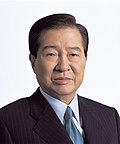 President Kim Dae-jung, the 2000 Nobel Peace Prize recipient for advancing democracy and human rights in South Korea and East Asia and for reconciliation with North Korea, was sometimes called the “Nelson Mandela of Asia.” (from History of South Korea)
 -
 Burial grounds of the victims of the Gwangju Uprising at Mangwol-dong cemetery (from History of South Korea)
 -
 Sinchon movie theatre (from Culture of South Korea)
 -
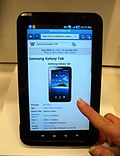 Samsung Galaxy Tab (from Culture of South Korea)
 -
 An Internet cafe in Seoul (from Culture of South Korea)
 -
-

-
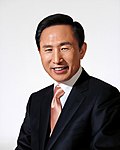 Lee Myung-bak, President of South Korea from 2008 to 2013 (from History of South Korea)
 -
 President Park Geun-hye with chaebol business magnates Lee Kun-hee and Chung Mong-koo, May 2013 (from History of South Korea)
 -
 Korean newspapers (from Culture of South Korea)
 -

-
 A card portrait of Park Chung Hee during a military parade on Armed Forces Day, 1 October 1973 (from History of South Korea)
 -
 Fireworks during the closing ceremonies of the 1988 Summer Olympics (from History of South Korea)
 -
-
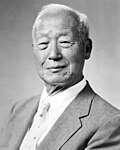 Syngman Rhee, the 1st President of South Korea (from History of South Korea)
 -
 Inauguration of the 21st President of South Korea Lee Jae-myung. (from History of South Korea)
 -
 North Korean leader Kim Jong Un and South Korean President Moon Jae-in shaking hands inside the Peace House on 27 April 2018 (from History of South Korea)
 -
 President Park Chung Hee, who ruled South Korea from 1961 to 1979 (from History of South Korea)
 -
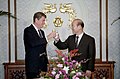 South Korean President Chun Doo-hwan with U.S. President Ronald Reagan in Seoul, November 1983 (from History of South Korea)
 -
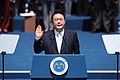 Yoon takes the presidential oath of office outside the National Assembly, 10 May 2022. (from History of South Korea)


Did you know (auto-generated)

- … that the Korean protest song “Morning Dew” was banned in North and South Korea?
- … that anti-Korean sentiment, due to South Korea’s economic growth, motivated Djuna to write the sci-fi novel Counterweight?
- … that South Korea has a day to celebrate North Koreans?
- … that South Korean band Seventeen partnered with Apple to let fans create remixes of their song “Darl+ing” on GarageBand?
- … that Jeong Haneul went from being a North Korean soldier to a South Korean YouTuber?
- … that Singaporean former lawyer David Yong learned Korean and moved to South Korea to become a K-pop singer?
WikiProjects
See WikiProject Korea for collaborating on South Korea topics, and more broadly, on all things Korea-related.
Categories


Related portals


East Asia


Associated Wikimedia
The following Wikimedia Foundation sister projects provide more on this subject:
-
 Commons
Free media repository -
 Wikibooks
Free textbooks and manuals -
 Wikidata
Free knowledge base -
 Wikinews
Free-content news -
 Wikiquote
Collection of quotations -
 Wikisource
Free-content library -
 Wikiversity
Free learning tools -
 Wikivoyage
Free travel guide -
 Wiktionary
Dictionary and thesaurus


Web resources
- The official website of the Republic of Korea (Korea.net)
- The Official Korea Tourism Guide Site
- Korea National Statistical Office
- Video on South Korea-US Relations from the Dean Peter Krogh Foreign Affairs Digital Archives
- “South Korea”. The World Factbook (2025 ed.). Central Intelligence Agency.
- A Country Study: South Korea in the Library of Congress
- South Korea from UCB Libraries GovPubs
- Korea OECD
- South Korea profile from the BBC News
- South Korea Encyclopædia Britannica entry
- The War Memorial of Korea
- Key Development Forecasts for South Korea from International Futures
Sources
-

-

-

-

-

-

-

-

-

-

-
 Random portal
 -


