In chemistry, a radical, also known as a free radical, is an atom, molecule, or ion that has at least one unpaired valence electron.[1][2] With some exceptions, these unpaired electrons make radicals highly chemically reactive. Radicals consisting of main group elements are often very reactive and undergo uncontrollable reactions, notably dimerization and polymerization. Most organic radicals have short lifetimes.
A notable example of a radical is the hydroxyl radical (HO·), a molecule that has one unpaired electron on the oxygen atom. Two other examples are triplet oxygen and triplet carbene (꞉CH
2) which have two unpaired electrons.
Radicals may be generated in a number of ways, but typical methods including redox reactions, ionizing radiation, heat, electrical discharges, and electrolysis are known to produce radicals. Radicals are intermediates in many chemical reactions, more so than is apparent from the balanced equations.
Radicals are important in combustion, atmospheric chemistry, polymerization, plasma chemistry, biochemistry, and many other chemical processes. A majority of natural products are generated by radical-generating enzymes. In living organisms, the radicals superoxide and nitric oxide and their reaction products regulate many processes, such as control of vascular tone and thus blood pressure. They also play a key role in the intermediary metabolism of various biological compounds. Such radicals are also messengers in a process dubbed redox signaling. A radical may be trapped within a solvent cage or be otherwise bound.
Formation
Radicals are either (1) formed from spin-paired molecules or (2) from other radicals. Radicals are formed from spin-paired molecules through homolysis of weak bonds or electron transfer, also known as reduction. Radicals are formed from other radicals through substitution, addition, and elimination reactions.[citation needed]
Radical formation from spin-paired molecules
Homolysis

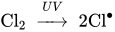
Homolysis makes two new radicals from a spin-paired molecule by breaking a covalent bond, leaving each of the fragments with one of the electrons in the bond.[3] The homolytic bond dissociation energies, usually abbreviated as “ΔH °” are a measure of bond strength. Splitting H2 into 2 H•, for example, requires a ΔH ° of +435 kJ/mol, while splitting Cl2 into two Cl• requires a ΔH ° of +243 kJ/mol. For weak bonds, homolysis can be induced thermally. Strong bonds require high energy photons or even flames to induce homolysis.[citation needed]
Some homolysis reactions are particularly important because they serve as an initiator for other radical reactions. One such example is the homolysis of halogens, which occurs under light and serves as the driving force for radical halogenation reactions. Another notable reaction is the homolysis of dibenzoyl peroxide, which results in the formation of two benzoyloxy radicals and acts as an initiator for many radical reactions.[4]

Reduction

Classically, radicals form by one-electron reductions. Typically one-electron reduced organic compounds are unstable. Stability is conferred to the radical anion when the charge can be delocalized. Examples include alkali metal naphthenides, anthracenides, and ketyls.
Radical formation from other radicals
Abstraction

Hydrogen abstraction generates radicals. To achieve this reaction, the C-H bond of the H-atom donor must be weak, which is rarely the case in organic compounds. Allylic and especially doubly allylic C-H bonds are prone to abstraction by O2. This reaction is the basis of drying oils, such as linoleic acid derivatives.[citation needed]
Addition

In free-radical additions, a radical adds to a spin-paired substrate. When applied to organic compounds, the reaction usually entails addition to an alkene. This addition generates a new radical, which can add to yet another alkene, etc. This behavior underpins radical polymerization, technology that produces many plastics.[5][6]
Elimination
Radical elimination can be viewed as the reverse of radical addition. In radical elimination, an unstable radical compound breaks down into a spin-paired molecule and a new radical compound. Shown below is an example of a radical elimination reaction, where a benzoyloxy radical breaks down into a phenyl radical and a carbon dioxide molecule.[7]

Stability
A large variety of inorganic radicals, as well as a smaller number of organic radicals, are stable and in fact isolable. Nitric oxide (NO) is well known example of an isolable inorganic radical, and Fremy’s salt (Potassium nitrosodisulfonate, (KSO3)2NO) is a related example. Many thiazyl radicals are known, despite limited π resonance stabilization (see below).[8][9]
The term “stable radical” bears a pernicious ambiguity. Radicals’ behavior varies with distinct thermodynamic and kinetic stabilities, and no general rule connects the two. For example, resonance delocalization thermodynamically stabilizes benzyl radicals, but those radicals undergo rapid, diffusion-limited dimerization. Under normal conditions, their kinetic lifetime measures in nanoseconds.[10] Conversely, H• is highly reactive (thermodynamically unstable), but also the most abundant chemical in the universe (kinetically stable) because it exists primarily in low-density environments.[citation needed]
Following Griller and Ingold’s extremely influential 1976 review,[10] modern chemists call a carbon-centered radical R• stabilized if the corresponding R–H bond is weaker than in an alkane; the radical is persistent if the radical lifetime lasts longer than the encounter limit.[11] Persistence is almost exclusively a steric effect.[10] However, orbitals of high angular momentum (d or f), delocalization, and the α effect can all make organic radicals stabilized.[citation needed]

The radical of commerce 2,2,6,6-tetramethylpiperidinyloxyl (TEMPO) illustrates these phenomena: the methyl substituents shield the N-hydroxypiperidinyl core radical for persistence; and the vicinal nitrogen and oxygen lone pairs weaken any bonds that might form to oxygen, keeping the radical stabilized. Consequently, TEMPO behaves, aside from its paramagnetism, like a normal organic compound.[3][better source needed]
Singly-occupied molecular orbitals


In molecular orbital theory, a radical electronic structure is characterized by a highest-energy filled molecular orbital that contains only an unpaired electron. That orbital is called the “singly-occupied molecular orbital” or SOMO, and is traditionally filled spin-up without loss of generality.[3]: 977 Radical compounds are thermodynamically unstable because fixed nuclear positions cannot simultaneously minimize the filled spin-up orbital energies (which include the SOMO) and the filled spin-down orbital energies (which do not). Thus a SOMO whose energy depends little on nuclear position can produce a relatively stabilized radical.[citation needed] Two common types of such SOMOs are a d orbital,[12] which requires only Jahn-Teller distortion;[citation needed] and a SOMO delocalized over a large portion of the molecule or crystal,[13]: 649–650 which requires little motion at each nucleus.[citation needed]
SOMOs can in principle be of any type, but amongst the main group atoms, almost all known stable radicals have a π-type SOMO.[11] Consequently, SOMOs delocalize like other π bonds: to nearby lone pairs on hydroxyl groups (−OH), ethers (−OR), or amines (−NH2 or −NR); to conjugated π bonds in alkenes, carbonyls, or nitriles; or in hyperconjugation to nearby hydrogen– or fluorine-rich moieties.[14]

Many of the above functional groups are electron-donating, but electron donation is not necessary to achieve SOMO delocalization, and electron withdrawal functions just as well.[3]: 978 Indeed, radicals are particularly stable if they can delocalize into both an electron-withdrawing and an electron-donating group, the “capto-dative effect“.[15]
In the electron-donating case, the SOMO interacts with the lower energy lone pair to form a new, lower-energy, filled, delocalized bond orbital and a new, higher-energy antibonding SOMO (in net, a three-electron bond). Because the new bonding orbital contains more electrons than the SOMO, the resulting electronic state reduces molecular energy.[3]: 979
In the electron-withdrawing case, the SOMO interacts with an empty σ* or π* antibonding orbital. That antibonding orbital has less energy than the isolated SOMO, as does the resulting hybrid orbital.[3]: 978
Common equilibria

The stability of many (or most) organic radicals is not indicated by their isolability but is manifested in their ability to function as donors of H•. This property reflects a weakened bond to hydrogen, usually O−H but sometimes N−H or C−H. This behavior is important because these H• donors serve as antioxidants in biology and in commerce. Illustrative is α-tocopherol (vitamin E). The tocopherol radical itself is insufficiently stable for isolation, but the parent molecule is a highly effective hydrogen-atom donor. The C−H bond is weakened in triphenylmethyl (trityl) derivatives.[citation needed]
Most main-group radicals are in notional equilibrium with closed-shell dimers. For example, nitrogen dioxide equilibrates with dinitrogen tetroxide, and tributyltin radicals equilibrate with hexabutyldistannane. Consequently, radicals may be stabilized when the dimeric bond is weak. For example, compounds with a radical localized to atoms with adjacent lone pairs experience a powerful α effect when dimerized, such that the dimer may practically never form.[16] Likewise, the quinonic loss of aromaticity in Gomberg’s dimer predisposes the compound towards homolysis.[citation needed]
In other cases, radical dimers may form a “π dimer“, analogous to a donor-acceptor complex but without charge transfer.[17]
Diradicals
Diradicals are molecules containing two radical centers. Dioxygen (O2) is an important example of a stable diradical. Singlet oxygen, the lowest-energy non-radical state of dioxygen, is less stable than the diradical due to Hund’s rule of maximum multiplicity. The relative stability of the oxygen diradical is primarily due to the spin-forbidden nature of the triplet-singlet transition required for it to grab electrons, i.e., “oxidize“. The diradical state of oxygen also results in its paramagnetic character, which is demonstrated by its attraction to an external magnet.[18] Diradicals can also occur in metal-oxo complexes, lending themselves for studies of spin forbidden reactions in transition metal chemistry.[19] Carbenes in their triplet state can be viewed as diradicals centred on the same atom, while these are usually highly reactive persistent carbenes are known, with N-heterocyclic carbenes being the most common example.[citation needed]
Triplet carbenes and nitrenes are diradicals. Their chemical properties are distinct from the properties of their singlet analogues.[citation needed]
Occurrence of radicals
Combustion

A familiar radical reaction is combustion. The oxygen molecule is a stable diradical, best represented by •O–O•. Because spins of the electrons are parallel, this molecule is stable. While the ground state of oxygen is this unreactive spin-unpaired (triplet) diradical, an extremely reactive spin-paired (singlet) state is available. For combustion to occur, the energy barrier between these must be overcome. This barrier can be overcome by heat, requiring high temperatures. The triplet-singlet transition is also “forbidden“. This presents an additional barrier to the reaction. It also means molecular oxygen is relatively unreactive at room temperature except in the presence of a catalytic heavy atom such as iron or copper.[citation needed]
Combustion consists of various radical chain reactions that the singlet radical can initiate. The flammability of a given material strongly depends on the concentration of radicals that must exist, or be obtained – as in laboratory conditions, before initiation and propagation reactions dominate leading to combustion of the material. Once the combustible material has been consumed, termination reactions again dominate and the flame dies out. As indicated, promotion of propagation or termination reactions alters flammability. For example, because lead itself deactivates radicals in the gasoline-air mixture, tetraethyl lead was once commonly added to gasoline. This prevents the combustion from initiating in an uncontrolled manner or in unburnt residues (engine knocking) or premature ignition (preignition).[citation needed]
When a hydrocarbon is burned, a large number of different oxygen radicals are involved. Initially, hydroperoxyl radical (HOO•) are formed. These then react further to give organic hydroperoxides that break up into hydroxyl radicals (HO•).[citation needed]
Polymerization
Many polymerization reactions are initiated by radicals. Polymerization involves an initial radical adding to non-radical (usually an alkene) to give new radicals. This process is the basis of the radical chain reaction. The art of polymerization entails the method by which the initiating radical is introduced. For example, methyl methacrylate (MMA) can be polymerized to produce Poly(methyl methacrylate) (PMMA – Plexiglas or Perspex) via a repeating series of radical addition steps:

Newer radical polymerization methods are known as living radical polymerization. Variants include reversible addition-fragmentation chain transfer (RAFT) and atom transfer radical polymerization (ATRP).[citation needed]
Being a prevalent radical, O2 reacts with many organic compounds to generate radicals together with the hydroperoxide radical. Drying oils and alkyd paints harden due to radical crosslinking initiated by oxygen from the atmosphere.[citation needed]
Atmospheric radicals
The most common radical in the lower atmosphere is molecular dioxygen. Photodissociation of source molecules produces other radicals. In the lower atmosphere, important radical are produced by the photodissociation of nitrogen dioxide to an oxygen atom and nitric oxide (see eq. 1.1 below), which plays a key role in smog formation—and the photodissociation of ozone to give the excited oxygen atom O(1D) (see eq. 1.2 below). The net and return reactions are also shown (eq. 1.3 and eq. 1.4, respectively).
[h \\nu] NO + O”}}’>![{\displaystyle {\mathrm {NO} {\vphantom {A}}_{\smash[{t}]{2}}{}\mathrel {\xrightarrow {\mathrm {h} ~\mathrm {\nu } } } {}\mathrm {NO} {}+{}\mathrm {O} }}](https://wikimedia.org/api/rest_v1/media/math/render/svg/5da627b27ee3e5b4dc45b156c54a91e1d79ffbd1)
NO2 + O2 ->[h \\nu] NO + O3</chem>”},”3″:{“wt”:”{{EquationRef|eq. 1.3}}”}},”i”:0}}]}’>
| |||||||||||||||