| ||
|---|---|---|
|
Personal
Overthrow, exile and death (1979–1980) Works and writings   |
||

| Part of a series on |
| Monarchism in Iran |
|---|
 |


| Part of a series on |
| Conservatism in Iran |
|---|


The Resurrection Party of the Iranian Nation,[n 3][a][11] simply known as the Rastakhiz Party,[b] was Iran’s sole legal and ruling political party from 2 March 1975[13][14] until it’s dissolvement amid the Iranian Revolution on 1 October 1978.[15] The party was founded by Mohammad Reza Pahlavi, the last Shah of Iran, who was the party’s de facto leader.[n 4]
Although the Rastakhiz Party was presented as a vehicle for national political participation, it operated within a highly centralized political structure closely connected to the state.[17] Membership was strongly encouraged and in many cases effectively required, particularly for government employees and professionals. Despite official claims of millions of members, historians have noted that the organization functioned largely as an extension of the state apparatus rather than as an independent political movement.
During the political unrest that preceded the Iranian Revolution, the party became a frequent target of criticism and protest. As demonstrations intensified in 1978, the Shah dissolved the Rastakhiz Party as part of broader attempts to ease political tensions. The collapse of the monarchy in 1979 led to the suppression of monarchist political organizations, and the party ceased to exist with the establishment of the Islamic Republic of Iran. The Islamic Republican Party succeeded the Rastakhiz Party in 1980.
Background
Prior to the establishment of the Rastakhiz Party, Mohammad Reza, Shah of Iran, had publicly rejected the idea of creating a single-party system in Iran. In his 1961 book Mission for My Country, he wrote:
If I were a dictator rather than a constitutional monarch, I would try to take over the leadership of a single, dominant party, like Hitler or what you see in socialist (communist) countries today. […] As the king of a constitutional country, I see no reason not to encourage the formation of political parties and, like dictators, to support a puppet party.
Despite these earlier statements, the political environment in Iran changed considerably during the following decade. During the late 1960s and early 1970s, the Pahlavi state oversaw a period of rapid economic expansion associated with the development programs of the White Revolution. The sharp rise in global oil prices following the 1973 oil crisis greatly increased Iran’s oil revenues and significantly expanded the Iranian state’s financial resources. These developments enabled the Imperial government to fund large-scale industrial projects, infrastructure programs, and the expansion of the state bureaucracy and security apparatus.[19]
At the same time, the political system remained highly centralized around the monarchy. Since the early 1960s, Iran had operated under a limited two-party framework dominated by the pro-government New Iran Party and the People’s Party. These parties functioned largely within the political structure of the Pahlavi state and were widely regarded as lacking genuine political competition. By the mid-1970s, the Shah concluded that the existing arrangement was ineffective and that a unified political organization could more effectively mobilize support for the monarchy and the reform program of the White Revolution. This shift in political strategy led to the creation of the Rastakhiz Party in March 1975, which replaced the existing party structure with a single national political organization aligned with the state.
Some commentators have argued that the Shah’s decision to create a single-party system conflicted with constitutional principles. According to a BBC Persian analysis, the establishment of the Rastakhiz Party contradicted Article 21 of the 1906 Constitution, which formally guaranteed political association.[20] The article notes that although the Shah frequently invoked the constitution as a source of legitimacy, critics accused him of disregarding provisions related to political rights and democratic participation.
History
The party was formed through the merger of several pro-government political organizations, including the Iranians’ Party, the New Iran Party,[21] the People’s Party,[16] and the Pan-Iranist Party.[22] Founded under the government of Prime Minister Amir Abbas Hoveyda, the party has been blamed by some for contributing to the overthrow of the Pahlavi monarchy by antagonizing formerly apolitical Iranians with its compulsory membership and dues (taxes), and general interference in the political, economic, and religious concerns of people’s lives.[12]
Along with the party, a youth wing—Rastakhiz Youth—was established, which Hoveyda referred to as “the instrument of Iran’s development”. Through this youth wing and a special task force of the party, Rastakhiz embarked upon a large-scale anti-profiteering campaign directed against the bazaari merchants, who were soon identified as “enemies of the state”. In October 1975, the Shah, referring to this campaign as a “cultural movement”, decreed that anti-profiteerism be made the fourteenth principle of the White Revolution. The single-party system ended in late 1978 as the Iranian Revolution gained ground.[15]
When announcing the creation of the Rastakhiz Party, the Shah declared that citizens who rejected the party’s principles should either join the organization or leave the country. He stated:
Anyone who does not join this political organization and does not believe in the three principles I mentioned has two options: either he is a person who belongs to an illegal organization, which is what we call a “mass.” That is, again, what we call a “mass” and with the power of proof: a stateless person. He should either be in an Iranian prison or, if he wants to, he can leave tomorrow willingly, without paying any fees, with a passport in his hand, because he is not Iranian, it is illegal, and the law has determined his punishment. A person who is not a mass and is not a stateless person but does not share this trend is free, provided that he says—provided that he says openly, officially, and without any veil—that I do not agree with this trend, but I am not anti-patriotic either. We have nothing to do with him.
— Quoted in Negin magazine (March 1974, no. 118) and Jalal Rafi, Information: 80 Years, vol. 1, p. 296.[23][24]
Following the announcement, the Shah emphasized that the new organization was intended to unify Iranian political life around the principles of the constitutional monarchy and the reforms of the White Revolution. According to his public statements at the time, the party was envisioned as a mechanism through which citizens could participate in political life while supporting the monarchy’s modernization program.[25]
In a 1975 interview, Mohammad Reza Pahlavi discussed the establishment of Iran’s one-party system under the Rastakhiz Party, stating that it was intended to suit the country’s specific political and social conditions. He suggested that the system reflected widespread public participation and presented it as an alternative to multi-party models used in other countries.[26]
But I think that we have just taken what is good for this country. And I even sometimes wonder if this multi-party system is good for those who have it elsewhere. But for us, it seems that what we have done now is the best because, as I said, just go in the streets and question anybody, you will see the whole country has joined the movement.
Dissolution
In January 1978, the Iranian Revolution began. As the sole legal political party and a central component of the Shah’s political system, the Rastakhiz Party became a frequent target during the unrest. Party offices were attacked, and some party officials were assaulted in several cities. At the same time, the party, under the leadership of Jafarian, organized counter-demonstrations in support of the Shah and attempted to mobilize industrial workers in response to opposition activity among bazaar merchants.[27]
Party publications and media outlets promoted the government’s position during the growing political crisis. Despite these efforts, the party failed to develop a large-scale pro-government movement. Contemporary observers and later historians have noted that the organization functioned largely within the framework of the state apparatus rather than as an independent political movement. On 2 October 1978, the government announced the dissolution of the Rastakhiz Party.[28] The authorities hoped that the decision would help reduce political tensions, but protests continued.[29]
On 25 October, residents of Rasht stormed the headquarters of SAVAK and the Rastakhiz Party. The following day, in Khorramabad,[30] a member of the secret police was killed, and several others were wounded. Following the revolution’s victory in February 1979, several former Rastakhiz officials were arrested. Amir-Abbas Hoveyda, Mahmoud Jafarian, Javad Saeed, and Mohammad Reza Ameli-Tehrani were later executed after being sentenced by the Islamic Revolutionary Court under the leadership of Sadegh Khalkhali.
Ideology
The Rastakhiz Party was created as a political instrument intended to consolidate support for the Pahlavi dynasty and the modernization policies associated with the White Revolution. Its official doctrine emphasized loyalty to the monarchy, national unity, and secular governance within the framework of the Iranian constitutional system.[12] Core themes of the party included monarchism,[31] secularism,[32] populism,[33] and strong anti-communism. These positions reflected the broader political orientation of the Pahlavi state, which sought to promote rapid economic modernization while suppressing both Marxist and Islamist opposition movements.[34]
Some historians have described the party’s ideological framework as eclectic and largely state-directed rather than doctrinally coherent. According to Gholam Reza Afkhami, early discussions surrounding the creation of the party included references to corporatist organizational models used by certain European authoritarian regimes,[35] although these ideas were ultimately not implemented.[36][37]
In practice, the party functioned through a highly centralized political structure in which policy direction flowed from the leadership and ultimately from the Shah himself. Scholars have compared aspects of this internal structure to forms of democratic centralism, although the term was not formally adopted by the party.[36][12]

Persian nationalism
State nationalism during the reign of Mohammad Reza Shah (1941–1979) emphasized the Persian language, territorial unity, and loyalty to the monarchy as central elements of Iranian national identity. Persian was promoted as the dominant language of administration, education, and public life, and was widely framed by the state as a symbol of national cohesion.[38] The Pahlavi government also drew heavily on pre-Islamic historical imagery in its nationalist discourse. Official cultural initiatives frequently highlighted ancient Persian civilization and figures such as Cyrus the Great, while symbols associated with Zoroastrianism were invoked to emphasize continuity between modern Iran and its pre-Islamic past.[39]
Although the state promoted a unified national identity, Iran remained a multiethnic society. Scholars have noted that the emphasis on Persian language and culture contributed to the development of a Persian-centered conception of Iranian national identity. According to Alex Shams, the Pahlavi state drew on Aryanist narratives and pre-Islamic symbolism to frame Persian identity as central to the Iranian nation-state.[40] These themes of national unity, modernization, and loyalty to the monarchy were reflected in the political ideology of the Rastakhiz Party, which the Shah presented as a vehicle for mobilizing society around the goals of the White Revolution and strengthening national cohesion under the Pahlavi state.
Principles
The Rastakhiz Party was officially founded upon three core principles that members were expected to uphold: loyalty to the Pahlavi monarchy, adherence to the Persian Constitution of 1906, and support for the reforms of the White Revolution, often referred to as the “Shah and People Revolution”. These principles were presented by the government as the ideological foundation for national unity and political participation within the framework of the monarchy.
Factions
Although the party was officially presented as a unified national movement, it contained several internal factions representing different political tendencies among the pro-government elite.[16][3] Two principal factions emerged within the organization: the Progressive faction associated with Jamshid Amouzegar and the Constructive faction associated with Hushang Ansary.[16][3] These factions were intended to represent differing policy approaches while remaining loyal to the party’s core principles and the authority of the Shah. In 1978, a liberal-oriented faction reportedly emerged under the leadership of Hushang Nahavandi, seeking to introduce limited internal debate on political and economic policy.[16][3] Around the same time, an intellectual circle known as the “Iran Issues Study Group,” associated with Cyrus Nahavandi, reportedly sought recognition as an additional faction within the party and published internal studies examining the party’s political performance and organizational weaknesses.[41]
Organization
The Rastakhiz Party operated through a hierarchical organizational structure closely connected to the Iranian state. Its principal institutions included the party congress, the national committee, the central council, and the office of the secretary-general. According to the party’s statutes, the congress represented the highest authority and was intended to meet periodically with representatives from party councils and members of the Iranian parliament. In practice, the party leadership remained closely aligned with the government and the Shah’s authority. The party also maintained affiliated organizations intended to mobilize different segments of society, including youth organizations and labor bodies such as the Worker House. These institutions were designed to integrate social groups into the political structure established by the Pahlavi state.
Central Council
The first Central Council of the Rastakhiz Party convened on 23 May 1978 following a message from Mohammad Reza Shah and opening remarks by Jamshid Amouzegar, who served as both prime minister and secretary-general of the party.[42] During the initial session, 55 permanent members of the executive committee were selected from among approximately 1,900 participants in the council. The Central Council’s primary responsibility was to make decisions on matters referred to it by the secretary-general, who presided over the body in his capacity as prime minister. The council also reviewed and approved the qualifications of candidates seeking to participate in elections for the two houses of the Iranian parliament as well as local councils.[43]
In addition to the Central Council and executive committee, the party leadership included a smaller political bureau responsible for coordinating party activity with the government. This body included members of the executive committee, as well as representatives of the cabinet, and was chaired by the prime minister, reflecting the close integration of the party with the executive branch of the state.[44]

Publications
The party sponsored several newspapers and publications intended to promote its political message and communicate government policies to the public. The most prominent publication was Rastakhiz, the party’s official newspaper.[45] Other affiliated publications included Rastakhiz-e Javan, Rastakhiz-e Rustā, and Rastakhiz-e Kargaran, which targeted different social groups and served as instruments of political mobilization and propaganda for the party and the state.
Membership
Official figures claimed that the Rastakhiz Party had several million members by 1976.[3] According to statistics cited by Mohsen Dehā, an official of the Rastakhiz Party, approximately 2.4 million individuals had joined party centers by the end of 1975.[46] This figure reportedly increased to approximately 4.5 million by 1976.[46]
Contemporary and later accounts have suggested that the party’s emphasis on numerical expansion often outweighed the creation of meaningful channels for public participation in political life.[46] Membership was strongly encouraged and in many cases effectively compulsory for civil servants, professionals, and business owners.[47] Critics argued that these membership totals reflected administrative enrollment and political pressure more than voluntary participation.
Funding
The party did not rely on membership dues for funding. Instead, its activities were financed through public revenues as part of the national budget, further reinforcing its character as an extension of the state rather than an independent political organization.[48]
Economic policies


The Rastakhiz Party became involved in economic policy shortly after its formation, particularly through campaigns to control prices and regulate market activity. These measures emerged in the context of rapid inflation, supply bottlenecks, and expanded state spending during the later phases of the White Revolution and the revised Fifth Development Plan.[49][50] In this period, the party functioned as an auxiliary instrument of state economic enforcement, especially in efforts to supervise retail markets and discipline urban commercial activity.
One of the most notable initiatives associated with the party was the anti-profiteering campaign against price increases and alleged overcharging. A special task force was established within Rastakhiz to coordinate enforcement, and thousands of student inspectors and party activists were deployed to markets and commercial districts to monitor prices and file complaints against merchants.[51] Thousands of shopkeepers were fined, while others faced temporary shop closures, imprisonment, or internal exile. Historians have described the campaign as one of the most significant examples of late Pahlavi economic coercion directed at the bazaar.[52][53]
The party also became associated with efforts to increase state supervision over the traditional guild system and the bazaars. During the anti-profiteering campaign, government authorities intervened directly in guild institutions, dismissed leading guild officials, and reorganized or dissolved many guild chambers considered insufficiently cooperative with state policy.[51] At the same time, state agencies expanded their role in regulating imports, distributing basic goods such as wheat, sugar, and meat, and implementing price-stabilization measures intended to curb inflation.[53]
Economic initiatives associated with Rastakhiz also reflected broader efforts by the Pahlavi state to expand supervision over industrial ownership, labor participation, and national economic planning. These policies were presented by the Shah as part of a “democratic economy” that would combine private enterprise with broader social participation, while limiting the concentration of private economic power.[50]
Many observers and later historians argued that these policies generated substantial resentment among bazaar merchants and small traders, who viewed the anti-profiteering campaign and expanded regulation as intrusions into traditional economic institutions. The campaign contributed to worsening relations between the monarchy and the bazaar community, and has frequently been cited as one of the factors that strengthened the alliance between bazaar networks and the clerical opposition in the final years of the Pahlavi state.[52][51]
Criticism
Some historians and critics interpreted the creation of the one-party system as a sign of increasing authoritarianism in the late Pahlavi state. According to historian Ervand Abrahamian, the Shah dismissed demands for political liberalization, stating:
Freedom of thought! Freedom of thought! Democracy, democracy! With five years of strikes and street marches in a row! Democracy? Freedom? What does this mean? We don’t want any of that.
— Ervand Abrahamian, Iran Between Two Revolutions (1982), p. 542.[54]
The party’s anti-profiteering campaign targeted merchants in the traditional bazaars, accusing them of price manipulation and economic sabotage. Thousands of shopkeepers were fined, arrested, or forced to temporarily close their businesses. These policies generated significant resentment among the bazaar merchant class, which had historically played an influential role in Iranian society and later became an important supporter of opposition movements during the Iranian Revolution.[12] According to reports cited by historian Benjamin B. Smith, the Rastakhiz Party struggled to develop broad public support. Internal assessments by the intelligence service SAVAK in late 1977 reportedly concluded that the party was widely perceived as dependent on the government and had limited influence among the population. These reports also noted that many Rastakhiz offices were largely inactive.[55]
Internal criticism also emerged within pro-government circles during the final year of the party’s existence. In 1978, a political report prepared by the “Iran Issues Study Group,” led by Cyrus Nahavandi, attributed the Rastakhiz Party’s declining effectiveness to organizational weaknesses, including bureaucratic inefficiency, weak leadership, limited political education, the suppression of internal factional debate, and the absence of effective internal elections. The report argued that these factors contributed to public indifference toward the party and created a broader “political vacuum” in Iranian political life.[41]

Some contemporary observers described the Rastakhiz Party as lacking genuine political independence. In an oral history interview, American diplomat Michael Metrinko stated:
The Rastakhiz Party I never took seriously as any sort of political expression. It was basically a way for the ass kissers to continue kissing ass. It had no political role other than to serve as a rubber stamp for the Shah. The membership was totally artificial. The leadership was not elected or selected by anyone other than the Shah and his closest advisers. The positions in the party itself, as far as I could see, were simply sinecures or temporary assignments for people to earn money. There was no expression of political fervor or belief, and I met a fair number of the leaders of the party, either in Tehran or in Tabriz. None of them were — that I can think of offhand — were noted particularly for their political acumen or their patriotism or their willingness to serve Iran or anything else. It was just another job.
— Michael Metrinko, interview, 1983.[56]
According to BBC Persian, the dissolution of existing parties and the establishment of a single national party reduced opportunities for political activity in a country that already faced significant restrictions on freedom of expression and political organization.[20]
Ayatollah Ruhollah Khomeini, then living in exile in Najaf, issued a statement condemning the creation of the Rastakhiz Party and declaring participation in it religiously forbidden for Muslims.[57] In the statement, he argued that the party violated the Iranian constitution and accused the monarchy of suppressing Islam and imposing political conformity on the population.[58]
Anthem
The party anthem, “Time of Resurrection”,[59] emphasized themes of national rebirth, civic awakening, labor, and devotion to Iran. Its lyrics invoked both modern nationalist imagery and pre-Islamic Iranian symbolism, particularly through references to the land of the Kayanids. The repeated use of rastākhiz (“resurrection” or “rebirth”) reflected the party’s broader ideological emphasis on renewal and national mobilization.
| Persian original | English translation |
|---|---|
ایرانی، ای، نسل باهوش و پهن، |
Iranians, O intelligent and broad-minded Youth, |
Gallery
Image gallery
-
 Persian-language political propaganda comic, 1976
 -
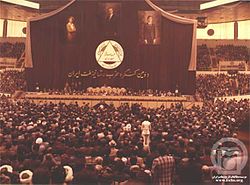 The Second Congress of the Rastakhiz Party at Mohammad Reza Pahlavi Stadium, 1976
 -
 Second Anniversary of Resurgence Party of Iran, March 1976
 -
 Dariush Homayun in a discussion meeting with members in Babol city, 1977
 -
 Asadollah Alam, Minister of the Court, during a speech at the second congress of the Rastakhiz Party in Mohammad Reza Pahlavi Stadium
 -
 Civil flag of Iran in Rastakhiz Party gathering, 1978


Electoral history
| Election | Party leader | Assembly | Senate | Ref |
|---|---|---|---|---|
| 1975 | Amir-Abbas Hoveyda | 268 / 268
|
30 / 30
|
IPU |
Voter turnout was 78.6%,[60] although according to official reports, for both houses, out of an electorate of 14 million, 70 percent (9.8 million) registered to vote and 78 percent of the electorate (about 7 million) cast its vote.[61] This was the final election held under the rule of the Shah of Iran before the Iranian Revolution of 1979.[62]
Leadership
See also
Notes
References
Notes
- ^ Logo featuring ‘Resurrection Party of People of Iran’ (centre), ‘Constitution‘ (top left), ‘Shah–People Revolution‘ (below), ‘Imperial System‘ (top right) writings in Persian.
- ^ The headquarters of the Rastakhiz Party were located in central Tehran near Imam Khomeini Square (then known as Sepah or Toopkhaneh Square). The party’s administrative building was completed in the late Pahlavi period and after the Iranian Revolution became part of the complex used by the Ministry of Interior.[2]
- ^ The word رستاخیز literally means “rising again” or “revival.” Depending on context, translators sometimes render it as: resurrection, revival, resurgence, or awakening.
- ^ Although the Secretary-General was the official leader, Mohammad Reza Pahlavi was the one who held actual power within the Rastakhiz Party, making him the party’s de facto leader.[16]
Citations
- ^ “Shah Decrees One Party State in Iran”, Milwaukee Sentinel, March 3, 1975, p1
- ^ Bani-Masoud, Amir (10 July 2025). “ساختمان وزارت کشور (حزب رستاخیز ایران)” [Ministry of Interior building (Rastakhiz Party building)]. Instagram (in Persian).
- ^ a b c d e Parviz Daneshvar (2016). Revolution in Iran. Springer. p. 73. ISBN 978-1349140626.
- ^ Pullapilly, Cyriac K. (1980). Islam in the Contemporary World. Cross Roads Books. p. 117. ISBN 9780940121003.
Modernization was pervasive in the ideology of the state in the Middle East, whether it be Arab Socialism, Pahlavism, or Ataturk’s Etatism.
- ^ Journal of International Affairs. Vol. 35. 1981. p. 195.
Certainly, the attempts by the Shah to generate intermediate institutions of legitimation in the post-1960 period were a failure; the Majlis and the parties in it were phantoms, and neither Pahlavism, as a national ideology stressing the pre-Islamic past, nor authoritarian concepts of farmandari or ‘commandism’ were widely accepted.
- ^ Randjbar-Daemi, Siavush (2016). “Looking Back at Mashrutih: Late Pahlavi Narratives on the Constitutional Revolution”. Iran’s Constitutional Revolution of 1906 and Narratives of the Enlightenment. pp. 223–238. JSTOR j.ctt1m3p32s.13.
Through a concerted and wide-ranging effort, which featured the Shah’s progressive encroachment on the political sphere, the effort to create an all-encompassing political ideology known as ‘Pahlavism’, the adoption of frequent national celebrations, including his own belated coronation and the Persepolis celebrations which culminated with the establishment of the Rastakhiz single party, the Shah re-established the monarch as the driving and pivotal force in the Iranian state system.
- ^ Shakibi, Zhand. “The Rastakhiz Party and Pahlavism: The Beginnings of State Anti-Westernism in Iran.” British Journal of Middle Eastern Studies, vol. 45, no. 2, 2018, pp. 251–68. JSTOR.
- ^ [4][5][6][7]
- ^ Javadi Araz, Majid (5 October 2025). “The Pahlavi “Resurrection” to the “Resurrection” of the Islamic Republic: Two archaic resurrections and two identical fates?!”. Araz News (in Persian). Retrieved 14 March 2026.
In the Resurrection Party, this thinking was expressed with the slogan ‘Shah, Homeland, Party’ and the suppression of national languages and identities;
- ^ BBC Persian (6 March 2025). “۵۰ سال پیش در چنین روزهایی، مردم ایران ناگهان با یکی از تصمیمات جدید محمدرضا شاه روبهرو شدند: انحلال همه احزاب سیاسی، تشکیل یک حزب واحد به نام «رستاخیز ملت ایران» و اعلام نظام سیاسی تکحزبی”. X (formerly Twitter) (in Persian). BBC News فارسی.
- ^ “The Iranian Revolution”. Stanford University. Stanford University. Retrieved 3 April 2026.
In 1975, the Shah shifted all political activity into one party, the National Resurgence Party, in an attempt to provide the country with stronger political leadership. Leading his people toward the “Great Civilization,” the Shah established himself as the Farmandar, the Great Commander. To give credibility to the new one-party system, the Shah used a nationally televised address to call for elections. While many people labeled the Shah’s policies as oppressive, others noted the stark contrast to the governments of Iraq and South Yemen. Politically active Iranians under the Shah’s regime enjoyed many freedoms that included practicing the religion of their choice, engaging in trade and industry, travelling and studying abroad, and living “according to their individual preferences”.
- ^ a b c d e Abrahamian, Ervand (1982). Iran Between Two Revolutions. Princeton University Press. pp. 442–446. ISBN 0-691-10134-5.
- ^ “The Resonance of History, Episode 28: Mohammad Reza Shah Pahlavi’s Historical Conference on the Occasion of the Inauguration of the Rastakhiz Party on March 2, 1975”. Abdi Media. Retrieved 3 April 2026.
- ^ Fadaee, Simin (18 August 2023). “70 years ago, an Anglo-US coup condemned Iran to decades of oppression – but now the people are fighting back”. The Conversation. Retrieved 3 April 2026.
- ^ a b Amini, Parvin Merat (January 2002). “A Single Party State in Iran, 1975–78: The Rastakhiz Party: The Final Attempt by the Shah to Consolidate His Political Base”. Middle Eastern Studies. 38 (1): 131–168. JSTOR 4284214.
- ^ a b c d e John H. Lorentz (2010). “Rastakhiz Party”. The A to Z of Iran. The A to Z Guide Series. Vol. 209. Scarecrow Press. pp. 266–268. ISBN 978-1461731917.
- ^ “حزب فقط «رستاخیز»!” [Only the Rastakhiz Party!]. Hambastegi Melli (in Persian). Retrieved 14 March 2026.
- ^ Pahlavi, M. R. (1961). Mission for my country. McGraw-Hill. pp. 173, 336. ISBN 978-0091203818.
- ^ “رئیس دانشکده حقوق و علوم سیاسی دانشگاه تهران: حزب رستاخیز نتیجه خودکامگی فراگیر شاه بود” [Dean of the Faculty of Law and Political Science, University of Tehran: The Rastakhiz Party was the result of the Shah’s pervasive autocracy]. Shafaqna International News Agency (in Persian). 5 March 2023.
- ^ a b Hosseini, Keyvan (15 March 2024). “پنجاهمین سالگرد تأسیس حزب رستاخیز؛ روزی که تظاهر دموکراسی در ایران شاهنشاهی پایان یافت” [50th anniversary of the establishment of the Rastakhiz Party; the day the pretense of democracy in imperial Iran ended]. BBC Persian (in Persian). BBC. Retrieved 12 March 2026.
- ^ John H. Lorentz (2010). “Rastakhiz Party”. The A to Z of Iran. The A to Z Guide Series. Vol. 209. Scarecrow Press. pp. 266–268. ISBN 978-1461731917.
- ^ Sahimi, Muhammad (20 April 2010). “April 19, 1975”. Tehran Bureau / FRONTLINE. PBS. Archived from the original on 21 April 2010. Retrieved 16 March 2026.
- ^ “برگزیدهای از سخنان شاهنشاه آریامهر” [A Selection of the Speeches of Shahanshah Aryamehr]. Negin (in Persian) (118). March 1974.
- ^ Rafi, Jalal (1 March 1974). اطلاعات ۸۰ سال [Information: 80 Years] (in Persian). Vol. 1. Information Publications. p. 296.
- ^ Ladan, Amirhossein (23 July 2019). “جعل حقایق و تحریف تاریخ؛ شاه و حزب رستاخیز، انقلاب…” [Falsifying Facts and Distorting History: The Shah and the Rastakhiz Party]. سایت ملیون ایران (in Persian).
- ^ a b “Interview with Shah Mohammad Reza Pahlavi on one party system, Iran; 1975 (Editorial footage no. 2179991040)”. Getty Images. BBC Motion Gallery Editorial/BBC Archive via Getty Images. 17 June 1975. Retrieved 3 April 2026.
- ^ “بازخواني پرونده محمود جعفريان”. Archived from the original on 17 March 2016. Retrieved 27 January 2020.
- ^ Misagh Parsa. Social Origins of the Iranian Revolution Archived 2021-07-15 at the Wayback Machine, Rutgers University Press, (1989), p. 96.
- ^ Ettelaat (October 21, 1978).
- ^ Kayhan (October 28, 1978)
- ^ Daryaee, Touraj (2012). The Oxford Handbook of Iranian History. Oxford Handbooks in History. Oxford University Press. p. 361. ISBN 978-0199732159.
- ^ Abrahamian, Ervand (2008). A History of Modern Iran. Cambridge University Press. p. 153. ISBN 978-0521528917.
- ^ Abrahamian, Ervand (1999). Tortured Confessions: Prisons and Public Recantations in Modern Iran. University of California Press. p. 113. ISBN 9780520216235.
- ^ Abrahamian, Ervand (2008). A History of Modern Iran. Cambridge University Press. p. 153.
- ^ Yousefi, Hamidreza (18 September 2024). “رستاخیز؛ «جنبشی» که محمدرضاشاه آن را به «حزب» تبدیل کرد” [Resurrection: A “movement” that Mohammad Reza Shah turned into a “party”]. Radio Zamaneh (in Persian). Retrieved 14 March 2026.
- ^ a b Gholam Reza Afkhami (2008). The Life and Times of the Shah. University of California Press. pp. 434–444. ISBN 978-0-520-25328-5.
The conception of the party, a hybrid of the Italian and Spanish schools of fascism, met with widespread opposition and was withdrawn once the queen sided with its opponents. But then fascism yielded to communism. The organization became principal democratic centralism, though the term was not mentioned.
- ^ Yom, Sean (2015). From Resilience to Revolution: How Foreign Interventions Destabilize the Middle East. Columbia University Press. pp. 142–143. ISBN 9780231540278.
- ^ Dashti, Naseer (10 February 2017). The Baloch Conflict with Iran and Pakistan: Aspects of a National Liberation Struggle. Trafford Publishing. p. 215. ISBN 978-1-4907-8092-4.
- ^ Sanasarian, Eliz (2012). Nationalism and religion in contemporary Iran (PDF). pp. 322–323.
- ^ Shams, Alex (18 May 2012). “A “Persian” Iran?: Challenging the Aryan Myth and Persian Ethnocentrism”. Ajam Media Collective. Archived from the original on 14 September 2024. Retrieved 29 November 2024.
- ^ a b “سیروس نهاوندی: روحانیت ایران هرگز جدا از سلطنت نبود”. Radio Zamaneh. 25 July 2008.
- ^ Hosseini, Keyvan (15 March 2024). “پنجاهمین سالگرد تأسیس حزب رستاخیز؛ روزی که تظاهر دموکراسی در ایران شاهنشاهی پایان یافت” [50th anniversary of the establishment of the Rastakhiz Party; the day the pretense of democracy in imperial Iran ended]. BBC Persian (in Persian). Retrieved 12 March 2026.
- ^ Nabavi, Seyyed Ibrahim (24 May 2008). “از ۲۶ اردیبهشت تا سوم خرداد ۱۳۵۷ چه گذشت” [What happened from 16 May to 3 June 1978?]. Radio Zamaneh (in Persian). Retrieved 12 March 2026.
- ^ Afkhami, Gholam Reza (2009). The Life and Times of the Shah. University of California Press. p. 436.
- ^ Sa’edi, Gholam Hoseyn (1984). “Iran under the Party of God”. Index on Censorship. 13 (1): 16–20.
The newspaper Rastakhiz, which was published by the Shah’s Rastakhiz party, managed to get along with the Islamic government and continue publication with a newspaper called Bamdad.
- ^ a b c “واقعیت حزب رستاخیز چیست؟”. پایگاه اطلاع رسانی و خبری جماران (in Persian). Tehran. 24 June 2015. Retrieved 4 April 2026.
- ^ Boroujerdi, Mehrzad (1990). “Review of Social Origins of the Iranian Revolution, by Misagh Parsa”. Iranian Studies. 23 (2–4): 183. doi:10.1017/S0021086200013529. Retrieved 3 April 2026.
- ^ Azarang, Abdul Hossein. “Rastakhiz Party”. Encyclopaedia Islamica. Archived from the original on 24 January 2010. Retrieved 16 March 2026.
- ^ Naini, Ahmad (1975). “The Fifth Development Plan”. Intereconomics. 10 (8): 253–255. doi:10.1007/BF02929277.
- ^ a b Daftary, Farhad. “Barnāma-rīzī”. Encyclopaedia Iranica. Retrieved 15 March 2026.
- ^ a b c Ashraf, Ahmad. “Bazaar iii. Socioeconomic and Political Role”. Encyclopaedia Iranica. Retrieved 15 March 2026.
- ^ a b Mazaheri, Nimah (2006). “State Repression in the Iranian Bazaar, 1975–1977: The Anti-Profiteering Campaign and an Impending Revolution”. Iranian Studies. 39 (3): 401–414. doi:10.1080/00210860600808250.
- ^ a b “اقتصاد رستاخیزی” [Resurrection Economics]. Tejarat Farda (in Persian). 2018. Retrieved 15 March 2026.
- ^ Abrahamian, Ervand (1982). Iran Between Two Revolutions. Princeton, NJ: Princeton University Press. p. 542.
- ^ Benjamin B. Smith. Hard Times in the Lands of Plenty: Oil Politics in Iran and Indonesia. (2007), p. 142.
- ^ Metrinko, Michael (1983). “Foreign Affairs Oral History Collection: Michael Metrinko Interview” (Interview). Association for Diplomatic Studies and Training. p. 2.
- ^ Imam Khomeini, who was exiled abroad at the time, said the following about the Shah’s party: “Given the opposition of this party to Islam and the interests of the Muslim nation of Iran, participation in it is forbidden to the general public and aiding in oppression… and opposing it is one of the clearest cases of forbidding evil.” (See: Iran, Organization of Cultural Records of the Islamic Revolution; and, Sahifeh Noor; Tehran, Organization of Cultural Records of the Islamic Revolution; 1991; Vol. 1; p. 358)
- ^ Ruhollah Khomeini. “تحریم شرکت در حزب رستاخیز” [Ban on participation in the Resurrection Party]. Sahifeh Imam (collection of Khomeini’s statements) (in Persian). Najaf.
- ^ Persian: سرود رسمی حزب رستاخیز ایران, romanized: Ruzegâr-e Rastâkhiz
- ^ Nohlen, Dieter; Grotz, Florian; Hartmann, Christof (2001). “Iran”. Elections in Asia: A Data Handbook. Vol. I. Oxford University Press. pp. 69, 74. ISBN 978-0-19-924958-9.
- ^ Hassan Mohammadi-Nejad (1977). “The Iranian Parliamentary Elections of 1975”. International Journal of Middle East Studies. 8 (1): 103–116. doi:10.1017/S0020743800026787. JSTOR 162456.(subscription required)
- ^ P. Bearman; Th. Bianquis; C.E. Bosworth; E. van Donzel; W.P. Heinrichs (1986). “Mad̲j̲lis”. In W. Madelung; Rahman, Munibur; Landau, J. M.; Yapp, M.E.; Robinson, F.C.R. (eds.). Encyclopaedia of Islam. Vol. 5 (Second ed.). Leiden, Netherlands: Brill. doi:10.1163/1573-3912_islam_COM_0606. ISBN 9789004161214.
Further reading
- “Iran: Political Parties”. Library of Congress Country Studies. Library of Congress. December 1987.
- Amini, Parvin Merat (2002). “A Single Party State in Iran, 1975–78: The Rastakhiz Party: The Final Attempt by the Shah to Consolidate His Political Base”. Middle Eastern Studies. 38 (1). Frank Cass: 131–168. JSTOR 4284214.
- Shakibi, Zhand (2018). “The Rastakhiz Party and Pahlavism: the beginnings of state anti-Westernism in Iran”. British Journal of Middle Eastern Studies. 45 (2): 251–268. doi:10.1080/13530194.2016.1246242. S2CID 151598124.
- Shakibi, Zhand (2020). Pahlavi Iran and the Politics of Occidentalism: The Shah and the Rastakhiz Party. London: I.B. Tauris. ISBN 978-1-7883-1736-8.
External links
 Media related to Rastakhiz Party at Wikimedia Commons
- “Iran: Religious Opposition to the Shah” (PDF). Central Intelligence Agency. CIA FOIA Reading Room. 1978. Retrieved 3 April 2026.
- Rastakhiz Party: documents and analysis – Institute for Iranian Contemporary Historical Studies (Persian)
- مرامنامه حزب رستاخیز ملی ایران (transl. The manifesto of the National Resurrection Party of Iran)
- Rastakhiz Party archival documents and photographs – Institute for Iranian Contemporary Historical Studies (Persian)
- Rastakhiz Newspaper, No. 291, 29 Farvardin 1355 (1976), archived at Ketabnak
- Andishah ha-yi Rastakhiz at the Nashriyah: Digital Iranian History archive, University of Manchester Library
- حزب رستاخیز از تاسیس تا فرجام – Persian translation of Parvin Merat Amini, The Rastakhiz Party: From Establishment to End (PDF), hosted at Ketabnak.

