The School of Paris (French: École de Paris, pronounced [ekɔl də paʁi]) refers to the French and émigré artists who worked in Paris in the first half of the 20th century.[1] Never a single art movement or institution, the term “School of Paris” refers instead to the primacy of Paris as the centre of Western art between 1900 and 1940.[2]
Artists of Jewish origin always figured prominently in the School of Paris.[3] Before 1917, Jews faced restrictions in mobility within the Pale of Settlement and strict quotas or outright bans from studying art in the Russian Empire‘s most illustrious art schools in St. Petersburg and Moscow.[4] So many got their start in Odesa, Vilnius, Kyiv, and Munich before moving to Paris for reasons that included artistic ambition, a desire to escape the pogroms of the Russian Empire, and the hope that the exoneration of Dreyfus in 1906 was “a sign that eventually the state would in fact side with justice and inclusion.”[5][6] In the 1930s and 1940s, many of these artists immigrated to the United States and Israel where they went on to heavily influence modern art.[3]
Art critic André Warnod first coined École de Paris to describe the mainly Jewish group of immigrant artists that included Jules Pascin, Yitzhak Frenkel, Chaïm Soutine, Marc Chagall and others in 1925.[7] But it was always an elastic classification, encompassing a loose community, particularly of non-French artists, centred in the cafes, salons and shared workspaces and galleries of Montparnasse.[8] Before World War I, it was also applied to artists involved in the many collaborations and overlapping new art movements, between Post-Impressionists and Pointillism and Orphism, Fauvism and Cubism in the well-established art scene in Montmartre.[9]
In its broader sense, the group included artists like Pablo Picasso, Marc Chagall, Amedeo Modigliani, and Piet Mondrian, and associated French artists, such as Pierre Bonnard, Henri Matisse, Jean Metzinger, and Albert Gleizes. In its more narrow sense, it described Chagall and Modigliani as prominent members of the early school, and Picasso and Matisse as its twin pre-war leaders (chefs d’école).[2] By the 1920s, Montparnasse had become a centre of the avant-garde, so the name was also used to refer to that group. After World War II, the name was also applied to a group of abstract artists and a group of émigré classical composers.[10][11]
La Ruche
Many École de Paris artists lived in the iconic La Ruche, a complex of studio apartments and other facilities in Montparnasse on the Left Bank, at 2 Passage Dantzig, built by a successful sculptor, Alfred Boucher, who wanted to develop a creative hub where struggling artists could live, work and interact.[12] Built from materials dismantled from the Medoc Wine Pavilion from the 1900 Paris World’s Fair, it comprised 50 modest studios with large windows that let in a lot of light, with nearby buildings providing 50 more studios for the overflow of artists.[12] Boucher called the complex La Ruche — French for “beehive” — because he wanted the artists to work like bees in a beehive; he dedicated a large room in the complex where the poorer artists could draw a model that he paid for, and included a small theatre space for plays and concerts.[12][13]
La Ruche opened in 1902, with the blessing of the French government. It was often the first destination of émigré artists who arrived in Paris eager to join the art scene and find affordable housing.[12] Living and working in close quarters, many artists forged lasting friendships, e.g., Chaïm Soutine with Modigliani, Chagall and poet Blaise Cendrars, and influenced each other’s work.[12][14] Artists who lived and worked in La Ruche include Amedeo Modigliani, Yitzhak Frenkel, Diego Rivera, Tsuguharu Foujita, Jacob, Soutine, Michel Kikoine, Moïse Kisling, Pinchus Krémègne, Ossip Zadkine, Jules Pascin, Marc Chagall, Amshey Nurenberg, Jacques Lipchitz, and more.[12][13]
After World War I


The term “School of Paris,” which André Warnod had used innocently to refer to the many foreign-born artists who had migrated to Paris, soon gained currency, often as a derogatory label by critics who saw the foreign artists — many of whom were Jewish — as a threat to the purity of French art.[7][15] Art critic Louis Vauxcelles, noted for coining the terms “Fauvism” and “Cubism” (also meant disparagingly), called immigrant artists unwashed “Slavs disguised as representatives of French art”.[16] Waldemar George, himself a French Jew, in 1931 lamented that the term “allows any artist to pretend he is French … it refers to French tradition but instead annihilates it.”[17]
School of Paris artists were progressively marginalised. Beginning in 1935, articles about Chagall no longer appeared in art publications (apart from those published for Jewish audiences) and, by June 1940, when the Vichy government took power, School of Paris artists could no longer exhibit in Paris at all.[17]
The artists working in Paris between World War I and World War II experimented with various styles including Cubism, Orphism, Surrealism and Dada. Foreign and French artists working in Paris included Jean Arp, Joan Miró, Constantin Brâncuși, Raoul Dufy, Tsuguharu Foujita, artists from Belarus like Michel Kikoine, Pinchus Kremegne, the Lithuanian Jacques Lipchitz and Arbit Blatas, who documented some of the greatest representatives of the School of Paris in his oeuvre, the Polish artists Marek Szwarc and Morice Lipsi and others such as Russian-born prince Alexis Arapoff.[18]
A significant subset, the Jewish artists, came to be known as the “Jewish School of Paris” or the “School of Montparnasse.”[19] The “core members were almost all Jews, and the resentment expressed toward them by French critics in the 1930s was unquestionably fuelled by anti-Semitism.”[1] One account points to the 1924 Salon des Indépendants, which decided to separate the works of French-born artists from those by immigrants; in response, critic Roger Allard referred to them as the School of Paris.[1][20] Jewish members of the group included Emmanuel Mané-Katz, Abraham Mintchine, Chaïm Soutine, Adolphe Féder, Marc Chagall, Yitzhak Frenkel Frenel, Moïse Kisling, Maxa Nordau and Shimshon Holzman.[21]
The artists of the Jewish School of Paris were stylistically diverse. Some, like Louis Marcoussis, worked in a Cubist style, but most tended toward expression of mood rather than an emphasis on formal structure.[19] Their paintings often feature thickly brushed or trowelled impasto. The Musée d’Art et d’Histoire du Judaïsme has works from School of Paris artists including Pascin, Kikoine, Soutine, Mintchine, Orloff and Lipschitz.[22]
Jewish School of Paris
| French art history |
|---|
| Historical periods |
| French artists |
| Thematic |
| Movements |
| See also |
France
Artists of Jewish origin had a marked influence in the École de Paris. Paris, the capital of the art world, attracted Jewish artists from Eastern Europe, some fleeing persecution, discrimination and pogroms. Many of these artists settled in Montparnasse.[23] Several Jewish painters were notable in the movement; these include Marc Chagall and Jules Pascin, the expressionists Chaïm Soutine and Isaac Frenkel Frenel as well as Amedeo Modigliani and Abraham Mintchine.[24][25][26] Many Jewish artists were known for depicting Jewish themes in their work, and some artists’ paintings were imbued with heavy emotional tones. Frenkel described the artists as “members of the minority characterised by restlessness whose expressionism is therefore extreme in its emotionalism”.[27]
The term l’École de Paris coined by the art critic André Warnod in 1925 in the magazine Comœdia, was intended by Warnod to negate xenophobic attitudes towards the foreign artists, many of whom were Eastern European Jews.[28] Louis Vauxcelles, a prolific critic of Jewish painters, wrote several monographs for the publisher Le Triangle. In a 1931 monograph, he wrote: “like a swarm of locusts, an invasion of Jewish colourists fell on Paris — on the Paris of Montparnasse. The causes of this exodus: the Russian Revolution, and all that it brought with it of misery, pogroms, exactions, persecutions; the unfortunate young artists take refuge here, attracted by the influence of contemporary French art. […] They will constitute [an element of] what the young critic will call the School of Paris. Many talents are to be considered in this crowd of what is nowadays sometimes referred to as outsider art or métèque art.[28]
Following the Nazi occupation of France, several prominent Jewish artists died during the Holocaust,[29] leading to the dwindling of the Jewish School of Paris. Others managed to leave or fled Europe, mostly to Mandate Palestine or the US.[24][23]
Israel
Jewish art in Mandate Palestine was predominantly inspired by the École de Paris between the 1920s and 1940s, with French art continuing to strongly influence Israeli art for the following decades.[30] This phenomenon began with the return of École de Paris Yitzhak Frenkel to Mandatory Palestine in 1925 and his opening of the Histadrut Art Studio.[31][32] His students were encouraged to continue their studies in Paris, and upon their return to Pre-Independence Israel amplified the influence of the Jewish artists of the School of Paris they encountered.[31][32][30]
These artists, centred in Montparnasse in Paris, and in Tel Aviv and Safed in Israel, tended to portray humanity and the emotion evoked through human facial expression.[33] Furthermore, as is characteristic of Jewish Parisian Expressionism, the art was dramatic and even tragic, perhaps in connection to the suffering of the Jewish soul.[34] During the 1930s several such painters would paint scenes in the Land of Israel in an Impressionist style and a Parisian light, greyer and dimmer compared to the powerful Mediterranean sun.[35][36]
Artists Quarter of Safed
Safed, a city in the mountains of Galilee and one of the Four Holy Cities of Judaism, was a centre of École de Paris artists during the mid- and late 20th century. Artists were attracted there by the romantic and mystical qualities of the Kabbalistic mountain city. The artists’ quarter, founded in 1949, was formed at first by Moshe Castel, Shimshon Holzman, Yitzhak Frenkel, and other artists, many of them influenced by, or part of, the School of Paris.[31][37][dubious – discuss][38] Though not united by a common artistic trope, it was a clear bastion of École de Paris in the country.[37][38]
The painters of the community who were influenced by the Ecole de Paris attempted to express or reflect the mystics of Safed (Hebrew: Tzfat). Painting with colours that reflect the dynamism and spirituality of the ancient city, painting the fiery or serene sunsets over Mount Meron.[39] Marc Chagall would walk the streets and paint portraits of religious children.[40] Several of these artists would commute between Safed and Paris.[40][37][38]
Musicians
In the same period, the School of Paris name was also extended to an informal association of classical composers, émigrés from Central and Eastern Europe to who met at the Café Du Dôme in Montparnasse. They included Alexandre Tansman, Alexander Tcherepnin, Bohuslav Martinů, and Tibor Harsányi. Unlike Les Six, another group of Montparnasse musicians at this time, the musical School of Paris was a loosely-knit group that did not adhere to any particular stylistic orientation.[11]
After World War II
In the aftermath of the war, “nationalistic and anti-Semitic attitudes were discredited, and the term took on a more general use denoting both foreign and French artists in Paris”.[15] But although the “Jewish problem” trope continued to surface in public discourse, art critics ceased making ethnic distinctions in using the term. While in the early 20th century French art critics contrasted The School of Paris and the École de France, after World War II the question was School of Paris vs School of New York.[41]
New School of Paris
Post-World War II (Après-guerre), the term “New School of Paris” or École de Paris III often referred to tachisme, and lyrical abstraction, a European parallel to US Abstract Expressionism. These artists include again foreign ones and are also related to CoBrA (Copenhagen-Bruxelles-Amsterdam).[42] Important proponents were Jean Dubuffet, Jean Fautrier, Pierre Soulages, Nicolas de Staël, Hans Hartung, Wols, Serge Poliakoff, Bram van Velde, Max Ernst, Simon Hantaï, Gérard Schneider, Maria Helena Vieira da Silva, Zao Wou-Ki, Chu Teh-Chun, Georges Mathieu, André Masson, Jean Degottex, Pierre Tal-Coat, Jean Messagier, Alfred Manessier, Jean Le Moal, Olivier Debré, Zoran Mušič, Jean-Michel Coulon, and Fahrelnissa Zeid, among others. Many of their exhibitions took place at the Galerie de France in Paris, and then at the Salon de Mai, where a group of them exhibited until the 1970s.
In 1996, UNESCO organised the 50th anniversary of the School of Paris (1954–1975), bringing together “100 painters of the New School of Paris.” Notable artists included Arthur Aesbacher, Jean René Bazaine, Leonardo Cremonini, Olivier Debré, Chu Teh-Chun, Jean Piaubert, Jean Cortot, Zao Wou-ki, François Baron-Renouard, among others. This grand exhibition featured a hundred painters from 28 different countries at the UNESCO Headquarters in Paris. The exhibition’s curators were the art critics Henry Galy-Carles and Lydia Harambourg.[43]
Art critics
Art critics and renowned writers have written prefaces, books, and articles regarding the painters of the School of Paris, notably in periodicals such as Libération, Le Figaro, Le Peintre, Combat, Les Lettres Françaises, Les Nouvelles littéraires. Among these writers and critiques were Waldemar George, Georges-Emmanuel Clancier, Jean-Paul Crespelle, Arthur Conte, Robert Beauvais, Jean Lescure, Jean Cassou, Bernard Dorival, André Warnod, Jean-Pierre Pietri, George Besson, Georges Boudaille, Jean-Albert Cartier, Jean Chabanon, Raymond Cogniat, Guy Dornand, Jean Bouret, Raymond Charmet, Florent Fels, Georges Charensol, Frank Elgar, Roger van Gindertael, Georges Limbour, and Marcel Zahar.
Selected artists
- Michel Adlen (1898–1980), born a Ukrainian Jew in the Russian Empire, moved to Paris in 1923[44]
- Constantin Brâncuși (1876–1957), Romanian-born sculptor, considered a pioneer of modernism.[2] Arrived in Paris in 1904.
- Bernard Cathelin[45]
- Marc Chagall (1887–1985), lived in Paris from 1910 to 1914[46] then again after his exile from the Soviet Union in 1923; Jewish; was arrested in Marseilles by the Vichy government but escaped to the US with help from Alfred H. Barr Jr., director of the Museum of Modern Art, and collectors Louise and Walter Arensberg, among others[47]
- Émilie Charmy (1878–1974), French painter, who was exhibited by the Parisian dealer and collector Berthe Weill
- Giorgio de Chirico (1888–1978), Italian who showed the first signs of magical realism later highlighted in Surrealist works, lived in Paris 1911–1915 and again in the 1920s[46]
- Jean-Michel Coulon, French painter, had the particularity of having kept his work almost secret over his lifetime
- Geoffroy Dauvergne, French Painter, Sculpter and Mosaic artist.[48]
- Robert Delaunay (1885–1941), French painter, co-founder of Orphism with his wife Sonia
- Sonia Delaunay (1885–1979),[49] wife of Robert, born Sarah Stern in Ukraine[16]
- Isaac Dobrinsky[19]
- Jean Dubuffet (1901–1985)[50]
- François Zdenek Eberl, a naturalised French painter, a Catholic born in Prague
- Tsuguharu Foujita, Japanese-French painter
- Boris Borvine Frenkel, Jewish painter from Poland
- Yitzhak Frenkel, father of modern Israeli art, Jewish, Israeli-French artist. Sent his students to learn in Paris. Carried the influence of the School of Paris to pre-independence Israel which up to that point was dominated by Orientalism.[51][52][53][54][55]
- Leopold Gottlieb (1879–1934), Polish paintier[19]
- Philippe Hosiasson (1898–1978), a Jewish painter born in Odessa, associated with the Ballets Russes
- Max Jacob
- Wassily Kandinsky (1866–1944),[2] Russian abstract artist, arrived in 1933
- Georges Kars, Czech painter[19]
- Moïse Kisling,[1] lived at La Ruche[47]
- Jesekiel David Kirszenbaum, Polish Jewish artist[56]
- Pinchus Kremegne[1] Jewish artist
- Michel Kikoine, Jewish artist, born in Belarus
- Jacques Lipchitz, lived at La Ruche;[47] Jewish cubist sculptor; took refuge from the Germans in the US[16]
- Morice Lipsi, Jewish sculptor of Polish origin
- Jacob Mącznik (1905–1945), born in Poland, arrived in Paris in 1928, died at the hands of the Nazis 1945.[57][58] A young and highly regarded member of the École de Paris in the 1930s, prior to its decimation by the Reich.[59]
- Louis Marcoussis, had a studio in Montparnasse[47]
- Zygmunt Menkes, a Polish-Jewish painter who later moved to the U.S.[60]
- Adolphe MIlich, born and trained in Poland and Germany, arrived in Paris 1920, had a studio in Montparnasse
- Abraham Mintchine[19] lived in Paris from 1926, then intermittently from 1930 after René Gimpel encouraged him to discover the south of France. Died in 1931
- Yervand Kochar, Armenian sculptor and artist
- Amedeo Modigliani (1884–1920), Jewish Italian artist, arrived in Paris in 1906,[46] lived at La Ruche[47]
- Piet Mondrian (1872–1944), Dutch abstract artist, moved to Paris in 1920[2]
- Elie Nadelman, lived in Paris for ten years[49]
- Amshey Nurenberg (1887–1979), born in Elisavetgrad (Ukraine) in 1887, arrived in Paris in 1910, lived at La Ruche[61]
- Chana Orloff (1888–1968), Jewish Ukrainian portrait sculptor worked in Montparnasse[47][49][62]
- Pierre Palué (1920-2005), French painter, recognised as part of the New School of Paris[63]
- Jules Pascin,[1] Bulgarian-born Jew[16]
- Zinaida Serebriakova (1884–1967), Russian painter, arrived in Paris in 1905
- Chaïm Soutine (1893–1943), Jewish artist, born in a shtetl near Minsk,[16] was unable to get a US visa when the German Army invaded, and lived in hiding under the occupation until he died in 1943 at age 50. Soutine, a friend of Modigliani, arrived in Paris in 1913[46] and lived at La Ruche[47]
- Avigdor Stematsky (1908–1989), Israeli, student of Isaac Frenkel, especially notable in his later abstract and cubist art
- Kostia Terechkovitch was born in Russia and arrived in Paris in 1920, where he was part of the Montparnasse émigré group.
- Maurice Utrillo (1883–1955)
- Aleksander Vardi, Estonian painter, arrived in Paris in 1925
- Kuno Veeber, Estonian artist, arrived in Paris in 1924[64]
- Max Weber, German artist, arrived in Paris in 1905[49]
- Ossip Zadkine,[1] born in Belarus and lived at La Ruche[47]
- Faïbich-Schraga Zarfin, born in Belarus, friend of Soutine
- Princess Fahrelnissa Zeid (1901–1991), Turkish artist
- Alexandre Zinoview born in 1889 in Russia, died in France in 1977. Arrived in Paris in 1908. Volunteered for the French Foreign Legion in World War I, became a naturalised French citizen in 1938
Associated with artists
- Albert C. Barnes, whose buying trip to Paris gave many School of Paris artists their first break[1]
- Waldemar George, unfriendly art critic[1]
- Peggy Guggenheim, art dealer, art collector
- Paul Guillaume, art dealer introduced to de Chirico by Apollinaire[65]
- Jonas Netter, an art collector[1]
- Madeline and Marcellin Castaing, collectors[1]
- André Warnod, a friendly art critic[1]
- Léopold Zborowski, art dealer, represented Modigliani and Soutine[1]
Gallery
-
 Jean Metzinger, Femme au Chapeau (‘Woman with a Hat’), c.1906, oil on canvas, 44.8 x 36.8 cm, Korban Art Foundation
 -
 Marc Chagall, Still-life (Nature morte), 1912, oil on canvas, private collection
 -
 Robert Delaunay, Simultaneous Contrasts: Sun and Moon, 1912–13, oil on canvas, The Museum of Modern Art, New York City
 -
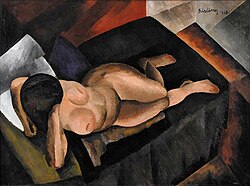 Moïse Kisling, Nu sur un divan noir, 1913, oil on canvas, 97 x 130 cm
 -
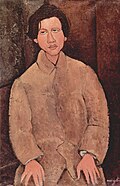 Amedeo Modigliani, Portrait of Chaïm Soutine, 1916
 -

-
 Jacques Lipchitz, Portrait of Jean Cocteau, 1920
 -
 Chaïm Soutine, Céret Landscape, c. 1920, oil on canvas, 55 x 65 cm, Musée d’Art et d’Histoire du Judaïsme
 -
 Abraham Mintchine, Portrait of the artist as a Harlequin, oil on canvas, c.1931, 72.5x50cm, Tate


See also
References
- ^ a b c d e f g h i j k l m Wendy Smith, The immigrants who were ‘School of Paris’ artists in early 20th century Archived 2017-11-14 at the Wayback Machine, Washington Post, June 19, 2015
- ^ a b c d e “Glossary of art terms: School of Paris”. Tate Gallery. Archived from the original on 26 July 2014. Retrieved 16 July 2014.
- ^ a b “Jewish Artists of the School of Paris 1905-1939”. ALBERTINE. Retrieved 31 March 2026.
- ^ “How the Russian Revolution changed the lives of Jewish artists”. GBH. 16 November 2017. Retrieved 31 March 2026.
- ^ “The YIVO Encyclopedia of Jews in Eastern Europe”. encyclopedia.yivo.org. Retrieved 31 March 2026.
- ^ Rayman, Noah. “The History of Jews in France in 6 Key Moments”. TIME. Archived from the original on 25 March 2025. Retrieved 31 March 2026.
- ^ a b André Warnod, Les Berceaux de la jeune peinture: Montmartre, Montparnasse, l’École de Paris, Edition Albin Michel, 1925
- ^ “School of Paris”. Heilbrunn Timeline of Art History. The Metropolitan Museum of Art. Retrieved 16 July 2014.
- ^ “Paris School of Art | Encyclopedia.com”. www.encyclopedia.com. Retrieved 31 March 2026.
- ^ “The Evolution of the School of Paris”. Sothebys.com. 8 May 2020. Retrieved 31 March 2026.
- ^ a b Korabelʹnikova, Li͡udmila Zinovʹevna (2008). “European Destiny: The Paris School”. Alexander Tcherepnin: The Saga of a Russian Emigré Composer. Indiana University Press. pp. 65–70. ISBN 978-0-253-34938-5.
- ^ a b c d e f Meisler, Stanley (2015). Shocking Paris: Soutine, Chagall and the Outsiders of Montparnasse. Palgrave Macmillan. ISBN 978-1-137-27880-7.
- ^ a b Muratova, X. (1979). Paris. The Burlington Magazine, 121(912), 198-198. Retrieved May 4, 2021.
- ^ Blood, A. (2011). “Chagall and his circle: Philadelphia”. The Burlington Magazine, 153(1301), 558-559. Retrieved May 4, 2021
- ^ a b Alley, Ronald. “Ecole de Paris.” Grove Art Online. Oxford Art Online. Oxford University Press. Web.
- ^ a b c d e Deborah Solomon (25 June 2015). “Montmartre/Montparnasse”. New York Times Review of Books. Retrieved 12 November 2017.
- ^ a b Romy Golan (2010). “The École Francaise vs the École de Paris: The Debate about the Status of Jewish Artists in Paris between the Wars”. In Rose-Carol Washton Long; Matthew Baigell; Milly Heyd (eds.). Jewish Dimensions in Modern Visual Culture: Anti-Semitism, Assimilation, Affirmation. Tauber Institute for the Study of European Jewry series. UPNE. p. 86. ISBN 978-1584657958 – via Google Books.
- ^ “Boston College University Libraries”. Archived from the original on 19 July 2011. Retrieved 3 April 2017.
- ^ a b c d e f Roditi, Eduard (1968). “The School of Paris”. European Judaism: A Journal for the New Europe, 3(2), 13–20.
- ^ Stanley Meisner, Albert Barnes and his pursuit of non-French art in Paris Archived 2017-11-14 at the Wayback Machine, Los Angeles Times, May 1, 2015
- ^ Schechter, Ronald; Zirkin, Shoshanna (2009). “Jews in France”. In M. Avrum Ehrlich (ed.). Encyclopedia of the Jewish Diaspora: Origins, Experiences, and Culture. Vol. 3. Santa Barbara, CA: ABC-CLIO. pp. 820–831, here: 829. ISBN 9781851098736. Retrieved 22 December 2016.
- ^ Jarrasse, Dominique, Guide du patrimoine juif parisien, éditions Parigramme, 2003, pages 213-225
- ^ a b “Paris School of Art”. www.encyclopedia.com. Retrieved 19 November 2023.
- ^ a b Nieszawer, Nadine (2020). Histoire des artistes juifs de l’École de Paris / Stories of Jewish Artists of the School of Paris (in French). France. ISBN 979-8633355567.
{{cite book}}: CS1 maint: location missing publisher (link) - ^ “Alexandre FRENEL”. Bureau d’art Ecole de Paris. 2 January 2019. Archived from the original on 7 December 2023. Retrieved 19 November 2023.
- ^ “Marc CHAGALL”. Bureau d’art Ecole de Paris. 2 January 2019. Archived from the original on 19 November 2023. Retrieved 19 November 2023.
- ^ Barzel, Amnon (1974). Frenel Isaac Alexander. Israel: Masada. p. 14.
- ^ a b Fogel, Macha; Salmona, Paul (25 November 2021). “The Jewish painters of l’École de Paris-from the Holocaust to today”. K.: Jews, Europe, the XXIst century. Archived from the original on 11 November 2023. Retrieved 19 November 2023.
“l’École de Paris is a term coined by the art critic André Warnod in 1925, in the magazine Comœdia, to define the group formed by foreign painters in Paris. The École de Paris does not designate a movement or a school in the academic sense of the term, but a historical fact. In Warnod’s mind this term was intended to counter a latent xenophobia rather than to establish a theoretical approach.
- ^ “Les peintres juifs de ” l’École de Paris ” imposent leur génie au MahJ”. Times of Israel (in French). 6 July 2021. Archived from the original on 28 October 2023. Retrieved 19 November 2023.
- ^ a b Turner, Michael; Bohm-Duchen, Monica; Manor, Dalia; Blair, Sheila S.; Bloom, Jonathan M.; Koffler, Lia (2003). “Israel”. Oxford Art Online. doi:10.1093/gao/9781884446054.article.T042514. ISBN 9781884446054.
- ^ a b c Hecht Museum (2013). After the School Of Paris (in English and Hebrew). Israel. ISBN 9789655350272.
{{cite book}}: CS1 maint: location missing publisher (link) - ^ a b “יצחק פרנקל: “חיבור ללא עצמים”“ [Frenkel: “Connection without objects”]. המחסן של גדעון עפרת (in Hebrew). 1 January 2011. Archived from the original on 2 November 2023. Retrieved 28 October 2023.
- ^ Lurie, Aya (2005). Treasured in the Heart: Haim Gliksberg’s Portraits. Tel Aviv. ISBN 978-9657161234.
{{cite book}}: CS1 maint: location missing publisher (link) - ^ Ofrat, Gideon (2012). The Birth of Secular Art from the Zionist Spirit (in Hebrew). Jerusalem: Carmel. p. 234.
- ^ Ofrat, Gideon. Eretz Israeli Painting in the 1930s: between Tel Aviv and Paris. pp. 186–187.
- ^ Manor, Dalia (3 December 2018). “Between Paris and Tel Aviv: Jewish art in 1930s Eretz Yisrael” – via academia.edu. Lecture for Miami FIU, Global Jewish Studies Program, 3 Dec. 2018.
- ^ a b c Ballas, Gila. The Artists of the 1920s and Cubism. Israel.
- ^ a b c Ofrat, Gideon (1987). The Golden Age of Painting in Safed (in Hebrew). Tel Aviv: Sifriat HaPoalim.
- ^ Ofrat, Gideon. The Art and Artists of Safed (in Hebrew). pp. 89–90.
- ^ a b “Frenkel Frenel Museum”. www.frenkel-frenel.org. Archived from the original on 26 November 2020. Retrieved 9 August 2019.
- ^ Malcolm Gee, Between Paris and New York: Critical constructions of ‘Englishness’, c. 1945 – 1960, Art Criticism Since 1900, Manchester University Press, 1993, p. 180. ISBN 0719037840
- ^ Aubert, Nathalie (March 2006). “‘Cobra after Cobra’ and the Alba Congress: From Revolutionary Avant-Garde To Situationist Experiment”. Third Text. 20 (2): 259–267. Retrieved 14 September 2015.
- ^ “Museum International: Artist’s Museums”. No 191. XLVIII (3): 65. 1996 – via unesdoc.unesco.org/ark.
- ^ Lilac Gallery, New York. “Michel Adlen.” lilacgallerynyc.com.
- ^ “Bernard Cathelin Biography”. Archived from the original on 18 November 2012.
- ^ a b c d James Voorhies (October 2004). “School of Paris”. Metropolitan Museum of Art. Archived from the original on 16 December 2023. Retrieved 13 November 2017.
- ^ a b c d e f g h “The School of Paris”. Philadelphia Museum of Art. 2017.
- ^ “Au collège de Tinténiac, la fresque de Geoffroy Dauvergne va être restaurée”. Ouest-France (in French). Retrieved 15 March 2026.
- ^ a b c d John Russell, Art Review: Jewish Artists Who Made Paris Their Exuberant Garret, New York Times, March 10, 2000
- ^ “The School of Paris: Paintings from the Florence May Schoenborn and Samuel A. Marx Collection”. Museum of Modern Art. 1965. Retrieved 12 November 2017.
- ^ “Schule von Paris – Wikipedia – Enzyklopädie”. wiki.edu.vn (in German). Archived from the original on 26 December 2022. Retrieved 9 March 2023.
- ^ “1883 | Encyclopedia of the Founders and Builders of Israel”. www.tidhar.tourolib.org. Archived from the original on 29 October 2023. Retrieved 6 April 2023.
- ^ “Abstract Alexander Frenel Frenkel was the first abstract painter in Israel. He learned his art from Paris in the twenties. When he exhibited at the “salon des independants” in 1924 in Paris, Mondrian acquired two of his paintings for an English collectionor”. www.frenkel-frenel.org. Archived from the original on 11 March 2023. Retrieved 11 March 2023.
- ^ “Famous Israel artist in Cape Town”. The South African Jewish Chronicle. January 1954.
- ^ Keehanski, Mendel (March 1951). “Pioneer of Art in Israel”. The Pioneer Woman. USA.
Frenkel may be considered the grand old man of modern painting in Israel in spite of the fact he is only about fifty.
- ^ “Jesekiel David Kirszenbaum (1900–1954). Student of the Bauhaus”. www.porta-polonica.de. Retrieved 9 April 2025.
- ^ “Macznik”.
- ^ Peintres Juifs A Paris: École de Paris, Nadine Nieszawer et al., Éditions Denoël, Paris, 2000
- ^ Undzere Farpainikte Kinstler, Hersh Fenster, Imprimerie Abècé. 1951
- ^ Kossowska, Irena (December 2001). “Zygmunt (Sigmund) Menkes”. Culture.pl. Archived from the original on 9 January 2022. Retrieved 5 December 2023.
- ^ Nurenberg, Amsheĭ (2010). Odessa — Parizh — Moskva. Vospominaniya khudozhnika [Odessa — Paris — Moscow. Memoirs of an artist] (in Russian). Moskva Jerusalim: Mosty kulʹtury Gesharim. ISBN 9785932732892. OCLC 635864735.
- ^ PJ Birnbaum (2016). “Chana Orloff: A modern Jewish woman sculptor of the School of Paris”. Journal of Modern Jewish Studies. 15 (1, 2016): 65. doi:10.1080/14725886.2015.1120430. S2CID 151740210.
- ^ “Pierre PALUE”. Art en Seine (in French). Retrieved 22 June 2024.
- ^ Õhtuleht Näitused 9 May 1998. Retrieved 27 August 2018.
- ^ Robert Jenson, Why the School of Paris Is Not French, Purdue University, Artl@s Bulletin, 2013
Further reading
- Stanley Meisler (2015). Shocking Paris: Soutine, Chagall and the Outsiders of Montparnasse. Palgrave Macmillan.
- West, Shearer (1996). The Bullfinch Guide to Art. UK: Bloomsbury Publishing. ISBN 978-0-8212-2137-2.
- Nieszawer, Nadine (2000). Peintres Juifs à Paris 1905-1939 (in French). Paris: Denoel. ISBN 978-2-207-25142-3.
- Painters in Paris: 1895–1950, Metropolitan Museum of Art, New York, 2000
- Paris in New York: French Jewish Artists in Private Collections, Jewish Museum, New York, 2000
- Windows on the City: The School of Paris, 1900–1945, Guggenheim Museum, Bilbao, 2016
- The Circle of Montparnasse, Jewish Artists in Paris 1905–1945, From Eastern Europe to Paris and Beyond, exhibition catalogue Jewish Museum New York, 1985
- Enriched by Otherness: Impact of the Ecole de Paris, written in French by Juliette Gaufreteau, Sorbonne University, translation by Lily Pouydebasque, University College of London. Article available on L’AiR Arts Association website.
External links
- (in French and English) Nadine Nieszawer’s website, dedicated to the School of Paris 1905-1939 (includes many biographies)
- The Second Spanish School of Paris
- Website for Jewish art of the School of Paris circle
- school-of-paris.org: community website open to any fan to École de Paris in the world
- The School of Paris 1945 – 1965
- Guggenheim holdings by School of Paris artists

| Authority control databases: National |
|---|
