Skyroot Aerospace Private Limited is a private Indian aerospace manufacturer and commercial launch service provider headquartered in Hyderabad, Telangana. The company was founded by two former ISRO scientists, Pawan Kumar Chandana, and Naga Bharath Daka.
Skyroot was started in 2018 with a team of ten individuals. Incubated in T–Hub and supported by T–Works, Skyroot became the first private space-tech company in India to launch a suborbital rocket.[3][4]
History
Founding

Skyroot Aerospace was founded in 2018 by former ISRO scientists Pawan Kumar Chandana and Naga Bharath Daka. The company sought to develop commercially competitive launch vehicles for the global small-satellite market.[5][6]
The company emerged during a period of increasing government support for private participation in India’s space industry. Reforms introduced in 2020 enabled private firms to access certain ISRO facilities and created a regulatory framework under the oversight of Indian National Space Promotion and Authorisation Centre (IN-SPACe).[7][8][9]
Early development
During its initial years, Skyroot focused on developing launch vehicle technologies, and manufacturing processes aimed at reducing launch costs and production times. The company adopted technologies including carbon-composite structures, 3D printing, and modular launch vehicle designs.[10][11]
Mission Prarambh

On 18 November 2022, Skyroot launched Vikram-S, a suborbital rocket, from the Satish Dhawan Space Centre in Sriharikota under a mission designated Prarambh (lit. ‘the beginning‘). The mission reached an altitude of approximately 89.5 km (55.6 mi) and marked the first successful launch of a privately developed rocket from India. The event was widely regarded as a milestone in the development of India’s private space industry.[13]
Expansion and funding
Following the Vikram-S mission, Skyroot raised capital from domestic and international investors. On 30 October 2023, the company announced that it has raised US$27.5 million in a pre-Series C funding round led by Temasek Holdings that brought its cumulative funding to approximately US$95 million.[14]
On 21 January 2025, the Government of Telangana signed a MoU with Skyroot Aerospace at the World Economic Forum to establish a private rocket manufacturing, integration, and testing facility in Telangana with an estimated investment of ₹500 crores.[15][16]
On 7 May 2026, with its latest funding round of approximately US$60 million, Skyroot Aerospace crossed US$1.1 billion in valuation.[17][18]
Hardware
Launch vehicles

| Launch Vehicle | Payload capacity | First flight | Last flight | Total launches | |
|---|---|---|---|---|---|
| SSPO (500 km) |
Low Earth orbit (500 km; 45°) | ||||
| Vikram-S (suborbital) | – | – | 18 November 2022 | 18 November 2022 | 1 |
| Vikram-I | 260 kg (570 lb) | 350 kg (770 lb) | 2026 (planned) | 0 | |
| Vikram-II | 600 kg (1,300 lb) | 900 kg (2,000 lb) | 2027 (planned) | 0 | |
Vikram-I
Vikram-I is a four-stage small-lift launch vehicle. The company is planning its first launch by 2026.[19][20]
Vikram-II
Vikram-II is an under-development small-lift launch vehicle. The rocket will use an upper stage cryogenic engine powered by the Dhawan-series rocket engine.[21]
Rocket engines
Solid rocket motors
Kalam-5
On 22 December 2020, Skyroot tested the solid-fuel rocket engine Kalam-5 (named after A. P. J. Abdul Kalam), the first of five planned carbon-composite Kalam rocket motors which are expected to power its launch vehicles. The test happened in Nagpur at a private test facility owned by Solar Industries. In the name Kalam-5, the 5 refers to the peak sea level thrust of 5.3 kN.[22]
Kalam-100
The Kalam-100 is the third-stage solid rocket motor of Vikram-I. The stage produces a peak vacuum thrust of approximately 100 kN (or ~10 tons). In April 2025, Skyroot conducted successful static firing of Kalam-100 featuring an advanced flex-nozzle system for thrust vector control. The test lasted over 102 seconds and formed part of the qualification programme for the maiden orbital flight of Vikram-I.[23]
Kalam-250
The Kalam-250 is the second-stage solid rocket motor of Vikram-I. for the second stage of the Vikram-I launch vehicle. It was successfully static-tested on 27 March 2024 at ISRO’s Satish Dhawan Space Centre, validating its 85-second burn and critical propulsion systems.[24]
Kalam-1200
The Kalam-1200 is the first-stage solid rocket motor of Vikram-I. On 8 August 2025, Skyroot Aerospace successfully conducted the first static test of the Kalam-1200 solid rocket motor at Satish Dhawan Space Centre, Sriharikota. The 110 second test validated the booster of the Vikram-I.[25]
Earth-storable rocket engine
Raman-I
Raman-I (named after C. V. Raman) is a liquid-fuel upper stage engine of Vikram-I.[26]
Cryogenic rocket engines
Dhawan-I
On 25 September 2020, Skyroot Aerospace unveiled the Dhawan-I (named after Satish Dhawan) upper stage cryogenic engine that will power heavier-lift systems such as Vikram-II. This is the first cryogenic engine in India that will use liquefied natural gas (LNG) as fuel. Dhawan-I is 3D printed and designed with a regenerative cooling configuration.[27]
On 25 November 2021, Skyroot successfully test fired India’s first privately developed small cryogenic engine called Dhawan-I running on LNG and liquid oxygen (LOX). It was a technology demonstration experiment for the upper stage of Vikram-II rocket that is under active development. Solar Industries provided the test site. The engine made by 3D printing process and using superalloys.[28][29]
Dhawan-II
On 5 April 2023, Skyroot announced the successful completion of a 200-second endurance static-fire test of its Dhawan-II engine, showcasing the viability of large-scale additive manufacturing for cryogenic propulsion.[30]
Dhawan-III
The Dhawan-III engine represents an evolution of the earlier Dhawan-I and Dhawan-II engines, incorporating improvements aimed at future reusable launch vehicles and advanced upper-stage propulsion systems. In February 2026, Skyroot announced that Dhawan-III had successfully completed a 145-second endurance static-fire test. The firing was conducted on an indigenous mobile test stand designed and built in-house by the company. The test was intended to validate the engine’s performance, combustion stability, and operational reliability over an extended duration.[31]
Facilities
MAX-Q
On 24 October 2023, the largest private integrated rocket development facility in India was unveiled by Skyroot Aerospace.[32][33] It is situated next to the Rajiv Gandhi International Airport and spans 60,000 square feet. With space for about 300 personnel, this facility will host Skyroot’s integrated design, manufacturing, and testing infrastructure for developing rockets.[34][35]
Infinity Campus
On 27 November 2025, Prime Minister Narendra Modi inaugurated the Infinity Campus of Skyroot Aerospace. Spread across 200,000 square feet in Hyderabad, this facility will be able to design, manufacture, integrate, and test a number of launch vehicles and produce one orbital rocket each month.[36]
Industry collaboration
An agreement has been signed by Nibe Space, a division of Nibe Defence and Aerospace on 9 September 2024, with Skyroot Aerospace, AgniKul Cosmos, Centum Electronics, SpaceFields, Sisir Radar, CYRAN AI Solutions, and Larsen & Toubro for the launch of India’s first constellation of multi-sensor, all-weather, high-revisit Earth observation satellites.[37]
On 25 June 2025, Skyroot Aerospace and Axiom Space signed an MoU to work together to increase access to LEO.[38] Skyroot Aerospace and Axiom Space will look into orbital and launch systems that are integrated for next trips to Axiom Station and beyond.[39] The two businesses intend to look into potential joint ventures for the construction of space infrastructure.[40] By connecting Axiom’s under-construction commercial space station and other LEO projects with Skyroot’s upcoming Vikram-I launch capability, the partnership hopes to create a new logistics corridor for research payloads, orbital data-center nodes, and upcoming commercial missions.[41]
Gallery
-
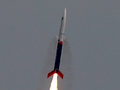 Vikram-S, the first privately launched rocket of India.

See also


References
- ^ “Skyroot Aerospace posts Rs 55 Cr loss in FY23”. Entrackr.
- ^ “About Skyroot”. www.skyroot.in. Retrieved 19 November 2025.
- ^ Kandavel, Sangeetha (18 November 2022). “Vikram-S, India’s first private rocket, lifts off from ISRO spaceport”. The Hindu. ISSN 0971-751X. Retrieved 31 May 2026.
- ^ “India’s Private Space Race Lifts Off with Singapore”. The Straits Times. 29 September 2025. ISSN 0585-3923. Retrieved 15 November 2025.
- ^ Swati, Gupta; Madhok, Diksha (18 November 2022). “India’s first private rocket Vikram-S is launched into space | CNN Business”. CNN. Retrieved 4 September 2025.
- ^ Kumar, CR; Krishnan, Raghu (17 April 2019). “With a simpler rocket, Skyroot is eyeing the space”. The Economic Times. Retrieved 21 August 2020.
- ^ “IN-SPACe: Unlocking India’s potential in the Space Sector”. www.psa.gov.in. Retrieved 31 May 2026.
- ^ “Skyroot Aerospace signs MoU with ISRO, this move may revolutionize the industry : CEO”. Indian Aerospace and Defence Bulletin. 17 September 2021. Retrieved 30 May 2026.
- ^ www.ETTelecom.com. “Space sector to become key component of India’s overall economy: Jitendra Singh”. ETTelecom.com. Retrieved 2 June 2026.
- ^ “With Skyroot at the head of the class, India’s private space industry seeks to take off”. Ars Technica. 11 May 2026. Retrieved 20 May 2026.
- ^ “Skyroot Aerospace successfully test-fires 3D-printed cryogenic engine for a record 200 seconds”. The Hindu. 4 April 2023. Retrieved 6 June 2026.
- ^ “Skyroot | Opening Space For All”. skyroot.in. Retrieved 19 November 2022.
- ^ “India successfully launches Vikram-S, first privately made rocket”. Al Jazeera. Retrieved 2 June 2026.
- ^ “Skyroot raises $27.5 mln, heating up India’s private sector space race”. Reuters. 30 October 2023. Retrieved 2 November 2023.
- ^ “Telangana signs MoU with Skyroot for integrated, private rocket manufacturing, integration and testing facility”. ANI News. Retrieved 31 May 2026.
- ^ “Skyroot to Invest Rs 500 Cr in Telangana”. Deccan Chronicle. 21 January 2025. Retrieved 31 May 2026.
- ^ “Skyroot Aerospace raises $60 million, becomes India’s first space-tech unicorn”. Fortune India. 7 May 2026. Retrieved 31 May 2026.
- ^ “Indian space-tech company Skyroot Aerospace becomes unicorn”. The Hindu. 7 May 2026. Retrieved 8 June 2026.
- ^ “With Skyroot at the head of the class, India’s private space industry seeks to take off”. Ars Technica. 11 May 2026. Retrieved 20 May 2026.
- ^ “Indian Private rocket Vikram-I to liftoff from ISRO’s first launchpad in 2026”. Wion. Retrieved 8 June 2026.
- ^ “Skyroot Aerospace successfully test-fires 3D-printed cryogenic engine for a record 200 seconds”. The Hindu. 4 April 2023. Retrieved 10 June 2026.
- ^ “Spacetech startup Skyroot Aerospace successfully test-fired solid-fueled rocket engine”. Inceptive Mind. 29 December 2020. Retrieved 10 June 2026.
- ^ “Skyroot Aerospace’s Kalam-100 engine roars to life in successful static fire test | WATCH”. Mathrubhumi English. 7 April 2025. Retrieved 31 May 2026.
- ^ “Skyroot successfully test fires Stage-2 of Vikram 1 space launch vehicle”. The Hindu. 28 March 2024. Retrieved 13 June 2026.
- ^ “Skyroot successfully tests India’s largest privately built rocket stage before Vikram-1’s first flight”. Mathrubhumi English. 8 August 2025. Retrieved 12 June 2026.
- ^ “Raman-1 Engine: Skyroot successfully tests the engine designed to help Vikram-I rocket”. www.business-standard.com. Archived from the original on 22 July 2023. Retrieved 13 June 2026.
- ^ “Hyderabad: India’s first private cryogenic rocket engine unveiled”. The Times of India. ISSN 0971-8257. Retrieved 31 May 2026.
- ^ “Cryogenic: India’s first private cryogenic engine test fired by Skyroot”. The Times of India. 25 November 2021. Retrieved 25 November 2021.
{{cite web}}: CS1 maint: url-status (link) - ^ “Skyroot Aerospace successfully tests cryogenic engine”. www.thehindubusinessline.com. 25 November 2021. Retrieved 17 June 2026.
- ^ “Skyroot wraps up endurance test of Dhawan-II cryo engine”. The Times of India. ISSN 0971-8257. Retrieved 1 June 2026.
- ^ “Watch: Skyroot fires new rocket engine, makes diamonds in the air”. India Today. 1 March 2026. Retrieved 1 June 2026.
- ^ “India’s 1st pvt sector rocket facility in unveiled Hyderabad”. The Times of India. 25 October 2023. ISSN 0971-8257. Retrieved 29 November 2025.
- ^ Madanapalle, Aditya (1 November 2023). “Skyroot Aerospace provides glimpse of Kalam-1200 motor ahead of Vikram I launch”. News9live. Retrieved 29 November 2025.
- ^ “Isro chief visits Skyroot’s Max-Q facility, briefed on Vikram-I developments”. India Today. 3 April 2024. Retrieved 29 November 2025.
- ^ Kurmanath, K. V. (18 August 2025). “Inside Skyroot’s Max-Q Campus: Crafting India’s next rocket”. BusinessLine. Retrieved 29 November 2025.
- ^ “PM Modi inaugurates Skyroot campus, unveils Vikram-I rocket”. thefederal.com. 27 November 2025. Retrieved 31 May 2026.
- ^ “Nibe Limited announces setting up India’s first earth observation satellite constellation”. ANI News. Retrieved 31 May 2026.
- ^ Kumar, Chethan (26 June 2025). “Axiom partners with India’s skyroot to boost access to low-earth orbit”. The Times of India. ISSN 0971-8257. Retrieved 27 June 2025.
- ^ Gupta, Sanjana (26 June 2025). “Axiom Space Partners with India’s Skyroot Aerospace to Boost Space Exploration”. Analytics India Magazine. Retrieved 27 June 2025.
- ^ “Axiom Space ties up with Hyderabad-based Skyroot”. BusinessLine. 25 June 2025. Retrieved 27 June 2025.
- ^ Ketkar, Swati (26 June 2025). “Skyroot Aerospace, Axiom Space join hands for low-earth-orbit access”. english.mathrubhumi.com. Retrieved 27 June 2025.
External links
| Organisations |
|  | |||||
|---|---|---|---|---|---|---|---|
| Programmes | |||||||
| Satellites | |||||||
| Space observatories |
| ||||||
| Lunar and planetary spacecraft |
| ||||||
| Human spaceflight | |||||||
| Launch vehicles |
| ||||||
| Engines |
| ||||||
| Spaceports | |||||||
| Research facilities | |||||||
| Communications | |||||||
| Legislation and policy | |||||||
| Private companies | |||||||
| Related |
| ||||||
| Satellites |
|  | ||||||||||
|---|---|---|---|---|---|---|---|---|---|---|---|---|
| Space probes |
| |||||||||||
| Human spaceflight | ||||||||||||
| ||||||||||||