
A cezve (Turkish: cezve, pronounced [dʒezˈve] ⓘ; Serbo-Croatian: džezva / џезва; Arabic: جِذوَة), also ibriki/briki (Greek: μπρίκι), srjep (Armenian: սրճեփ), rakwa (Arabic: ركوة), ghallaya (Arabic: غلاية), or kanaka (Arabic: كَنَكَة), is a small long-handled pot with a pouring lip designed specifically to make Turkish coffee.[1] It is traditionally made of brass or copper, occasionally also silver or gold. In more recent times cezveler are also made from stainless steel, aluminium, or ceramics.
Name
The name cezve is of Turkish origin, where it is a borrowing from Arabic: جِذوَة (jadhwa or jidhwa, meaning ’ember’).
The cezve is also known as an ibrik, a Turkish word from Arabic إبريق (ʿibrīq). This term was loaned from medieval Eastern Aramaic forms in ʾaḇrēqā, and originated in New Persian *ābrēž (cf. Farsi ābrēz), from Middle Persian *āb-rēǰ, ultimately from Old Persian *āp- ‘water’ + *raiča- ‘pour’ (New Persian ریختن [rêxtan]).[2][3]
Other variants are ghallaya, briki, rakwa, túrka (Турка) in Russian and kanaka.
Variations
In Bulgaria, Albania, Bosnia and Herzegovina, Croatia, Czechia, Montenegro, North Macedonia, Serbia, Slovakia and Slovenia, the cezve is a long-necked coffee pot. In Turkish an ibrik is not a coffee pot, but simply a pitcher or ewer.
Gallery
-
 Copper cezve with Turkish coffee pouring out
 -
 Utensils to prepare Turkish coffee (handmade from Crete). A cezve is at the bottom.
 -
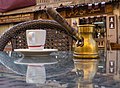
 Turkish coffee set containing a cup of coffee, a cezve and a sugar bowl
 -
 A brass cezve


See also

- Dallah (Arabic coffee pot)
- Jebena (Ethiopian coffee pot)
- Arabic coffee
- Turkish coffee
- List of cooking vessels
References
- ^ https://web.archive.org/web/20090416133124/http://imeu.net/news/article001840.shtml
- ^ Steingass, Francis Joseph (1992). A Comprehensive Persian-English Dictionary: Including the Arabic Words and Phrases to be Met with in Persian Literature, Being, Johnson and Richardson’s Persian, Arabic, and English Dictionary, Revised, Enlarged, and Entirely Reconstructed. Asian Educational Services. ISBN 978-81-206-0670-8. page 8.
- ^ Arabic in Context: Celebrating 400 years of Arabic at Leiden University. BRILL. 6 June 2017. ISBN 9789004343047.
Sources
- alt.coffee thread archive regarding cezve word origin Archived 2011-05-14 at the Wayback Machine
- Comech’s cezve page at tamu.edu Archived 2011-05-14 at the Wayback Machine


| Beverages |
|
|---|---|
| Breads | |
| Appetizers and salads |
|
| Cheeses | |
| Soups | |
| Dishes |
|
| Grilled meats | |
| Desserts |
|
| Frequent ingredients | |
| Unique instruments | |
| Related cuisines | |
