Veliky Novgorod (/vəˈliːki ˈnɒvɡərɒd/ ⓘ və-LEE-kee NOV-gə-rod; Russian: Великий Новгород, IPA: [vʲɪˈlʲikʲɪj ˈnovɡərət]; lit. ‘Great Newtown‘),[a] also known simply as Novgorod (Новгород), is the largest city and the administrative centre of Novgorod Oblast, Russia. The city lies along the Volkhov River, just 6 kilometres (3.7 mi) downstream of its outflow from Lake Ilmen, and is situated on the M10 federal highway, which connects Moscow and Saint Petersburg.[11] The city has a population of 224,286 (2021 census).[12]
Novgorod is one of the oldest cities in Russia;[13] it was first mentioned in the 9th century.[14] From 1136 to 1478, it was the center of a separate administrative and political entity known as the Novgorod Republic, which controlled much of the Russian North.[15]: 18 [16] Novgorod served as the intermediary between other Russian cities and northwestern Europe, allowing it to flourish through trade with the Hanseatic League, whose major trading post, or kontor, in the city was the Peterhof.[15]: 17–18 At its peak in the 14th century, it was one of Europe’s largest cities.[15]: 23–24
The city was historically known as Veliky Novgorod to distinguish it from other Russian cities known as Novgorod.[14][17]: 26 In 1999, it was renamed Veliky Novgorod.[18] UNESCO recognized Novgorod as a World Heritage Site in 1992.[19]
Climate
Veliky Novgorod has a warm-summer humid continental climate (Köppen Dfb). The city has warm summers with temperatures reaching over 30 °C (86 °F) and relatively cold winters with frequent snowfall. The lowest air temperature ever recorded is -45 °C (-49 °F). The warmest month is July with a daily mean of 18.7 °C (65 °F), the coldest month is February with a daily mean of -6 °C (21 °F).[20] The highest amount of precipitation is on average in June with 73 mm (2.9 inches) of precipitation, the driest is March with 30 mm (1.2 inches) of precipitation. The annual amount of precipitation is 603 mm (23.7 inches).[20]
History
| Year | Pop. | ±% |
|---|---|---|
| 1897 | 25,736 | — |
| 1926 | 32,764 | +27.3% |
| 1939 | 39,758 | +21.3% |
| 1959 | 60,669 | +52.6% |
| 1970 | 127,944 | +110.9% |
| 1979 | 186,003 | +45.4% |
| 1989 | 229,126 | +23.2% |
| 2002 | 223,263 | −2.6% |
| 2010 | 218,717 | −2.0% |
| 2021 | 224,286 | +2.5% |
| Source: Census data | ||
Early developments

The Nikon Chronicle, a late source, makes initial mention of the city under the year 859, in reference to the death of Novgorod’s elder Gostomysl, while the copy of the Primary Chronicle found in the Laurentian Codex first mentions Novgorod under the year 862.[21][3] The Charter of Veliky Novgorod recognizes 859 as the year when the city was first mentioned and therefore the year it was founded.[22] This date was proposed by the historian Mikhail Tikhomirov in 1959, when the city celebrated its 1,100th anniversary.[23]
The precursor to the modern site of Veliky Novgorod is Rurikovo Gorodische, located about a mile away, and it was founded sometime in the 9th century.[24]: 190 By 930, the elite residences outside of the fort had merged into a new site on the present-day site of Veliky Novgorod.[25] The reliably dated archaeological layers of Veliky Novgorod date back no earlier than the 930s, and so the modern site of the city is estimated to have appeared around the turn of the 9th and 10th centuries,[26][27] or at the beginning of the 10th century.[28]
The name of the city, which literally means “new town”, suggests that it was preceded by an “old town”.[29]: 84 Although often identified with Gorodische, according to the alternative view, Gorodische served as a princely pogost that controlled the area that became Novgorod.[30] The historian Valentin Yanin believed that Gorodische was not separate from Novgorod and instead formed part of a larger developing urban agglomeration.[30] Novgorod therefore emerged as the merger of the several kontsy (‘ends’).[30]
The Old Norse name Hólmgarðr is usually identified with the city.[31] A wide range of explanations for the origin of the name have been proposed, including it referring to Ilmensky gorod (a town on Lake Ilmen), a town on an island (from hólmr, ‘island’), settlements in the insularum regio (during the flood on the Volkhov), and Holm-gorod (a fortified settlement called Holm).[31]: 71–73 Another possibility is that it referred to Gorodische.[31]: 74
According to the Primary Chronicle, the Varangian chieftain Rurik was invited by the local tribes to rule over them in 862.[29]: 90 [24]: 190 The copy of the Primary Chronicle found in the Hypatian Codex says that Rurik first arrived at Ladoga before establishing himself at Novgorod.[32] The prince of Novgorod continued to reside in Gorodische until the late 15th century.[24]: 190 These Varangians, known as the Rus’, gave their name to the land and subsequently to Russia.[33]: 1, 60 As a result, Novgorod is traditionally viewed as the birthplace of the Russian monarchy in Russian historiography and a cradle of Russian statehood.[34][35][36]
Kievan period

According to the Primary Chronicle, Rurik’s successor Oleg conquered Kiev in 882 and laid the foundations for the state of Kievan Rus’. Nevertheless, most Greek and Latin sources continued to mention Novgorod as the political center for the next century, until it was eclipsed by Kiev.[37] Following military campaigns in 947, the territories between the valleys of the Luga River in the west and the Msta River in the east were incorporated into the Novgorodian land.[11] Around this time, as a result of increased urban revenues, a street-based layout of estates emerged and mandatory street paving was introduced.[11] In addition, the Novgorod Detinets was built and served as the city’s main fortification.[11][38] The name Novgorod was initially given to the detinets (or kremlin).[11][38]
Novgorod’s size, as well as its political, economic, and cultural influence, made it the second-most important city in Kievan Rus’.[11] According to custom, the eldest son and heir of the ruling Kievan prince was sent to rule in Novgorod, even as a minor.[11] When the ruling monarch had no such son, Novgorod was governed by posadniki (mayors), such as Dobrynya, Konstantin, and Ostromir.[39]: 395–396
By the end of the 10th century, the Novgorodians had been baptized during the reign of Vladimir the Great.[11] Yaroslav the Wise served as the prince of Novgorod from 1010 to 1019, while his father, Vladimir, ruled in Kiev. Yaroslav gave significant privileges to Novgorodian boyars (nobles) after they supported him in seizing the Kievan throne in 1019.[11] Yaroslav promulgated the first written code of laws, later incorporated into the Russkaya Pravda; historians generally believe that Yaroslav wrote a law and that this was connected to Novgorod’s support in his war against his half-brother, Sviatopolk.[40]: 110 The beginning of widespread literacy in Novgorod is also dated to Yaroslav’s reign, as he ordered 300 Novgorodian children from boyar and priestly families to be taught.[11] As a result, from the 11th century, Novgorod was one of the largest centres of chronicle writing.[11] Yaroslav’s son, Vladimir, sponsored the construction of the great Saint Sophia Cathedral, which stands to this day.[41]
In Norse sagas, the city is mentioned as the capital of Gardariki.[42][43][44] Many Viking leaders came to Novgorod seeking refuge or employment, including the Norwegian kings Olaf Tryggvason, Olaf Haraldsson, Magnus Olafsson, and Harald Hardrada.[45] Following the death and canonization of Olaf Haraldsson, the Novgorodians built Saint Olaf’s Church in his memory.[46]: 147 : 158
Republican period


From 1136 to 1478, Novgorod was the center of a separate political and administrative entity known as the Novgorod Republic.[47][16] The Novgorodians dismissed their prince, Vsevolod Mstislavich, in 1136, and this year is traditionally taken as the beginning of the republican period, although the development of republican institutions in Novgorod was a much more complicated process that began earlier and ended much later.[48]: 279 Novgorod was effectively a city-state that was dominated by a small group of wealthy merchant and noble families; although such city-states were common in Western Europe, this was unique in Russia, where princes typically held supreme authority.[49][40]: 39–41 Novgorod was the largest Russian state until it was surpassed by Moscow in the 15th century.[50]: 263 It controlled much of the Russian North; its hinterland stretched from the Gulf of Finland in the west to the Ural Mountains in the east.[38]
The city was able to appoint and dismiss a number of princes over the next two centuries, but the princely office was never abolished and powerful princes, such as Alexander Nevsky, could assert their will in the city regardless of the wishes of the Novgorodians.[51][49] One of the most important local figures in Novgorod was the posadnik, or mayor, an official elected by the veche (popular assembly) from among the city’s boyars, or aristocracy.[50]: 159 The tysyatsky, or “thousandman”, originally the head of the town militia but later a commercial and judicial official, was also elected by the veche.[50]: 159 Another important local official was the archbishop, who shared power with the boyars.[52][50]: 159 The archbishop was elected by the veche or by the drawing of lots, and, after his election, was sent to the metropolitan of the Russian Orthodox Church for consecration.[53][54][50]: 159
While a basic outline of the various officials and the veche can be drawn up, the city-state’s exact political constitution remains unknown. In theory, supreme power belonged to the veche.[50]: 265 The boyars and the archbishop ruled the city together, although where one official’s power ended and another’s began is uncertain. The prince, although his power was greatly dimished from the 13th century, was represented by his namestnik, or lieutenant, and still played important roles as a military commander, legislator and jurist.[55]: 48–50 The exact composition of the veche, too, is uncertain, with some historians, such as Vasily Klyuchevsky, claiming it was democratic in nature, while later scholars, such as Valentin Yanin and Aleksandr Khoroshev, see it as a “sham democracy” controlled by the ruling elite.[39]: 114 It has also been characterized as an oligarchy.[49]
The merchants of the Hanseatic League were particularly attracted to the Russian trade because of its vast resources of furs and beeswax, with Novgorod being the leading supplier of furs.[56] In the 13th century, the easternmost kontor of the Hanseatic League was located in Novgorod, through which enormous quantities of luxury (sable, ermine, fox, marmot) and non-luxury furs (squirrel pelts) were traded.[57] Traders from Gotland arrived and founded the Gothic court around the turn of the 12th century.[48]: 279 Around the late 12th or early 13th century, merchants from northern Germany also established their own trading post, or kontor, in Novgorod, known as the Peterhof.[58] German merchants came in substantial numbers; around 200 German merchants resided in the trade city in the 1430s, accounting for about 1% of Novgorod’s total population.[59]
Throughout the Middle Ages, the city was also one of the most important centers of Russian art and culture.[60]: 253–254 Approximately 1,000 birch bark manuscripts dating from the 11th–15th centuries have been unearthed in excavations.[61][62][62]: 19–20 Most of those documents are letters written by laypeople in a local dialect, Old Novgorodian.[40]: 288–290 As a result, it has been suggested that there was widespread literacy across large segments of urban society in medieval Russia; according to one estimate, 20% of the urban male population in Russian city-states were literate around the mid-13th century.[63] It was also in Novgorod that the Novgorod Codex, the oldest East Slavic book, and birch bark letter no. 292, the oldest inscription in a Finnic language, were unearthed. Some of the oldest Russian chronicles, such as the Novgorod First Chronicle, were written in the scriptorium of the archbishops who also promoted iconography and patronized church construction. The Novgorodian merchant Sadko appears as a hero in Russian folklore.[64][65]
Novgorod never fell during the Mongol conquests, although it was forced to pay tribute.[66]: 83 In 1259, Mongol tax-collectors and census-takers arrived in the city, leading to political disturbances and forcing Alexander Nevsky to punish a number of city officials.[66]: 183–184 As a result of his efforts at mediation, local nobles began to oversee tax collection directly.[66]: 183–184 From the mid-13th century, the throne of Novgorod belonged to the grand prince of Vladimir, and subsequently the grand prince of Moscow, who inherited the Grand Principality of Vladimir.[67]: 83 From the end of the 14th century, the city was known as Sovereign Lord Novgorod the Great, which was equivalent to the title of Moscow’s Sovereign Lord Grand Prince.[11] Around this time, at its peak, Novgorod had an estimated population of about 20,000 to 30,000.[62]: 11
In the 15th century, Novgorod faced significant struggles with food scarcity.[68] As a result, it was dependent on the Russian lands to its southwest for imports such as grain.[69]: 90 Although Novgorod traditionally recognized the authority of the Russian grand princes, relations with Moscow deteriorated over issues of autonomy.[70]: S372–S374 Some Novgorodians were attracted to Moscow as the center of Russian Orthodoxy, in contrast to Lithuania, where Catholicism was dominant, although some Novgorodian clergy adopted a pro-Lithuanian policy for political reasons, due to fears that embracing the grand prince of Moscow would eventually lead to the end of Novgorod’s independence.[69]: 90
Grand Prince Ivan III (r. 1462–1505– ) began the process of annexing the other Russian states.[71]: 77 He defeated the Novgorodian militia at the Battle of Shelon, although its republican institutions remained intact until 1478, when he imposed his direct rule on the city.[67]: 73, 83 Novgorod was then formally annexed into the Muscovite state; the veche was dismantled, the posadnichestvo (mayoralty) was abolished, and the local government was replaced with the grand prince’s governor, or namestnik.[67]: 73 The Hanseatic kontor was closed in 1494, and although it was briefly re-opened in 1514, the Hanseatic League never regained its former monopoly.[15]: 18–19 [72]
Muscovite period
At the time of its incorporation into the centralized Russian state, Novgorod was one of its largest cities. In the mid-16th century, the English explorer Richard Chancellor described it as the second-largest city, adding: “The great wealth of flax and help indisputably ensures Novgorod a place of pre-eminence before all other Russian cities”.[73] Novgorod retained this position until it was sacked by the oprichniki under Ivan IV in 1570.[74]: 256 The population of the Novgorodian land declined significantly, although this was mainly due to famine and plague.[75]: 367 Although estimates of the death toll of the massacre vary greatly, the historian Ruslan Skrynnikov concluded that 2,170–2,180 deaths were recorded, though this figure cannot be considered final.[75]: 369
The last decade of the 16th century was a comparatively favourable period for the city as Boris Godunov restored trade privileges and raised the status of the archbishop of Novgorod to that of metropolitan. The German trading post was re-established in 1603.[76] Even after its incorporation into the centralized state, the Novgorodian land retained its distinct identity and institutions, including its own customs policy and administrative divisions. Certain elective offices were quickly restored after having been abolished by Ivan III.[77] Local political life continued the traditions of the republic in many ways.[15]: 106
During the Time of Troubles, after Tsar Vasily Shuisky was deposed and the Seven Boyars elected Władysław IV of Poland as the tsar of all Russia, the Russian state began to fall into its constituent parts.[78]: 31 Swedish forces led by Jacob De la Gardie stormed the city and occupied it from 1611 until 1617, following the signing of the Treaty of Stolbovo, which ended the Russo-Swedish War.[78]: 31–33 The population fell significantly during the occupation, with the number of homesteads in the city decreasing from 1,158 in 1607 to only 493 in 1617, with the Sofia side described as “deserted”.[79][80] Novgorod only regained a measure of its former prosperity towards the end of 17th century, when such ambitious buildings as the Cathedral of the Sign and the Vyazhischi Monastery were constructed. Patriarch Nikon was active in Novgorod between 1648 and 1652. The Novgorodian land became one of the Old Believers‘ strongholds following the Schism of the Russian Church.[76] The city remained an important trade centre, even though it was now eclipsed by Arkhangelsk, and Novgorodian merchants continued to trade in Baltic cities and Stockholm, while Swedish merchants came to Novgorod and had their own trading post from 1627.[81] Novgorod continued to be a major centre of crafts which employed the majority of its population. There were more than 200 distinct professions in the 16th century. Bells, cannons and other arms were produced in Novgorod; its silversmiths were famous for the skan’ technique used for religious items and jewellery. Novgorodian chests were in widespread use all across Russia, including the tsar’s household and the northern monasteries.[82]
Imperial period


In 1727, Novgorod was made the administrative center of Novgorod Governorate of the Russian Empire, which was detached from Saint Petersburg Governorate (see Administrative divisions of Russia in 1727–1728). This administrative division existed until 1927. Between 1927 and 1944, the city was a part of Leningrad Oblast, and then became the administrative center of the newly formed Novgorod Oblast.[83]
Modern period
On 15 August 1941, during World War II, the city was occupied by the German Army. Its historic monuments were systematically obliterated. The Red Army liberated the city on 19 January 1944, during the Leningrad–Novgorod Offensive. Out of 2,536 stone buildings, fewer than forty remained standing. After the war, thanks to plans laid down by Alexey Shchusev, the central part was gradually restored. In 1992, the chief monuments of the city and the surrounding area were inscribed on the UNESCO World Heritage Site list as the Historic Monuments of Novgorod and Surroundings.[19] As of 2025, regular archeological rescue work continues across the site.[84] In 1999, the city was officially renamed Veliky Novgorod (literally ‘Great Novgorod’),[18] thus partly reverting to its medieval title “Lord Novgorod the Great”. This reduced the temptation to confuse Veliky Novgorod with Nizhny Novgorod, a larger city to the east of Moscow.
Administrative and municipal status
Veliky Novgorod is the administrative center of the oblast and, within the framework of administrative divisions, it also serves as the administrative center of Novgorodsky District, even though it is not a part of it.[2] As an administrative division, it is incorporated separately as the city of oblast significance of Veliky Novgorod—an administrative unit with status equal to that of the districts.[2] As a municipal division, the city of oblast significance of Veliky Novgorod is incorporated as Veliky Novgorod Urban Okrug.[7]
Sights

The city is known for the variety and age of its medieval monuments. The foremost among these is the Saint Sophia Cathedral, built between 1045 and 1050 under the patronage of Vladimir Yaroslavich, the son of Yaroslav the Wise; Vladimir and his mother, Anna Porphyrogenita, are buried in the cathedral.[85] It is one of the best preserved churches from the 11th century. It is also probably the oldest structure still in use in Russia and the first one to represent original features of Russian architecture (austere stone walls, five helmet-like domes). Its frescoes were painted in the 12th century originally on the orders of Bishop Nikita (died 1108) (the “porches” or side chapels were painted in 1144 under Archbishop Nifont) and renovated several times over the centuries, most recently in the 19th century.[86] The cathedral features famous bronze gates, which now hang in the west entrance, allegedly made in Magdeburg in 1156 (other sources see them originating from Płock in Poland) and reportedly snatched by Novgorodians from the Swedish town of Sigtuna in 1187. More recent scholarship has determined that the gates were most likely purchased in the mid-15th century, apparently at the behest of Archbishop Euthymius II (1429–1458), a lover of Western art and architectural styles.[87]
The Novgorod Kremlin, traditionally known as the Detinets, also contains the oldest palace in Russia (the so-called Chamber of the Facets, 1433), which served as the main meeting hall of the archbishops; the oldest Russian bell tower (mid-15th century), and the oldest Russian clock tower (1673). The Palace of Facets, the bell tower, and the clock tower were originally built on the orders of Archbishop Euphimius II, although the clock tower collapsed in the 17th century and had to be rebuilt and much of the palace of Euphimius II is no longer standing. Among later structures, the most remarkable are a royal palace (1771) and a bronze monument to the Millennium of Russia, representing the most important figures from the country’s history (unveiled in 1862).

Outside the Kremlin walls, there are three large churches constructed during the reign of Mstislav the Great. St. Nicholas Cathedral (1113–1123), containing frescoes of Mstislav’s family, graces Yaroslav’s Court (formerly the chief square of Novgorod). The Yuriev Monastery (one of the oldest in Russia, 1030) contains a tall, three-domed cathedral from 1119 (built by Mstislav’s son, Vsevolod, and Kyurik, the head of the monastery). A similar three-domed cathedral (1117), probably designed by the same masters, stands in the Antoniev Monastery, built on the orders of Antony, the founder of that monastery.
There are now some fifty medieval and early modern churches scattered throughout the city and its surrounding areas.[88] Some of them were blown up by the Nazis and subsequently restored. The most ancient pattern is represented by those dedicated to Saints Pyotr and Pavel (on the Swallow’s Hill, 1185–1192), to Annunciation (in Myachino, 1179), to Assumption (on Volotovo Field, 1180s) and to St. Paraskeva-Piatnitsa (at Yaroslav’s Court, 1207). The greatest masterpiece of early Novgorod architecture is the Savior church at Nereditsa (1198).
In the 13th century, tiny churches of the three-paddled design were in vogue. These are represented by a small chapel at the Peryn Monastery (1230s) and St. Nicholas’ on the Lipnya Islet (1292, also notable for its 14th-century frescoes). The next century saw the development of two original church designs, one of them culminating in St Theodor’s church (1360–1361, fine frescoes from 1380s), and another one leading to the Savior church on Ilyina street (1374, painted in 1378 by Feofan Grek). The Savior’ church in Kovalevo (1345) was originally frescoed by Serbian masters, but the church was destroyed during the war. While the church has since been rebuilt, the frescoes have not been restored.
During the last century of the republican government, some new churches were consecrated to Saints Peter and Paul (on Slavna, 1367; in Kozhevniki, 1406), to Christ’s Nativity (at the Cemetery, 1387), to St. John the Apostle’s (1384), to the Twelve Apostles (1455), to St Demetrius (1467), to St. Simeon (1462), and other saints. Generally, they are not thought[by whom?] to be as innovative as the churches from the previous period. Several shrines from the 12th century (i.e., in Opoki) were demolished brick by brick and then reconstructed exactly as they used to be, several of them in the mid-15th century, again under Archbishop Yevfimy II (Euthymius II), perhaps one of the greatest patrons of architecture in medieval Novgorod.
Novgorod’s conquest by Ivan III in 1478 decisively changed the character of local architecture. Large commissions were thenceforth executed by Muscovite masters and patterned after cathedrals of Moscow Kremlin: e.g., the Savior Cathedral of Khutyn Monastery (1515), the Cathedral of the Mother of God of the Sign (1688), the St. Nicholas Cathedral of Vyaschizhy Monastery (1685). Nevertheless, the styles of some parochial churches were still in keeping with local traditions: e.g., the churches of Myrrh-bearing Women (1510) and of Saints Boris and Gleb (1586).
In Vitoslavlitsy, along the Volkhov River and the Myachino Lake, close to the Yuriev Monastery, a museum of wooden architecture was established in 1964. Over twenty wooden buildings (churches, houses and mills) dating from the 14th to the 19th century were transported there from all around the Novgorod region.
11,400 graves of the German 1st Luftwaffe Field Division are found at the war cemetery in Novgorod, and 1,900 soldiers of the Spanish Blue Division are buried there.[89]
-
 Bronze monument to the Millennium of Russia (1862)
 -
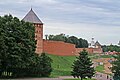 Walls of the Novgorod Kremlin
 -
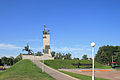 War Memorial
 -
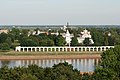 View of the Yaroslav’s Court
 -
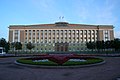 Government Building


Transportation
Intercity transport

Novgorod has connections to Moscow (531 km) and St. Petersburg (189 km) by the federal highway M10. There are public buses to Saint Petersburg and other destinations.
The city has direct railway passenger connections with Moscow (Leningradsky Rail Terminal, by night trains), St. Petersburg (Moscow Rail Terminal and Vitebsk Rail Terminal, by suburban trains), Minsk (Belarus) (Minsk Passazhirsky railway station, by night trains) and Murmansk.
The city’s former commercial airport Yurievo was decommissioned in 2006, and the area has now been redeveloped into a residential neighbourhood. The still existing Krechevitsy Airport does not serve any regular flights since mid-1990s although there is a plan to turn Krechevitsy into a new operational airport by 2025.[90] The nearest international airport is St. Petersburg’s Pulkovo, some 180 kilometres (112 miles) north of the city.
Local transportation

Local transportation consists of a network of buses and trolleybuses. The trolleybus network, which currently consists of five routes, started operating in 1995 and is the first trolley system opened in Russia after the fall of the Soviet Union.
-
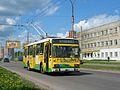 trolleybus Skoda-VMZ-14Tr
 -
 Trolleybuses ZiU-9
 -
 Bus LiAZ-5256


Honours
A minor planet, 3799 Novgorod, discovered by the Soviet astronomer Nikolai Stepanovich Chernykh in 1979, is named after the city.[91]
Notable people
- Onfim (1220–60) was a Russian artist and student, renowned for his notes, drawings and homework exercises scratched onto soft birch bark.
- Anton Stepanovich Arensky (1861–1906) was an outstanding Russian composer, pianist and conductor. He became one of the prominent representatives of the Russian musical culture of the late 19th century. Arensky composed symphonic and chamber music, as well as music for the theater.
- Sergei Vasilyevich Rachmaninoff (1873–1943) was a great Russian composer, pianist and conductor, whose work occupies one of the central places in the history of music. His works, such as the Second and Third Piano Concertos, are considered masterpieces and are performed all over the world.
- Gavrila Romanovich Derzhavin (1743–1816) was an outstanding Russian poet, statesman, and representative of Russian classicism. His poetic works are known for their greatness and deep patriotic themes.
- Vsevolod Anisimovich Kochetov (1912–1973) was a Soviet writer, editor and journalist. He is known as the author of novels about life in the Soviet Union, including Zhurbiny and What do you Want?.
- Igor Alexandrovich Kaberov (1917–1995) — ace pilot of WWII, Hero of the Soviet Union. He has many successful aerial battles and victories to his credit.
- Nicholas Miklouho-Maclay (1846–1888) was a famous Russian traveler, ethnographer, anthropologist and humanist. He studied the life and way of life of the peoples of Southeast Asia, Oceania and Australia and made significant contributions to ethnography.
- Vitaly Valentinovich Bianki (1894–1959) was a Russian writer, the author of many works about nature, famous for short stories and fairy tales for children. His books help to develop children’s love and interest in the world around them.
Twin towns – sister cities
Veliky Novgorod is twinned with:[92][93]
 Bielefeld, Germany
 Kohtla-Järve, Estonia
 Moss, Norway
 Nanterre, France
- Strasbourg, France
 Rochester, New York, USA
 Uusikaupunki, Finland
 Watford, UK
- Valga, Estonia
 Zibo, China
See also
Notes
- ^ Also translated as Great Novgorod or Novgorod the Great.
References
- ^ Resolution #121
- ^ a b c d e f Law #559-OZ
- ^ a b Тихомиров, М.Н. (1956). Древнерусские города (in Russian). Государственное издательство Политической литературы. Archived from the original on January 1, 2018. Retrieved June 13, 2012.
- ^ a b Charter of Veliky Novgorod, Article 6
- ^ Russian Federal State Statistics Service (2011). Всероссийская перепись населения 2010 года. Том 1 [2010 All-Russian Population Census, vol. 1]. Всероссийская перепись населения 2010 года [2010 All-Russia Population Census] (in Russian). Federal State Statistics Service.
- ^ a b Численность постоянного населения Российской Федерации по муниципальным образованиям на 1 января 2025 года (in Russian), Moscow: Federal State Statistics Service, April 25, 2025, Wikidata Q133797648, archived from the original on April 26, 2026
- ^ a b c d Oblast Law #284-OZ
- ^ “Об исчислении времени”. Официальный интернет-портал правовой информации (in Russian). June 3, 2011. Retrieved January 19, 2019.
- ^ Почта России. Информационно-вычислительный центр ОАСУ РПО. (Russian Post). Поиск объектов почтовой связи (Postal Objects Search) (in Russian)
- ^ a b Official website of Veliky Novgorod. Geographic Location Archived April 12, 2023, at the Wayback Machine (in Russian)
- ^ a b c d e f g h i j k l Rybina, Yanin & Pavlinov 2006, p. 5.
- ^ Russian Federal State Statistics Service. Всероссийская перепись населения 2020 года. Том 1 [2020 All-Russian Population Census, vol. 1] (XLS) (in Russian). Federal State Statistics Service.
- ^ Yanin, Valentin L. (1990). “The Archaeology of Novgorod”. Scientific American. 262 (2): 84–91. ISSN 0036-8733.
- ^ a b Everett-Heath, John (2005). “Novgorod”. The Concise Dictionary of World Place-names. Oxford University Press. p. 383. ISBN 978-0-19-860537-9. Archived from the original on January 6, 2026. Retrieved April 16, 2026.
One of Russia’s oldest cities, first mentioned in the 9th century, it became known as Novgorod Velikiy ‘New Town the Great’ and retained this title until the 18th century.
- ^ a b c d e Crummey, Robert O. (June 6, 2014) [1987]. The Formation of Muscovy 1300–1613. Routledge. ISBN 978-1-317-87200-9.
- ^ a b Bushkovitch 2010, p. 1217.
- ^ Uspensky, B. A. (September 5, 2021). “‘Господарь Великий Новгород’: происхождение названия”. Древняя Русь. Вопросы медиевистики. 85 (3). doi:10.25986/IRI.2021.85.3.003.
- ^ a b “Федеральный закон от 11.06.1999 г. № 111-ФЗ”. kremlin.ru. Archived from the original on March 6, 2019. Retrieved August 6, 2021.
- ^ a b Rybina, Yanin & Pavlinov 2006, p. 7.
- ^ a b “Climate norms” (in Russian). Archived from the original on February 19, 2025. Retrieved February 10, 2025.
- ^ Chereneva, Vera (January 7, 2022). “Ученые выяснили точный период основания Великого Новгорода”. Rossiskaya Gazeta. Archived from the original on November 16, 2025. Retrieved June 17, 2026.
- ^ “Устав города — Дума Великого Новгорода”. duma.nov.ru (in Russian). March 2, 2026. Archived from the original on February 18, 2026. Retrieved June 17, 2026.
- ^ Alekseyev, Aleksey (June 9, 2019). “День рождения колыбели царства всероссийского”. Коммерсантъ (in Russian). Archived from the original on April 25, 2025. Retrieved June 17, 2026.
- ^ a b c Yanin, Valentin L. (2006). “Medieval Novgorod”. The Cambridge History of Russia: Volume 1: From Early Rus’ to 1689. Cambridge University Press. pp. 188–210. doi:10.1017/CHOL9780521812276.009. ISBN 978-1-139-05410-2. Archived from the original on April 22, 2026. Retrieved April 16, 2026.
- ^ Curta, Florin (July 8, 2019). Eastern Europe in the Middle Ages (500-1300) (2 vols). BRILL. pp. 281–283. ISBN 978-90-04-39519-0.
- ^ Носов Е. Н. Новгород и новгородская округа IX—X вв. в свете новейших археологических данных (к вопросу о возникновении Новгорода) // Новгородский исторический сборник. — 1984. — Вып. 2 (12). — С. 3—38.
- ^ Янин В. Л. Новгород // Великий Новгород. История и культура IX—XVII веков. Энциклопедический словарь. — СПб.: Нестор-История, 2007. — С. 352.
- ^ Куза А. В. Новгородская земля // Древнерусские княжества X—XIII вв. — М.: Наука, 1975. — С. 172.
- ^ a b Yanin, Valentin L. (1990). “The Archaeology of Novgorod”. Scientific American. 262 (2): 84–91. ISSN 0036-8733.
- ^ a b c Petrukhin, Vladimir Yakovlevich (2019). “Новгородское Городище и Гнёздово: 40 лет полемики” [Gorodische from Novgorod and Gnyozdovo: 40 years of controversy]. Studia Slavica et Balcanica Petropolitana (in Russian). 26 (2): 93–100. doi:10.21638/11701/spbu19.2019.206.
- ^ a b c Jackson, Tatjana N. (2019). “Hólmgarðr (Novgorod) and Kænugarðr (Kiev)”. Eastern Europe in Icelandic Sagas. Arc Humanities Press. pp. 71–84. ISBN 978-1-64189-027-4. Archived from the original on April 29, 2026. Retrieved April 16, 2026.
The Old Norse place-name Hólmgarðr has traditionally been considered to be the designation of Novgorod
- ^ Dolukhanov, Pavel (July 10, 2014). The Early Slavs: Eastern Europe from the Initial Settlement to the Kievan Rus. Routledge. pp. 181–182. ISBN 978-1-317-89222-9. Archived from the original on November 30, 2024. Retrieved June 17, 2026.
- ^ Duczko, Wladyslaw (2004). Viking Rus: Studies on the Presence of Scandinavians in Eastern Europe. The Northern World. Vol. 12. Brill. ISBN 90-04-13874-9.
- ^ Borrero, Mauricio (2009). Russia: A Reference Guide from the Renaissance to the Present. Infobase Publishing. p. 254. ISBN 978-0-8160-7475-4.
- ^ Middleton, John (June 1, 2015). World Monarchies and Dynasties. Routledge. p. 805. ISBN 978-1-317-45158-7.
One of the Rus princes—Rurik (r. ca. 862–879)—became ruler of Novgorod (r. ca. 862–879) and is considered the traditional founder of Russia. Rurik was the ancestor of the many family branches of the Riurikid dynasty, which ruled until 1598.
- ^ Magill, Frank N. (November 12, 2012). “Rurik”. The Middle Ages: Dictionary of World Biography. Vol. 2. Routledge. pp. 803–805. ISBN 978-1-136-59313-0. Archived from the original on December 9, 2024. Retrieved June 17, 2026.
- ^ Jakobsson, Sverrir (October 14, 2020). The Varangians: In God’s Holy Fire. Springer Nature. p. 65. ISBN 978-3-030-53797-5.
- ^ a b c Vodoff 2000, p. 1032.
- ^ a b Yanin, Valentin, ed. (2007). Великий Новгород. Энциклопедический словарь (in Russian). Вектор-История. ISBN 978-5981872365.
- ^ a b c Feldbrugge, Ferdinand J. M. (October 2, 2017). A History of Russian Law: From Ancient Times to the Council Code (Ulozhenie) of Tsar Aleksei Mikhailovich of 1649. BRILL. ISBN 978-90-04-35214-8.
- ^ Brumfield, William Craft (December 2, 2013). Landmarks of Russian Architect. Routledge. p. 37. ISBN 978-1-317-97325-6. Archived from the original on December 11, 2025. Retrieved June 17, 2026.
- ^ Jackson, Tatjana (2015). “Garðaríki and Its Capital: Novgorod on the Mental Map of Medieval Scandinavians”. Slověne (in Russian). 4 (1). Moscow: 170–179. doi:10.31168/2305-6754.2015.4.1.9. Retrieved June 24, 2022. p. 175: “в сознании авторов и их слушателей Хольмгард на всем протяжении сложения и записи саг оставался столицей лежащей за Балтийским морем страны Гарды/Гардарики” [throughout the composition and recording of the sagas, in the minds of the authors and their listeners, Hólmgarðr remained the capital of the country Garðar/Garðaríki across the Baltic Sea]
- ^ Mägi, Marika (May 15, 2018). In Austrvegr: The Role of the Eastern Baltic in Viking Age Communication across the Baltic Sea. BRILL. pp. 160–161. ISBN 978-90-04-36381-6.
- ^ Rafn, Carl Christian, ed. (1830). “Gaungu-Hrólf Saga”. Fornaldar sögur Nordrlanda eptir gömlum handritum (in Icelandic). Kaupmannahöfn: Popp. p. 362:
í Hólmgarðaborg er mest atsetr Garðakonúngs, þat er nú kallat Nógarðar
[The main residence of the king of Garðar is in Hólmgarðaborg, which is now called Nógarðar] - ^ Franklin, Simon; Shepard, Jonathan (2014). The Emergence of Russia 750-1200. Routledge. p. 201. ISBN 9781317872245.
- ^ Jackson, Tatjana (2010). “The Cult of St Olaf and Early Novgorod”. In Antonsson, Haki; Garipzanov, Ildar H. (eds.). Saints and their Lives on the Periphery: Veneration of Saints in Scandinavia and Eastern Europe (c.1000-1200). Cursor Mundi. Vol. 9. Brepols. pp. 147–167. ISBN 978-2-503-53033-8. Archived from the original on December 7, 2024. Retrieved April 26, 2023.
- ^ Vodoff 2000, p. 32.
- ^ a b Lukin, Pavel V. (August 25, 2016). “Urban Community and Consensus: Brotherhood and Communalism in Medieval Novgorod”. Imagined Communities on the Baltic Rim. Amsterdam University Press. pp. 279–306. doi:10.1017/9789048528998.011. ISBN 978-90-485-2899-8.
- ^ a b c Koenigsberger, Helmut G. (2014). Medieval Europe 400–1500. Routledge. p. 177. ISBN 978-1-317-87089-0.
- ^ a b c d e f Feldbrugge, Ferdinand J. M (2009). Law in Medieval Russia. Brill. ISBN 978-90-04-16985-2.
- ^ Paul, Michael C. (2004). “The Iaroslavichi and the Novgorodian Veche 1230-1272: A Case Study on Princely Relations with the Veche”. Russian History. 31 (1/2): 39–59. doi:10.1163/187633104X00016. ISSN 0094-288X. JSTOR 24657734.
- ^ Paul, Michael C. (March 2007). “Secular Power and the Archbishops of Novgorod before the Muscovite Conquest”. Kritika: Explorations in Russian and Eurasian History. 8 (2): 231–270. doi:10.1353/kri.2007.0020.
- ^ Paul, Michael C. (2003). “Episcopal Election in Novgorod, Russia 1156-1478”. Church History. 72 (2): 251–275. doi:10.1017/S0009640700099844. ISSN 0009-6407. JSTOR 4146642.
- ^ Christensen, C. S. (2022). “Великий Новгород (1136–1478): средневековый русский демократический эксперимент или нет?” [Veliky Novgorod (1136–1478): a Russian democratic experiment in the Middle Ages or not?]. Studia Humanitatis (in Russian) (2). ISSN 2308-8079. Archived from the original on February 8, 2026. Retrieved June 17, 2026.
- ^ Gorsky, Anton A. (1996). Русские земли в XIII-XIV веках: пути политического развития [The Russian lands in the 13th–14th centuries] (in Russian). Институт российской истории РАН. ISBN 978-5-201-00608-2.
- ^ Habakkuk, Hrothgar J. (1987). Cambridge Economic History of Europe: Vol. 2: Trade and Industry in the Middle Ages. Cambridge University Press. p. 593. ISBN 978-0-521-08709-4.
- ^ Martin, Janet L. B. (June 7, 2004) [1986]. Treasure of the Land of Darkness: The Fur Trade and Its Significance for Medieval Russia. Cambridge University Press. pp. 61–68. ISBN 978-0-521-54811-3. Archived from the original on August 13, 2025. Retrieved June 17, 2026.
- ^ Lukin 2016, pp. 279–280.
- ^ Lukin, Pavel V. (2022), “German Merchants in Novgorod: Hospitality and Hostility, Twelfth–Fifteenth Centuries”, in Nauman, Sari; Jezierski, Wojtek; Reimann, Christina; Runefelt, Leif (eds.), Baltic Hospitality from the Middle Ages to the Twentieth Century: Receiving Strangers in Northeastern Europe, Cham: Springer International Publishing, pp. 117–142, doi:10.1007/978-3-030-98527-1_5, ISBN 978-3-030-98527-1
- ^ Paul, Michael C. (2009). “Archbishop Vasilii Kalika of Novgorod, the Fortress of Orekhov and the Defence of Orthodoxy”. In Murray, Alan V. (ed.). The Clash of Cultures on the Medieval Baltic Frontier. Ashgate Publishing, Ltd. pp. 253–272. ISBN 978-0-7546-6483-3.
- ^ Drinka, Bridget (February 16, 2017). Language Contact in Europe: The Periphrastic Perfect through History. Cambridge University Press. p. 329. ISBN 978-0-521-51493-4.
- ^ a b c Schaeken, Jos (November 5, 2018). Voices on Birchbark: Everyday Communication in Medieval Russia. BRILL. ISBN 978-90-04-38942-7.
- ^ Rakhlin, Natalia; Kornilov, Sergey A.; Grigorenko, Elena L. (October 12, 2017). “Learning to Read Russian”. Learning to Read across Languages and Writing Systems. Cambridge University Press. p. 393. ISBN 978-1-107-09588-5.
- ^ Francis, Yelena P. “bylinas”. World Epics. Columbia University. Archived from the original on September 17, 2025. Retrieved May 18, 2026.
- ^ Kononenko, Natalie (April 11, 2025). “Byliny: Russian Folk Epic”. In Beissinger, Margaret H. (ed.). The Oxford Handbook of Slavic and East European Folklore. Oxford University Press. p. 492. ISBN 978-0-19-008077-8. Archived from the original on September 16, 2025. Retrieved June 17, 2026.
- ^ a b c Favereau, Marie (April 20, 2021). The Horde: How the Mongols Changed the World. Harvard University Press. ISBN 978-0-674-24421-4. Archived from the original on January 6, 2026. Retrieved June 17, 2026.
- ^ a b c Paul, Michael C. (2008). “Was The Prince of Novgorod a Third-Rate Bureaucrat after 1136?”. Jahrbücher für Geschichte Osteuropas. 56 (1): 72–113. ISSN 0021-4019. JSTOR 41052013.
- ^ Ljungqvist, Fredrik Charpentier; Seim, Andrea; Huhtamaa, Heli (November 19, 2020). “Climate and society in European history”. WIREs Climate Change. 12 (2) e691. doi:10.1002/wcc.691. ISSN 1757-7780.
- ^ a b Moss, Walter G. (2003). A History of Russia Volume 1: To 1917. Anthem Press. ISBN 978-0-85728-752-6.
- ^ Lukin, P. V.; Polekhov, S. V. (September 1, 2022). “Why Did Lord Novgorod the Great Fall? The Novgorod Republic and Its Neighbors in 1470–1471”. Herald of the Russian Academy of Sciences. 92 (5): S367–S384. doi:10.1134/S1019331622110090. ISSN 1555-6492. Archived from the original on August 3, 2025. Retrieved June 17, 2026.
- ^ Riasanovsky, Nicholas V.; Steinberg, Mark D. (2019). A History of Russia (9th ed.). New York: Oxford University Press. ISBN 978-0190645588.
- ^ Kazakova, N. A. (1984). “Еще раз о закрытии Ганзейского двора в Новгороде в 1494 г.”. Новгородский Исторический Сборник. 2 (12): 177.
- ^ Kotilaine, J. T. (January 1, 2005). Russia’s Foreign Trade and Economic Expansion in the Seventeenth Century: Windows on the World. BRILL. p. 27. ISBN 978-90-04-13896-4.
- ^ Madariaga, Isabel de (September 25, 2006). Ivan the Terrible. Yale University Press. ISBN 978-0-300-11973-2. Archived from the original on December 2, 2024. Retrieved June 17, 2026.
- ^ a b Skrynnikov, Ruslan G. (October 20, 2015). Reign of Terror: Ivan IV. BRILL. ISBN 978-90-04-30401-7. Archived from the original on January 16, 2025. Retrieved June 17, 2026.
- ^ a b Kovalenko, Guennadi (2010). Великий Новгород. Взгляд из Европы XV-XIX centuries (in Russian). Европейский Дом. pp. 48, 72, 73. ISBN 9785801502373.
- ^ Варенцов, В. А.; Коваленко, Г. М. (1999). В составе Московского государства: очерки истории Великого Новгорода конца XV-начала XVIII в (in Russian). Русско-Балтийский информационный центр БЛИЦ. ISBN 9785867891008.
- ^ a b Löfstrand, Elisabeth (2005). Accounts of an occupied city: catalogue of the Novgorod Occupation Archives 1611–1617. Series 1. Stockholm: Riksarkivet. ISBN 91-88366-67-7.
- ^ J.T., Russia’s Foreign Trade and Economic Expansion in the Seventeenth Century: Windows on the World (2005). Kotilaine. Brill. p. 30. ISBN 9789004138964.
- ^ Варенцов, В. А.; Коваленко, Г. М. (1999). В составе Московского государства: очерки истории Великого Новгорода конца XV-начала XVIII в (in Russian). Русско-Балтийский информационный центр БЛИЦ. pp. 44, 45. ISBN 9785867891008.
- ^ Варенцов, В. А.; Коваленко, Г. М. (1999). В составе Московского государства: очерки истории Великого Новгорода конца XV-начала XVIII в (in Russian). Русско-Балтийский информационный центр БЛИЦ. p. 71. ISBN 9785867891008.
- ^ Варенцов, В. А.; Коваленко, Г. М. (1999). В составе Московского государства: очерки истории Великого Новгорода конца XV-начала XVIII в (in Russian). Русско-Балтийский информационный центр БЛИЦ. pp. 52–60. ISBN 9785867891008.
- ^ “Novgorod Region”. Federation Council of the Federal Assembly of the Russian Federation. Retrieved May 18, 2026.
- ^ Vdovichenko, Marina (February 28, 2020). “Medieval Churches in Novgorod: Aspects of archaeological investigations and museum presentation”. Internet Archaeology (54). doi:10.11141/ia.54.10. ISSN 1363-5387. S2CID 213325311.
- ^ Tatiana Tsarevskaia, St. Sophia’s Cathedral in Novgorod (Moscow: Severnyi Palomnik, 2005), 3.
- ^ Tsarevskaia, 14, 19-22, 24, 29, 35.
- ^ Jadwiga Irena Daniec, The Message of Faith and Symbol in European Medieval Bronze Church Doors (Danbury, CT: Rutledge Books, 1999), Chapter III “An Enigma: The Medieval Bronze Church Door of Płock in the Cathedral of Novgorod,” 67-97; Mikhail Tsapenko, ed., Early Russian Architecture (Moscow: Progress Publisher, 1969), 34-38
- ^ Vdovichenko, Marina (2020). “Medieval Churches in Novgorod: Aspects of archaeological investigations and museum presentation”. Internet Archaeology (54). doi:10.11141/ia.54.10.
- ^ de:Kriegsgräberstätte Nowgorod
- ^ “Аэропорт Кречевицы начнёт работать в 2025 году”. September 4, 2019.[dead link]
- ^ Schmadel, Lutz D. (2003). Dictionary of Minor Planet Names (5th ed.). New York: Springer Verlag. p. 321. ISBN 3-540-00238-3.
- ^ “Международные культурные связи”. adm.nov.ru (in Russian). Veliky Novgorod. Archived from the original on January 26, 2021. Retrieved February 5, 2020.
- ^ “Ystävyyskaupungit”. seinajoki.fi (in Finnish). Seinäjoki. Retrieved February 5, 2020.
Sources
- . Brockhaus and Efron Encyclopedic Dictionary (in Russian). 1906.
- Дума Великого Новгорода. Решение №116 от 28 апреля 2005 г. «Устав муниципального образования – городского округа Великий Новгород», в ред. Решения №515 от 11 июня 2015 г. «О внесении изменений в Устав муниципального образования – городского округа Великий Новгород». Вступил в силу со дня официального опубликования, но не ранее 1 января 2006 года, за исключением статей, для которых подпунктом 5.1 установлены иные сроки вступления в силу. (Duma of Veliky Novgorod. Decision #116 of April 28, 2005 Charter of the Municipal Formation–Veliky Novgorod Urban Okrug, as amended by the Decision #515 of June 11, 2015 On Amending the Charter of the Municipal Formation–Veliky Novgorod Urban Okrug. Effective as of the day of official publication but not earlier than January 1, 2006, with the exception of the clauses for which subitem 5.1 establishes other dates of taking effect.).
- Администрация Новгородской области. Постановление №121 от 8 апреля 2008 г. «Об реестре административно-территориального устройства области», в ред. Постановления №408 от 4 августа 2014 г. «О внесении изменений в реестр административно-территориального устройства области». Опубликован: “Новгородские ведомости”, №49–50, 16 апреля 2008 г. (Administration of Novgorod Oblast. Resolution #121 of April 8, 2008 On the Registry of the Administrative-Territorial Structure of Novgorod Oblast, as amended by the Resolution #408 of August 4, 2014 On Amending the Registry of the Administrative-Territorial Structure of Novgorod Oblast. ).
- Новгородская областная Дума. Областной закон №284-ОЗ от 7 июня 2004 г. «О наделении сельских районов и города Великий Новгород статусом муниципальных районов и городского округа Новгородской области и утверждении границ их территорий», в ред. Областного закона №802-ОЗ от 31 августа 2015 г. «О внесении изменений в некоторые областные Законы, устанавливающие границы муниципальных образований». Вступил в силу со дня, следующего за днём официального опубликования. Опубликован: “Новгородские ведомости”, №86, 22 июня 2004 г. (Novgorod Oblast Duma. Oblast Law #284-OZ of June 7, 2004 On Granting the Status of Municipal Districts and Urban Okrug of Novgorod Oblast to the Rural Districts and the City of Veliky Novgorod and on Establishing the Borders of Their Territories, as amended by the Oblast Law #802-OZ of August 31, 2015 On Amending Various Oblast Laws Establishing the Borders of the Municipal Formations. Effective as of the day following the day of the official publication.).
- Государственная Дума Российской Федерации. Федеральный закон №111-ФЗ от 11 июня 1999 г. «О переименовании города Новгорода — административного центра Новгородской области в город Великий Новгород». Вступил в силу со дня официального опубликования. Опубликован: “Собрание законодательства РФ”, No.24, ст. 2892, 14 июня 1999 г. (State Duma of the Russian Federation. Federal Law #111-FZ of June 11, 1999 On Renaming the City of Novgorod—the Administrative Center of Novgorod Oblast—the City of Veliky Novgorod. Effective as of the day of official publication.).
- Bushkovitch, Paul (June 24, 2010). “Novgorod”. In Bjork, Robert E. (ed.). The Oxford Dictionary of the Middle Ages. Vol. 3. OUP Oxford. p. 1217. ISBN 978-0-19-866262-4.
- Rybina, Ye. A.; Yanin, V. L.; Pavlinov, P. S. (2006). “Великий Новгород”. In Kravets, S. L. (ed.). Большая Российская энциклопедия. Том 5: Великий князь — Восходящий узел орбиты (in Russian). Большая Российская энциклопедия. pp. 5–7. ISBN 5-85270-334-6.
- Vodoff, Vladimir (2000). “Novgorod”. Encyclopedia of the Middle Ages. Vol. 2. James Clarke & Co. p. 1032. ISBN 978-0-227-67931-9.

Further reading
- Bogucki, Peter (1997). “Novgorod”. In Bahn, Paul G. (ed.). Lost Cities: 50 Discoveries in World Archaeology. Barnes & Noble Books. ISBN 0760707561.
- Brumfield, William C. (2004). A History of Russian Architecture. University of Washington Press. ISBN 978-0-295-98394-3.
- Coxe, William (1784). “Novogorod”. Travels into Poland, Russia, Sweden and Denmark. London: Printed by J. Nichols, for T. Cadell. OCLC 654136. OL 23349695M.
- Kropotkin, Peter Alexeivitch; Bealby, John Thomas a (1911). . Encyclopædia Britannica. Vol. 19 (11th ed.). p. 839.
- Kropotkin, Peter Alexeivitch; Bealby, John Thomas (1911). . Encyclopædia Britannica. Vol. 19 (11th ed.). pp. 839–840.
- Lukin, Pavel V. (2018). “Великий Новгород” [Novgorod the Great]. Slovene. 7 (2): 383–413. doi:10.31168/2305-6754.2018.7.2.15.
- Meakin, Annette M. B. (1906). “Novgorod the Great”. Russia, Travels and Studies. London: Hurst and Blackett. OCLC 3664651. OL 24181315M.
External links
 Media related to Velikiy Novgorod at Wikimedia Commons

- Official website of Veliky Novgorod (in Russian)
- Veliky Novgorod City Portal
- Veliky Novgorod for tourists
- The Faceted Palace of the Kremlin in Novgorod the Great site
- Veliky Novgorod’s architecture and buildings history
| History |  | ||
|---|---|---|---|
| Expansion |
| ||
| Paganism and mythology | |||
| Cosmology | |||
| Rituals and worship | |||
| Society | |||
| Events | |||
| Sources | |||
| Settlements | |||
Names in italics are settlements whose Norse names are not recorded | ||
| Volkhov–Volga trade route |  | |
| Dvina–Dnieper trade route | ||
| Other locations | ||
Members of the Hanseatic League by quarter, and trading posts of the Hanseatic League | ||||
|---|---|---|---|---|
| ||||
| Wendish |
|   | ||
| Saxon | ||||
| Baltic | ||||
| Westphalian | ||||
| Kontore | ||||
| Vitten | ||||
| Factories | ||||
| International | |
|---|---|
| National | |
| Geographic | |
| Other | |
