
In mathematics, the Wright omega function or Wright function,[note 1] denoted ω, is defined in terms of the Lambert W function as:
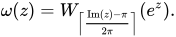
It is simpler to be defined by its inverse function

Uses
One of the main applications of this function is in the resolution of the equation z = ln(z), as the only solution is given by z = e−ω(π i).
y = ω(z) is the unique solution, when for x ≤ −1, of the equation y + ln(y) = z. Except for those two values, the Wright omega function is continuous, even analytic.

Properties
The Wright omega function satisfies the relation .

It also satisfies the differential equation
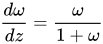
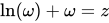
wherever ω is analytic (as can be seen by performing separation of variables and recovering the equation , and as a consequence its integral can be expressed as:

Its Taylor series around the point takes the form :

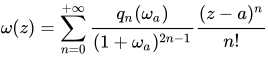
where
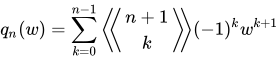
in which

is a second-order Eulerian number.
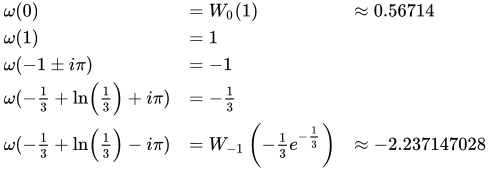
Values
Plots
- Plots of the Wright omega function on the complex plane
-

-

-


Notes
- ^ Not to be confused with the Fox–Wright function, also known as Wright function.
References
- Corless, R.M.; Jeffrey, D.J. (June 2002). “The Wright ω function” (PDF). International Conference on Artificial Intelligence and Symbolic Computation. Lecture Notes in Computer Science. Vol. 2385. Springer. pp. 76–89. doi:10.1007/3-540-45470-5_10. ISBN 3-540-45470-5.
- Mezo, Istvan (2022). “3. Unwinding number and branch differences §3.4 The Wright ω function”. The Lambert W function: its generalizations and applications. Chapman and Hall/CRC. pp. 82–87. ISBN 978-1-003-16810-2.