
The xouba, parrocha, or little sardine is a small or juvenile European pilchard (Sardina pilchardus) caught off the coast of Galicia, Spain[1]. Like all European pilchards, xoubas are pelagic ray-finned fish in the monotypic genus Sardina in the family Clupeidae.
Description
The fish is blue-green and has a silver underside. In comparison to other sardines, xouba are caught at a smaller size[2]. Xouba generally live in shallow areas of water between 5 m (16 ft) and 50 m (160 ft).[2] The fish is harvested between the months of May and July when it reaches 13 cm (5.1 in) in length.[2] In some areas xouba are instead called parrocha.[1][3]
Xoubas have a tender distinct flavor and they nutrient-dense. They have a high omega-3 fatty acid content and are high in healthy fats.[4] Xoubas have more fat than other sardines.[5]
History

Since the 15th century, Xouba is caught with a technique called Xeito. The technique employs a net stretched between boats; a type of drift netting.[5] In Spain there are several annual events to celebrate the Xouba. One such event is the Burial of the xoubiña.[6] It is celebrated on Ash Wednesday and it includes funeral procession that is satirical. The procession ends with the burning of the effigy of a sardine.[7] Galicia, Spain is the home of a festival (Festa da Xouba) celebrating the Xouba.[4] The event takes place about the same time as the “Feast of Saint James” which happens in July.[8]
Preparation
Prepared as a dish, it can be used in empanadas, or pickled, or made in a casserole with potatoes.[2] Xouba is also grilled and served on bread, or breaded with chickpea flour and fried.[9]
Gallery
-
 Xouba
Xouba -
 Guiso de xoubas
 -
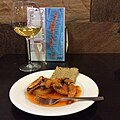 Prepared Xouba with bread


References
- ^ a b “Voces de aquí e acolá: Da xouba á parrocha Allos con bugallos”. Portal das Palabras (in Galician). Real Academia Galega. 17 June 2024. Retrieved 15 September 2024.
- ^ a b c d Muñoz, Patricia (16 January 2022). “Xouba of Rianxo, delicatessen with an ancient tradition”. GCiencia. Retrieved 14 September 2024.
- ^ Blanco, Rosario Álvarez; García, Francisco Dubert; Fernández, Xulio C. Sousa (2006). Lingua e territorio (in Galician). La Coruña, Spain: Consello da Cultura Galega. p. 406. ISBN 978-84-96530-20-1. Retrieved 15 September 2024.
- ^ a b “Savoring Xouba: A Guide to Enjoying Small Sardines”. Discover Real Food in Texas. 2024. Archived from the original on 15 September 2024. Retrieved 15 September 2024.
- ^ a b Martinez, Monica (18 December 2023). “Conservas de oro: propuesta gourmet de A Conserveira para estas navidades”. Mundiario (in Spanish). Retrieved 14 September 2024.
- ^ “Desfile e enterro da sardiña compartirán data no entroido grovense”. Pontevedra Viva (in Galician). Pontevedra. 5 March 2016. Archived from the original on 15 September 2024. Retrieved 15 September 2024.
- ^ Gostling, Loraine (18 February 2022). “The Burial of the Sardine.. Origin of the rather bizarre fiesta”. Javea Connect. Archived from the original on 15 September 2024. Retrieved 15 September 2024.
- ^ “Festa da Xouba Turismo da Deputación da Coruña”. turismo.dacoruna.gal. Provincial Deputation of Coruña. Retrieved 15 September 2024.
- ^ Guitian, Jorge (10 September 2024). “Meloxeira Praia, the gastronomic beach bar in the heart of the Rías Baixas in Galicia”. La Vanguardia. Retrieved 15 September 2024.
Sardines (pilchards) | ||
|---|---|---|
| Notable species |  | |
| Ecology | ||
| Culinary use | ||
| Popular culture | ||